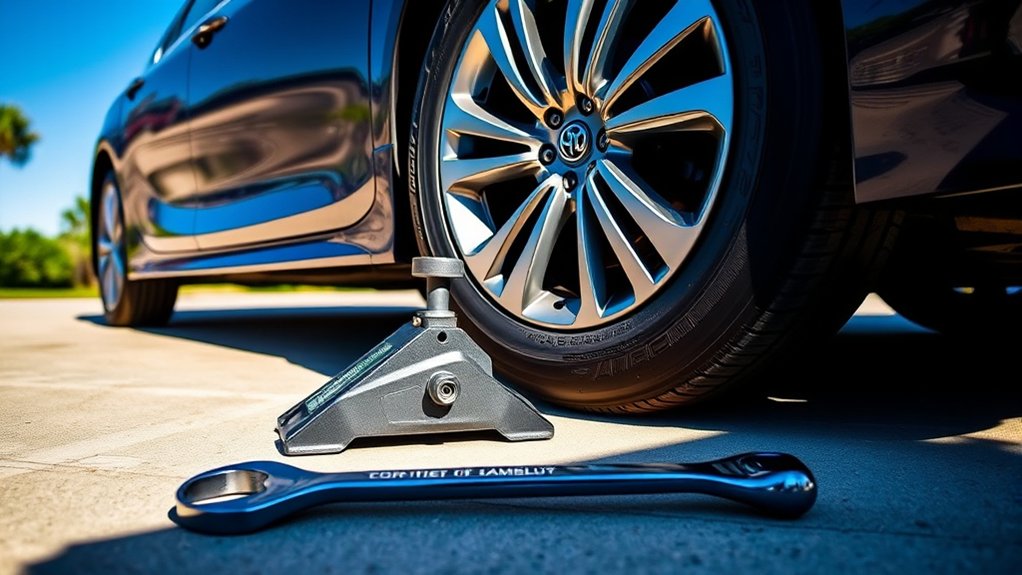
A flat tire is stressful, but knowing where your Toyota Camry jack and lug wrench are stored can make the situation easier to manage. Before lifting the car, move to the safest practical location, secure the vehicle, confirm that the spare and tools are usable, and identify the exact jack point shown in the owner’s manual for your Camry’s model year and equipment.
Quick Answer
The jack, handle, lug wrench, and spare are usually stored beneath or beside the Camry’s trunk floor, but the layout varies. On firm, level ground, secure the car, loosen the lug nuts slightly, use only the approved reinforced jack point, install the spare, lower the vehicle, and tighten the nuts evenly to the model-specific torque.
Key Takeaways
- Jack, spare-tire, and tool locations vary by Camry model year, trim, market, and installed equipment.
- Use only the reinforced jack point shown in the correct owner’s manual; never choose a point by measuring from the tire.
- Loosen the lug nuts slightly while the flat tire is still on the ground, then hand-start every nut during installation.
- Never put any part of your body beneath a Camry supported only by the emergency jack.
- Check the spare’s cold pressure, the wheel-lock key, and the complete tool kit before a road trip.
At a Glance
| Time Required | Varies with conditions and experience; do not rush. A first roadside wheel change may take 30 minutes or more. |
| Difficulty | Moderate |
| Tools Needed | Factory jack and handle, lug wrench, usable spare wheel, wheel-lock key if fitted, and wheel chocks; gloves, a flashlight, and a torque wrench are recommended |
| Cost | No added cost when the factory tools and a usable spare are present; replacement tools, tire service, or roadside assistance cost extra |
Warning: Do not change a tire on a steep slope, soft shoulder, blind curve, narrow roadway, unstable surface, or beside fast-moving traffic. Never place any part of your body beneath a vehicle supported only by the emergency jack. Call roadside assistance when the location, weather, lighting, equipment, traffic, or your physical ability makes the job unsafe.
Locate the Toyota Camry Jack, Lug Wrench, and Spare
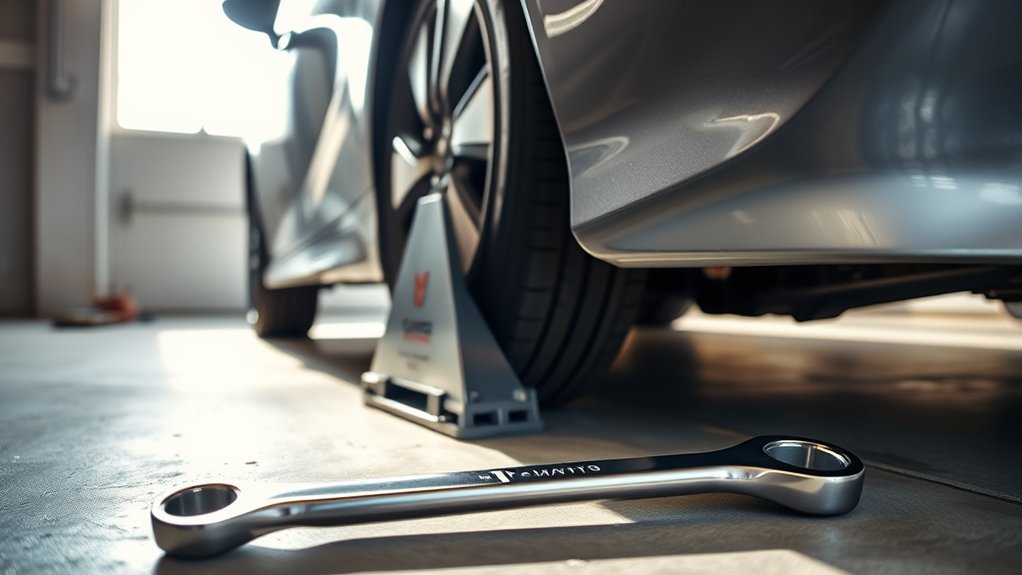
Knowing where the jack in your Toyota Camry is stored saves time during a flat-tire emergency. On many Camrys, the jack, handle, lug wrench, and spare are beneath the trunk floor or behind a nearby access panel. The exact layout, spare type, and retention system can vary, so compare what is in the trunk with the manual for the exact vehicle.
Some models may use a molded foam organizer, tray, strap, threaded retainer, separate side compartment, compact spare, full-size spare, or tire-repair kit. A used Camry may also be missing one or more factory tools. Before a road trip, lift the trunk floor and confirm that you have:
- The correct jack for the vehicle
- The complete jack handle or extension pieces
- A lug wrench that fits the wheel nuts
- A wheel-lock key if locking nuts are installed
- A usable spare wheel or the tire-repair equipment supplied with the car
The safest time to learn your Camry’s tool layout is in your driveway, not on a dark roadside with a flat tire.
Use the Toyota Manuals and Warranties portal to select your exact model year and review the tool location, jack-point illustrations, wheel-nut instructions, and temporary-spare restrictions.
Check Whether the Roadside Location Is Safe
Move the Camry as far from moving traffic as safely possible before attempting a tire change. Choose a hard, level, stable surface where the jack cannot sink, tilt, or slide. Turn on the hazard lights. Keep passengers away from traffic, but do not make them exit if leaving the vehicle would expose them to greater danger.
If a tire suddenly loses air, keep the vehicle controlled, release the accelerator gradually, and move only as far as needed to reach the nearest safer stopping place when the Camry remains steerable. Do not continue driving merely to protect the wheel or avoid inconvenience. If the car is difficult to control or no safe area is reachable, stop as safely as possible and request assistance.
Avoid lifting the vehicle when:
- The ground is gravel, mud, sand, ice, or noticeably sloped.
- The vehicle is close to passing traffic.
- The jack point is bent, rusted, crushed, or difficult to identify.
- The wheel nuts cannot be loosened with controlled pressure.
- The jack, handle, spare, or wheel-lock key is missing or damaged.
- The spare tire is flat, cracked, or otherwise unsafe.
Safely Removing the Jack From the Trunk
Open the trunk and remove loose cargo that blocks access to the trunk floor. Lift or fold back the carpeted floor panel carefully. Depending on your Camry, you may find a cardboard-style cover, molded organizer, foam holder, side panel, retaining strap, or threaded fastener.
Release the jack only after noting how it is secured. Some jacks must be shortened slightly before they can be removed from a bracket. Others lift directly from a molded compartment.
Remove the lug wrench, handle pieces, spare wheel, and wheel-lock key at the same time. Place the tools on the ground away from traffic, but close enough that you will not need to reach beneath the car later.
Note: A jack from another vehicle may have the wrong load rating or saddle shape. Use the jack supplied for your Camry or a properly rated replacement approved for the vehicle. Do not use bricks, concrete blocks, loose boards, or other unstable objects to compensate for poor ground.
Prepare the Camry Before Jacking
Secure the vehicle before touching the wheel nuts:
- Switch on the hazard lights.
- Switch off the engine or hybrid system and confirm the vehicle is not in a drivable state.
- Place the transmission in Park.
- Apply the parking brake firmly.
- If it is safe to exit, ask passengers to leave on the side away from traffic and move behind a barrier or well clear of the roadway. If exiting is more dangerous, keep them belted and call for help.
- Chock the wheel diagonally opposite the flat tire on both sides when suitable wheel chocks can be placed safely.
- Remove the spare and place it nearby before raising the vehicle.
Inspect the spare for cuts, cracking, a bent wheel, or obvious underinflation. The National Highway Traffic Safety Administration recommends checking all tires, including the spare, at least once a month when they are cold. Use the spare-tire pressure printed on the tire, label, or model-year manual; do not assume it uses the same pressure as the regular tires.
Loosen the Lug Nuts Before Lifting
Remove the wheel cover if it blocks the lug nuts, using only the method shown in the owner’s manual. Fit the lug wrench fully over one nut and turn it counterclockwise.
Loosen each nut about one-half turn while the tire is still touching the ground. Do not remove the nuts yet. Keeping the wheel on the ground prevents it from spinning while you break the nuts loose. Use steady pressure and keep your body balanced; do not jump or stand on the wrench.
If the wheel has a locking nut, fit the wheel-lock key squarely before applying force. Stop if the key slips, the nut begins to round off, or you cannot loosen the nuts without jumping on the wrench.
Position the Toyota Camry Jack Correctly
Do not place the jack a fixed number of inches from the flat tire. Instead, identify the designated reinforced jack point nearest the affected wheel. On many passenger cars, this is a reinforced section of the pinch weld beneath the rocker panel, often marked by notches or shown in the owner’s manual.
Place the jack on hard, level, stable ground. Center its saddle around the designated point exactly as shown for your model. The jack base must sit flat, and the jack should rise vertically rather than leaning toward or away from the vehicle.
Turn the jack by hand until the saddle contacts the lift point. Stop and recheck the alignment before the tire begins to leave the ground. The saddle must not press against thin floor metal, plastic trim, suspension links, the engine oil pan, or an unapproved frame location.
Pro Tip: Practice identifying all four jack points at home in daylight. Photograph the correct tool layout and the relevant owner-manual diagram so you can reference them during an emergency.
Raise the Toyota Camry Safely
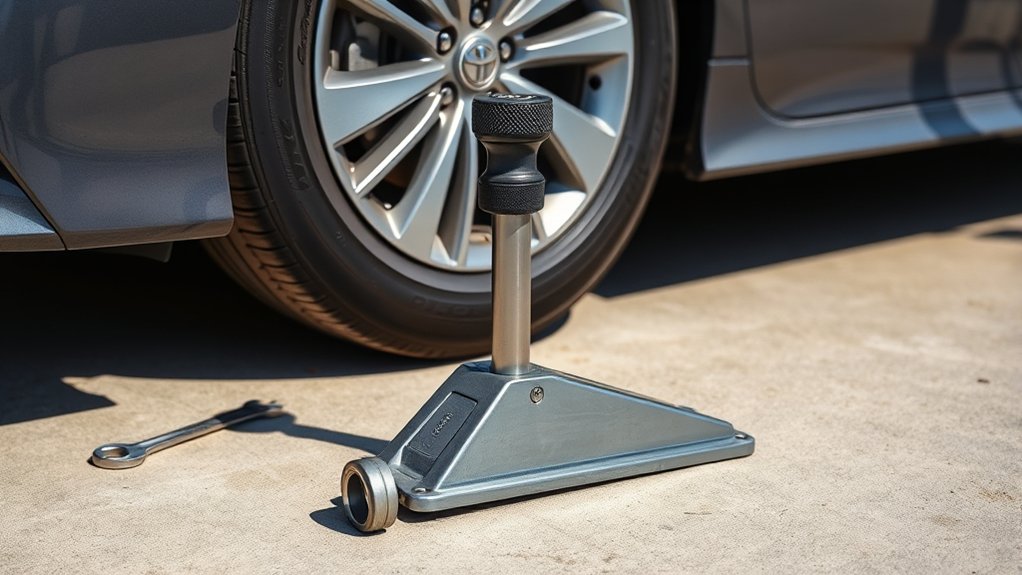
Assemble the jack handle according to the tool design and turn it smoothly to raise the vehicle. Watch the jack base, saddle, lift point, and vehicle body throughout the lift.
Raise the vehicle only until the flat tire clears the ground and the inflated spare has enough room to fit. Avoid extending the jack farther than necessary.
Stop immediately if:
- The jack begins to lean.
- The base shifts, sinks, or lifts at one edge.
- The saddle moves away from the reinforced point.
- The vehicle rocks or rolls.
- The jack makes unusual cracking, slipping, or grinding sounds.
Lower the vehicle carefully and reposition it if anything looks unstable. OSHA’s workplace jack standard reinforces general principles such as using a jack with sufficient capacity, providing a firm foundation, and securing a raised load. It is not a substitute for Toyota’s model-specific roadside procedure.
Do not place your hands, head, legs, or tools beneath the vehicle. If a repair requires anyone to go underneath, stop the job. Properly rated jack stands must be placed at manufacturer-approved support points identified in service information, not at a location guessed from a general article.
Remove the Flat Tire and Install the Spare
Once the wheel is clear of the ground and the jack remains stable, remove the loosened lug nuts. Keep them together in a clean container or on a dry cloth so they do not roll away.
Grip the wheel at approximately the 3 o’clock and 9 o’clock positions and pull it straight toward you. A wheel and tire can be heavy, so keep your back straight and avoid twisting while lifting.
Before installing the spare:
- Check that the wheel studs are not bent or visibly damaged.
- Remove loose dirt or rust flakes from the wheel’s mating surface with a dry cloth.
- Do not apply oil or grease to the studs or nuts unless Toyota specifically instructs it.
- Confirm that the spare faces the correct direction.
Align the spare with the studs and slide it fully onto the hub. Install every lug nut by hand first. Turn each nut several full rotations to reduce the risk of cross-threading.
Tighten the Lug Nuts Evenly
Snug the lug nuts with the wrench in an alternating or star pattern rather than tightening adjacent nuts in a circle. Do not apply full force while the wheel is suspended.
Lower the vehicle until the spare tire just touches the ground and cannot rotate. Snug the nuts again in the same alternating pattern without using maximum force. Then lower the Camry completely, remove the jack, and perform the final tightening with the vehicle fully supported by the ground.
Use a calibrated torque wrench to tighten the wheel nuts to the specification listed for your exact Camry model year and wheel configuration. The factory lug wrench cannot confirm torque. If you do not have a torque wrench, have a qualified tire shop or Toyota service department verify the wheel-nut torque as soon as possible.
Recheck Vehicle Stability Before Removing the Wheel
Pause and recheck vehicle stability after the wheel first leaves the ground and again before removing the lug nuts. Do not rely on the parking brake alone.
- Park on a firm, flat, stable surface.
- Place the transmission in Park and apply the parking brake.
- Chock the wheel diagonally opposite the flat tire when possible.
- Inspect the designated jack point for serious rust, bending, or damage.
- Confirm that the jack base remains flat and centered.
- Keep passengers out of the vehicle while it is raised.
- Do not start the engine, slam a door, or push against the vehicle.
- Recheck the jack after the wheel first leaves the ground.
If the vehicle moves or the jack shifts, do not try to catch or hold the car. Move away, let it settle, and call for professional help.
Troubleshooting Common Problems
The Lug Nuts Will Not Loosen
Confirm that you are turning counterclockwise and that the wrench is fully seated. Apply slow, controlled pressure while the wheel remains on the ground. Do not jump on the wrench or use an improvised pipe that may cause the tool to slip, damage the nut, or make you fall.
Severely corroded, rounded, cross-threaded, or over-tightened nuts require professional tools. Roadside assistance is safer than continuing with a slipping wrench.
The Wheel Is Stuck on the Hub
If the wheel will not slide off, reinstall the lug nuts loosely so it cannot fall. Do not kick or strike the wheel while the vehicle is raised, crawl beneath the car, or rock the Camry on the jack. Lower the vehicle carefully and request professional help rather than using force on an unstable setup.
The Jack Point Looks Damaged
Do not lift from a crushed, heavily rusted, or deformed pinch weld. Do not move the jack to an unverified suspension or body component. A technician should inspect the lift point and identify an approved alternative using model-specific service information.
The Spare Tire Is Flat
Do not install a visibly damaged or severely underinflated spare. Tire sealant and inflators are not suitable for every type of damage, especially major sidewall cuts or wheel damage. Call roadside assistance when the supplied emergency equipment cannot make the car safe to move.
Driving on the Temporary Spare
A compact spare is intended only for temporary emergency use. Follow the speed, distance, inflation-pressure, wheel-position, tire-chain, and other restrictions printed on the spare and listed in your Camry owner’s manual. Handling, braking, and ground clearance may feel different. Drive smoothly and repair or replace the regular tire promptly.
After Installing the Spare: Final Checks and Driving Limits
Before moving the Camry, walk around the vehicle and confirm that the jack, handle, wheel cover, lug wrench, loose nuts, and other tools are no longer near the tires. Secure the flat wheel and cargo so they cannot move inside the trunk or cabin.
- Check that every lug nut is installed and seated evenly.
- Confirm that the spare looks properly inflated and is not rubbing any body or brake component.
- Read the temporary-spare sidewall and owner’s manual before driving.
- Stop immediately if you feel severe vibration, pulling, wobbling, scraping, or a loose-wheel sensation.
- Have the wheel-nut torque verified with a calibrated torque wrench as soon as practical.
- Repair or replace the regular tire promptly; a compact spare is not a permanent replacement.
Note: A tire-pressure warning light may remain on after a flat tire or spare installation. The system’s behavior varies by Camry model year and spare equipment, so follow the correct owner’s manual and do not use the warning light as a substitute for checking pressure with a gauge.
Storing the Jack and Tools After Use
After the regular wheel has been repaired or replaced, return the jack and lug wrench to their designated storage locations. Secure the removed wheel first. Loose metal tools or an unsecured wheel can rattle, damage the trunk, or become hazards during sudden braking.
Clean dirt and moisture from each tool and inspect the jack for bending, cracked welds, damaged threads, or a distorted saddle. Replace a damaged jack rather than trusting it during the next emergency.
Proper Tool Placement
Return each component to the same molded holder, bracket, side compartment, or trunk-floor position from which it was removed. Tool placement varies, so use the retention system fitted to your Camry.
- Retract the jack enough to fit securely without forcing it.
- Place the jack in its original holder or bracket.
- Reconnect the strap, retainer, fastener, or clamp.
- Store the jack handle and lug wrench in their assigned spaces.
- Return the wheel-lock key to a location that will be easy to remember.
- Secure the spare or repaired wheel with its factory retainer.
- Reinstall the trunk organizer, cover, and carpet correctly.
Cleaning Before Storage
Wipe away mud, road salt, moisture, and grease with a damp cloth. Dry the tools completely before returning them to an enclosed compartment. Moisture and salt can promote corrosion on the jack screw, handle, and lug wrench.
Do not coat the wheel studs or lug nuts with grease while cleaning. Lubrication can change the clamping force produced during tightening unless the manufacturer specifically requires it.
Check the jack’s screw mechanism for dirt or damage. Follow the manufacturer’s maintenance instructions rather than applying an unknown lubricant that may attract grit or affect the jack’s operation.
Securing the Jack
Make sure the jack cannot move, expand, or rattle inside its holder. Tighten its factory retainer or shorten the jack slightly if that is how your Camry’s bracket secures it.
- Place the jack in its designated holder.
- Secure the factory strap, clamp, or threaded retainer.
- Organize the handle and lug wrench in their compartments.
- Secure the spare wheel and any removed wheel cover.
- Replace the trunk floor and carpet.
- Inspect the complete kit during monthly tire-pressure checks.
Frequently Asked Questions
How do you use a Toyota Camry car jack?
Secure the vehicle on firm, level ground, loosen the wheel nuts slightly, identify the designated jack point in the model-year manual, center the jack beneath it, and raise the wheel only far enough to install the spare. Never go beneath a Camry supported only by the emergency jack.
How do you raise a Toyota Camry safely?
Place the transmission in Park, apply the parking brake, switch off the engine or hybrid system, chock the opposite wheel, and use a hard, level surface. Position the jack only at the reinforced point shown in the correct owner’s manual. Raise the vehicle slowly while watching for leaning, sinking, or movement.
What is the correct step-by-step order for using a car jack?
Move to a safe surface, secure the vehicle, remove the spare and tools, loosen the lug nuts, identify the approved jack point, raise the wheel, replace it, hand-start the nuts, snug them in an alternating pattern, lower the car, and tighten them to the manufacturer’s torque specification.
Does every Toyota Camry come with a jack?
Do not assume that every Camry has the same equipment. The supplied tools can vary by model year, trim, market, and spare-tire package, and tools may be missing from a used vehicle. Check beneath the trunk floor and compare the equipment with the correct owner’s manual.
Can you work underneath a Camry while it is on the factory jack?
No. The emergency jack is intended to lift the vehicle for a wheel change. Never put any part of your body beneath the car while the jack is the only support. Underbody work requires properly rated stands or professional lifting equipment at approved support points.
How often should you check the spare tire and jack?
Check the complete kit before long trips and during regular tire inspections. NHTSA recommends checking the pressure of all tires, including the spare, at least once a month when cold. Inspect the jack, handle, wrench, wheel-lock key, retainers, and spare for corrosion, missing parts, pressure loss, or damage.
Where are the Toyota Camry jack and lug wrench stored?
They are commonly stored beneath the trunk floor, in a molded organizer, or behind a nearby access panel. The exact position and retention method vary by model year, trim, market, and spare-tire package, so use the correct owner’s manual.
What should you do if the Camry has no usable spare or wheel-lock key?
Do not improvise with an incorrect wheel, damaged repair kit, or tool that does not fit. Move away from traffic, keep the vehicle secure, and call roadside assistance or a qualified tire service.
Conclusion
Using your Toyota Camry jack and lug wrench safely starts before the tire ever goes flat. Confirm that the tools, wheel-lock key, and usable spare are present; study the model-specific jack-point diagram; and inspect the kit regularly. During a tire change, choose the safest available location, secure the car, loosen the nuts before lifting, keep the jack vertical, and never place yourself beneath the vehicle.
After installing the spare, lower the vehicle fully, tighten the lug nuts evenly to the correct specification, secure the flat wheel and tools, and follow every temporary-spare restriction in the owner’s manual. Choose roadside assistance whenever traffic, ground conditions, missing equipment, damaged parts, or personal safety makes the job uncertain.
Sources
- Toyota Manuals and Warranties — model-year-specific tool locations, jack points, wheel-changing procedures, torque instructions, and spare-tire restrictions
- NHTSA TireWise — cold tire-pressure checks, spare-tire maintenance, blowout response, TPMS guidance, and tire-safety information
- OSHA 29 CFR 1910.244 — general workplace principles for jack capacity, foundation, raised-load security, inspection, and damaged-jack removal from service
