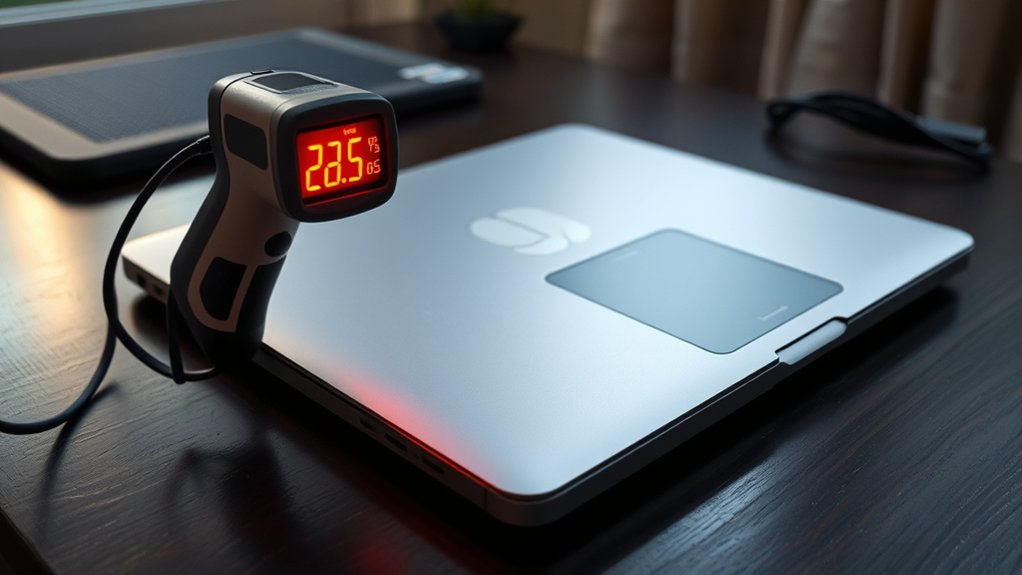
A laptop temperature of 98°C means the cooling system is operating near its limit. Brief spikes can occur under gaming or rendering loads, but sustained temperatures at this level are not considered safe. Thermal throttling, louder fans, and reduced performance usually follow. Common causes include dust buildup, weak airflow, degraded thermal paste, or poor thermal design. Before buying, buyers should check sustained-load temperature tests, cooling quality, and long-term reliability concerns outlined below.
What Does 98°C Mean on a Laptop?
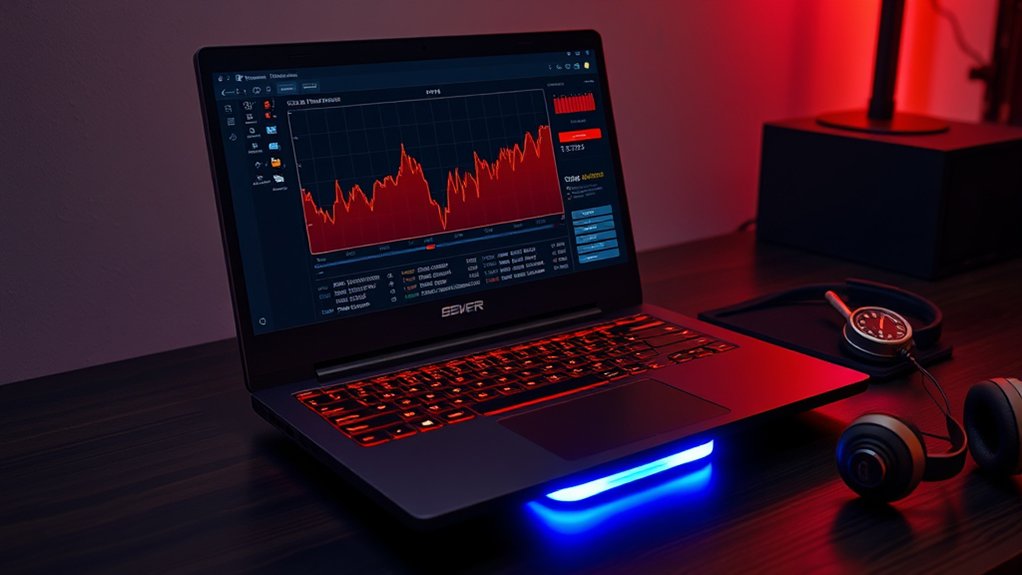
Why does a laptop reaching 98°C warrant concern? Such a reading signifies operation beyond the typical safe envelope of roughly 50°C to 95°C. In technical terms, it reflects compromised thermal management and a system approaching protective limits. At this temperature, the machine is no longer functioning with full autonomy; heat begins dictating behavior through internal safeguards.
Sustained exposure to 98°C commonly triggers thermal throttling, forcing the CPU and GPU to reduce clock speeds and power draw to avoid immediate damage. This constraint diminishes computational freedom and indicates that performance is being sacrificed for survival.
Repeated overheating at this level also accelerates wear on sensitive components, especially the battery and internal circuitry. Frequent spikes to 98°C often point to inadequate cooling solutions, obstructed vents, dust accumulation, or developing hardware faults.
Regular temperature monitoring, vent cleaning, and external cooling pads help restore stable operating conditions and reclaim reliable performance.
Is 98°C Safe for a Laptop?
A laptop temperature of 98°C exceeds the typical safe operating range and approaches critical thermal safety limits for sustained use.
At this level, the CPU is likely to trigger thermal throttling, which reduces performance and can introduce system instability under load.
If exposure is prolonged, elevated heat can accelerate component degradation and increase the probability of premature hardware failure.
Thermal Safety Limits
At 98°C, a laptop is operating beyond the generally accepted safe thermal range, since sustained temperatures are ideally kept between 50°C and 95°C. This threshold indicates inadequate thermal management and signals a system under excessive heat stress. For users seeking freedom from preventable hardware risk, such readings demand scrutiny rather than normalization.
Most CPUs function best between 70°C and 85°C, while GPUs should remain below 85°C. Consequently, 98°C represents a clear excursion beyond standard thermal safety limits during heavy workloads.
At that level, protective responses may activate to contain heat, showing that current cooling solutions are insufficient for sustained demand. Analytical evaluation should focus on whether the device can maintain safe operating boundaries under realistic use, without recurring excursions into potentially hazardous thermal territory during prolonged sessions.
Performance And Lifespan
Sustained operation near 98°C typically reduces both immediate performance and long-term hardware durability, making it an unsafe thermal condition for a laptop. At this level, systems commonly enter thermal throttling, lowering clock speeds to control heat and causing measurable performance degradation and instability.
Effective thermal management thus becomes essential for preserving reliable computation and user autonomy.
Prolonged exposure also accelerates wear in the CPU and GPU, components that ideally remain below 85°C under heavy workloads. Continued overheating can contribute to physical failures, including battery swelling reported in some models.
For performance optimization, maintaining operating temperatures within roughly 70°C to 85°C is more sustainable. Regular temperature monitoring, airflow improvements, and external cooling solutions help prevent unsafe spikes, reduce repair risk, and extend service life while preserving consistent output overall.
When Is 98°C Normal for a Laptop?
A temperature of 98°C may appear briefly during heavy load spikes, but it is not considered normal as a sustained operating condition.
Its significance also varies by component, since CPUs and GPUs have different thermal thresholds and may throttle at different points.
Persistent readings near 98°C, repeated performance drops, loud fan activity, or surface overheating function as warning signs that thermal management is inadequate.
Heavy Load Spikes
Thermal spikes to 98°C can occur during short bursts of heavy load, such as gaming, video rendering, or other compute-intensive workloads, but this level is not considered safe when maintained for more than brief intervals.
- Typical laptop operation should remain near 50°C to 95°C; 98°C exceeds recommended thermal management thresholds.
- Sustained exposure at 98°C often triggers thermal throttling, reducing performance and undermining sustained computational freedom.
- Persistent overheating increases stress on internal components, raising the probability of accelerated wear or failure.
- Continuous monitoring with software tools, plus improved ventilation, maintenance, and external cooling solutions, helps control spikes.
A liberated user evaluates spikes by duration, frequency, and workload intensity, not by isolated peak numbers alone.
Repeated 98°C events indicate corrective action is warranted soon.
CPU Vs GPU
Peak temperature alone does not identify the source of risk; the distinction between CPU and GPU behavior matters when a laptop reaches 98°C. A CPU at 98°C sits well beyond its preferred 70°C to 85°C range, increasing the likelihood of thermal throttling and cumulative silicon stress.
A GPU may tolerate brief higher loads, yet sustained 98°C operation still exceeds prudent limits and can accelerate performance loss or hardware degradation.
Analytical monitoring of both components is essential during gaming, rendering, or other sustained workloads. Effective thermal management depends on determining which processor saturates first, then evaluating airflow, dust buildup, fan behavior, and chassis design.
If either chip repeatedly approaches 98°C, the system likely requires improved cooling solutions, cleaner vents, or reduced workload intensity to preserve long term operational freedom.
Warning Signs
Although brief temperature spikes can occur in thin or high performance laptops under heavy load, 98°C should be treated as a warning threshold rather than a normal operating state. Sustained operation at that level exceeds safe thermal expectations and compromises long term component freedom, stability, and service life.
- Persistent readings above 85°C indicate elevated risk to CPU and GPU longevity.
- Reaching 98°C under load suggests overheating causes such as dust blockage, degraded thermal paste, or inadequate airflow.
- Thermal throttling, fan surging, chassis hot spots, and sudden shutdowns are actionable warning signs.
- Immediate cooling solutions include vent cleaning, inspection for battery swell, and verification of fan and heatsink performance.
A brief peak may be tolerable in select systems; sustained 98°C is not technically acceptable. Immediate corrective action is warranted.
Signs 98°C Is Too Hot
Several indicators show that 98°C is beyond a safe laptop operating temperature. At that level, overheating symptoms become measurable rather than speculative. Monitoring software provides the clearest evidence, because a sustained reading near 98°C exceeds the commonly accepted safe operating range of 50°C to 95°C.
If the CPU passes 85°C during heavy workloads, inadequate airflow, dust accumulation, failing fans, or poor thermal interface material should already be suspected. Reaching 98°C repeatedly signals that cooling solutions are no longer optional but necessary.
Additional signs appear in hardware behavior and physical condition. Consistent exposure to temperatures near 98°C accelerates wear on critical components, especially the CPU and GPU, reducing long term reliability and service life.
In more severe cases, users have documented physical distortion, including a bulging trackpad, often associated with heat stressed battery systems. These markers indicate a system operating outside prudent thermal boundaries, limiting user autonomy, safety, and hardware longevity.
How 98°C Affects Laptop Performance
Thermal stress at 98°C directly degrades laptop performance by forcing the CPU and GPU into aggressive thermal throttling, reducing clock speeds and limiting sustained computational throughput.
As frequencies drop, frame rates decline, render times increase, and multitasking responsiveness deteriorates. This temperature also narrows operational freedom by pushing hardware beyond the ideal 70°C to 85°C range, where stable output and efficiency are more achievable.
- Throughput falls: sustained workloads lose speed as processors enforce protective limits.
- Stability weakens: safety mechanisms may trigger abrupt shutdowns, disrupting sessions and risking unsaved data.
- Component longevity declines: repeated exposure accelerates wear on processors, graphics silicon, and surrounding circuitry.
- Physical integrity is threatened: battery swelling or warped internal parts can impair function and future reliability.
From a technical perspective, effective thermal management and competent cooling solutions are not optional at this threshold; they are prerequisites for preserving consistent performance, system autonomy, and long-term hardware viability.
What Causes a Laptop to Hit 98°C?
Reaching 98°C usually indicates that heat generation has exceeded the laptop’s capacity to remove it. This condition commonly arises when cooling hardware underperforms. Blocked vents, failing fans, and airflow obstruction reduce the volume of air moving through the chassis, trapping heat near the CPU and GPU.
A laptop hitting 98°C usually signals that cooling performance has fallen behind the heat being generated.
Dust accumulation worsens the problem by insulating internal components and limiting heatsink efficiency.
High computational demand is another primary cause. Gaming, rendering, and video editing can drive sustained processor and graphics loads that sharply increase thermal output.
If the laptop’s thermal design is constrained, compact, or poorly balanced, dissipation may lag behind generation. Degraded or low-quality thermal paste further compounds this imbalance by weakening heat transfer from silicon to heatsink surfaces.
External usage conditions also matter. When a laptop rests on beds, couches, or other soft materials, intake and exhaust pathways become restricted, amplifying heat buildup.
The result is a system approaching thermal limits under ordinary pressure.
How to Lower a 98°C Laptop Temperature
Start by restoring airflow, because a laptop operating at 98°C usually requires immediate reduction in heat retention and thermal load. Effective thermal management begins with clearing dust from intake and exhaust vents and ensuring no surface blocks airflow. This removes a basic constraint and creates space for more independent cooling solutions.
- Clean and unobstruct all cooling vents to improve air exchange and reduce internal heat accumulation.
- Use a cooling pad to force additional airflow beneath the chassis, often lowering component temperatures measurably.
- Monitor CPU and GPU readings with software tools to isolate overheating hardware and verify whether interventions are working.
- Reduce simultaneous heavy workloads by limiting resource-intensive applications, which cuts power draw and suppresses heat generation.
If temperatures still remain beyond safe limits, repasting the CPU and GPU with high-quality thermal paste may improve heat transfer efficiency. This step addresses degraded interface material rather than external airflow alone.
What to Check Before Buying a Hot-Running Laptop
Before purchasing a laptop known to run hot, the evaluation should focus on measured operating temperatures under sustained load rather than idle behavior alone. CPU readings during demanding tasks should generally remain within 70°C to 85°C, preserving performance and reducing the likelihood of thermal throttling.
GPU temperatures should also stay below 85°C, since repeated overheating can degrade stability and accelerate hardware wear.
Attention should then shift to thermal management architecture. Heat pipe layout, fan capacity, intake and exhaust placement, and chassis ventilation determine whether heat is dissipated efficiently during prolonged sessions.
The broader safe operating envelope of 50°C to 95°C provides context, but temperatures near the upper boundary demand scrutiny rather than trust. Independent benchmarks and user reviews are especially valuable for identifying persistent thermal defects, including battery problems or bulging components reported in certain models such as the EVGA SC17.
Such verification helps buyers act from evidence, not marketing claims alone.
Who Should Avoid a Laptop That Runs at 98°C?
Why would any user with sustained performance requirements accept a laptop that operates at 98°C under load? From an analytical standpoint, such a device compromises autonomy rather than enabling it.
Temperatures beyond safe operating thresholds invite thermal throttling, suppress gaming performance, and erode system responsiveness during prolonged workloads. Poor thermal management also accelerates component wear, undermining long-term value and reliability.
Excessive heat triggers throttling, degrades sustained performance, and hastens component wear, compromising both reliability and long-term system value.
The users who should avoid such systems include:
- Gamers, because frame consistency and gaming performance deteriorate under thermal throttling.
- Content creators, whose rendering, encoding, and export tasks demand stable clocks and dependable thermal management.
- Multitaskers and power users, since heavy applications at 98°C raise the probability of instability, crashes, and interrupted workflows.
- Safety-conscious buyers, because persistent overheating increases the risk of hardware failure and, in extreme cases, fire hazards.
In practical terms, anyone seeking durable, liberated computing without thermal constraints should reject a laptop that regularly reaches 98°C under load.
Frequently Asked Questions
Is a 98 Degree Temperature Bad?
No, 98 degrees is not bad for a normal body; temperature myths often distort interpretation. It is generally considered within typical range, though context, measurement method, symptoms, and individual baseline determine whether concern is warranted.
Should I Go to the ER if My Temperature Is 96?
Possibly—what threshold justifies urgent evaluation? A 96°F body temperature is below normal; if accompanied by emergency signs like confusion, breathing difficulty, dizziness, or profound fatigue, ER assessment is advisable. Otherwise, prompt clinical consultation remains prudent.
What Illnesses Cause a Low Body Temperature?
Illnesses causing low body temperature include hypothyroidism, sepsis, malnutrition, vitamin B12 deficiency, and neurological injury or stroke. These medical conditions impair thermoregulation; recognizing hypothermia symptoms supports timely evaluation and greater autonomy in urgent health decisions.
Why Is 98.6 Not the Average Anymore?
98.6 is no longer average because body temperature trends have drifted, like a compass recalibrated, reflecting modern health standards, lower metabolic rates, improved hygiene, demographic variation, and more precise thermometry, freeing understanding from outdated nineteenth-century assumptions.
Conclusion
A laptop reaching 98°C operates near a thermal red line where design limits, workload behavior, and cooling efficiency must be examined with precision. Like Icarus flying too near the sun, a system that repeatedly sustains such heat may trade short-term performance for long-term reliability loss, throttling, and component stress. Before purchase, buyers should verify thermal controls, fan design, paste quality, and real-world benchmarks to determine whether 98°C reflects a controlled peak or a persistent engineering compromise indeed.
