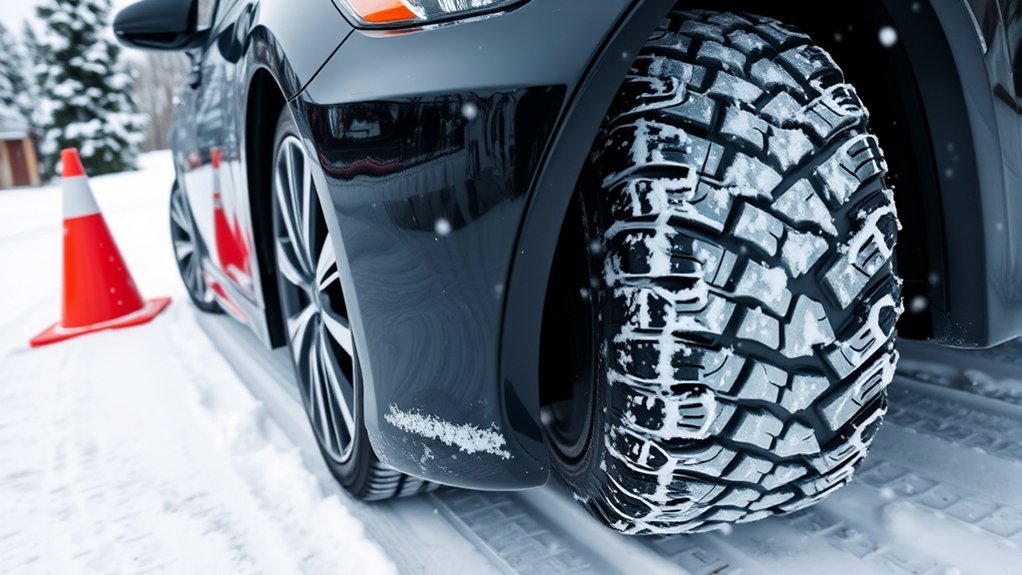
Improving your Toyota Camry’s winter traction starts before snow reaches the road. The tires make the biggest difference, but pressure, tread condition, visibility, vehicle maintenance, and your driving inputs all matter. A well-prepared Camry can handle winter travel more predictably, although no tire, drivetrain, or drive mode can eliminate the risks of ice.
Quick Answer
To improve Toyota Camry winter traction, install four matching winter tires when snow, ice, or sustained temperatures near or below 7°C (45°F) are common. Maintain the cold pressure on the driver-door placard, replace tires before snow grip becomes poor, and use slow, smooth steering, braking, and acceleration.
Key Takeaways
- Use four matching tires carrying the Three-Peak Mountain Snowflake symbol for frequent snow, ice, or prolonged freezing temperatures.
- Check pressure when the tires are cold and use the value printed on the Camry’s driver-door placard, not the tire sidewall maximum.
- Treat 2/32 inch as the worn-out floor; for winter use, plan replacement before tread reaches about 4 mm, or 5/32 inch.
- AWD, traction control, and Snow Mode may help the car begin moving, but they cannot create extra tire grip for every stop or turn.
- Slow down, avoid abrupt inputs, leave a much larger stopping gap, and postpone nonessential travel when conditions exceed your equipment or experience.
At a Glance
| Time Required | About 30 to 60 minutes for a home inspection; tire installation, wheel service, or repairs take longer |
| Difficulty | Easy inspection; professional service recommended for mounting, balancing, alignment, TPMS service, or damaged tires |
| Tools Needed | Accurate tire-pressure gauge, tread-depth gauge, flashlight, snow brush, ice scraper, and the exact Camry owner’s manual |
| Cost | Basic inspection costs little; tires, batteries, repairs, TPMS service, and professional labor vary by model and condition |
Last updated: July 13, 2026.
Why Winter Tires Are a Must for Safe Winter Driving
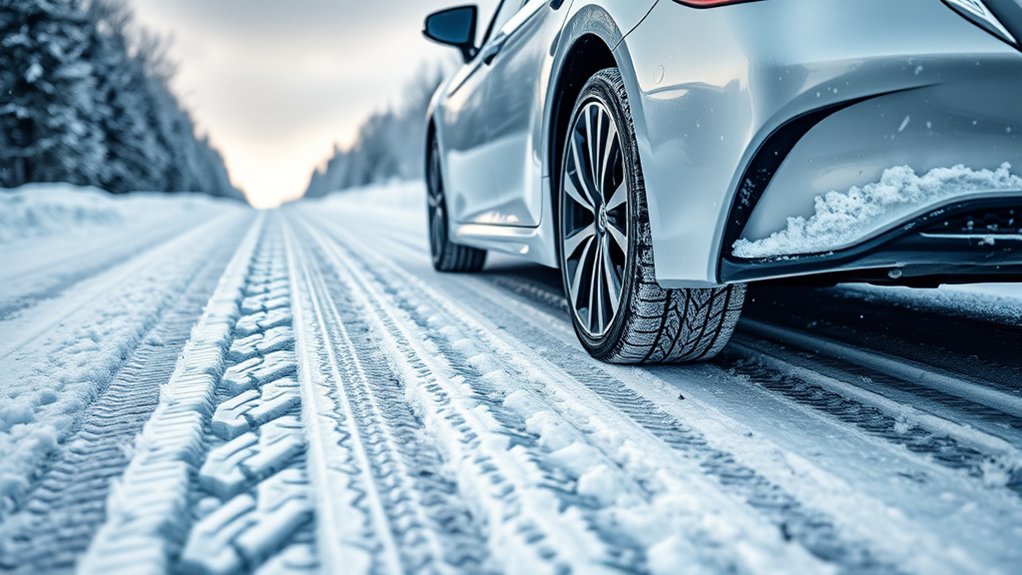
When snow, packed slush, and freezing temperatures are common, winter tires provide more dependable cold-weather grip than ordinary all-season tires. Their tread compounds are designed to remain more flexible in low temperatures, while their channels and sipes help the tire engage snow-covered surfaces and move slush away from the contact area.
Look for tires carrying the Three-Peak Mountain Snowflake symbol. The symbol confirms that the tire meets a standardized snow-traction test. An M+S marking describes tread characteristics, but it is not the same severe-snow performance benchmark.
Install winter tires as a complete set of four. Mixing winter tires with all-season tires can create different grip levels between the front and rear axles, making the Camry less predictable during braking or cornering. Use tires of the same type, size, load rating, and compatible speed rating unless Toyota specifically approves another configuration for your model.
When to Install and Remove Winter Tires
A practical changeover point is when daily temperatures remain near or below 7°C (45°F), even before the first lasting snowfall. When temperatures remain consistently above that range in spring, return to the approved warm-weather tires. Winter compounds can wear faster and feel less precise in warm conditions, so do not leave them on year-round unless the tire manufacturer specifically permits that use.
Warning: Winter tires improve available grip, but they cannot make glare ice behave like dry pavement. Reduce your speed and do not assume that new tires, AWD, Snow Mode, traction control, or stability control will prevent every skid.
Use the tire size, load rating, speed rating, and pressure approved for your exact model year, trim, market, and wheel package. The original tire information appears on the driver-door placard and in the Toyota owner’s manual.
How to Check and Maintain Tire Pressure in Cold Weather
Cold weather lowers measured tire pressure. Even when a tire is not leaking, the dashboard warning may appear after a sharp temperature drop. Proper pressure supports predictable handling, even tread wear, and tire durability.
Tire Pressure Fluctuations Explained
Do not estimate pressure from the weather alone. A temperature change, slow leak, valve problem, or wheel-seal issue can all affect the reading, so use an accurate gauge and inspect any tire that repeatedly loses air.
Measure pressure when the tires are cold. The National Highway Traffic Safety Administration defines cold tires as tires that have not been driven for at least three hours.
Do not use the maximum pressure molded into the tire sidewall as the normal setting. Use the Camry’s recommended cold pressure on the driver-door placard. Front and rear specifications may differ on some vehicles or tire configurations.
Checking Pressure Regularly
- Park the Camry and allow the tires to remain unused for at least three hours.
- Remove the valve cap and press an accurate gauge firmly onto the valve stem.
- Compare the reading with the driver-door placard, not the tire sidewall.
- Add or release air as needed, then measure the pressure again.
- Check every road tire and inspect the spare if your Camry carries one.
- Replace each valve cap and recheck pressure at least monthly and before a long trip.
TPMS After a Seasonal Wheel Change
If you install a separate winter wheel-and-tire set, confirm that the tire-pressure monitoring system sensors are compatible with your exact Camry. Some model years may require sensor registration, initialization, or a relearn procedure after a wheel change. Follow the exact owner’s manual or have a qualified tire shop complete the procedure; do not ignore a warning light simply because the tires look inflated.
Pro Tip: Do not wait for the tire-pressure warning light. TPMS normally warns only after pressure has fallen significantly, so a monthly manual check can identify a smaller loss earlier.
How Tread Depth Impacts Winter Traction
Tread must create space for snow, slush, and water to move away from the tire’s contact area. As the tread wears, the tire has less room to manage those materials, which can reduce braking and cornering control.
Minimum Tread Depth Requirements
NHTSA identifies 2/32 inch as the point at which a passenger tire is worn out and should be replaced. That is a basic wear limit, not an ideal target for winter travel.
For dependable snow use, plan replacement before winter tread approaches 4 mm, which is about 5/32 inch. Transport Canada advises that winter tires should have at least 4 mm of tread for the safest winter operation. Local laws, chain-control rules, or mountain-road requirements may impose additional standards.
The penny test identifies tread near 2/32 inch, so it is not precise enough for a winter-readiness check. Use an inexpensive tread-depth gauge and measure several main grooves across every tire.
Tread Patterns for Traction
Winter tires use larger channels to move slush and many small cuts, called sipes, to create additional biting edges. The complete tire design matters more than tread appearance alone, so do not choose a tire only because its grooves look aggressive.
Use four tires of the same category and similar condition. Large differences in tread depth or construction can change how the front and rear of the car respond on a slippery road. When tire position is not dictated by a directional pattern, staggered size, or Toyota procedure, the tires with the deepest tread should generally be fitted to the rear axle to reduce the risk of rear-end loss of control.
Monitoring Tread Wear Regularly
Measure each tire at the inner edge, center, and outer edge. Uneven readings may indicate an alignment, inflation, suspension, balance, or rotation problem. Follow the tire maker’s and Toyota’s rotation guidance; NHTSA notes that many vehicles call for rotation roughly every 5,000 to 8,000 miles, but the exact interval for your Camry takes priority.
| Tread Reading | What It Means for Winter Use |
|---|---|
| More than 5/32 inch | Generally leaves more space for snow and slush, assuming the tire is winter-rated, evenly worn, and undamaged |
| About 5/32 inch, or 4 mm | Plan replacement before demanding winter travel; this is the minimum winter tread guidance published by Transport Canada |
| About 4/32 inch | Reduced margin for snow, slush, and standing water; replace before relying on the tire in severe winter conditions |
| 2/32 inch or less | The tire is worn out and should be replaced |
Also inspect for exposed cords, cuts, punctures, bulges, cracking, embedded objects, or recurring pressure loss. A tire can require repair or replacement even when its tread appears adequate.
Check the tire’s DOT date code and ask a tire professional about age-related replacement. Rubber can deteriorate with time, storage conditions, sunlight, heat, and use. Do not rely on age alone; condition, service history, and the tire manufacturer’s guidance also matter.
The Importance of Wheel Alignment for Winter Safety
Correct wheel alignment helps the tires meet the road evenly and prevents premature, irregular wear. It also helps the Camry track straight on a level road.
An alignment is not automatically required each winter. Schedule an inspection when the vehicle pulls to one side, the steering wheel sits off-center, a tire shows uneven wear, or the car has struck a severe pothole or curb.
Wheel balance is a separate service. An imbalance often causes vibration at certain speeds, while an alignment problem more often causes pulling, an off-center steering wheel, or uneven tread wear.
Fixing either problem helps preserve the tire’s available traction, but it cannot restore worn tread or turn an unsuitable tire into a winter tire.
Smooth Driving Tips for Icy Roads
On snow or ice, every acceleration, braking, and steering request uses part of the limited grip available. Abrupt inputs can demand more grip than the tires can provide.
- Accelerate gently and allow extra time to reach traffic speed.
- Begin slowing much earlier than you would on dry pavement.
- Steer smoothly and avoid sudden lane changes.
- Increase the time gap behind the vehicle ahead as conditions worsen.
- Avoid cruise control on slippery roads so you remain fully involved in speed control.
- Do not crowd snowplows or drive beside them for extended periods.
Your tires can accelerate, brake, or turn only within the grip available. Asking them to do several of those jobs aggressively at once makes a skid more likely.
How to Brake With ABS on Snow and Ice
Most modern Camrys have an antilock brake system. During an emergency stop, press the brake pedal firmly and continuously while steering toward a safe path. Pedal vibration or noise can be normal while ABS operates.
Do not repeatedly pump an ABS-equipped brake pedal. Check the manual for your exact vehicle and have warning lights inspected if the ABS or stability-control indicator remains on.
What to Do if the Camry Starts to Skid
Look where you want the vehicle to travel, ease off the accelerator, and make small, smooth steering corrections. Avoid slamming on the brakes or making a sharp countersteer.
If the front tires slide straight ahead, gently reduce the steering angle and allow the car to slow until the tires regain grip. If the rear begins to move sideways, keep looking and steering smoothly toward your intended path without abrupt braking. Electronic stability control can assist in some situations, but it cannot overcome excessive speed or nearly frictionless ice.
Driver-Assistance Systems in Winter
Snow, ice, road spray, darkness, and poor lane markings can reduce the performance or availability of cameras, radar, parking sensors, automatic high beams, adaptive cruise control, and other driver-assistance features. Clear the sensor areas identified in the owner’s manual and respond to any temporary-unavailable message. These systems support the driver; they do not replace direct observation or careful control.
How Front-Wheel Drive and AWD Affect Winter Traction
A front-wheel-drive Camry places engine and drive-system weight over the front tires, which can help it begin moving. An AWD Camry can distribute driving force across more wheels when the system detects a need.
AWD mainly helps the car accelerate. It does not give the tires extra friction during every stop or turn. A front-wheel-drive Camry on suitable winter tires can therefore be more controllable in snow than an AWD model on worn or unsuitable tires.
Traction control may reduce engine power or brake a spinning wheel. Stability control may help correct certain slides. These systems support the driver, but they cannot overcome excessive speed or a surface with almost no grip.
Must-Have Winter Gear for Your Toyota Camry
Store emergency supplies where you can reach them without unloading the entire trunk. Secure heavy items so they do not become projectiles during a collision.
| Gear | Purpose |
|---|---|
| Ice scraper and snow brush | Clears the windows, mirrors, lights, roof, hood, license plates, and sensor areas |
| Compact shovel | Removes snow around the tires and exhaust outlet |
| Sand, traction mats, or non-clumping cat litter | Adds temporary surface texture near a spinning drive tire after packed snow is cleared |
| Winter windshield-washer fluid | Supports visibility at temperatures appropriate to the product rating |
| Jumper cables or a charged jump pack | Helps with a weak 12-volt battery when used according to the manual |
| Flashlight, reflective vest, and warning markers | Improves visibility during a roadside emergency |
| Blankets, hat, gloves, and warm layers | Reduces cold exposure during a delay |
| Water, shelf-stable food, and essential medicine | Supports occupants if travel is delayed |
| First-aid kit, phone charger, and power bank | Supports minor first aid and communication |
Check whether your Camry has a compact spare tire, a full-size spare, or a tire-repair kit. Inspect that equipment before winter and learn its limits before an emergency occurs.
How to Prepare Your Camry for Winter Weather Conditions
Complete the following inspection before freezing weather becomes routine:
- Inspect all four tires. Check winter rating, pressure, tread depth, damage, age, and uneven wear.
- Test the 12-volt battery. Cold weather reduces available battery power and can expose a weak battery.
- Check the wipers and defrosters. Replace damaged blades and confirm that the front and rear defogging systems work.
- Fill the washer reservoir. Use winter fluid rated for the temperatures expected in your area.
- Inspect exterior lights. Confirm that the headlights, brake lights, turn signals, and emergency flashers work.
- Check coolant protection. Use coolant that meets Toyota’s specification and have leaks or questionable fluid tested.
- Inspect the brakes. Address warning lights, unusual noise, vibration, pulling, or reduced braking performance.
- Secure the correct floor mats. Use mats that fit the Camry, fasten them with the retention clips, and never stack one mat on another where it could interfere with the pedals.
- Pack the emergency kit. Adjust its contents for the trip length, passengers, and expected temperatures.
- Fuel or charge before the trip. Keep a gasoline model’s tank at least half full in severe winter conditions, or leave a larger battery reserve in a hybrid, because cold, detours, and cabin heat can reduce range.
- Check weather, road conditions, and recalls. Review the route, share your plans, verify that no safety recall is outstanding, and delay nonessential travel when roads are not safely passable.
Note: Before driving, clear snow and ice from the windshield, side glass, mirrors, lights, roof, hood, license plates, and driver-assistance sensors. Snow left on the vehicle can block your view, disable a feature, or strike another road user.
Using Snow Chains or Cables on a Toyota Camry
Do not assume that every chain or cable fits every Camry wheel-and-tire combination. Some vehicles have limited clearance around the tire, suspension, brakes, or bodywork.
Check the exact owner’s manual for the permitted device, installation axle, speed limit, tire size, and clearance requirements. Practice installation in dry conditions before the trip, follow local chain-control signs, and remove the device when it is no longer required. An incorrectly sized or loosely installed traction device can damage the vehicle or affect control.
What Safe Driving Habits Should You Practice in Winter?
Reduce your speed before reaching a slippery curve, intersection, bridge, shaded area, or downhill section. These surfaces may remain icy even when nearby pavement looks clear.
Use a much larger time gap than you would on dry pavement. A five- or six-second gap may be only a starting point in light winter conditions; deeper snow, ice, poor visibility, traffic, or downhill travel can require substantially more space. Choose a gap that lets you brake gradually without relying on a precise universal number.
Watch several vehicles ahead so you can respond gradually. Avoid positioning the Camry where another driver’s sudden stop leaves you no escape route.
Keep both hands ready to steer, remove distractions, and avoid using a phone. Never drive after using alcohol, cannabis, sedating medication, or any substance that affects reaction time or judgment.
Learn the vehicle’s controls and warning lights before a storm. Do not use a public parking lot as an informal skid course. Professional winter-driving instruction provides a safer environment for learning vehicle-control techniques.
What to Do if Your Camry Gets Stuck or Stranded
If the drive tires spin, stop pressing harder on the accelerator. Straighten the front wheels, clear packed snow from around the tires, and use a small amount of sand, a traction mat, or non-clumping litter for added surface texture.
Use gentle acceleration and avoid prolonged wheelspin, which can dig the tires deeper and overheat components. Check the owner’s manual before attempting to disable traction control because doing so is appropriate only in limited situations.
If the Camry becomes stranded in dangerous weather, staying with the vehicle is often safer than walking for help. Turn on the emergency flashers, call for assistance, and make the car visible with warning markers when you can do so safely.
Warning: Keep the exhaust outlet completely clear of snow before running the engine. A blocked exhaust can allow deadly carbon monoxide to enter the cabin. Run the engine only as needed, remain alert for symptoms, and never run a vehicle in an enclosed space.
Conserve battery power, keep warm with clothing and blankets, and avoid overexertion. Share your location, route, vehicle description, and number of occupants with emergency services or a trusted contact.
Related Guides
Frequently Asked Questions
How can you get more traction in snow?
Use four matching winter tires with adequate tread, maintain the vehicle’s specified cold pressure, remove packed snow from the wheel area, and accelerate gently. Slow down before curves and stops. Adding power cannot create traction after the tires have exceeded the available grip.
What is the 7-7 rule for winter tires?
The “7-7 rule” is an informal reminder, not a universal law or technical standard. It commonly means considering winter tires after temperatures stay around or below 7°C (45°F) for roughly seven days, then changing back after sustained warmer weather. It does not create a 7/32-inch tread requirement; measure tread separately and follow local law, Toyota guidance, and the tire maker’s instructions.
How do you put a Toyota Camry in Snow Mode?
Snow Mode is not available or activated the same way on every Camry. Check the controls and owner’s manual for your exact model year, trim, market, and drivetrain. When equipped, the mode adjusts power delivery or system response, but it does not replace winter tires or careful driving.
What are the three P’s of winter driving?
Preparation, patience, and practice form a useful safety mnemonic, although they are not a formal national standard. Prepare the vehicle and route, remain patient enough to slow down or delay travel, and build skills through approved instruction rather than experimenting on public roads.
Does an AWD Toyota Camry still need winter tires?
AWD can help the Camry begin moving by sending driving force to more wheels. Braking and cornering still depend on the tires’ grip. Where snow and ice are frequent, four suitable winter tires can improve control regardless of whether the Camry has front-wheel drive or AWD.
Can you use chains on a Toyota Camry?
Compatibility depends on the Camry’s model year, tire size, wheel size, and available clearance. Follow the exact owner’s manual and local chain-control requirements. Use only an approved size, install it on the specified axle, and obey the device’s speed limit.
When should you install winter tires on a Toyota Camry?
Install them before regular snow and ice arrive, typically when temperatures remain near or below 7°C (45°F). Book early enough to avoid the first-storm rush, and confirm that all four tires match the Camry’s approved size and load requirements.
Why is the tire-pressure warning on after a winter wheel swap?
The winter wheels may have incompatible, unregistered, or uninitialized TPMS sensors, or one or more tires may actually be low. Measure every tire cold, then follow the exact Camry manual or have a qualified shop register or relearn the sensors. Do not clear the warning without confirming pressure first.
Conclusion
The most effective way to improve Toyota Camry winter traction is to combine suitable tires with careful maintenance and slower, smoother driving. Use four matching winter tires when local conditions justify them, maintain the door-placard pressure, replace winter tires before tread approaches 4 mm or about 5/32 inch, and inspect for damage and uneven wear.
Prepare the battery, visibility systems, fluids, brakes, lights, TPMS, floor mats, fuel or charge level, and emergency supplies. Confirm model-specific features such as Snow Mode, approved tire sizes, traction devices, and spare equipment in the exact Toyota manual. When snow, ice, or poor visibility exceeds your equipment or experience, postponing the trip remains the safest decision.
Sources
- NHTSA Winter Weather Driving Tips — winter driving, vehicle preparation, emergency supplies, ABS use, tire pressure, floor-mat safety, and stranded-vehicle precautions
- NHTSA TireWise — cold tire pressure, TPMS limitations, tread wear, tire damage, rotation, alignment, and replacement guidance
- Transport Canada: Using Winter Tires — Three-Peak Mountain Snowflake marking, four-tire installation, the 7°C changeover guideline, and 4 mm winter tread guidance
- Transport Canada: Driving Safely in Winter — safer braking, steering, following distance, visibility, and driver-assistance limitations
- Toyota Manuals and Warranties — model-specific tire, TPMS, control, drive-mode, traction-device, and emergency-equipment instructions
