Your Toyota Camry’s headlight bulb size depends on its model year, sales market, trim, and actual headlamp assembly. Toyota manuals show older examples with 9006 low beams, later halogen systems with H11 low beams, and recent models with integrated LED headlamps that have no ordinary replaceable low- or high-beam bulb.
Last updated: September 19, 2026 — verified Toyota bulb-code examples, clarified integrated-LED fitment, and aligned U.S. LED-conversion guidance with NHTSA.
Quick Answer
There is no single Toyota Camry headlight bulb size. Toyota manuals list 9006/HB4 low beams with 9005/HB3 high beams for some older Camrys, H11 low beams with 9005/HB3 high beams for several later halogen systems, and D4S HID low beams on selected trims. Recent Camrys often use integrated LED headlamps instead of ordinary replaceable low- or high-beam bulbs. Confirm the VIN, owner’s manual, existing bulb code, and housing label before ordering.
Key Takeaways
- 2003 and 2006 North American Toyota manuals list a 9006/HB4 low beam and 9005/HB3 high beam.
- The 2007 manual lists an H11 low beam and 9005/HB3 high beam; some later halogen Camrys use the same combination.
- Some trims use HID or integrated LED systems instead of ordinary halogen bulbs.
- Recent U.S.-market Camrys generally use integrated LED low- and high-beam headlamps.
- Replace matching left and right halogen bulbs of the same function as a pair when practical.
- Do not treat socket fit, “DOT approved” marketing, or an online catalog result as proof that an LED conversion is compliant or optically safe.
At a Glance
| Common Older Pattern | 9006/HB4 low beam + 9005/HB3 high beam in the cited 2003 and 2006 Toyota manuals |
| Common Later Halogen Pattern | H11 low beam + 9005/HB3 high beam in the cited 2007, 2014, and 2015 halogen configurations |
| Other Factory Systems | D4S HID on selected older trims; integrated LED or Bi-LED systems on many newer Camrys |
| Fastest Fitment Check | Match the owner’s manual, VIN-based Toyota parts information, code on the installed bulb, and markings on the installed headlamp housing |
Why Headlight Bulb Size Matters
A headlight bulb code identifies more than the bulb’s general shape. It specifies important physical and electrical features such as the base, locking tabs, connector, light-source position, and operating wattage.
A similar-looking bulb may fail to lock into the housing, connect to the wiring, or place its filament in the optical focal point. Incorrect positioning can produce dark areas, short beam reach, scattered light, or glare toward other drivers.
Installing a higher-wattage bulb can also overheat the connector, damage insulation, discolor the reflector, or deform plastic inside the housing. Use the bulb type and wattage specified for the exact headlamp assembly.
A brighter-looking light source is not automatically a better headlight. Useful visibility depends on beam reach, width, uniformity, aim, housing condition, and glare control.
Toyota Camry Headlight Bulb Size Chart and Headlamp Types
The following chart contains verified examples from Toyota manuals and official Toyota model information. It is not a substitute for checking the exact vehicle because production changes, regional specifications, trim options, and previously replaced headlamp assemblies can alter fitment.
| Model year and market | Low beam | High beam | Important notes |
|---|---|---|---|
| 2003 North American manual | 9006 / HB4, 51W | 9005 / HB3, 60W | Toyota’s 2003 manual also lists 9006 for the fog lights, so identify the lighting position before ordering. |
| 2006 North American manual | 9006 / HB4, 51W | 9005 / HB3, 60W | Confirmed in Toyota’s 2006 Camry manual. |
| 2007 North American manual | H11, 55W | 9005 / HB3, 60W | The 2007 Camry manual identifies H11 as the low-beam bulb type. |
| 2014 U.S. manual | H11, 55W on halogen systems D4S, 35W on discharge/HID systems |
9005 / HB3, 60W | The 2014 Camry manual covers both halogen and discharge low-beam equipment. |
| 2015 U.S. manual | H11, 55W where a halogen low beam is fitted | 9005 / HB3, 60W where a halogen high beam is fitted | Toyota’s 2015 manual states that light sources not listed in its bulb table are LEDs. |
| 2019 Canada | Integrated LED headlamp system | Integrated LED headlamp system | Toyota Canada’s 2019 model information identifies LED headlights as standard and premium LED equipment on selected trims. |
| 2024 U.S. | LED or Bi-LED assembly, depending on grade | LED or Bi-LED assembly, depending on grade | The 2024 U.S. brochure lists LED and Bi-LED headlamp configurations rather than ordinary H11 or 9005 low/high bulbs. |
| 2025 U.S. | Bi-LED or dual-LED projector | Bi-LED or dual-LED projector | The 2025 Camry brochure specifies integrated LED low- and high-beam projectors by grade. |
| 2026 U.S. | Integrated LED | Integrated LED | Toyota states that all 2026 grades have LED headlights. |
Note: This chart uses verified examples, not a universal generation-wide guarantee. Confirm the exact vehicle because a trim option, regional specification, production change, collision repair, or aftermarket headlamp assembly can change the required part.
How this guide was verified: Each chart row is tied to a Toyota owner’s manual, Toyota brochure, or official Toyota model page. Years not shown are intentionally left out rather than filled with a generation-wide guess. If your year is missing, use the verification sequence below.
What If Your Toyota Camry Model Year Is Not Listed?
Do not copy the nearest model year automatically. Toyota can change headlamp equipment within a generation, and trims or regional models may use different technology. Use your exact owner’s manual or VIN-specific Toyota parts information first, then confirm the code on the installed bulb or the markings on the installed headlamp assembly. If those sources disagree, identify whether the vehicle has a replacement or aftermarket headlamp before buying a bulb.
How to Confirm Your Exact Toyota Camry Bulb Size
Use at least two fitment checks before purchasing. A used Camry may have an aftermarket or salvage-yard headlamp that no longer matches the original VIN configuration.
- Identify the failed function. Confirm whether the problem is the low beam, high beam, fog light, daytime running light, turn signal, or another lamp.
- Check the owner’s manual. Look under light bulbs, specifications, or do-it-yourself maintenance in Toyota’s official Manuals and Warranties portal.
- Use the VIN in Toyota’s parts catalog. Search the Toyota Genuine Parts catalog and confirm the headlamp type, side, and included modules.
- Read the existing bulb code. Codes such as H11, 9005, 9006, or D4S are normally printed or molded into the bulb base.
- Inspect the headlamp housing label. The rear cover, housing, or lens markings may identify the approved light source.
- Compare the connector and tabs. The new bulb should align and lock without trimming, bending, or forcing any part.
- Resolve any disagreement before ordering. If the VIN catalog and existing bulb differ, investigate whether the vehicle has a replacement housing. The code on the installed housing is normally the controlling clue for that assembly.
Pro Tip: Photograph the old bulb, connector, rear housing, parts label, and full 17-character VIN before visiting a parts store. These photos help expose a catalog mismatch or previously replaced headlamp.
How to Identify Halogen, HID, or Integrated LED Headlights
| Headlamp type | What you may see | Normal service approach |
|---|---|---|
| Replaceable halogen | A removable twist-lock or clipped bulb, a two-wire connector, and codes such as H11, 9005, or 9006 | Replace the bulb with the same code and wattage, then confirm operation and beam pattern |
| HID or discharge | A D-series bulb such as D4S, a ballast or igniter, high-voltage warnings, and a projector lens | Diagnose the bulb, ballast, igniter, wiring, and power supply; observe high-voltage precautions |
| Integrated LED | No ordinary removable low- or high-beam bulb holder; the light source is built into the headlamp | Test the connector, fuse, wiring, driver module, communication faults, and assembly before replacing parts |
| Adaptive or auto-leveling LED/HID | Level sensors, swivel or adaptive functions, warning messages, and additional control modules | Use model-specific diagnostic procedures and perform any required calibration or aiming |
Warning: HID systems can generate high voltage. Switch the lights and ignition off, follow the exact Toyota service procedure, and use a qualified technician if the system includes a ballast, igniter, adaptive function, or damaged wiring.
Low-Beam vs. High-Beam Bulb Codes
Low beams spread controlled light across the roadway while limiting glare toward oncoming traffic. High beams project farther ahead and should be used only when they will not affect other road users.
A bulb code identifies a standardized light source; it does not assign that source to the same beam function on every vehicle. A 9005 is often used as a high beam and an H11 is often used as a low beam, but the headlamp design determines the actual application.
| Code | Also called | Camry context |
|---|---|---|
| 9005 | HB3 | Verified as the high beam in multiple Toyota Camry manuals |
| 9006 | HB4 | Verified as the low beam in the cited 2003 and 2006 manuals; it may also appear in fog-light positions |
| H11 | H11 | Verified as a low beam in the cited 2007, 2014, and 2015 halogen configurations |
| D4S | Discharge/HID capsule | Listed for the optional 2014 discharge low-beam system |
| H7 | H7 | May appear in regional or aftermarket catalogs, but it is not part of the verified U.S. low- or high-beam examples in this guide and is not interchangeable with H11 |
| 912 / 921 | Wedge bulbs | May appear in catalogs for other lamp positions, but it is not part of the verified Camry low- or high-beam examples in this guide |
Some Camry assemblies use separate low- and high-beam bulbs. Others use one Bi-LED projector or several LED elements to perform both functions. Identify the failed function and headlamp technology before ordering any part.
Recommended Replacement Options for Toyota Camry Headlights
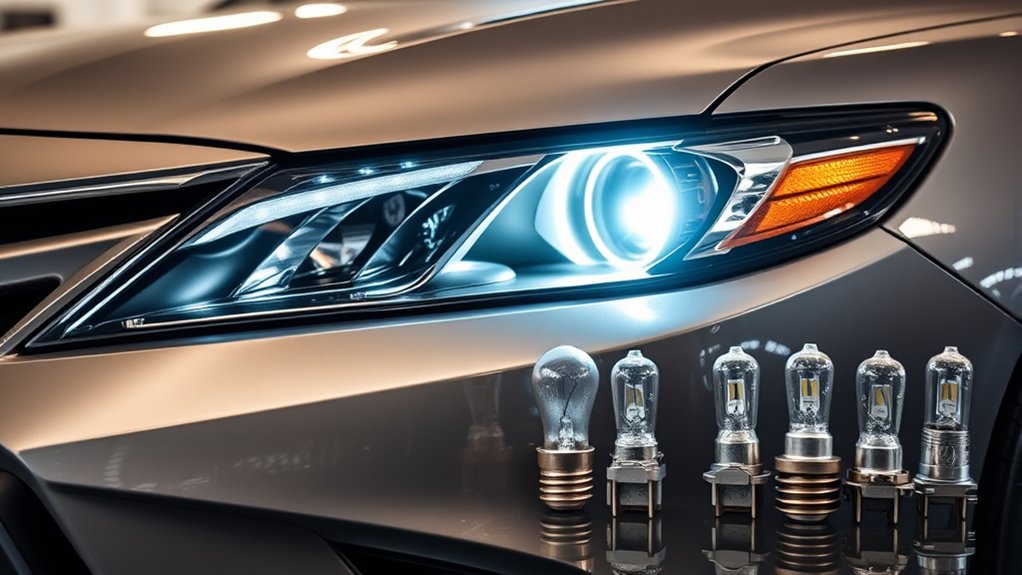
The safest replacement matches the original code, wattage, connector, and approved headlamp design. Choose an identifiable manufacturer and verify that the product is intended for the vehicle and legal for road use in your location.
Standard Halogen Replacements
A standard-output halogen bulb normally provides the closest match to factory beam pattern, electrical load, color, and service life. It is a practical choice when reliable fitment matters more than a whiter appearance.
Performance Halogen Bulbs
A road-legal performance halogen bulb may improve usable output while retaining the original filament position and wattage. The tradeoff can be shorter service life. Compare the manufacturer’s expected life, warranty, and road-use documentation rather than relying only on color-temperature or brightness marketing.
HID and Discharge-System Parts
An HID failure can involve the D-series bulb, ballast, igniter, connector, wiring, fuse, or control circuit. A bulb that changes color, flickers, or takes repeated attempts to ignite may be failing, but testing should come before replacing an expensive ballast or complete assembly.
Integrated LED Headlamp Parts
With an integrated LED headlamp, the failed component may be a fuse, connector, wiring ground, driver module, internal LED circuit, leveling component, or complete assembly. Scan for lighting-related diagnostic trouble codes and test power and ground before condemning the headlamp.
Warning: Do not install a higher-wattage bulb, trim locking tabs, modify an H9 bulb to force it into an H11 application, or splice an incompatible connector. Changed wattage, heat, or filament position can damage the vehicle and create an unsafe beam.
How to Replace a Camry Halogen Headlight Bulb
If your Camry has an accessible replaceable halogen bulb, the job is usually straightforward: switch the lights and ignition off, let the bulb cool, disconnect the plug, release the bulb, install the exact same code and wattage without touching the glass, reseal the housing, and test the beam.
- Confirm the bulb is actually serviceable. Stop if the headlamp is HID, adaptive, integrated LED, or requires major disassembly.
- Match the old bulb before installation. Compare the full code, wattage, base, tabs, connector, and seal.
- Handle and seat it correctly. Hold a halogen bulb by the base, keep the glass clean, and lock it evenly into the housing.
- Test the repaired light. Check low beam, high beam, warning indicators, and the resulting beam pattern before driving at night.
For the complete model-aware procedure, access cautions, and troubleshooting sequence, see How to Replace Toyota Camry Headlight Bulb. If the beam looks uneven after installation, use the model-specific process in How to Aim Toyota Camry Headlights Properly rather than turning adjusters to compensate for a crooked bulb.
When one aged halogen bulb burns out, replacing the matching left and right bulbs of the same function as a pair can keep output and color more consistent. There is no need to replace the high beams simply because one low beam failed.
Note: A correctly seated replacement bulb normally does not change the mechanical aim of an undamaged headlamp, but checking the resulting beam can reveal a bulb that is crooked, loose, incorrect, or poorly manufactured.
Upgrading Your Headlights: Compatibility, Performance, and Law
Upgrade Compatibility Considerations
Socket fit is only one part of compatibility. The light-emitting point must align with the reflector or projector, the electrical load must suit the circuit, and heat must remain within the housing’s limits. Cooling fans, heat sinks, external drivers, and adapters can interfere with dust caps, seals, wiring, or nearby components.
For an integrated LED headlamp, an upgrade normally means installing a complete compliant assembly designed for the vehicle rather than inserting a different bulb. Depending on the Camry, that change may also involve driver modules, wiring differences, automatic leveling, adaptive functions, coding, calibration, or aiming.
What Actually Improves Headlight Performance
Useful visibility depends on beam reach, width, uniformity, aim, and glare control. The Insurance Institute for Highway Safety reports that on-road illumination varies widely. IIHS also reports that vehicles with good headlight ratings have 19% fewer nighttime single-vehicle crashes and 23% fewer nighttime pedestrian crashes than vehicles with poor-rated headlights, reinforcing why beam performance matters more than a whiter-looking bulb.
Before changing light-source technology:
- Clean the headlamp lenses.
- Restore heavily oxidized exterior lenses.
- Confirm that the bulb is seated correctly.
- Measure power and ground integrity at a dim lamp.
- Inspect connectors for heat damage or corrosion.
- Replace aged matching halogen bulbs.
- Check headlamp aim using the correct factory procedure.
These steps can restore more usable roadway light than an incompatible conversion bulb.
Legal Rules for Headlight Modifications
In the United States, Federal Motor Vehicle Safety Standard No. 108 covers original and replacement lamps, light sources, and associated equipment.
In a February 13, 2024 interpretation, the National Highway Traffic Safety Administration explained that LEDs may be used as part of a compliant integral LED headlamp. It also stated that no LED replaceable light source was permitted in a replaceable-bulb headlamp under the federal framework described in that letter.
That means a factory integral LED headlamp and a plug-in LED light source inserted into an H11, 9005, or 9006 replaceable-bulb headlamp are not the same type of regulated equipment. NHTSA’s interpretation also notes that federal rules generally regulate manufacture and sale, while state law addresses many owner-installed, in-use modifications.
NHTSA does not pre-approve vehicle equipment. Manufacturers self-certify that their products comply with applicable standards. A package claim such as “DOT approved,” “fits H11,” or “for off-road use” does not by itself establish that the complete headlamp application is compliant for public-road use. State and provincial requirements can differ, so check the rules where the vehicle is registered and driven.
- Use the original light-source type unless a compliant complete replacement application is clearly documented.
- Avoid blue, purple, or other colored bulbs that reduce useful light or violate local color requirements.
- Do not exceed the original wattage.
- Recheck aim after replacing a headlamp assembly.
- Use high beams only when they will not affect oncoming traffic or a vehicle ahead.
Common Toyota Camry Headlight Problems and Fixes
| Symptom | Likely causes | What to check |
|---|---|---|
| One halogen lamp is out | Failed bulb, loose connector, damaged socket, open ground, or wiring fault | Bulb filament or continuity, terminal tension, heat damage, power, and ground |
| One integrated LED lamp is out | Connector, fuse, driver module, internal LED fault, wiring, or communication problem | Diagnostic trouble codes, power, ground, connector condition, and module operation |
| Both low beams or both high beams fail | Fuse, relay where used, switch input, shared ground, wiring, body-control circuit, or charging-system issue | The owner’s-manual fuse chart and complete circuit diagnosis before buying two bulbs or assemblies |
| Flickering or intermittent light | Loose terminal, corrosion, weak ground, failing HID ballast, LED driver fault, or unstable system voltage | Connector tension, moisture, ground voltage drop, battery condition, and charging voltage |
| Dim or yellow-looking light | Aged halogen bulb, cloudy lens, low connector voltage, poor ground, damaged reflector, or discolored projector | Lens clarity, voltage under load, ground resistance, reflector condition, and matching bulb age |
| Uneven or scattered beam | Bulb not fully seated, wrong bulb code, damaged retaining hardware, incompatible conversion, damaged reflector, or poor aim | Bulb tabs, locking ring, retaining clip, housing damage, light-source position, and aim |
| Light condensation after rain or washing | Temperature and humidity difference inside a vented housing | Whether the light mist clears normally and whether droplets or pooled water develop |
| Droplets or pooled water inside | Loose cap, damaged bulb seal, blocked vent, cracked housing, failed lens seam, or collision damage | Caps, seals, vents, lens seams, mounting tabs, and evidence of previous repair |
Why Bulbs Fail Early
Heat, vibration, moisture, excessive system voltage, loose connectors, fingerprints on halogen glass, and poor-quality bulbs can shorten service life. Repeated failure on the same side usually indicates a socket, connector, voltage, sealing, or housing problem rather than repeated bad luck.
Normal Condensation vs. a Water Leak
A thin temporary haze after rain, a car wash, or a rapid temperature change can occur in a vented headlamp and may clear as conditions change. Large droplets, water collecting at the bottom, recurring electrical faults, staining, or corrosion are not normal and require inspection.
Installation Access Challenges
Some Camry engine bays provide limited space behind the headlamp. Do not twist the wiring, pry against the housing, damage an intake duct, or leave a dust cap loose. A qualified technician is the better choice when access requires bumper removal, major component removal, or work around HID high-voltage parts.
When to Use a Toyota Dealer or Qualified Repair Shop
A dealer is not required for every ordinary halogen-bulb replacement. However, dealer or qualified-shop diagnosis is appropriate when the Camry has:
- Integrated LED or HID headlamps
- Adaptive, swiveling, or automatic-leveling lights
- A headlight-system warning message
- Repeated bulb failures
- A melted connector or damaged wiring
- Water pooled inside the assembly
- Collision or previous repair damage
- Both lamps failing at the same time
- An expensive assembly that should be tested before replacement
- A new assembly requiring calibration or precise aiming
Toyota technicians can identify factory equipment by VIN and access model-specific procedures. An independent repair shop with suitable service information, electrical test equipment, and scan-tool capability can also diagnose many lighting faults.
Toyota Camry Bulb Code and Fitment Checklist
Record these details before purchasing a bulb, module, or complete headlamp:
- Model year and full 17-character VIN
- Country or sales market
- Gasoline or hybrid model
- Trim level
- Low beam, high beam, fog light, daytime running light, or another function
- Halogen, HID, or integrated LED headlamp
- Code and wattage printed on the old bulb
- Housing and lens markings
- Connector shape and number of terminals
- Left or right side when ordering an assembly
- Adaptive-lighting, auto-leveling, or appearance-package equipment
- Whether the assembly includes or excludes its driver, ballast, or control module
Common Bulb Types You May Encounter
Toyota manuals and fitment catalogs may show H11, 9005, 9006, D4S, H7, 912, or 921 for different model years, countries, and lighting positions. Do not assume every listed code refers to a low- or high-beam headlight. In this guide, only H11, 9005/HB3, 9006/HB4, D4S, and the cited integrated-LED systems are treated as verified low/high-beam examples.
H7 and H11 use different bases, connectors, and retaining arrangements. Likewise, 9005 and 9006 have different keyed bases and specifications. Do not remove tabs or alter wiring to make one code fit another.
Replacement Tips and Tricks
- Keep the new bulb in its packaging until installation.
- Wear clean gloves when handling a halogen bulb.
- Do not pull a connector by its wires.
- Do not force a locking ring or retaining clip.
- Transfer a seal only when the service procedure or bulb manufacturer specifically requires it.
- Inspect an old seal for flattening, tearing, or incorrect placement.
- Confirm the rear cover is secure to reduce moisture entry.
- Test every light function before closing the hood.
- Keep the packaging and receipt until fitment and beam operation are confirmed.
Tips for Maintaining Optimal Headlight Performance
- Clean headlamp lenses with products safe for automotive plastic.
- Restore heavily oxidized lenses and apply suitable ultraviolet protection.
- Inspect housings after front-end repairs, curb impacts, or minor collisions.
- Replace aged left and right halogen bulbs of the same function as a matched pair when practical.
- Check aim after suspension changes, collision repairs, or headlamp replacement.
- Investigate recurring condensation instead of repeatedly drying the housing.
- Repair loose or overheated connectors before installing another bulb.
- Address dimming, flicker, or warning messages before complete failure.
- Do not cover housing vents or drill holes into the assembly.
Where to Purchase Toyota Camry Headlight Bulbs
Replacement bulbs are available from Toyota dealers, established auto-parts stores, identifiable bulb manufacturers, and reputable online retailers. Use the VIN for factory parts and compare every listing with the code on the original bulb or housing.
For a complete headlamp assembly, confirm:
- Left or right side
- Model year and production range
- Country or market
- Trim and appearance package
- Halogen, HID, or LED design
- Adaptive or auto-leveling functions
- Connector arrangement
- Whether bulbs, ballasts, drivers, or modules are included
- Whether calibration or aiming is required
Very inexpensive assemblies may omit required electronics, use poor seals, fit badly, or produce an inferior beam pattern even when their mounting points align. Avoid products with unclear specifications, unsupported compliance claims, or no identifiable manufacturer.
Related Guides
Frequently Asked Questions
What headlight bulb size does a Toyota Camry use?
There is no single Camry bulb size. Verified Toyota examples include 9006 low beams with 9005 high beams on 2003 and 2006 models, H11 low beams with 9005 high beams on the 2007 model, and H11, D4S, or LED equipment on some later Camrys. Check the exact manual and housing.
How do I read a headlight bulb code?
Read the complete letters and numbers printed on the bulb base or housing. Codes such as H11, H7, 9005, 9006, and D4S identify standardized physical and electrical features. Match the full code and wattage rather than relying on appearance alone.
Is H11 or 9005 the Camry low-beam bulb?
H11 is the low beam and 9005/HB3 is the high beam in several verified Camry halogen systems, including the cited 2007 manual. That combination is not universal, so verify your model year, market, trim, and housing before buying.
What is the difference between 9006 and H11 on a Camry?
Both may serve as low-beam bulbs on different Camry years, but they have different bases, connectors, and specifications. Toyota’s cited 2003 and 2006 manuals use 9006/HB4 low beams, while the cited 2007 manual uses H11. They are not direct substitutes.
Are H7 and H11 bulbs interchangeable?
No. H7 and H11 bulbs use different bases, connectors, and mounting systems. Do not modify the tabs, retaining hardware, or wiring to make one fit the other.
Can I replace a Camry halogen bulb with a plug-in LED bulb?
A plug-in LED may fit the socket but still produce an unsuitable beam, create glare, interfere with the dust cap, or fail road-use requirements. NHTSA’s February 13, 2024 interpretation states that no LED replaceable light source was permitted in a replaceable-bulb headlamp under the federal framework described in that letter. Retain the original technology unless a compliant complete application is documented.
Do 2019–2022 Toyota Camrys have replaceable low- and high-beam bulbs?
These later eighth-generation Camrys generally use integrated LED headlamp systems rather than ordinary H11 or 9005 low- and high-beam bulbs. Equipment still varies by country, trim, and replacement assembly, so confirm the VIN and inspect the rear of the installed headlamp.
Do 2024–2026 Toyota Camrys use replaceable headlight bulbs?
Official U.S. Toyota information lists LED, Bi-LED, or dual-LED low- and high-beam systems for these model years. These are integrated headlamp systems rather than ordinary replaceable halogen headlight bulbs. Diagnose the wiring, driver, module, and assembly before ordering a complete lamp.
Should I replace both headlights when one burns out?
For aged halogen bulbs, replacing the matching left and right bulbs of the same function can keep color and output consistent. You do not need to replace the high beams when only a low beam fails. Integrated LED or HID systems should be diagnosed before replacing costly parts.
Is condensation inside a Camry headlight normal?
A light temporary haze after rain, washing, or a rapid temperature change can be normal in a vented housing. Large droplets, pooled water, recurring electrical trouble, staining, or corrosion indicate a sealing, vent, cap, or housing problem that needs repair.
What should I do if the VIN catalog and old bulb show different codes?
Check the part number and light-source markings on the installed headlamp. The vehicle may have received an aftermarket or used replacement assembly. Do not force the VIN-listed bulb into a housing designed for another code; identify the assembly and verify its application first.
Conclusion
The correct Toyota Camry headlight bulb size cannot be determined from the Camry name alone. Toyota manuals show 9006/9005 combinations on some older models, H11/9005 combinations on several later halogen systems, D4S HID equipment on selected trims, and integrated LED systems on newer vehicles.
Confirm the exact function, VIN, market, headlamp technology, existing bulb code, and housing label before purchasing. Match the original code and wattage, install a replaceable halogen bulb without touching its glass, and verify the resulting beam. For HID, adaptive, integrated LED, repeated-failure, wiring, or water-intrusion problems, diagnose the system before replacing expensive parts.
Sources
- Toyota Manuals and Warranties — official model-year owner’s-manual lookup.
- 2003 Toyota Camry Owner’s Manual — 9006 low-beam and 9005 high-beam specifications and bulb-handling precautions.
- 2006 Toyota Camry Owner’s Manual — 9006/HB4 low-beam and 9005/HB3 high-beam specifications.
- 2007 Toyota Camry Owner’s Manual — H11 low-beam and 9005/HB3 high-beam specifications.
- 2014 Toyota Camry Owner’s Manual — H11 halogen, D4S discharge, and 9005 high-beam specifications.
- 2015 Toyota Camry Owner’s Manual — halogen bulb specifications and Toyota’s note that unlisted light sources are LEDs.
- 2024 Toyota Camry eBrochure — U.S. LED and Bi-LED headlamp configurations by grade.
- 2025 Toyota Camry eBrochure — Bi-LED and dual-LED projector configurations by grade.
- Toyota USA Newsroom: 2026 Camry — Toyota states that all 2026 grades have LED headlights and daytime running lights.
- NHTSA LED Headlamp Interpretation, February 13, 2024 — federal distinction between integral LED headlamps and LED replacement light sources in replaceable-bulb headlamps.
- Insurance Institute for Highway Safety: Headlights — current research on visibility, glare, aim, headlamp performance, and nighttime crash reductions associated with better-rated headlights.
