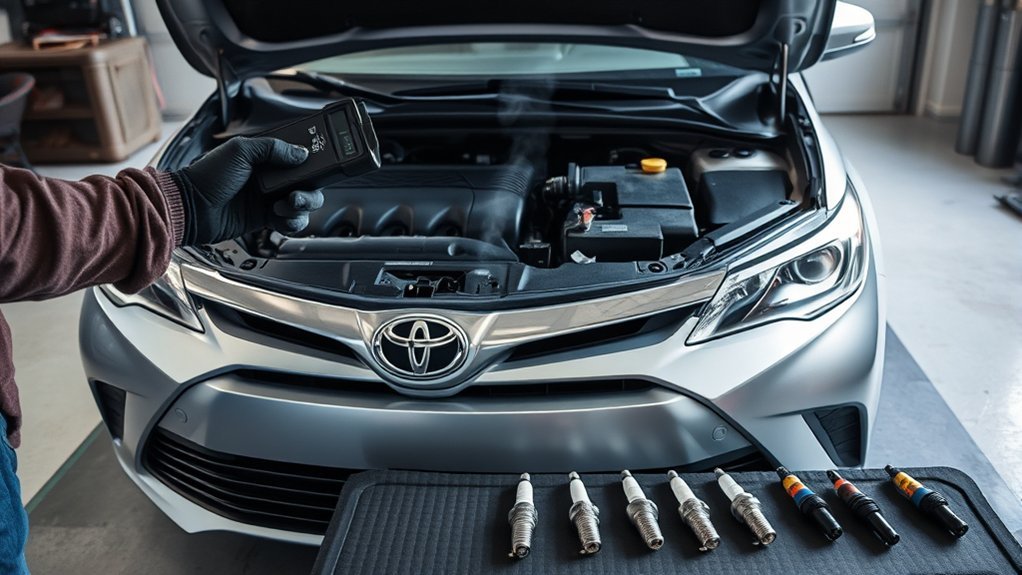
Quick Answer
A Toyota Camry misfire means one or more cylinders are not burning the air-fuel charge correctly. Start by reading OBD-II codes and freeze-frame data, then inspect the affected cylinder’s spark plug, coil, connector, injector, intake system, and compression. Stop driving if the Check Engine light flashes or the engine shakes severely.
Key Takeaways
- A P0300-series code identifies the detected misfire pattern, not the failed part.
- Save the codes and freeze-frame data before clearing anything or disconnecting the battery.
- Check ignition parts first when one cylinder is affected, but also inspect wiring, injectors, vacuum leaks, and compression.
- A flashing Check Engine light can mean the catalytic converter is at risk from unburned fuel.
- Use specifications and maintenance intervals for your exact Camry year, engine, and powertrain.
At a Glance
| Time Required | About 15–30 minutes for an initial scan and visual inspection; one to three hours or more for deeper testing |
| Difficulty | Beginner for scanning and inspection; intermediate to advanced for fuel, electrical, and mechanical testing |
| Tools Needed | OBD-II scanner, flashlight, basic hand tools, spark-plug socket, and torque wrench; optional smoke tester, fuel-pressure equipment, compression gauge, and leak-down tester |
| Cost | Low for scanning and visual checks; moderate for plugs or coils; potentially high for injector, compression, timing, or catalytic-converter repairs |
Warning: If the Check Engine light flashes, the engine shakes violently, power falls sharply, or you smell raw fuel, reduce engine load and pull over safely. Continued driving can overheat and damage the catalytic converter. On a Camry Hybrid, switch the vehicle fully off, confirm the READY indicator is off, keep the key away from the car, and do not touch orange high-voltage cables or components.
Understanding Misfires in Your Toyota Camry
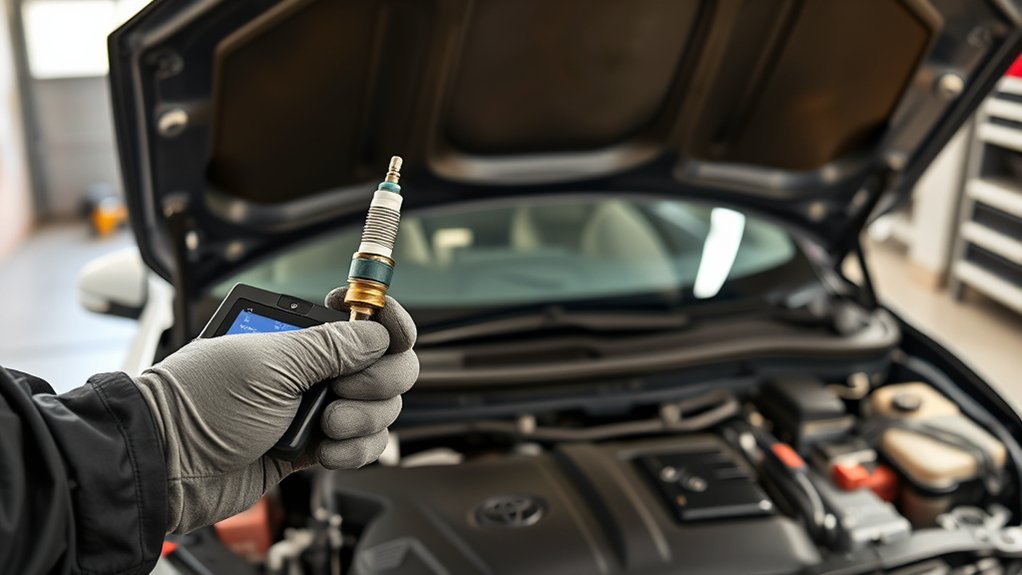
A misfire occurs when combustion in one or more cylinders is weak, incomplete, late, or absent. The engine may still run, but its speed becomes uneven because the affected cylinder contributes less power than the others.
Your Camry’s onboard diagnostic system monitors emissions-related operation and stores information when it detects a fault. An OBD-II scanner can retrieve that information, including trouble codes and, on many scanners, freeze-frame data captured when the fault was recorded. The code is the start of the diagnosis, not proof that a specific part has failed. You can read more about the system through the California Air Resources Board OBD program.
Common misfire codes include:
| Code | General Meaning | Important Limitation |
|---|---|---|
| P0300 | Random or multiple-cylinder misfire detected | May point toward a shared air, fuel, timing, sensor, or mechanical problem |
| P0301 | Cylinder 1 misfire detected | Does not prove that the spark plug or coil is defective |
| P0302–P0306 | Misfire detected on the numbered cylinder | Available cylinder numbers depend on the engine fitted to your model year |
| P035x or P020x | Possible ignition-coil or injector-circuit fault | Wiring, connectors, control circuits, and the component itself all require testing |
Note: Camry engines and service procedures vary by year. Older models may use a four-cylinder or V6 engine, while newer models may use a four-cylinder hybrid powertrain. Confirm the engine, cylinder layout, plug specification, torque value, and maintenance schedule before ordering parts.
Common Symptoms of a Misfire
A misfire may be obvious, or it may appear only during a cold start, at idle, under acceleration, or after the engine becomes hot. The operating condition matters because it can help separate an ignition fault from an air leak, fuel-delivery problem, or mechanical issue.
Common Symptoms Experienced
- Rough idle: The engine may shake while stopped, and the tachometer may move slightly.
- Hesitation or jerking: The car may stumble when you press the accelerator or climb a hill.
- Loss of power: One or more weak cylinders reduce total engine output.
- Check Engine light: The light may remain steady or flash during a severe active misfire.
- Hard starting: A fuel, ignition, compression, or coolant-intrusion problem may make cold starts difficult.
- Poor fuel economy: Incomplete combustion and corrective fuel adjustments can increase consumption.
- Fuel odor: Unburned fuel may enter the exhaust during a strong misfire.
- Abnormal exhaust: Black smoke may indicate an overly rich mixture, blue smoke may indicate oil burning, and persistent white vapor with coolant loss may indicate coolant entering a cylinder. These are diagnostic clues, not proof of a misfire cause.
Impact on Vehicle Performance
A misfiring cylinder produces uneven torque, so you may feel vibration through the seat, steering wheel, or floor. The engine control system may reduce power to protect the engine or emissions system. Unburned fuel can also reach the catalytic converter, where it may ignite and create damaging heat.
A cylinder-specific code tells you where the misfire was detected. It does not tell you whether the cause is spark, fuel, air, wiring, compression, or timing.
Common Causes of Engine Misfires and How to Fix Them
Most misfires fall into four broad groups: ignition, fuel delivery, air metering, and mechanical condition. Electrical wiring and control faults can overlap any of these groups.
Ignition System Issues
Worn, fouled, cracked, or incorrectly specified spark plugs can weaken the spark. A failing coil can work when cold but break down when hot or under load. Damaged coil boots, moisture, oil inside a plug well, loose terminals, corroded connectors, or broken wiring can produce similar symptoms.
Inspect the plug and coil from the affected cylinder, but do not replace every ignition part only because a P030x code is present. Compare the plug with the others, check the connector and harness, and use the exact plug type, gap guidance, and tightening specification listed for your engine.
Fuel Delivery Problems
A restricted or electrically faulty injector can make one cylinder run lean. Low fuel pressure, contaminated fuel, a weak pump, or a pressure-control problem may affect several cylinders, especially during acceleration. An injector-circuit code may come from the injector, wiring, connector, or control circuit.
Detergent gasoline may help limit deposit formation, but it cannot repair a failed injector or fuel pump. The TOP TIER gasoline program lists licensed fuel brands that meet its detergency requirements.
Air-Metering and Vacuum Leaks
Unmetered air can make the mixture too lean, especially at idle. Possible leak points include cracked vacuum hoses, the PCV hose or valve, intake-manifold gaskets, brake-booster plumbing, loose clamps, and damaged intake ducting. A contaminated mass-airflow sensor or an air leak after the sensor can also distort the calculated air charge.
Mechanical and Timing Problems
A burned valve, worn valve seat, damaged piston ring, cylinder-wall problem, head-gasket leak, incorrect valve timing, or variable-valve-timing fault can reduce cylinder pressure. These faults are less common than routine ignition problems, but they should be considered when the misfire remains on the same cylinder after ignition, injector, air-leak, and wiring checks.
How Misfires Impact Performance and How to Diagnose Them
Use a staged process. Each step should either identify the cause or narrow the next test.
- Check the warning-light behavior. Do not continue a road test if the light flashes, the engine shakes badly, or power drops sharply.
- Scan before clearing. Record all stored, pending, and permanent codes. Save freeze-frame data such as engine speed, coolant temperature, load, speed, and fuel trims.
- Identify the pattern. Determine whether the fault affects one cylinder, several cylinders, one bank, or the entire engine.
- Note when it happens. Record whether the misfire appears only when cold, at hot idle, during acceleration, in wet weather, or after refueling.
- Perform a visual inspection. Look for loose connectors, damaged wiring, cracked intake hoses, oil or water in plug wells, disconnected vacuum lines, and signs of rodent damage.
- Inspect the plug and coil. Compare components from the affected cylinder with those from healthy cylinders. Use a controlled substitution test only when parts are identical and the engine is safe to operate.
- Check air and fuel data. Review short-term and long-term fuel trims. Large positive trims at idle that improve as engine speed rises can support a vacuum-leak diagnosis, but scan data must be interpreted with the full symptom pattern.
- Test the injector and fuel supply. Advanced checks may include injector command, current waveform, balance testing, fuel pressure, or fuel-volume testing.
- Check compression and leakage. If the fault stays on the same cylinder, use compression and leak-down testing to evaluate valves, rings, the head gasket, and cylinder sealing.
- Verify the repair. Reassemble correctly, clear codes only after recording the data, run the engine under the original fault conditions, and scan again for pending codes or returning misfire counts.
Pro Tip: If one cylinder has a misfire code, label each coil and connector before moving anything. Change only one variable at a time. If you move several coils, plugs, and injectors together, you may lose the evidence needed to identify the failed part.
| Component or Data | Inspection Focus | What the Result Can Show |
|---|---|---|
| Spark plugs | Wear, cracks, deposits, wetness, incorrect part, plug-well contamination | Ignition wear, oil burning, rich operation, coolant intrusion, or installation trouble |
| Ignition coils | Boot damage, carbon tracking, connector fit, wiring, controlled swap result | Whether the misfire follows a suspect coil or remains with the cylinder |
| Fuel trims | Short-term and long-term correction at idle and higher engine speed | Possible lean leak, rich condition, metering problem, or fuel-supply issue |
| Injector and fuel system | Command, circuit condition, balance, pressure, and fuel quality | Restricted injector, electrical fault, weak supply, or contaminated fuel |
| Compression and leak-down | Cylinder pressure and where leakage escapes | Valve, ring, head-gasket, piston, or cylinder-sealing problem |
Effective Solutions for Common Misfire Issues
The correct repair depends on the test result. Avoid replacing several parts at once unless inspection shows that scheduled maintenance or shared wear justifies it.
| Confirmed Cause | Typical Evidence | Appropriate Repair |
|---|---|---|
| Worn or fouled spark plug | Visible wear, incorrect gap or part, damaged insulator, maintenance overdue | Install the correct plug or plug set using the specified procedure and torque |
| Failed ignition coil | Misfire follows the coil, waveform failure, or confirmed circuit test | Replace the failed coil and correct boot, connector, or moisture problems |
| Vacuum or intake leak | Smoke-test leak, damaged hose, gasket leak, or supporting fuel-trim pattern | Repair the hose, gasket, duct, valve, or connection and recheck trims |
| Restricted or faulty injector | Failed balance, electrical, current, or flow test | Professionally clean or replace the confirmed injector and inspect its circuit |
| Low fuel pressure or volume | Reading below the specification for the exact engine and operating condition | Diagnose the pump, supply, control, filter arrangement, wiring, and pressure regulation |
| Low compression or excessive leakage | Mechanical test confirms poor cylinder sealing | Repair the valve, ring, piston, head-gasket, timing, or cylinder fault identified by testing |
Use parts that match the original electrical and mechanical specifications. Correct fit, plug heat range, connector design, resistance characteristics, and installation procedure matter more than an unsupported claim that one label always performs better.
The Role of Spark Plugs and Ignition Coils in Misfires
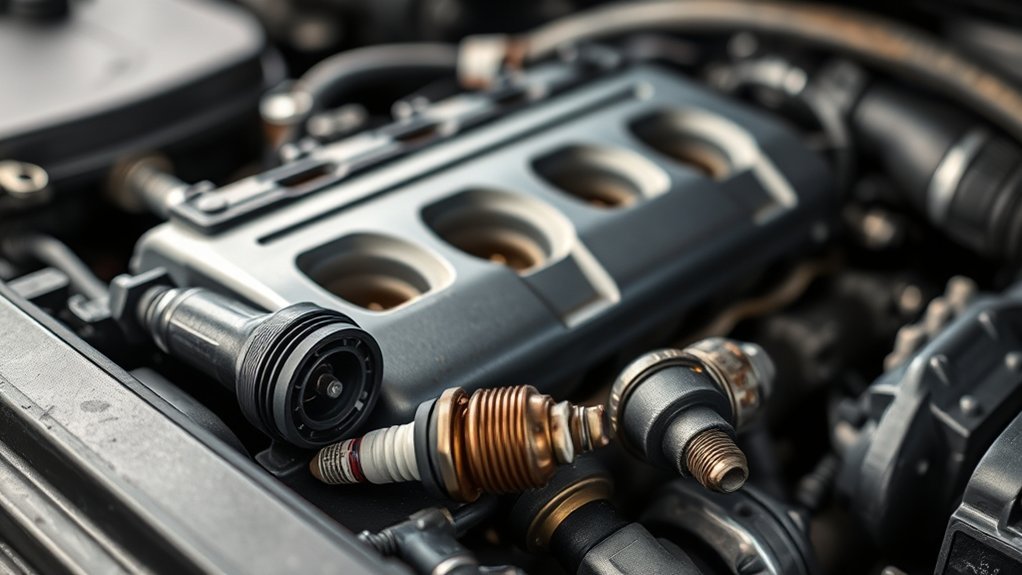
The spark plug must ignite the compressed air-fuel charge at the correct time. The ignition coil raises battery voltage to the level needed for the spark to cross the plug gap. A fault in either component, its boot, connector, wiring, power supply, or control circuit can produce a misfire.
When worn plugs turn out to be the cause, replacing all four as a set keeps the cylinders firing evenly instead of leaving one fresh plug next to three tired ones. Our comparison of NGK and DENSO plugs that fit the 2.4L Camry covers the copper, platinum, and iridium options and what each is worth on this engine.
Spark Plug Functionality
Remove spark plugs only when the engine is cool and follow the procedure for your exact engine. A worn electrode, cracked insulator, carbon tracking, heavy deposits, oil fouling, fuel wetness, or coolant contamination can reveal useful clues.
Do not assume every deposit means the plug itself caused the problem. Oil on the firing end may point toward internal oil consumption, while oil around the outside of the plug may come from a leaking tube seal. A fuel-wet plug may be the result of a cylinder that is not firing for another reason.
Use the plug specified for your model and avoid changing the gap on a fine-wire plug unless the manufacturer’s service information directs you to do so. Incorrect torque can damage threads, reduce heat transfer, or allow the plug to loosen.
Ignition Coil Performance
Modern coil-on-plug units can fail intermittently under heat, cylinder pressure, or electrical load. A basic resistance measurement may miss that behavior, so it should not be treated as a guarantee that a coil is good.
When access is safe and the coils are identical, a controlled swap can be useful:
- Record the original codes and affected cylinder.
- Switch the suspect coil with a known working cylinder.
- Reconnect every connector fully and route the wiring correctly.
- Run the engine only if the misfire is not severe.
- Scan again. If the cylinder-specific misfire follows the coil, the coil becomes the leading suspect. If it remains on the original cylinder, continue testing the plug, injector, wiring, air leak, and compression.
Do not road-test a vehicle with a flashing Check Engine light merely to complete a coil-swap test.
How Fuel System Problems Cause Engine Misfires
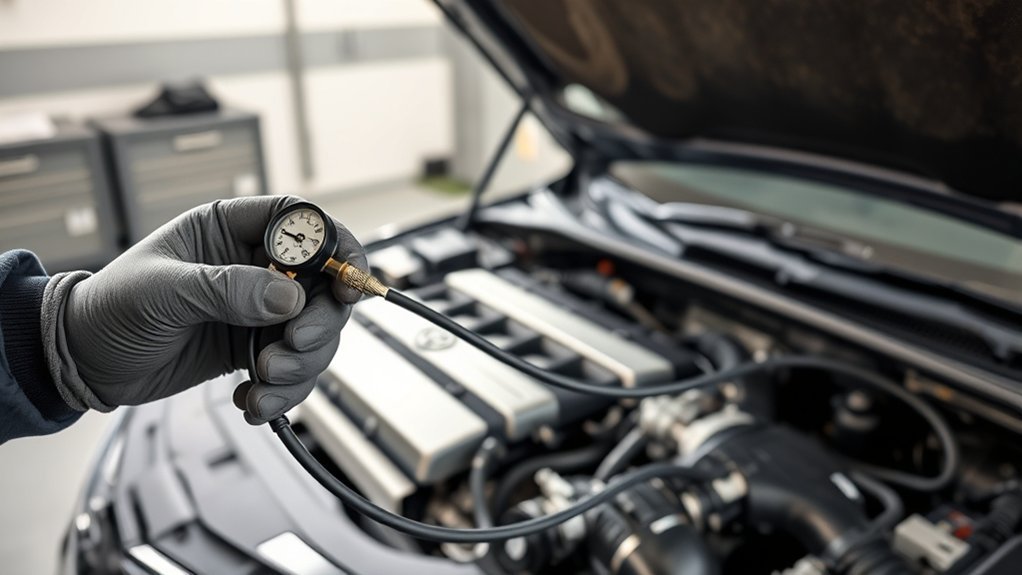
Combustion becomes unstable when a cylinder receives too little fuel, too much fuel, or fuel at the wrong time. A restricted injector may affect one cylinder, while low supply pressure can affect several cylinders under load.
Useful fuel-system checks may include:
- Reviewing lean or rich codes that appeared with the misfire
- Comparing fuel trims at idle and under controlled higher-load conditions
- Listening for injector operation while recognizing that sound alone does not prove correct flow
- Inspecting injector connectors and wiring
- Measuring fuel pressure or volume with equipment and specifications appropriate for the exact engine
- Performing an injector balance or current-ramp test
- Checking whether the symptoms began immediately after refueling
Warning: Fuel systems may remain pressurized after the engine is switched off. Fuel vapor is flammable. Do not loosen a fuel line without the correct pressure-relief procedure, ventilation, fire protection, and model-specific service information.
If contaminated fuel is suspected, avoid repeatedly adding cleaners or additives. Confirm the contamination and correct the fuel source. Detergent fuel can support deposit control during normal operation, but it is not a substitute for testing a restricted injector or weak pump.
Inspecting for Vacuum Leaks in Your Engine
A vacuum or intake leak allows air to enter without being measured correctly. The extra air may produce a lean mixture and a rough idle. Because the leak becomes a smaller percentage of total airflow as engine speed rises, some vacuum-leak symptoms improve above idle.
Inspect these areas:
- Intake ducting: Check for cracks, loose clamps, and splits hidden in the folds.
- Vacuum hoses: Look for hardened, collapsed, disconnected, or damaged hoses.
- PCV system: Inspect the valve, hose, seals, and connections for an unintended air path.
- Intake-manifold gaskets: Look for a leak affecting one cylinder or one side of the intake.
- Brake-booster line: Check its hose, valve, and fittings.
- Mass-airflow area: Inspect for leaks after the sensor and contamination that could distort airflow measurement.
A smoke test is usually safer and more controlled than spraying a flammable chemical around a running engine. Introduce smoke only with suitable equipment and the engine off, then inspect for smoke escaping from the intake system.
A vacuum leak often leaves a pattern: rougher at idle, positive fuel correction, and improvement as airflow rises. Use that pattern as evidence, not as a substitute for locating the leak.
When to Get Professional Help?
Basic scanning and visual checks are reasonable for many owners, but some conditions call for professional equipment or immediate assistance.
| Sign or Situation | Recommended Action | Why It Matters |
|---|---|---|
| Flashing Check Engine light | Stop safely and arrange prompt diagnosis or towing | An active misfire can overheat the catalytic converter |
| Severe shaking, stalling, or major power loss | Do not continue driving | The vehicle may be unsafe in traffic, and additional damage may occur |
| Raw-fuel smell or visible fuel leak | Switch off the vehicle and keep ignition sources away | Fuel and vapor create a fire hazard |
| Coolant loss, overheating, or persistent white exhaust | Have the cooling system and cylinders tested | Coolant intrusion can damage the engine and catalytic converter |
| Misfire remains after confirmed ignition checks | Request injector, wiring, fuel, compression, leak-down, and timing tests | More parts replacement without testing may waste money |
| Hybrid or high-voltage work is involved | Use a technician trained for Toyota hybrid systems | The engine can start automatically in READY mode, and high voltage can cause serious injury |
A trained shop should provide the codes, test results, and reasoning behind the recommended repair. Ask whether the technician verified spark, injector operation, air leaks, compression, and wiring before recommending internal-engine work.
Maintaining Your Engine to Prevent Misfires
Maintenance can reduce the risk of a misfire, but the correct schedule depends on your Camry’s year, engine, mileage, and operating conditions.
- Follow the exact maintenance guide. Use Toyota’s owner-manual and warranty portal to select your vehicle and review its maintenance information.
- Use the specified spark plugs. Replace them at the interval listed for your engine and install them correctly.
- Address oil or coolant leaks. Fluid entering a plug well or cylinder can damage ignition parts and cause repeated misfires.
- Inspect intake and vacuum hoses. Replace cracked, loose, or hardened components before they create a lean condition.
- Use suitable fuel. Buy the octane specified for the vehicle and use a reputable fuel source.
- Keep electrical connections protected. Repair damaged wire insulation, loose terminals, corrosion, and water intrusion.
- Respond to warning lights promptly. Early diagnosis can protect the catalytic converter and prevent a small fault from becoming more expensive.
- Check recalls and campaigns. Search the VIN through the Toyota recall and service-campaign tool and the NHTSA recall database.
After a repair, confirm that the engine runs smoothly under the same conditions that caused the original symptom. Check for pending codes and monitor data rather than assuming the repair succeeded because the warning light is temporarily off.
Frequently Asked Questions
What are the three most common causes of a misfire?
The three broad groups are ignition problems, fuel or air-mixture problems, and mechanical compression or timing problems. Spark plugs and coils are common suspects, but injectors, vacuum leaks, wiring, valves, and cylinder sealing can produce the same code.
What causes a Toyota misfire?
A Toyota can misfire because of a worn plug, failed coil, damaged connector, injector fault, low fuel pressure, intake leak, air-metering problem, incorrect valve timing, or low compression. The likely cause depends on the code, engine, operating condition, and test results.
What is the most common problem with a Toyota Camry?
There is no single most common problem for every Camry. Reliability concerns vary by model year, engine, mileage, climate, use, and maintenance history. Check the VIN for recalls and review model-year-specific service information before treating a problem as typical.
How do you find out what is causing a misfire?
Read all codes and freeze-frame data, identify the affected cylinder and operating condition, inspect the wiring and intake system, test the plug and coil, evaluate fuel delivery, and check compression if the problem stays on the same cylinder. Change one variable at a time so the test remains meaningful.
Can you drive a Toyota Camry with a misfire?
Do not keep driving if the Check Engine light flashes, the engine shakes severely, power drops, or you smell raw fuel. A mild intermittent misfire with a steady light still requires prompt diagnosis because unburned fuel can damage the catalytic converter.
Why does a Camry misfire only when it is cold?
A cold-only misfire may involve moisture in an ignition component, an intake-gasket leak that changes as parts warm, a weak injector, coolant entering a cylinder, or a mechanical sealing problem. Freeze-frame data and the condition of the spark plug after a cold start can help narrow the cause.
Can a bad spark plug damage the catalytic converter?
Yes. If a plug fails to ignite the mixture, unburned fuel can enter the exhaust and overheat the catalytic converter. A flashing Check Engine light is a warning that the misfire may be severe enough to create rapid converter damage.
Why did the misfire return after replacing plugs or coils?
The original cause may be an injector, wiring fault, intake leak, oil or coolant contamination, low compression, or incorrect part or installation. Recheck the codes and freeze-frame conditions instead of replacing the same parts again.
Conclusion
A Toyota Camry misfire should be diagnosed in a logical order. Start with warning-light behavior, OBD-II codes, freeze-frame data, and a visual inspection. Then test ignition, air, fuel, wiring, and mechanical condition based on the evidence. Avoid replacing parts at random or considering internal-engine work until compression and leak-down testing support that conclusion.
Prompt diagnosis protects drivability, fuel economy, and the catalytic converter. Follow the service information for your exact model year and powertrain, and seek professional help when the light flashes, the engine shakes severely, fuel is leaking, or hybrid high-voltage work may be involved.
Sources
- Toyota Owner’s Manuals and Warranty Information — model-specific operating, maintenance, and safety information
- Toyota Recall and Service Campaign Lookup — VIN-based open recall and campaign information
- National Highway Traffic Safety Administration Recall Database — recalls, investigations, complaints, and manufacturer communications
- California Air Resources Board OBD Program — purpose and operation of onboard emissions diagnostics
- CARB OBD II Systems Fact Sheet — warning-light, stored-fault, repair, and readiness information
- TOP TIER Gasoline Brands — licensed detergent-gasoline brands and program requirements
