
Choosing a Toyota Camry battery by model name alone can lead to the wrong fit. The correct 12-volt battery depends on the model year, engine, powertrain, factory equipment, sales market, and sometimes the production date. Before buying, match the battery group, terminal layout, hold-down, venting, rating, and technology to your VIN and the original battery.
Quick Answer
U.S. Toyota Camry battery sizes commonly include Group 24F, Group 35, H5/LN2/Group 47, and H6/LN3/Group 48. The correct group changes by year and powertrain. A 2018 non-hybrid Camry is commonly listed with H6, while the 2018 Camry Hybrid is listed with H5. Always confirm by VIN.
Key Takeaways
- Toyota Camry battery size is not universal. Match the model year, engine, hybrid status, market, and factory equipment.
- Toyota’s U.S. application chart lists Group 24F for many older gasoline Camrys, with Group 35 appearing as an option in several older applications.
- The chart lists H6/LN3 for 2018–2019 non-hybrid Camrys and H5/LN2 for the 2018-on Camry Hybrid line covered by that catalog.
- A group number describes physical compatibility. It does not, by itself, guarantee the correct CCA, reserve capacity, chemistry, venting, or cable reach.
- A Camry Hybrid has a 12-volt auxiliary battery and a separate high-voltage traction battery.
- Never open the traction-battery case or touch orange high-voltage cables unless you are properly trained and equipped.
At a Glance
| Time Required | About 10 to 15 minutes to confirm fitment; replacement time varies by battery location and model |
| Difficulty | Easy to identify; moderate to replace safely |
| Tools Needed | VIN, owner’s manual, existing battery label, tape measure, safety glasses, gloves, insulated hand tools, and a battery tester or multimeter |
| Cost | Varies by group size, flooded, EFB or AGM construction, warranty, market, core charge, and installation needs |
How to Find the Correct Toyota Camry Battery Size

The safest approach is to identify your exact vehicle before comparing batteries. Toyota provides year-specific manuals through its Toyota Owners manuals and warranties portal. For U.S. replacement applications, Toyota also publishes a TrueStart and True-2 battery application chart.
- Identify the powertrain. Confirm whether the Camry is gasoline-only or hybrid. If it is a hybrid, make sure you are shopping for the low-voltage auxiliary battery rather than the high-voltage traction battery.
- Record the model year and engine. Similar-looking Camrys from the same generation can use different batteries. Engine codes and cold-area packages can also affect the listing.
- Use the VIN. Enter the 17-character VIN into Toyota’s parts system, ask a Toyota parts department, or use a reputable fitment catalog that resolves the exact engine and powertrain.
- Read the existing label. Record the group size, Toyota or manufacturer part number, cold-cranking amps, reserve capacity or amp-hour rating, and battery technology.
- Inspect the installation. Confirm the case length, width and height, positive-terminal position, hold-down design, cable reach, heat shield, and any vent hose.
- Match the required performance. Choose a battery that meets the application’s specified rating. A battery with more advertised CCA is not suitable if its case, terminals, hold-down, venting, or chemistry is wrong.
- Confirm the market. U.S., Canadian, European, Asian, and Australian Camrys may use different battery designations and equipment. Do not apply a U.S. chart automatically to another market.
Pro Tip: Photograph the old battery label, terminal orientation, hold-down, heat shield, and vent connection before removing anything. Compare those photos with the replacement at the parts counter.
Toyota Camry Battery Size Chart by Year and Powertrain
The table below summarizes U.S. applications in Toyota’s 2024 replacement-battery chart. It is more precise than a year-only retailer search, but it is still a guide rather than permission to skip a VIN check. Production changes, market differences, and newer model years can alter the result.
| U.S. Camry application | Toyota catalog listing | Fitment note |
| 1992–1998 gasoline models | Group 24F | Confirm that the tray, terminals, and cables remain in factory configuration |
| 1999–2011 gasoline models | Group 24F; Group 35 appears as an option in several engine and year listings | Do not treat 24F and 35 as automatically interchangeable |
| 2012–2017 non-hybrid models | Group 24F | Hybrid applications in this range use a separate original-equipment listing |
| 2007–2017 Camry Hybrid | Original-equipment battery application | Match the Toyota part number, venting, terminal layout, and battery location by VIN |
| 2018–2019 non-hybrid models | H6/LN3, commonly cross-referenced as BCI Group 48 | Do not select H5 merely because an unresolved 2018 catalog page displays both sizes |
| 2020–2024 gasoline 2.5-liter A25A-FKS applications | H5/LN2, commonly Group 47 | Confirm the engine and factory battery technology |
| 2020–2024 gasoline V6 2GR-FKS applications | H6/LN3, commonly Group 48 | The longer H6 case must match the tray and hold-down |
| 2018–2024 Camry Hybrid | H5/LN2, commonly Group 47 | This is the 12-volt auxiliary battery, not the traction battery |
| 2025–2026 U.S. Camry | Hybrid-only lineup; confirm the current auxiliary-battery part by VIN | Do not assume an older Group 24F or a prior gasoline-model listing applies |
Note: Toyota describes the current 2026 U.S. Camry as having an all-hybrid powertrain. Advice about a conventional gasoline starting battery applies to earlier non-hybrid Camrys, not the current U.S. lineup.
Understanding Battery Group Sizes for the Toyota Camry
The Battery Council International group-size system classifies batteries by voltage, maximum dimensions, terminal arrangement, and other features that affect fit. European-style battery names can also appear alongside BCI numbers. H5 commonly corresponds to LN2 or Group 47, while H6 commonly corresponds to LN3 or Group 48.
A group designation is not a complete electrical specification. Two batteries in the same group can have different cold-cranking amps, reserve capacity, amp-hour ratings, technology, warranty, and vent arrangements.
The correct Camry battery must satisfy both the physical installation and the vehicle’s electrical requirements.
Group 24F vs. Group 35
Group 24F and Group 35 batteries differ in case dimensions and terminal configuration. A Group 24F case is generally longer, while Group 35 is generally shorter. Toyota’s older application listings sometimes show Group 35 as an option, but that does not make it a universal substitute for Group 24F.
Before changing between them, confirm that the factory hold-down secures the case, the positive and negative cables reach without strain, the posts are on the correct sides, and the installed height leaves safe clearance above the terminals.
H5/LN2/Group 47 vs. H6/LN3/Group 48
H5 and H6 are European-style case formats. H5 is commonly cross-referenced as LN2 or BCI Group 47. H6 is commonly LN3 or Group 48. H6 is longer, so a tray designed for H5 may not have enough room for H6, while an H5 may not be secured correctly in an H6 installation without the correct factory provision.
For the 2018 U.S. Camry, Toyota’s chart separates the applications: the non-hybrid line uses H6, while the Camry Hybrid line uses H5. That is more reliable than assuming both sizes fit because both appear on a generic retailer results page.
Where Is the Toyota Camry Battery Located?
Battery location changes by generation and powertrain:
- Gasoline Camry: The 12-volt starting battery is normally in the engine compartment, but its side and access arrangement vary.
- Older Camry Hybrid: Some generations place the 12-volt auxiliary battery in the trunk or rear body area and may require a dedicated vent connection.
- Current Camry Hybrid: Current owner information identifies the 12-volt battery in the engine compartment.
- High-voltage traction battery: Its location and chemistry vary by generation. It is not a normal do-it-yourself replacement item.
Check the model-specific manual before disconnecting anything. Do not assume that a visible under-hood jump terminal is the battery itself, and do not remove interior trim while searching for a hybrid traction battery.
Essential Specifications for Selecting the Right Battery for Your Camry
Group size is only the first checkpoint. Compare each of these specifications:
- Terminal position and polarity: The positive and negative posts must match the original orientation. Reversed posts can prevent safe cable connection.
- Cold-cranking amps: CCA measures starting-current performance under a standardized cold-temperature test. Meet the application requirement rather than choosing an arbitrary universal number.
- Reserve capacity: RC indicates how long a battery can supply a specified load before its voltage falls to the test limit. It is important when the charging system cannot meet electrical demand.
- Amp-hour rating: Ah describes stored electrical capacity under a stated test method. This can be especially relevant to auxiliary batteries that support electronics and control systems.
- Battery chemistry: Use flooded, enhanced flooded, or AGM construction according to Toyota’s application data and the original equipment.
- Venting: A battery in an enclosed compartment may require a vent port and hose. Never leave a required vent disconnected or plug the wrong side.
- Hold-down: The original clamp must secure the case without improvised spacers, drilled holes, or excessive force.
- Case height and clearance: The terminals must not contact the hood, brace, body panel, seat structure, or trim.
- Freshness and warranty: Check the manufacturing date and understand the free-replacement period, prorated coverage, exclusions, and service locations.
A battery with a higher advertised CCA can still be wrong because it is too large, has reversed terminals, lacks a required vent, uses the wrong technology, or cannot be secured by the factory hold-down.
Differences Between Gasoline and Hybrid Model Batteries
Gasoline and hybrid Camrys both use a 12-volt electrical system, but the battery’s role is not identical.
Gasoline Camry Battery System
A non-hybrid gasoline Camry normally uses a 12-volt starting battery. It supplies the starter motor, lighting, control modules, and accessories. The alternator recharges the battery while the engine is running and supports the vehicle’s electrical loads.
Hybrid Camry Battery System
A Camry Hybrid has a 12-volt auxiliary battery and a separate high-voltage traction battery. The auxiliary battery powers locks, lights, computers, relays, and other low-voltage circuits. It allows the control system to start and connect the hybrid system so the vehicle can enter READY mode.
The 12-volt auxiliary battery does not perform the same high-current engine-cranking job as a conventional gasoline starting battery. However, a weak auxiliary battery can still prevent the Camry Hybrid from entering READY mode or can cause unstable warning messages and electronic behavior.
The traction battery stores energy for electric propulsion and regenerative braking. Toyota has used nickel-metal-hydride and lithium-ion traction-battery designs in different Camry Hybrid years and grades. Do not infer its chemistry from the Camry name or model year alone.
For applicable U.S. vehicles, Toyota states that the hybrid battery has 10-year or 150,000-mile limited warranty coverage, whichever comes first, subject to the applicable Warranty and Maintenance Guide. That factory coverage is different from the warranty on a replacement traction battery or a separately purchased 12-volt battery.
Warning: A hybrid traction battery can retain lethal voltage even when the gasoline engine is off. Do not open its case, remove the service plug, touch orange high-voltage cables, or attempt high-voltage diagnosis without Toyota-specific training and protective equipment.
Flooded, AGM, and EFB Batteries
Toyota Camry replacement batteries are available in several technologies. The correct choice is the type specified for the exact application, not automatically the least expensive or most expensive option.
- Flooded lead-acid: A conventional starting-battery design used in many gasoline vehicles. Modern versions are often sealed or described as maintenance-free.
- Enhanced flooded battery: EFB is an upgraded flooded design intended to tolerate more cycling than a basic flooded battery.
- Absorbent glass mat: AGM holds the electrolyte in glass mats, resists vibration, and supports repeated cycling. It may also be used where packaging or venting requirements favor a sealed valve-regulated design.
Do not replace an AGM battery with a basic flooded battery merely because the case dimensions are similar. Charging behavior, cycling duty, venting, and factory specifications can differ. Likewise, do not assume that installing AGM is automatically an upgrade when the application does not call for it.
How to Test a Camry Battery Before Replacing It
A no-start or no-READY condition does not prove that the battery has failed. Test systematically before purchasing a replacement.
- Inspect the case. Do not charge, jump, or handle a battery that is swollen, cracked, leaking, frozen, unusually hot, or giving off a strong sulfur odor. Arrange professional service.
- Inspect the connections. Look for loose terminals, corrosion, damaged grounds, broken cable strands, an unsecured hold-down, or a disconnected vent hose.
- Check the state of charge. A resting-voltage reading can indicate whether the battery is charged, but the reading is affected by recent charging, temperature, battery chemistry, and electrical loads.
- Charge before judging capacity. A discharged but otherwise serviceable battery can fail a test if it is not charged correctly first. Use a charger approved for the battery technology and follow Toyota’s model-specific instructions.
- Perform a conductance or load test. Enter the rating and battery type printed on the label. This tests output capability more directly than voltage alone.
- Test the charging system. On a gasoline model, inspect alternator output and belt condition. On a hybrid, diagnose the DC-to-DC charging system if the auxiliary battery is not being maintained in READY mode.
- Check for parasitic draw. If a charged, healthy battery repeatedly goes flat while parked, identify the circuit that remains awake instead of repeatedly replacing batteries.
Note: A battery can show a normal resting voltage yet have too little usable capacity to start a gasoline engine or reliably power a hybrid’s control systems. Voltage and battery health are related, but they are not the same measurement.
Typical Battery Problems for the Toyota Camry and How to Fix Them
Battery symptoms can also be caused by a cable, starter, alternator, DC-to-DC converter, control module, fuse, or parasitic electrical draw.
| Symptom | Possible causes | Best next step |
| Slow cranking on a gasoline model | Low charge, aging battery, poor cable connection, starter load, or charging fault | Charge and test the battery, then test the starting and charging systems |
| Hybrid will not enter READY mode | Weak auxiliary battery, loose terminal, key-recognition issue, fuse, brake-switch issue, or hybrid-system fault | Test the 12-volt battery and connections first, then scan the vehicle if the problem remains |
| White or blue-green terminal buildup | Corrosion, acid vapor, moisture, loose connection, or damaged cable end | Wear eye protection, disconnect safely, neutralize and clean the area, and inspect for leakage or cable damage |
| Battery repeatedly goes dead | Parasitic draw, frequent short trips, charging fault, prolonged storage, aging battery, or a light left on | Fully charge and test the battery, then perform charging-system and parasitic-draw tests |
| Dim lights or unstable electronics | Low voltage, loose grounds, battery failure, alternator fault, or DC-to-DC converter issue | Measure system voltage and have the complete low-voltage system tested |
| Battery or charging warning light | Charging-system fault, wiring problem, failed alternator, converter issue, or control-system fault | Reduce unnecessary electrical loads and arrange prompt diagnosis; do not replace the battery blindly |
Replace the battery when testing shows that it cannot deliver the output required for its application or cannot retain a proper charge. Do not use one universal 650- or 700-CCA threshold for every Camry.
Battery Brands and Buying Priorities
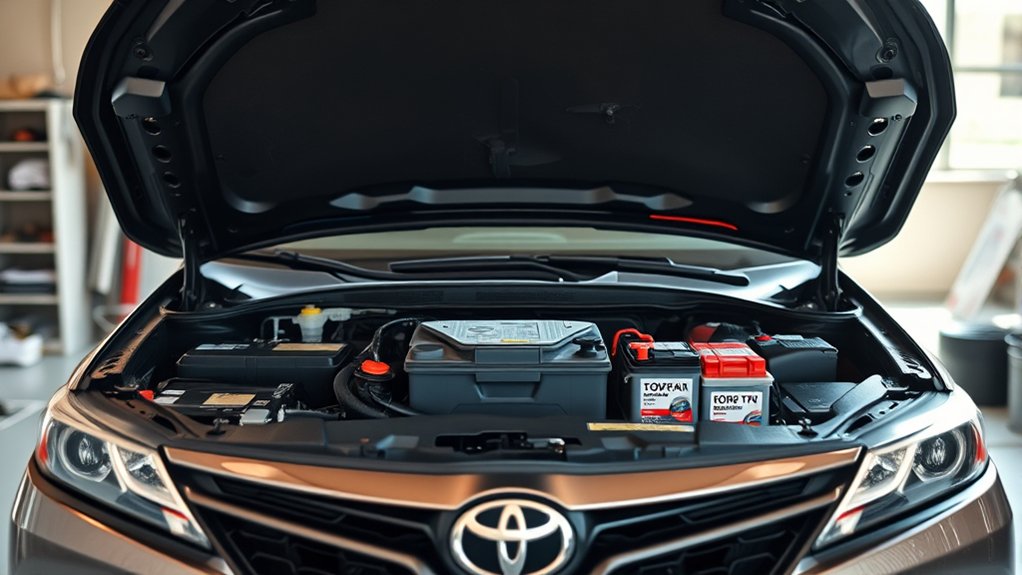
The following are common brand options, not a tested ranking. Exact fitment, fresh inventory, warranty support, and competent local installation matter more than the logo on the case.
- Toyota Genuine batteries: A Toyota parts department can search the VIN and identify a Toyota-approved service battery. This is particularly useful for a hybrid auxiliary battery or an application with unclear venting and hold-down requirements.
- Interstate: Interstate sells flooded and AGM batteries through a broad dealer network. Use its vehicle selector only after entering the complete year, engine, and powertrain, then compare the result with the original label.
- Optima: Optima is associated with AGM designs, but not every Camry has a direct-fit Optima application. Buy only a model explicitly listed for the vehicle and installation.
- Bosch: Bosch-branded automotive battery availability varies by country and seller. Confirm who provides the warranty, the manufacturing date, the group size, and the exact vehicle application.
Compare the free-replacement period, prorated coverage, proof-of-purchase requirements, exclusions, labor coverage, and available service locations. A long printed warranty is less useful when support is unavailable where the vehicle is operated.
Maintenance Tips to Extend Battery Life in Your Camry
- Keep the case and terminals clean. Dirt and corrosion can contribute to poor connections and unwanted surface current.
- Check the hold-down. The battery should not slide, tip, or rock in the tray.
- Inspect cables and grounds. Look for loose fasteners, damaged insulation, swollen cable ends, or corrosion hidden inside a terminal.
- Avoid repeated deep discharge. Interior lights, accessories, extended storage, and parasitic draws can shorten battery life.
- Use a compatible maintainer during storage. Match the maintainer to the battery chemistry and follow both the charger and vehicle instructions.
- Limit repeated short trips. Short operation may not restore the energy used during starting or accessory use.
- Test before extreme weather. Heat accelerates battery aging, while cold conditions expose reduced starting capacity.
- Keep hybrid air intakes clear. Do not block or contaminate the traction-battery cooling intake identified in the owner’s manual.
A common rule of thumb for many 12-volt automotive batteries is roughly three to five years, but climate, battery design, storage, electrical loads, and charging-system health can move the useful life well outside that range. Test the battery’s condition rather than replacing it solely because of age.
Only check or add water when the battery is specifically designed with removable service caps. Do not open an AGM, sealed, or maintenance-free battery.
Safe Battery Replacement Basics
Warning: Stop and arrange professional service if the battery is swollen, cracked, frozen, leaking, unusually hot, or producing a strong sulfur odor. Do not charge or jump-start a visibly damaged battery. The steps below apply only to the 12-volt battery, never the hybrid traction battery.
Battery access, venting, memory precautions, torque values, and initialization procedures vary by Camry generation. Follow the exact owner’s manual and service information. These general practices reduce risk:
- Park on a level surface, shift to Park, switch the vehicle fully off, set the parking brake, and keep the smart key away from the car.
- Wait for vehicle systems to shut down as directed by the manual. Do not begin while cooling fans, pumps, or other systems are operating.
- Wear safety glasses and gloves. Remove metal jewelry and prevent tools from bridging a terminal to the body or another terminal.
- Confirm the replacement battery is physically and electrically correct before disconnecting the original.
- Do not use a memory saver unless the device and procedure are approved for the vehicle. An incorrect connection can damage electronics or keep circuits energized while you work.
- Disconnect the negative terminal first, then the positive terminal. Disconnect any approved vent hose without damaging it.
- Remove the factory hold-down and lift the battery upright. Batteries can be heavy; use a suitable lifting strap or obtain assistance.
- Clean and inspect the tray, cables, vent hose, heat shield, and clamp. Replace damaged parts rather than improvising a repair.
- Install the correct battery, reconnect the vent as required, and secure the factory hold-down to the model-specific specification.
- Connect the positive terminal first and the negative terminal last. Confirm that the terminals cannot rotate by hand, but do not overtighten them.
- Start the gasoline engine or place the hybrid in READY mode. Check for warning lights, unstable electronics, abnormal heat, or charging problems.
- Restore or initialize the clock, windows, steering-related functions, multimedia settings, and other systems only as described in the exact manual.
There is no universal rule that every Toyota Camry needs battery registration or coding after replacement. Registration is different from restoring settings or initializing vehicle functions. Use a scan tool only when the service information for the exact model requires it or when diagnostic trouble codes remain after the installation.
Return the old lead-acid battery to a retailer or an approved household hazardous-waste program. The U.S. Environmental Protection Agency advises against putting lead-acid batteries in household trash or municipal recycling bins.
Related Guides
Frequently Asked Questions
What size battery does a Toyota Camry take?
It depends on the year, engine, powertrain, equipment, and market. Common U.S. listings include Group 24F, Group 35, H5/LN2/Group 47, and H6/LN3/Group 48. Hybrid auxiliary batteries can have additional venting and installation requirements. Verify the VIN and original label before buying.
What is the difference between a Group 24F and Group 35 battery?
They differ in case dimensions and terminal configuration. Group 35 appears as an option for several older Camry applications, but it is not automatically interchangeable with 24F. Confirm the tray, hold-down, terminal orientation, cable reach, height, and required rating.
Which battery is used in a Toyota Camry?
A non-hybrid gasoline Camry uses a 12-volt starting battery. A Camry Hybrid uses a 12-volt auxiliary battery and a separate high-voltage traction battery. The exact 12-volt battery must be matched to the model year, engine, powertrain, and factory installation.
What battery group does a 2018 Toyota Camry use?
Toyota’s U.S. replacement chart lists H6/LN3, commonly Group 48, for the 2018 non-hybrid Camry. It lists H5/LN2, commonly Group 47, for the 2018 Camry Hybrid. Confirm the VIN because market, production, and equipment differences can change the service part.
How much CCA does a Camry battery need?
Use the rating specified for the exact application or the current Toyota replacement part. There is no universal 650- or 700-CCA requirement for every Camry. The battery must also match the reserve capacity, chemistry, case, terminal orientation, venting, and hold-down.
Does a Toyota Camry Hybrid have a regular 12-volt battery?
Yes. Its 12-volt auxiliary battery powers low-voltage electronics, computers, locks, lights, and the circuits needed to enter READY mode. It is separate from the high-voltage traction battery used for electric propulsion and regenerative braking.
Where is the 12-volt battery in a Toyota Camry?
Most gasoline Camrys place it in the engine compartment. Some older Camry Hybrids place the auxiliary battery in the trunk or rear body area, while current Camry owner information identifies an engine-compartment battery. Check the exact manual before removing covers or disconnecting terminals.
Can I install a larger battery group if it fits in the tray?
Not based on tray space alone. The factory hold-down, terminal position, cable reach, case height, venting, chemistry, and electrical rating must all be correct. A battery that can be placed in the tray is not necessarily safe or compatible.
What battery does a 2025 or 2026 Toyota Camry use?
The U.S. 2025 and 2026 Camry lineup is hybrid-only, so it uses a 12-volt auxiliary battery plus a high-voltage traction battery. Confirm the current auxiliary-battery part by VIN and do not assume that an older Group 24F or prior gasoline-model listing applies.
Does a Toyota Camry need battery registration after replacement?
There is no universal registration rule for every Camry. Follow the owner’s manual and model-specific service information. Some settings or vehicle functions may need to be restored or initialized after power is disconnected, but that is not the same as coding the battery.
Conclusion
The correct Toyota Camry battery is the one matched to the vehicle’s year, engine, powertrain, market, and factory installation. Group 24F is common across many older U.S. gasoline applications, with Group 35 appearing as an option in several older listings. Toyota’s chart separates 2018 non-hybrid H6 applications from 2018 hybrid H5 applications, while current U.S. Camrys are hybrid-only. Confirm the VIN, original label, case, terminals, rating, technology, hold-down, and venting before purchase. Test the complete low-voltage system when a battery repeatedly discharges or fails prematurely.
Sources
- Toyota TrueStart and True-2 Battery Application Chart — U.S. Camry model-year, engine, hybrid, and battery-size applications
- Battery Council International: BCI Group Sizes — group-size dimensions, terminal arrangements, and fitment principles
- Toyota Manuals and Warranties — model-specific operating, safety, maintenance, and battery instructions
- 2026 Toyota Camry — current U.S. all-hybrid powertrain information
- Toyota Hybrid Battery Warranty — current U.S. limited hybrid-battery warranty information
- U.S. Environmental Protection Agency: Used Household Batteries — lead-acid battery handling and recycling guidance

