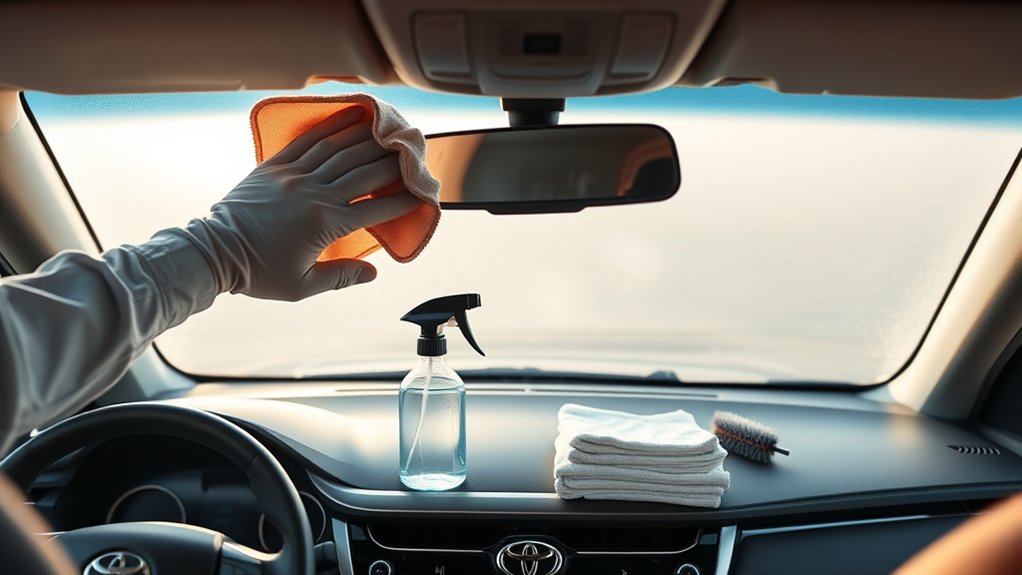
Haze on the inside of a Toyota Camry windshield can scatter sunlight and headlight glare, making an otherwise clean car feel difficult to see out of. The safest solution is not a bucket of water or a heavily soaked wash mitt. A small amount of automotive glass cleaner, two clean glass towels, and a controlled wiping technique usually remove the film without soaking the dashboard or leaving soap residue.
Quick Answer
To clean the inside windshield of a Toyota Camry, park in the shade, protect the dashboard, and mist a tint-safe automotive glass cleaner onto a clean glass towel—not directly over the glass. Wipe in overlapping passes, then immediately buff dry with a second towel. Repeat with fresh towel faces until the haze disappears.
Key Takeaways
- First determine whether the haze is on the inside, outside, or simply temporary condensation.
- Use a cleaner labeled for automotive glass and any aftermarket tint or film installed on the windshield.
- Apply a small amount of cleaner to the towel to reduce overspray onto the dashboard, vents, screens, and trim.
- Clean with one towel and immediately buff with a separate dry towel.
- Persistent oily fog, a sweet odor, damp carpeting, or unexplained coolant loss deserves professional inspection.
At a Glance
| Time Required | 10–20 minutes |
| Difficulty | Easy |
| Tools Needed | Automotive glass cleaner, two clean glass towels, a dashboard towel, and an optional windshield reach tool |
| Cost | Low; often no additional cost if suitable cleaner and towels are already available |
What Causes Hazy Windscreens in Your Toyota Camry?
Interior windshield haze is usually a thin layer of contamination rather than a problem with the glass itself. Common sources include fingerprints, smoke or vapor residue, airborne dust, cleaner residue, and overspray from dashboard dressings. Materials and products inside an enclosed cabin may also release airborne compounds. The U.S. Environmental Protection Agency lists air fresheners, cleansers, automotive products, furnishings, adhesives, and other consumer materials among potential sources of volatile organic compounds.
Heat can make deposited film more noticeable, especially after a parked vehicle has become hot. However, a persistent film should not be confused with temporary fogging.
Interior Film Versus Condensation
Condensation forms when moisture in the air contacts glass cold enough for that air to reach its dew point. Depending on the weather and cabin conditions, moisture may collect on either side of the windshield.
- Interior condensation responds to the defroster, air conditioning, fresh-air mode, and reduced cabin humidity.
- Exterior condensation can often be cleared with the exterior wipers.
- Deposited interior film remains after the moisture clears and must be physically cleaned from inside the vehicle.
Cleaning removes film, but it does not permanently prevent weather-related condensation. Using the Camry’s climate controls correctly and avoiding excess moisture inside the cabin are separate parts of maintaining clear glass.
How to Tell Whether the Haze Is Inside or Outside
- Park safely and allow the vehicle to remain still.
- Wipe a small corner of the inside glass with a clean, dry towel.
- Inspect the same area from outside the vehicle.
- If the clear patch is visible, the contamination is on the inside.
- If the patch makes no difference, clean a small area on the exterior and compare again.
At night, use a parked vehicle and look through the windshield toward a fixed light source. Do not perform this test while driving. Film often appears as halos or streaks around lights, while temporary fog tends to look evenly cloudy and may change as the climate controls operate.
Note: Wiper blades and washer fluid clean only the exterior surface. They cannot remove oily film, fingerprints, or cleaner residue from the cabin side of the windshield.
Must-Have Tools for Windshield Cleaning
You do not need a five-gallon bucket, wheel mitt, hot water, or a large squeegee for routine interior cleaning. A smaller, controlled setup is easier to use on the Camry’s angled glass and reduces the chance of drips.
| Tool | Purpose | Selection Tip |
|---|---|---|
| Automotive glass cleaner | Loosens film without car-shampoo residue | Choose one labeled for automotive glass and any installed tint or film |
| Cleaning towel | Applies cleaner and lifts contamination | Use a clean, low-lint glass microfiber towel |
| Dry finishing towel | Removes moisture and remaining streaks | Keep it completely dry and separate from the first towel |
| Dashboard towel | Catches accidental drips | Use a clean absorbent towel that will not scratch trim |
| Optional reach tool | Reaches the lower corners without leaning on the dashboard | Fit it with a clean, securely attached washable pad |
Current automotive-glass testing also emphasizes using an appropriate cleaner, good-quality towels, a small amount of product, and a complete dry buff. See the 2026 Road & Track automotive glass-cleaner test for a current comparison of product types and techniques.
What If the Windshield Has Tint or Film?
Some windshields have an aftermarket sun strip, clear heat-rejection film, or another applied product. Choose a cleaner specifically labeled as safe for that material. An ammonia-free automotive formula is a sensible default when tint is present, but the film manufacturer’s care instructions should take priority.
Do not use abrasive pads, razor blades, melamine foam, or an unlabeled solvent on applied film. If the vehicle has a heads-up display or other special windshield equipment, review the instructions for the exact model year through Toyota’s owner-manual portal.
Warning: Park before cleaning and work only on cool glass. Ventilate the cabin, protect the dashboard, and keep liquid away from defroster vents, screens, cameras, sensors, switches, speakers, and trim seams. Follow the cleaner label, and never mix cleaning products unless their manufacturers specifically direct you to do so.
Common Windshield Cleaning Mistakes
Most streaking comes from product quantity, towel condition, or an incomplete dry buff rather than a lack of scrubbing. Avoid these common errors:
- Spraying heavily over the dashboard: Overspray can settle on trim and run into vents. Apply cleaner to the towel instead.
- Using a bucket, soaked mitt, or hot water: Routine interior glass does not require that amount of liquid.
- Using car shampoo or washing-up liquid: Soap and fragrance ingredients may leave residue that becomes visible in direct light.
- Cleaning warm glass in direct sunlight: The product may dry before it can be evenly wiped and buffed.
- Using one towel for every stage: A damp or contaminated towel can redeposit the film it just removed.
- Using fabric-softened towels: Fabric softener and dryer-sheet residue can transfer to the glass.
- Overusing cleaner: More liquid does not necessarily provide more cleaning power and often creates additional streaks.
- Wiping with dirty hands: Skin oils can immediately return to the glass or towel.
- Ignoring the exterior surface: Interior glass may be clean while road film, water spots, or worn wiper blades still reduce clarity outside.
- Using inconsistent motions: Random wiping makes it harder to identify which surface still contains a streak.
Step-by-Step Guide to Cleaning Your Windshield
1. Park in the Shade and Cool the Glass
Park the Camry on level ground, switch it off, and allow a hot windshield to cool. Open a door or lower the windows slightly for ventilation. Do not attempt to wipe the glass while the vehicle is moving.
2. Protect the Dashboard
Place a clean absorbent towel along the base of the windshield. Keep it clear of controls and do not push it into the defroster vents. Remove loose dashboard items that could fall or scratch the trim.
3. Start With Clean Hands and Towels
Wash and dry your hands or wear clean, suitable gloves. Fold each glass towel into quarters so that several clean faces are available. Assign one towel to cleaning and the other to dry finishing.
4. Remove Loose Dust
Lightly wipe the windshield with a dry, clean towel face. This removes loose dust that could turn into muddy residue once cleaner is applied. Do not press hard against gritty contamination.
5. Apply Cleaner to the Towel
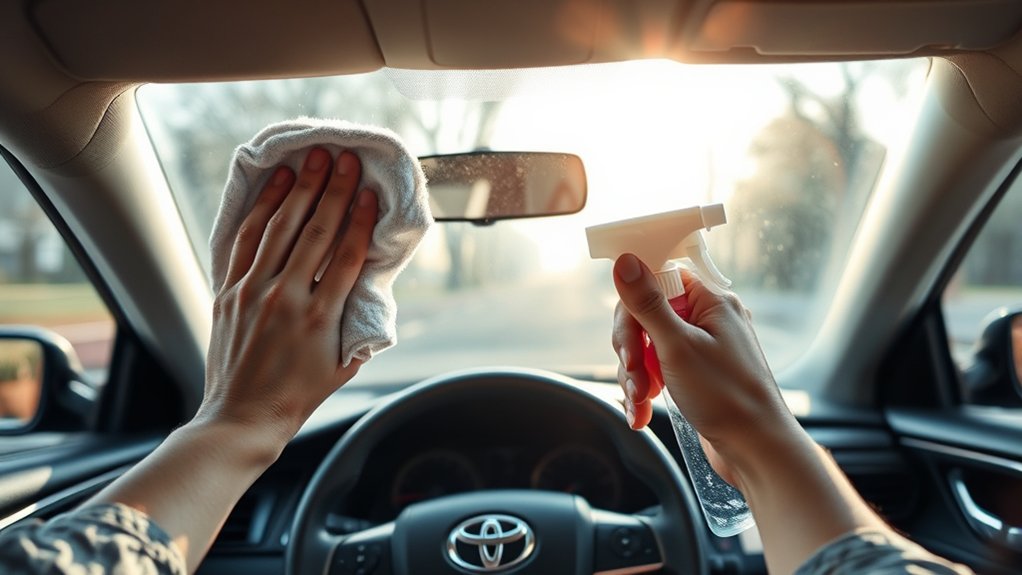
Mist a small amount of automotive glass cleaner onto the cleaning towel. The towel should be evenly damp, not soaked or dripping. Applying the cleaner to the towel gives you more control around the dashboard and electronics.
6. Clean One Section at a Time
Work on half of the windshield rather than trying to cover the entire surface at once. Use overlapping vertical or horizontal passes from the top toward the dashboard. Pay extra attention to the lower edge, where film is often difficult to see and reach.
To reach the passenger-side glass, move to the passenger seat rather than stretching across the steering wheel. A clean windshield reach tool can help with the deepest lower corners, but its pad must be clean and securely attached.
7. Buff the Section Dry Immediately
Before the cleaner air-dries, use the separate dry towel to buff the same section. Wipe in a direction perpendicular to the cleaning passes. For example, clean vertically and dry horizontally. This makes remaining streaks easier to identify.
8. Rotate to Fresh Towel Faces
Turn the towels as soon as a face becomes damp or visibly dirty. A saturated cleaning towel spreads contamination, while a damp finishing towel cannot produce a clear final buff.
9. Repeat Only Where Needed
Heavy smoke, vapor, dressing, or adhesive residue may need a second controlled pass. Use a fresh towel face and a small amount of cleaner rather than adding a large volume of liquid. Do not aggressively scrub tint, sensors, or unfamiliar coatings.
10. Inspect From More Than One Angle
After the glass is dry, inspect it from the driver’s seat, passenger seat, and outside the vehicle. Natural daylight often reveals residue that is difficult to see in a garage. A final dry buff with a fresh towel face should remove isolated streaks.
Pro Tip: Clean the interior with one wiping direction and the exterior with the opposite direction. If a streak remains, its orientation will help you identify which side of the windshield needs another pass.
Techniques for Streak-Free Glass Cleaning
A streak-free finish depends on controlling moisture and contamination. Use these techniques consistently:
- Use less cleaner: Begin with a light mist on the towel. Add more only if the towel does not remain damp enough to move smoothly.
- Keep the finishing towel dry: Change towels if necessary instead of trying to finish with a saturated cloth.
- Work in small sections: This prevents the product from drying before it is buffed.
- Use overlapping passes: Each pass should slightly overlap the previous one so that no narrow strip is missed.
- Do not polish with dashboard dressing residue: Store glass towels separately from towels used for waxes, protectants, leather products, or tire dressing.
- Wash towels without fabric softener: Follow the towel manufacturer’s laundering instructions and ensure the towels are fully rinsed.
- Finish with light pressure: Once the contamination is removed, heavy pressure is unnecessary and may flex a reach tool against the glass or trim.
The final dry buff is not optional: cleaner left to evaporate on the windshield can become the next visible layer of haze.
Troubleshooting Windshield Haze and Streaks
| Symptom | Likely Cause | What to Do |
|---|---|---|
| Long smears after wiping | Too much cleaner or a saturated towel | Use a clean, dry towel and buff until no moisture remains |
| Fine lint on the glass | Shedding towel or paper product | Switch to a clean low-lint glass towel |
| Haze returns within hours | Residue remains on the glass or towel | Repeat with fresh towels and less product; stop using oily dashboard dressings nearby |
| Cloudiness changes with the defroster | Condensation rather than deposited film | Use the climate system, fresh-air mode, and air conditioning as appropriate to reduce moisture |
| Streak remains after the inside is clean | Contamination is on the exterior | Clean the exterior glass and inspect the wiper blades |
| Lower corners remain hazy | The towel did not reach the full surface | Clean from the passenger seat or use a clean reach tool |
| Oily fog returns with a sweet odor, damp carpet, or coolant loss | Possible cooling-system or heater-core leak | Avoid treating it as an ordinary cleaning problem and arrange a qualified vehicle inspection |
When Cleaning Does Not Fix the Cloudiness
If the same area looks cloudy from every angle after both surfaces have been cleaned and fully dried, inspect the glass for scratches, pitting, delamination, damage to an applied film, or contamination trapped beneath a film. Do not use abrasives to chase a defect that may be within the material rather than on its surface.
Chips, cracks, optical distortion, or damage in the driver’s viewing area should be assessed by a qualified glass professional. Cleaning can reveal damage, but it cannot repair it.
Why You Should Keep Your Windshield Clean
A clear windshield supports safer, more comfortable driving, particularly in low sun, rain, and darkness. The benefits include:
- Clearer visibility: Removing film makes road markings, pedestrians, vehicles, and other objects easier to distinguish.
- Less distracting glare: Greasy residue and streaks can scatter light from the sun, streetlights, and other vehicles.
- Better focus: The driver does not have to look through halos, smears, or fingerprints.
- Easier fog management: Clean glass makes it easier to tell whether reduced clarity is new condensation or existing contamination.
- Earlier damage detection: A clean surface makes chips, cracks, scratches, and film damage easier to notice.
Clean glass does not guarantee safety or prevent every visibility problem. Drivers must still maintain the exterior windshield, washer system, wiper blades, lighting, and climate controls and adjust their driving to weather and road conditions. See the National Highway Traffic Safety Administration’s road-safety resources for broader vehicle and driving-safety information.
Further Resources for Effective Windshield Maintenance
For model-specific care, start with the owner’s manual for your exact Toyota Camry year. Toyota’s online portal lets owners select a vehicle and access available manuals. This is particularly important when the windshield has a heads-up display, camera area, special coating, aftermarket film, or other equipment that may require specific care.
Also review the instructions on the glass cleaner and any installed window film. Use only as much cleaner as needed, and do not combine products in an attempt to make a stronger solution. If a professional detailer is hired, explain what tint, film, coating, or electronic equipment is installed before work begins.
Exterior wipers remain important for rain and outside contamination, but they are not a substitute for cleaning the interior surface. Replace damaged or deteriorated blades according to the vehicle and blade manufacturers’ guidance, and keep the washer system filled with an appropriate automotive washer fluid.
There is no universal requirement to clean the inside windshield every week or month. Clean it when visible haze, fingerprints, smears, or increased glare return. Vehicles exposed to smoke, vapor, frequent dashboard-product use, high heat, or heavy cabin dust may need attention more often.
Related Guides
Frequently Asked Questions
How do I remove haze from the inside of a windshield?
Park in the shade and allow the glass to cool. Apply a small amount of automotive glass cleaner to a clean glass towel, wipe one section in overlapping passes, and immediately buff it dry with a second towel. Rotate to fresh towel faces and repeat only where residue remains.
How do detailers clean an inside windshield without streaks?
Detailers typically control the amount of product, use clean low-lint towels, work in small sections, and keep the cleaning and finishing towels separate. The glass is buffed completely dry before the cleaner evaporates. A reach tool may be used for the lower corners, but its pad must also be clean.
How can I get cloudiness out of a windshield?
First identify whether the cloudiness is inside, outside, or caused by condensation. Clean the affected surface with an appropriate automotive glass cleaner and dry towel. If cloudiness remains after both surfaces are clean and dry, inspect for scratches, pitting, delamination, or damaged window film.
What is the best way to remove film from the inside of a windshield?
Use a two-towel method. Mist a compatible automotive glass cleaner onto the first towel and wipe the film away. Before the cleaner dries, use a separate dry towel to buff the glass. For heavy film, repeat with fresh towel faces rather than soaking the windshield.
Can I use household glass cleaner on a Toyota Camry windshield?
Use a product labeled for automotive glass whenever possible. If the windshield has aftermarket tint or film, confirm that the cleaner is compatible with it; an ammonia-free automotive cleaner is generally the safer default. Follow the film manufacturer’s instructions when they differ from general advice.
Why does the windshield haze return so quickly?
Rapid recurrence commonly points to excess cleaner, a contaminated towel, dashboard-dressing overspray, smoke or vapor residue, or unresolved cabin moisture. Clean again with fresh towels and less product. Arrange an inspection if recurring oily fog appears with a sweet odor, wet carpeting, or unexplained coolant loss.
Conclusion
Cleaning the inside of a Toyota Camry windshield does not require a bucket, hot water, car shampoo, or heavy scrubbing. Work on cool glass, protect the dashboard, apply a compatible automotive glass cleaner to a clean towel, and buff each section dry with a second towel. This controlled two-towel method removes film while reducing drips and residue.
If haze returns, determine whether it is cleaner residue, exterior contamination, condensation, or a sign of excess cabin moisture. Keeping both windshield surfaces clear improves visibility and makes glare, fogging, damage, and maintenance problems easier to identify.
Sources
- Toyota Owner’s Manuals and Warranty Information — model-year-specific vehicle care and operating guidance.
- U.S. Environmental Protection Agency: Volatile Organic Compounds’ Impact on Indoor Air Quality — sources of volatile compounds, ventilation, label compliance, and chemical-use precautions.
- National Highway Traffic Safety Administration: Road Safety — broader vehicle and driving-safety resources.
- Road & Track: Best Car Glass Cleaners of 2026, Tested — current automotive cleaner, tint-compatibility, towel, and streak-prevention guidance.

