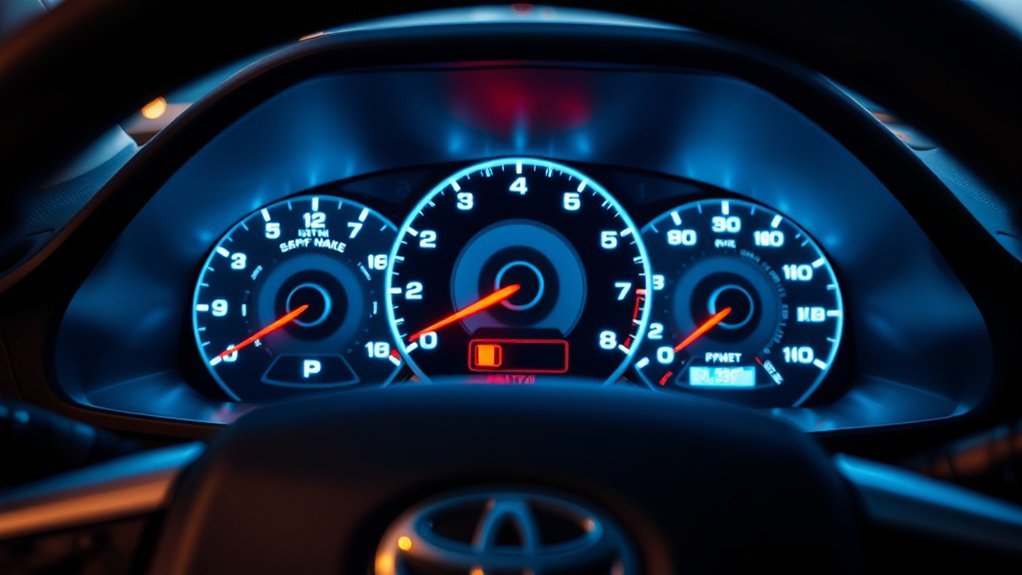
When the charging system warning light appears in your Toyota Camry, the car may not be maintaining power for the 12-volt battery and electrical system. The cause could be a weak battery, loose connection, damaged belt, failed alternator, blown fusible link, wiring fault, or, on a hybrid Camry, a problem with the DC-to-DC charging system. The correct response depends on whether the warning appears before startup, while a gasoline engine is running, or while a hybrid is in READY mode.
Quick Answer
If the charging warning stays on while your Camry is running or in READY mode, reduce electrical use and stop somewhere safe. Do not keep driving until the battery dies. Gasoline models may have an alternator, belt, battery, cable, or fuse problem. Hybrid Camrys require different diagnosis and should not be treated as conventional alternator systems.
Key Takeaways
- A charging light that remains on while the vehicle is operating can mean the 12-volt system is losing power.
- A light seen with the ignition on and engine off may be part of the normal warning-light check.
- Gasoline and hybrid Camrys use different charging-system hardware and diagnostic procedures.
- Do not disconnect the battery or alternator while the vehicle is running.
- A voltage reading alone cannot prove that the battery, alternator, or converter is healthy.
- Use the owner’s manual and service information for your exact model year, engine, and powertrain.
At a Glance
| Time Required | 10 to 20 minutes for safe preliminary checks; complete diagnosis may take longer |
| Difficulty | Basic visual checks are easy; circuit and hybrid diagnosis requires professional skill |
| Tools Needed | Safety glasses, flashlight, digital multimeter, battery tester, scan tool, and model-specific service information |
| Cost | Visual checks may cost nothing; testing and repairs vary by model year, powertrain, part, and labor rate |
Warning: If you smell burning insulation, see smoke, notice rising engine temperature, hear a belt failing, or lose steering assistance, stop as soon as it is safe and arrange a tow. Do not touch moving belts, hot components, exposed wiring, or orange hybrid high-voltage cables.
What Should You Do When the Charging System Warning Light Activates?

First, note exactly when the warning appears. A battery-shaped indicator may illuminate during the normal warning-light check when the ignition is on and the gasoline engine is not running. The serious condition is a warning that remains on, appears while driving, or appears while a hybrid Camry is in READY mode.
If the warning comes on while you are driving:
- Stay calm and watch for other warnings. Check the temperature gauge, steering effort, headlights, and instrument panel for signs of a wider electrical or belt failure.
- Reduce electrical demand. Turn off the rear defroster, seat heaters, high-powered audio, phone chargers, and climate-control blower when road and weather conditions allow. Keep headlights, wipers, and safety equipment on when needed.
- Move to a safe location. Avoid stopping in an active traffic lane or an unsafe roadside position.
- Shut the vehicle off once safely parked. Repeated restart attempts can use the battery’s remaining energy.
- Inspect only what is safe to inspect. Look for a missing belt, a loose battery terminal, heavy corrosion, damaged cables, smoke, fluid, or an obvious burning smell.
- Arrange testing or towing. If the light stayed on while the vehicle was operating, do not assume the problem cleared merely because the engine restarts.
The battery may keep a Camry running briefly after charging stops, but the vehicle can shut down without much warning once stored power is depleted.
Note: Toyota uses different warning symbols and messages across model years. Check the Toyota owner’s manual lookup for the exact meaning and response specified for your Camry.
Does the Warning Mean the Same Thing on Every Camry?
No. Before testing anything, identify whether your Camry has a conventional gasoline powertrain or a hybrid powertrain.
Gasoline Camry
A conventional gasoline Camry normally uses a belt-driven alternator to supply electrical power and recharge the 12-volt battery while the engine runs. Possible faults include:
- A slipping, damaged, or missing drive belt
- A failed alternator or internal voltage regulator
- A weak or internally damaged 12-volt battery
- Loose or corroded battery terminals
- High resistance in the positive cable or ground path
- A blown charging-system fuse or fusible link
- A damaged alternator connector or control circuit
- A control-module, sensor, or communication fault
Hybrid Camry
A hybrid Camry does not use the same conventional alternator arrangement. Its hybrid power electronics support the 12-volt electrical system through a converter circuit. The current U.S. Camry is sold with an all-hybrid powertrain, making this distinction especially important for newer vehicles.
A hybrid charging warning may involve the auxiliary 12-volt battery, battery connections, fuses, inverter or converter assembly, cooling system, wiring, control modules, or the high-voltage hybrid system.
Hybrid Safety Warning: Do not open the inverter, remove high-voltage covers, probe orange cables, or disconnect hybrid battery components. High voltage can remain present after the vehicle is switched off. Hybrid-system diagnosis should be performed by a qualified technician using Toyota procedures.
What Triggers the Charging System Warning Light?
The warning appears when the vehicle detects that the 12-volt electrical system is not operating as expected. The exact trigger depends on the Camry’s model year and powertrain.
| Possible Cause | What Happens | Common Clues |
|---|---|---|
| Weak or damaged 12-volt battery | The battery cannot store or supply power correctly. | Slow starting, clicking, repeated dead battery, or low test results |
| Failed alternator on a gasoline model | The alternator cannot provide enough current or stable voltage. | Warning while driving, dim lights, electrical shutdown, noise, or charging-test failure |
| Damaged or slipping drive belt | The alternator may not turn at the required speed. | Squealing, fraying, glazing, visible damage, or a missing belt |
| Loose or corroded connection | Resistance restricts current between the battery, charging unit, and vehicle. | Intermittent warning, hot terminal, visible corrosion, or voltage drop |
| Blown fuse or fusible link | The charging path or control circuit is interrupted. | No charging output, several electrical systems offline, or a no-start condition |
| Wiring or connector fault | Power, ground, sensing, or communication signals become unreliable. | Intermittent warning, damaged insulation, moisture, rodent damage, or stored codes |
| Hybrid converter or inverter fault | The hybrid system may not support the 12-volt bus correctly. | Master warning, hybrid-system message, reduced power, or multiple diagnostic codes |
| Control-system fault | A control module may detect improper voltage, current, temperature, or circuit response. | Warning returns despite good basic test results or follows a communication fault |
How to Diagnose the Charging System Warning
Use a step-by-step process. Do not replace the battery or alternator based on the warning light alone.
[Amazon Products Picked for You]

CEL Doctor: The ANCEL AD310 is one of the best-selling OBD II scanners on the market and is recommended by Scotty Kilmer, a YouTuber and auto mechanic. It can easily determine the cause of the check engine light coming on. After repairing the vehicle's problems, it can quickly read and clear diagnostic trouble codes of emission system, read live data & hard memory data, view freeze frame, I/M monitor readiness and collect vehicle information

Understand Your Check Engine Light – The ANCEL AD410 OBD2 scanner helps everyday drivers quickly read and clear engine-related fault codes, view code definitions, and understand why the check engine light is on before visiting a repair shop. With 42,000+ built-in DTC lookups, this car code reader helps reduce guesswork and makes basic vehicle diagnostics easier for beginners and DIY users

[Easy to Use—Work Out of the Box] + [FOXWELL 2026 New Version] FOXWELL NT604 Elite scan tool is the 2026 new version from FOXWELL, designed for car owners who want to figure out the cause of issues before fixing car problems by scanning common systems like ABS, SRS, engine, and transmission. The NT604 Elite obd2 scanner diagnostic tool comes with the latest software—no need to waste time downloading software first. Plug the scanner into the OBDII port with OBDII cable to start the diagnosis.
1. Confirm the Warning Condition
- Does the warning appear only with the ignition on and engine off?
- Does it stay on after a gasoline engine starts?
- Does it appear while a hybrid is in READY mode?
- Does it appear only at idle, under heavy electrical load, or during wet weather?
- Are other warnings present?
Record the conditions before shutting the vehicle down. Intermittent details can help a technician reproduce the problem.
2. Check the Battery and Connections
Inspect the 12-volt battery case, hold-down, terminals, cables, and ground points. Look for swelling, cracks, leakage, loose hardware, heavy corrosion, damaged cable insulation, or signs that a terminal has overheated.
Do not place tools across both battery terminals. Remove metal jewelry and keep sparks, flames, and smoking materials away from the battery.
3. Check the Belt on Applicable Gasoline Models
With the engine off and the key removed, confirm that the belt is present and routed correctly. Check for fraying, missing ribs, severe glazing, contamination, cracking, or obvious loss of tension.
If the belt also drives a coolant pump on your engine, a broken belt may create an overheating risk. Do not continue driving while watching the temperature rise.
4. Scan the Vehicle for Trouble Codes
A basic code reader may show only engine-related codes. A capable scan tool should check the engine, body, charging, hybrid, battery, and communication modules that apply to the vehicle.
Record codes and freeze-frame data before clearing anything. Clearing codes too early can erase the conditions needed for diagnosis.
5. Test Battery and Charging Performance
Measure battery voltage only with a correctly configured digital multimeter. A fully charged conventional lead-acid battery may read roughly 12.6 volts after resting, but temperature, battery type, surface charge, and battery condition affect the reading.
With a gasoline engine running, or a hybrid safely in READY mode, the measured voltage should normally rise above the battery’s resting voltage when the charging system is active. However, modern systems can change their target voltage. Compare the reading with Toyota service information for the exact model.
A proper diagnosis may also require:
- Battery conductance or load testing
- Alternator output-current testing
- AC ripple testing on a conventional alternator
- Positive-cable voltage-drop testing
- Ground-circuit voltage-drop testing
- Testing under different engine speeds and electrical loads
- Scan-tool review of commanded and measured charging values
Pro Tip: Test the 12-volt battery before condemning the charging unit. A deeply discharged or internally damaged battery can distort charging readings and place unusually high demand on the alternator or converter.
How to Inspect the Alternator Safely
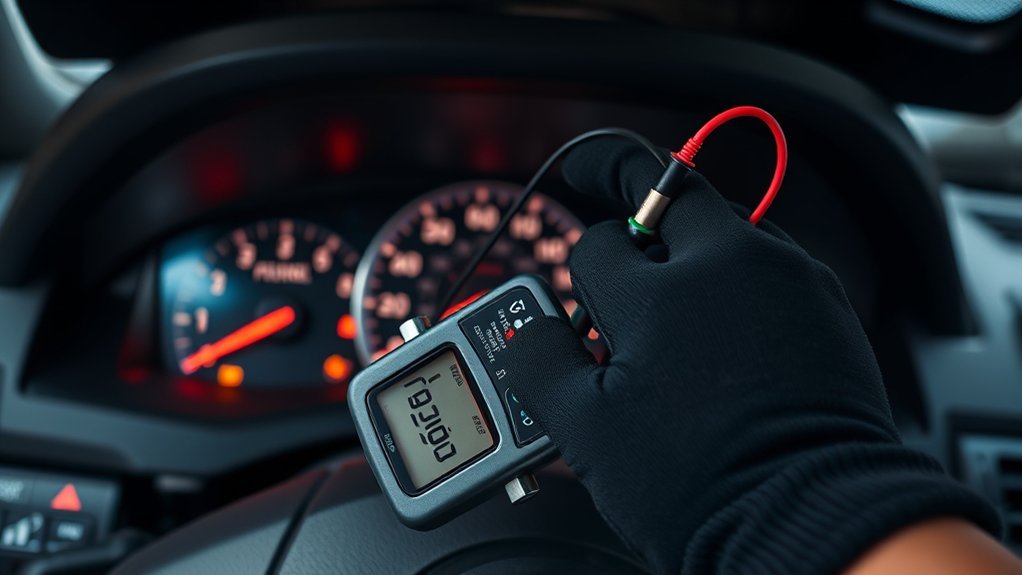
This section applies only to Camrys equipped with a conventional alternator. Do not use it as a hybrid-system procedure.
| Step | Inspection |
|---|---|
| 1. Look for physical damage | Check the housing, mounting points, pulley, connector, and visible wiring for cracks, looseness, impact damage, contamination, or overheating. |
| 2. Inspect the belt and tensioner | Confirm the belt is routed correctly, aligned on the pulley, and not slipping or damaged. |
| 3. Check connections | With the vehicle off, check for a loose output connection, damaged connector lock, corrosion, or burned insulation. Do not touch an exposed output terminal with a grounded tool. |
| 4. Measure system voltage | Measure at the battery and compare the result under the specified test conditions with service information for that Camry. |
| 5. Test voltage drop | Check the positive and ground paths under load. Excessive resistance can imitate a failed alternator. |
| 6. Test current and ripple | A technician may measure charging current and AC ripple to identify weak output, failed diodes, or internal alternator damage. |
Warning: Never disconnect the alternator or a battery cable while the engine is running. This old test method can create voltage spikes, damage electronic modules, produce sparks, and cause the vehicle to stall.
[Amazon Products Picked for You]

Catch Battery Problems Early: Featured in two videos by Project Farm, a popular YouTube channel with millions of subscribers, the ANCEL BA101 helps you quickly spot battery issues before they leave you stranded. It provides easy-to-understand readings for State of Health (SOH), State of Charge (SOC), voltage, current, CCA, plus cranking and charging system tests, so you can better understand your battery and help avoid unexpected breakdowns
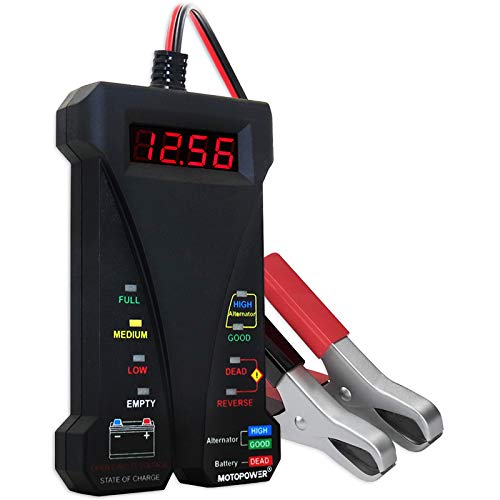
Effortless Operation - Boasting a “plug-and-test” design, there's no need for complex set-up procedures. Just connect it to the battery following simple steps. Without starting the vehicle, you can read the battery status, and after starting, quickly obtain the alternator status. Whether you're a professional mechanic or an ordinary car owner, you can easily use it to quickly determine if the battery needs jump - starting, replacement, or if the alternator output is normal.

【Reliable Car Battery Tester】: The alternator tester can accurately determine whether the car battery needs to be replaced or if there is a power outage, and at the same time evaluate the output status of the alternator, clearly presents real-time voltage data, battery health and charging status. It can effectively prevent the battery from being damaged due to overcharging or undercharging, and extend the battery's service life.
Checking the Drive Belt: Signs of Trouble
On a Camry that uses a belt-driven alternator, inspect the belt only while the engine is off. Keep hands, clothing, test leads, and tools away from the belt whenever the engine runs.
Signs that require attention include:
- Missing belt: The alternator cannot operate, and other belt-driven components may also stop.
- Frayed edges: Misalignment or pulley damage may be cutting the belt.
- Missing ribs or chunks: The belt may be close to failure.
- Heavy glazing: A shiny surface can indicate heat and slipping.
- Oil or coolant contamination: Fluid can weaken the belt and cause slipping.
- Squealing or chirping: The cause could be belt slip, pulley misalignment, a weak tensioner, or a failing accessory bearing.
- Visible tensioner movement or misalignment: The belt system may not be controlling tension correctly.
Replacing the belt alone may not solve the problem if a tensioner, pulley, alternator bearing, or fluid leak caused the damage.
How to Test the Battery and Its Connections
A battery can show acceptable open-circuit voltage and still fail under load. Use several checks rather than relying on one number.
Visual Check
- Confirm the case is not swollen, cracked, or leaking.
- Make sure the battery is securely mounted.
- Check both terminals for looseness or corrosion.
- Inspect the negative cable where it connects to the body and engine.
- Inspect the positive cable, fuse block, and protective cover.
Resting Voltage Check
Switch the vehicle off and allow the battery to rest when practical. Measure directly across the battery posts, not only on the cable clamps. A reading near 12.6 volts can indicate a well-charged conventional lead-acid battery, but it does not prove that the battery has adequate capacity.
Load or Conductance Test
Use a tester that matches the battery type and rating. Compare the result with the cold-cranking-amp rating printed on the battery. A battery that fails the test should be charged and retested according to the tester or battery manufacturer’s procedure before replacement is confirmed.
Terminal and Cable Voltage Drop
Resistance in a cable or connection may not be obvious during a visual inspection. Voltage-drop testing under load can reveal a poor positive connection, weak ground, damaged cable, or overheated terminal.
Do not perform a continuity or resistance test on a powered circuit. Disconnect power only as directed by the correct service procedure, since some Camrys require special precautions to protect memory, security, hybrid, and electronic systems.
How to Identify Wiring and Electrical Issues

Inspect the low-voltage wiring for corrosion, loose terminals, damaged insulation, rodent damage, moisture, collision damage, or signs of overheating.
- Check the battery grounds. Inspect the battery-to-body and engine-to-body ground paths that apply to the vehicle.
- Check the positive charging path. Inspect the battery connection, fuse block, fusible links, and alternator output circuit on applicable gasoline models.
- Inspect connector locks and terminals. A connector can look attached while a terminal inside is loose, pushed back, corroded, or heat-damaged.
- Use the correct wiring diagram. Wire colors and pin functions change across model years. Never assume a certain color is a power, ground, or control wire.
- Back-probe only when approved. Use proper probes and Toyota connector procedures. Oversized probes can spread terminals and create a new intermittent fault.
- Check communication codes. A charging warning may be related to lost communication between control modules rather than a failed power component.
Note: Model-specific wiring diagrams, connector views, test values, and diagnostic procedures are available through the Toyota Technical Information System.
The Role of the Powertrain and Hybrid Control Modules
The article’s original PCM explanation was too broad. Depending on the model year, a Camry may use an engine control module, generator or alternator control circuit, battery sensor, body control module, hybrid control module, power-management control unit, or other modules to monitor and manage the 12-volt system.
These modules may evaluate:
- Battery voltage and current
- Battery temperature or estimated state of charge
- Electrical load
- Engine speed
- Alternator command and feedback on applicable models
- Converter operation on hybrid models
- Communication between charging-related modules
Because the system can be computer-controlled, a changing voltage reading is not automatically proof of a bad alternator. Compare commanded values, measured values, circuit condition, and service specifications before replacing parts.
Common Charging-System Diagnostic Mistakes
- Replacing the battery without testing the charging system: A new battery may go dead if the actual fault remains.
- Replacing the alternator without testing the battery: A weak or shorted battery can overload the replacement unit.
- Ignoring cable resistance: Corroded connections can produce low voltage even when the alternator is working.
- Assuming one voltage number applies to every Camry: Test conditions and specifications vary.
- Clearing trouble codes before recording them: This can remove valuable evidence.
- Testing a hybrid as if it were a gasoline model: Hybrid charging and safety procedures are different.
- Using wire color as identification: Always verify the circuit with the proper diagram.
- Disconnecting the battery while running: This can damage electronics and is not an approved test.
When to Call a Mechanic or Request a Tow
Arrange professional help immediately when:
- The charging warning stays on while driving or while the hybrid system is in READY mode.
- The vehicle has dimming lights, unstable gauges, repeated stalling, or difficulty restarting.
- You smell burning insulation or see smoke.
- The drive belt is missing, severely damaged, or coming off a pulley.
- The temperature gauge rises or an overheating warning appears.
- The battery case is swollen, cracked, hot, or leaking.
- Battery cables or fuse connections are visibly overheated.
- A hybrid-system or master warning appears with the charging warning.
- The warning returns after a battery, alternator, or wiring repair.
- You do not have the correct tools, wiring information, or training.
A tow is usually safer than attempting to drive until the battery is empty. Loss of electrical power can shut down the engine, reduce lighting, disable accessories, and create several warning messages at once.
Tips to Prevent Future Charging System Problems
Preventive checks cannot stop every component failure, but they can identify corrosion, loose connections, belt wear, and battery weakness before you are stranded.
Regular Battery Maintenance
- Inspect the battery and terminals during routine service and before long trips.
- Keep the top of the battery clean and dry.
- Make sure the battery remains securely mounted.
- Have the battery tested when starting becomes slower or before severe seasonal weather.
- Use the correct replacement battery type, size, terminal layout, and rating.
- After replacement, follow any model-specific battery registration, initialization, or system-reset procedure.
Inspect Electrical Connections
Check visible battery cables, grounds, fuse-block connections, and low-voltage harnesses whenever the vehicle is serviced. Repair damaged seals, loose terminals, or corrosion before resistance becomes severe.
| Maintenance Check | Practical Time to Perform It |
|---|---|
| Battery case, hold-down, and terminals | During routine service, before a long trip, or when starting behavior changes |
| Drive belt on applicable gasoline models | During oil-service inspections and whenever noise, slipping, or visible damage appears |
| Battery performance test | When the battery is aging, starting is slow, or extreme weather is approaching |
| Charging-system test | After a warning, repeated dead battery, alternator replacement, or unexplained electrical fault |
If corrosion is cleaned, use products and methods suitable for battery terminals. Do not pack dielectric grease between surfaces that must make direct electrical contact. A light protective coating may be applied after the connection is clean and properly tightened when the product instructions permit it.
How to Verify the Repair
Do not consider the repair complete merely because the warning light turned off. A complete verification should include:
- A fully charged and tested 12-volt battery
- Correct charging performance under the specified conditions
- Acceptable positive and ground voltage drop
- No abnormal AC ripple on an applicable alternator system
- No loose, hot, or corroded connections
- A correctly operating belt and tensioner where fitted
- No returning diagnostic codes
- No warning during a controlled road test
- Normal operation with typical electrical loads
If the battery was deeply discharged, charge it with the correct charger before relying on a short drive to restore it. A charging system is designed to maintain a battery, not always to recover a severely discharged one safely and quickly.
What Affects Toyota Camry Charging-System Repair Cost?
There is no single reliable alternator or charging-system price for every Camry. The total depends on:
- Model year and powertrain
- Gasoline or hybrid system
- Engine configuration
- New, remanufactured, aftermarket, or Toyota-supplied parts
- Battery type and rating
- Access time and local labor rate
- Damage to cables, connectors, fuses, or belt components
- Diagnostic time for intermittent or communication faults
- Whether programming, initialization, or calibration is required
Request a written estimate based on the VIN and confirmed diagnosis. A battery replacement, cable repair, conventional alternator replacement, and hybrid converter repair are very different jobs.
[Amazon Products Picked for You]

[COMPATIBLE VEHICLE] ---- Alternator fit for Toyota for Camry 2.5L 2012-2015 | for Toyota for RAV4 2.5L 2009-2012 | for Scion for tC 2.5L 2011-2016

Compatible with: for Toyota Camry L4 2.5L 2012-2015 (To 9/2014; 100Amp), for RAV4 L4 2.5L 2009, for RAV4 L4 2.5L 2010-2012 (2494CC; 100Amp, Mfd in Japan or USA); for Scion tC L4 2.5L 2011-2016; Note: Not Fit For Hybrid

Direct replacement - this accessory drive belt idler pulley adjustment bolt kit is designed to match the original hardware required to repair the idler pulley on specified vehicles
Frequently Asked Questions
Why does my Toyota Camry say “Check Charging System”?
The message can appear because the 12-volt system is not being maintained correctly. Possible causes include a weak battery, poor connection, damaged belt, failed alternator on a gasoline model, blown fuse, wiring fault, control-system issue, or converter-related fault on a hybrid. Check whether the message appears only with the engine off or remains present while the vehicle is operating.
Is the charging-system light normal when the engine is off?
A battery or charging indicator may illuminate during the normal warning-light check when the ignition is on but a gasoline engine is not running. It should not remain on after startup unless the owner’s manual describes that condition as normal. On a hybrid, use READY status and the exact manual instructions rather than engine sound alone.
Can I drive with the charging-system warning light on?
Continuing to drive is risky because the vehicle may be using stored battery power without replacing it. Reduce unnecessary electrical loads, move to a safe location, and arrange diagnosis or towing. Stop immediately if you notice smoke, burning odor, overheating, a broken belt, heavy steering, or unstable electrical operation.
Does a hybrid Toyota Camry have a normal alternator?
A hybrid Camry does not use the same conventional belt-driven alternator system described for a gasoline-only Camry. Its power electronics support the 12-volt system through a converter. Do not use conventional alternator-disconnection tests or touch high-voltage hybrid components.
Can a bad battery cause the charging warning?
Yes. A weak, deeply discharged, internally shorted, or poorly connected battery can affect system voltage and charging demand. Test the battery’s state of charge and capacity before replacing the alternator or converter.
Will replacing the alternator automatically fix the warning?
Not always. The real problem may be the battery, belt, tensioner, cable resistance, ground connection, fuse, fusible link, connector, control circuit, or module communication. Confirm the failure with proper testing before replacing parts.
How much does it cost to replace a Toyota Camry alternator?
The price varies by model year, engine, part source, labor rate, location, and related repairs. Hybrid Camrys use different charging hardware, so a conventional alternator estimate does not apply. Get a VIN-based estimate after the fault has been diagnosed.
Conclusion
A Toyota Camry charging system warning should not be dismissed as a minor battery light. When it remains on while the vehicle is running or in READY mode, the 12-volt system may be losing power. Stop safely, reduce electrical demand, and avoid repeated restarts.
For a gasoline Camry, diagnosis may involve the battery, alternator, belt, cables, fuses, wiring, and control circuits. For a hybrid Camry, the system is different and may involve the auxiliary battery, converter, inverter, fuses, wiring, cooling, or hybrid controls. Use the manual and service information for the exact model, and leave high-voltage work to a qualified technician.
Sources
- Toyota Dashboard Warning Lights — explains warning-light colors, urgency, and the need to consult the vehicle manual.
- Toyota Manuals and Warranties — provides model-specific owner’s manuals and warranty information.
- Toyota Camry — confirms current U.S. Camry powertrain information.
- Toyota Technical Information System — provides service procedures, wiring diagrams, specifications, and technical information.
- NHTSA Recall Lookup — allows owners to check open safety recalls by VIN.
