A Toyota Camry 12V battery commonly lasts about 3 to 5 years, but age alone does not tell you whether it needs replacement. The Toyota Camry battery lifespan is shortened by heat, repeated discharge, short-trip use, long storage, loose connections, and charging-system faults. Gasoline Camrys may crank slowly when the battery is weak; hybrids may fail to enter READY mode. Test a safe, fully charged battery before replacing it unless the case is swollen, cracked, leaking, unusually hot, or otherwise unsafe.
Last updated: September 19, 2026. This guide covers the 12V starting or auxiliary battery, not the high-voltage hybrid traction battery.
Quick Answer
A Toyota Camry 12V battery commonly lasts about 3 to 5 years. Replace it when a proper test shows inadequate capacity or output, when it cannot hold a charge after the cause of discharge is addressed, or when the case is damaged or unsafe. A single voltage reading shows charge level more than battery health, so recharge and retest a physically safe battery before condemning it.
Key Takeaways
- Three to five years is a planning range, not a guaranteed Toyota replacement interval.
- Heat causes lasting battery wear, while cold weather reduces the power a battery can deliver.
- Gasoline Camrys may crank slowly, while hybrid Camrys may fail to enter READY mode or show unusual electrical problems.
- A rested voltage reading shows approximate charge level, but a load or conductance test is needed to judge battery health.
- A charging-system warning can indicate a fault in the charging circuit or related electrical system, not simply a worn battery.
How Long Should Your Toyota Camry’s 12V Battery Last?
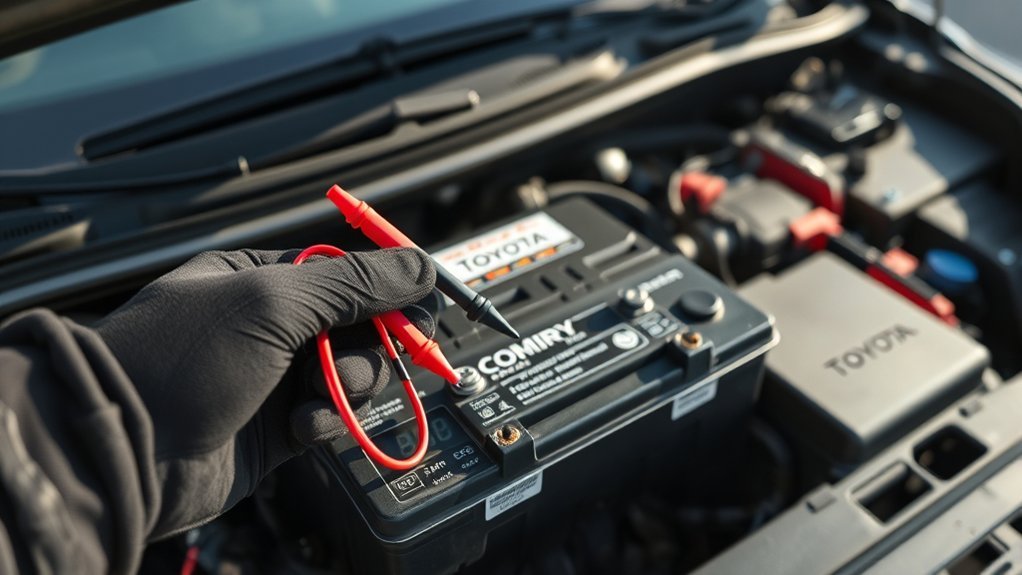
A useful planning range for a Toyota Camry 12V battery is about 3 to 5 years. Some batteries fail sooner in hot climates or after repeated deep discharge. Others last longer when they remain properly charged, securely mounted, and protected from excessive heat.
This range is not a scheduled replacement interval from Toyota. Battery age should prompt testing, not automatic replacement. Battery University summarizes a 2005 North American failure-mode study of 2,681 starter batteries that reported an average life of 50 months and shorter life in warmer regions. Treat that study as historical context rather than a current Camry-specific replacement interval.
A battery’s age tells you when closer monitoring is wise. A proper battery test tells you whether replacement is actually needed.
Does a Camry Hybrid Use the 12V Battery Differently?
The meaning of a weak 12V battery depends on your Camry’s powertrain:
| Camry Type | What the 12V Battery Does | Common Weak-Battery Behavior |
|---|---|---|
| Gasoline Camry | Powers electronics and operates the starter motor. | Slow cranking, clicking, dim lights, or no crank. |
| Camry Hybrid | Powers control modules and allows the hybrid system to initialize. It is separate from the high-voltage traction battery. | No READY indicator, weak or flickering electronics, warning messages, or failure to power up normally. |
The 2025 and 2026 U.S. Camry lineups are all-hybrid. Older Camrys include both gasoline and hybrid models, so always use the instructions for your exact model year and market.
Note: The 12V auxiliary battery is not the same as the high-voltage hybrid traction battery. A 3-to-5-year estimate for a 12V battery does not describe traction-battery life or warranty coverage.
Battery Age, Charge Level, and Battery Health Are Different
Three measurements answer three different questions. Battery age tells you when closer monitoring is sensible. State of charge tells you how much energy is stored at that moment. Battery health tells you whether the battery can still deliver adequate current and retain charge. Confusing these is why a low voltage reading can lead to an unnecessary replacement.
| Measure | What It Tells You | What to Do |
|---|---|---|
| Age | How long the battery has been in service. | Use age as a testing trigger, not an automatic replacement date. |
| Rested voltage | Approximate state of charge under the test conditions. | Recharge a low but physically safe battery before judging its condition. |
| Load or conductance test | Whether the battery can still deliver useful output. | Use the result, battery specification, and charging-system checks to make the replacement decision. |
Key Factors Affecting Your Battery’s Lifespan
Heat and Cold
Heat speeds up corrosion and other aging processes inside a lead-acid battery. This damage can remain even after the weather cools. Cold weather has a different effect: it reduces the battery’s available output at the same time a gasoline engine may require more power to start.
This is why a battery weakened during a hot summer may first become noticeable during the first cold spell.
Frequent Short Trips
Starting the vehicle uses stored energy. If most trips are short, the charging system may not have enough time to restore everything used during startup and accessory operation. The effect depends on traffic, temperature, accessory use, battery condition, and the vehicle’s charging strategy.
There is no universal mileage that guarantees a complete recharge. If your Camry receives mostly short-trip use, check the battery periodically and use a compatible smart maintainer when needed. On a hybrid, Toyota guidance emphasizes that the 12V system is charged when the vehicle is in READY mode, not simply because accessories are switched on.
Long Periods of Storage
Modern vehicles continue using a small amount of power for security, memory, keyless-entry, telematics, and control modules while parked. A healthy battery can therefore become discharged when the vehicle sits for an extended period.
For storage, follow the model-year owner’s manual and use a charger or maintainer that is compatible with the installed battery type. Do not attach a charger until you have confirmed the correct connection points and settings.
Loose Connections, Corrosion, and Poor Grounding
Corrosion or loose terminal connections can create electrical resistance. This may cause starting problems even when the battery itself is usable. The battery hold-down must also remain secure because excessive movement and vibration can damage the case or internal plates.
Charging-System or Parasitic-Draw Problems
A new battery will not solve a faulty alternator, damaged cable, weak ground, DC-to-DC converter problem, or excessive key-off electrical draw. If the battery repeatedly becomes discharged, have the complete charging and electrical system tested.
Common Signs of Battery Weakness and Failure
Battery symptoms can overlap with starter, charging-system, wiring, and control-module faults. Use the following signs as reasons to test the system, not as automatic proof that the battery has failed.
| Sign | What It May Mean | Next Step |
|---|---|---|
| Slow engine crank | Low charge, reduced battery capacity, poor connection, starter problem, or cold-weather load on a gasoline Camry. | Inspect connections and perform battery and starting-system tests. |
| Hybrid will not enter READY mode | Weak 12V auxiliary battery or another hybrid-system or electrical fault. | Check 12V battery condition and follow the model-year diagnostic guidance. |
| Dim, flickering, or resetting electronics | Low system voltage, loose terminals, poor grounding, battery weakness, or charging fault. | Test the battery, cables, grounds, and charging system. |
| Battery or charging-system warning | The battery may not be receiving proper charging voltage, or the vehicle may have another electrical-system fault. | Reduce unnecessary electrical loads, consult the owner’s manual, and arrange prompt diagnosis. |
| Repeated need for a jump-start | Battery capacity loss, charging fault, parasitic draw, storage-related discharge, or accessories left active. | Charge the battery fully, test it, and diagnose the cause of discharge. |
| Swollen, cracked, leaking, or hot battery case | Internal damage, overcharging, freezing, overheating, or pressure buildup. | Stop using or charging the battery and obtain professional service. |
Warning: Do not charge, jump-start, move, or continue using a battery that is cracked, leaking, swollen, unusually hot, or suspected of being frozen. Keep sparks, cigarettes, flames, and metal tools away from the terminals. Battery acid can cause severe burns, and charging can release flammable gas.
How to Check Battery Health on a Toyota Camry
At a Glance
| Time Required | 10 to 20 minutes for inspection and measurement, plus battery rest or charging time |
| Difficulty | Easy for visual and voltage checks; professional testing is recommended for complete diagnosis |
| Tools Needed | Safety glasses, protective gloves, digital multimeter, and an optional battery conductance or load tester |
| Cost | No added cost if you already own a meter or use a complimentary battery test; shop diagnostic pricing varies |
1. Confirm the Battery’s Age
Look for the installation date sticker, receipt, or date code. If the battery is more than three years old, test it before extreme summer or winter weather and whenever starting or power-up behavior changes.
2. Inspect the Battery and Connections
Turn the vehicle off, keep the smart key away from the car, and wear eye and hand protection. Check for:
- A swollen, cracked, leaking, or discolored case
- Loose or damaged terminal clamps
- Heavy white, blue, or green corrosion
- A loose or missing battery hold-down
- Damaged cables or ground connections
- An unusual sulfur or rotten-egg odor
Stop the inspection if the battery appears damaged, is hot, or may be frozen.
3. Measure Rested Voltage
A voltage check is most useful after the battery has rested with the vehicle off. Battery University notes that recent charging, recent discharge, temperature, battery chemistry, and the small electrical loads present in modern vehicles can distort the reading.
| Approximate Rested Voltage | General Interpretation |
|---|---|
| About 12.6 to 12.7 volts | Generally indicates a well-charged conventional 12V lead-acid battery. |
| About 12.4 to 12.5 volts | Partially charged. Recharge and retest before judging battery health. |
| About 12.2 to 12.3 volts | Low state of charge. Investigate the cause if the battery was recently driven or charged. |
| Below about 12.0 volts | Deeply discharged or possibly damaged. Charge only if the battery is physically safe and the correct charger is available. |
These values are approximate. Battery University’s cited BCI table places a rested 12V starter battery at about 12.65 volts at 100% state of charge, 12.45 volts at 75%, and 12.24 volts at 50% under its stated test conditions of about 26°C (78°F) after a 24-hour rest. AGM batteries, temperature, recent charging, and vehicle loads can shift the reading, so 12.24 volts can indicate a partly discharged battery rather than automatic failure.
Pro Tip: If the voltage is low, charge the battery with a compatible smart charger and then retest it. Replacing a battery before correcting a charging fault or parasitic drain can leave you with the same problem and a new battery.
4. Perform a Load or Conductance Test
A battery can show acceptable open-circuit voltage but still lose too much voltage under load. A battery shop, repair facility, or suitable tester can measure available starting performance, internal resistance, or conductance.
For a gasoline Camry, testing may include cranking performance. For a hybrid Camry, the technician should use a test method suitable for its auxiliary battery and verify that the vehicle enters READY mode normally.
5. Check the Charging System
If the battery passes testing but keeps going dead, test the charging system, cables, grounds, and key-off current draw. Charging voltage can vary with model year, operating mode, battery temperature, and smart-charging strategy, so do not rely on one universal running-voltage number.
Use the Toyota owner’s manual portal to find the correct battery location, jump-start points, precautions, and warning-light information for your exact Camry.
Maintenance Tips to Extend Your Battery’s Life
- Test an aging battery: Once the battery is around three years old, have it checked before extreme weather or a long trip.
- Keep it charged: Avoid leaving the vehicle unused for long periods with an already weak or partly discharged battery.
- Limit accessory-only use: Running lights, audio, climate controls, or electronics while the vehicle is not operating can discharge the battery.
- Avoid repeated partial recharge: On gasoline models, repeated short trips may not replace the energy used during startup. On hybrids, use READY mode rather than accessory-only mode when parked and using electrical features, following model-year guidance.
- Use the correct maintainer: During long storage, use a smart maintainer approved for the battery chemistry and follow Toyota’s connection instructions.
- Keep terminals secure: Have corrosion cleaned safely and make sure terminal clamps, grounds, and the hold-down are tight.
- Fix repeated discharge: Do not assume a recurring dead battery is normal. Check for a charging fault or excessive parasitic draw.
- Protect the smart key: When working near the vehicle, keep the key away so the car does not wake systems or respond unexpectedly.
If you clean minor terminal corrosion yourself, switch the vehicle off, wear eye and hand protection, avoid bridging the terminals with a tool, and follow the year-specific disconnection procedure. Professional service is safer when the battery location is difficult to access or corrosion is heavy.
How to Know When to Replace Your Camry’s Battery
Replace the battery when testing confirms that it cannot provide adequate output or retain a charge, or when the case has become unsafe. Age by itself is not enough.
| Condition | Recommended Action |
|---|---|
| Battery fails a load or conductance test after being fully charged | Replace the battery. |
| Battery repeatedly loses charge but passes testing | Diagnose the charging system and parasitic draw before replacement. |
| Swollen, cracked, leaking, overheated, or frozen case | Stop using it and arrange safe professional replacement. |
| Battery is older than three years but still passes testing | Continue using it and test it more frequently. |
| Charging-system warning remains on | Have the complete charging system inspected promptly. |
Choosing the Correct Replacement Battery
Do not buy a replacement based only on the words “Toyota Camry.” Battery specifications can differ by model year, engine, hybrid system, trim, market, and original equipment.
Verify all of the following before installation:
- Exact model year, trim, and powertrain
- Battery group size and physical dimensions
- Positive and negative terminal orientation
- Required cold-cranking or performance rating
- Flooded, enhanced flooded, AGM, or other specified battery type
- Vent-tube connection when the battery is installed in an enclosed area
- Hold-down design and terminal fit
- Manufacturer warranty and installation requirements
Use the original battery label, Toyota parts information, or the owner’s manual as the primary fitment reference. For fitment details, see the Toyota Camry battery group-size guide. If you are doing the work yourself, follow the separate Camry 12V battery replacement guide. Installing a battery with the wrong dimensions, terminal position, venting, or electrical rating can cause poor performance or damage.
Recycle the Old Battery
Automotive lead-acid batteries contain lead and corrosive sulfuric acid. The U.S. Environmental Protection Agency recommends returning an automotive battery to a battery retailer or an approved local collection program. Do not place it in household trash.
Frequently Asked Questions
How long does a Toyota Camry 12V battery usually last?
A typical planning range is about 3 to 5 years. Hot weather, repeated discharge, long storage, short trips, loose connections, and charging-system faults may shorten that life. Test the battery rather than replacing it only because of age.
Is the 12V battery in a Camry Hybrid the hybrid battery?
No. The 12V auxiliary battery powers electronics and allows the hybrid control system to initialize. The much larger high-voltage traction battery stores energy used by the electric drive system.
Does a 12.24-volt reading mean the battery is bad?
Not by itself. A rested conventional lead-acid battery near 12.24 volts may simply be partly discharged. Charge it with the correct equipment, let it stabilize, and perform a load or conductance test before deciding to replace it.
How does a weak battery act in a Camry Hybrid?
A hybrid may fail to enter READY mode, show dim or flickering electronics, display multiple warning messages, or behave inconsistently when the 12V auxiliary battery is weak. It may not produce the slow cranking sound associated with a gasoline-only Camry.
Does the battery-shaped dashboard light mean I need a new battery?
Not necessarily. The light can indicate that the charging system is not maintaining proper electrical power. The cause may be the alternator, DC-to-DC converter, wiring, belt, connection, ground, battery, or another electrical component. Consult the owner’s manual and arrange diagnosis promptly.
Should I replace a Camry battery after five years even if it works?
Replacement may be reasonable before a critical trip or severe weather if test results are marginal, but age alone does not prove failure. A battery that still passes testing and holds a charge can remain in service with closer monitoring.
Conclusion
A Toyota Camry 12V battery often lasts about 3 to 5 years, but its test results and physical condition should guide the replacement decision. Watch for slow cranking on gasoline models, failure to enter READY mode on hybrids, repeated discharge, unstable electronics, damaged terminals, and an unsafe battery case.
Do not replace the battery solely because a meter shows 12.24 volts or a battery-shaped warning appears. Recharge and test the battery, then check the charging system and parasitic draw when needed. Using the correct model-year procedure and replacement specification will help keep your Camry dependable without replacing usable parts.
Sources
- Toyota Camry Official Vehicle Page – confirms the current Camry’s all-hybrid powertrain.
- Toyota Manuals and Warranties – provides model-year-specific owner manuals, precautions, and vehicle information.
- Toyota Warning Lights – explains the need to consult the correct owner’s manual for warning indicators.
- Battery University: How to Measure State of Charge – supports rested-voltage interpretation and explains the limits of voltage-only testing.
- Battery University: How Heat and Loading Affect Battery Life – supports battery lifespan, heat, usage, and regional-life differences.
- Toyota UK: How to Care for Your Car’s 12V Battery – supports READY-mode charging guidance for Toyota hybrid and electrified vehicles.
- U.S. EPA: Used Household and Automotive Batteries – supports safe recycling and disposal guidance for automotive batteries.
