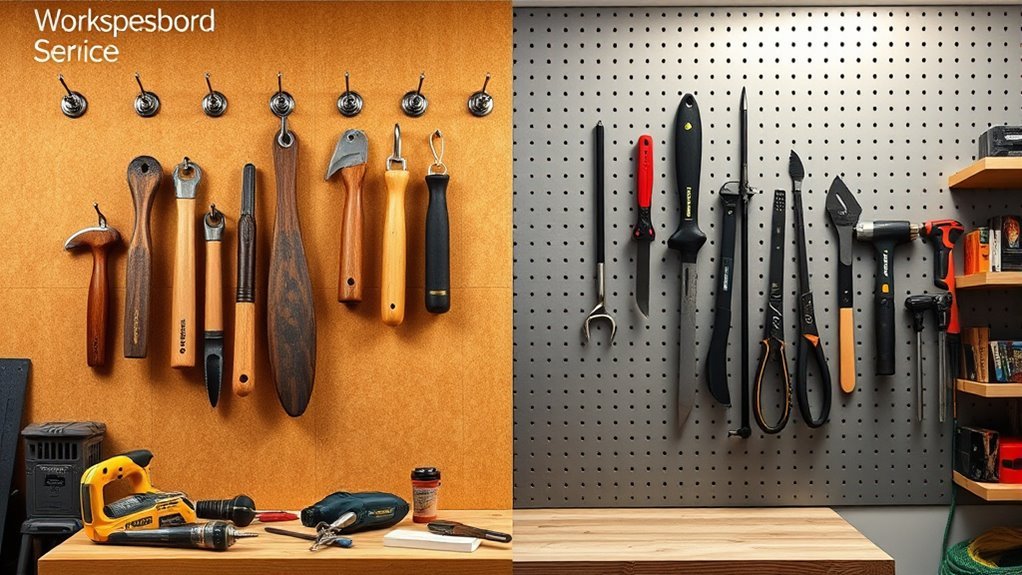
Fibreboard pegboard is a lightweight, low-cost storage panel with evenly spaced holes for hooks, but it typically supports only 10 to 20 pounds per square foot and can warp when exposed to moisture. Metal pegboard, usually galvanized steel, costs more yet offers far greater strength, often up to 75 pounds per square foot, with better resistance to sagging and wear. The choice depends on load, durability, budget, and installation needs, with further distinctions becoming clearer below.
Key Takeaways
- Fibreboard pegboard is cheaper and easier to install, making it good for light-duty storage and quick setups.
- Metal pegboard costs more but offers much greater strength, supporting heavier tools without sagging or warping.
- Fibreboard typically holds about 10–20 pounds per square foot, while metal pegboard can support up to 75 pounds.
- Fibreboard absorbs moisture and may splinter or break down, whereas metal resists warping, bending, and surface damage.
- Choose fibreboard for budget-friendly organization and metal for durable, long-term workshop performance.
What Is Fibreboard Pegboard?
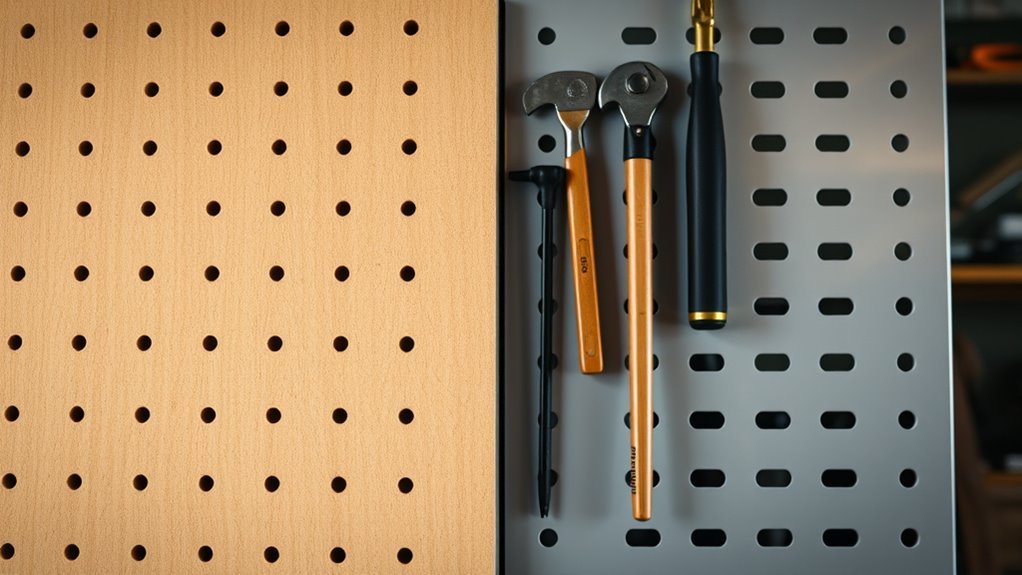
Fibreboard pegboard is a lightweight storage panel made from compressed wood fibers and resin, designed with evenly spaced holes for mounting hooks and accessories. As a fibreboard pegboard, it provides an economical framework for organizing tools and other items without demanding complex installation.
The panel is typically manufactured from compressed wood fiber and formed with 1/8-inch or 1/4-inch perforations, enabling standardized hook placement and modular arrangement. Its low mass supports easy handling, cutting, and wall mounting, which can expand practical access for users seeking orderly, self-directed workspaces. Availability at hardware stores further increases its utility.
However, the material is vulnerable to moisture absorption, which can cause warping or surface breakdown over time. It is thus best suited to lighter loads, where limited stress preserves function.
Paint or stain may be applied for visual coordination, though structural durability remains modest relative to harder panel materials.
How Does Metal Pegboard Compare?
Metal pegboard offers a sturdier alternative to fibreboard, with galvanized steel construction that resists warping and supports heavier loads without sagging. It accepts heavy-duty hooks and brackets, enabling secure storage for heavy tools and equipment while preserving an orderly, accessible workspace.
For users seeking practical autonomy, this material reduces dependence on frequent repairs and replacements.
- Durability: galvanized steel resists moisture-related damage and, with routine care, limits rust exposure.
- Maintenance: a damp cloth is usually sufficient, making cleaning straightforward and efficient.
- Installation: because metal pegboard is heavier, it may require additional structural support during installation, unlike lighter fibreboard options.
In comparative terms, metal pegboard emphasizes control, longevity, and disciplined organization. It suits environments where durability and clean handling matter more than minimal mounting effort.
Fibreboard Pegboard Vs Metal Pegboard Strength
When evaluating strength, the contrast is substantial: fibreboard pegboards, typically made from masonite, have a limited load capacity and may sag under heavier loads, generally supporting about 10–20 pounds per square foot. This makes the fibreboard pegboard suitable for light tools and modest organization, but not for demanding storage.
By comparison, metal pegboards provide a far higher weight capacity, often up to 75 pounds per square foot, because their rigid construction resists bending, warping, and sagging. Their impact resistance also preserves integrity under repeated use, which supports durable, autonomous workspaces.
Fibreboard surfaces, however, can splinter, wear, and absorb moisture, gradually reducing performance and reliability. In practical terms, metal pegboards offer a stronger structural margin for heavier items and long-term service, while fibreboard remains the weaker option where load, resilience, and durability are primary criteria.
Fibreboard Pegboard Vs Metal Pegboard Cost And Installation
Cost and installation distinguish the two materials as much as load capacity does: fibreboard pegboards are typically the more economical option, often priced between $10 and $30, and they are usually simpler to mount with furring strips and basic tools.
In a cost comparison, metal pegboards generally sit at $40 to $100, reflecting thicker stock and broader hardware demands. Their installation ease is lower because added support and more exact fastening are often required to manage mass and prevent deflection.
- Fibreboard lowers upfront expenditure.
- Metal increases structural demands.
- Mounting effort influences the final system.
For users seeking practical autonomy, the choice is not merely monetary; it is procedural.
Fibreboard suits lighter-duty setups where rapid deployment matters, while metal rewards builders prepared for greater complexity. Weight capacity follows the same pattern: the cheaper board accepts less load, whereas the metal panel accommodates heavier tools with more margin.
Which Pegboard Is Best For Your Space?
The best pegboard depends on the space’s load requirements, moisture exposure, and desired appearance. For light-duty storage space, fibreboard can be sufficient: it is inexpensive, widely available, and workable for modest tool arrays. Yet its masonite structure is limited, typically supporting only 10–20 pounds per square foot, and it may warp, sag, or absorb moisture if conditions are uncontrolled.
Metal pegboard is the stronger choice when liberation from clutter requires higher capacity and reliability. Constructed from galvanized steel, it resists rust, wear, and deflection, often carrying up to 75 pounds per square foot. That makes it better for heavier tools, dense accessory layouts, and demanding workshops.
Aesthetic priorities also matter: fibreboard reads utilitarian, while metal delivers a cleaner, modern surface. In most organized environments, metal offers greater freedom, durability, and long-term performance; fibreboard suits low-load, budget-sensitive installations.
Frequently Asked Questions
What Is the Best Material for a Pegboard?
Metal pegboard is generally best, offering superior weight capacity, moisture resistance, and aesthetic appeal. Installation tips emphasize secure wall anchoring and proper spacing. Fiberboard suits light duty only, where cost outweighs durability and longevity.
Is Metal Pegboard Worth It?
Yes, metal pegboard is often worth it for heavy-duty use, despite a higher cost comparison. Installation ease is moderate, aesthetic appeal is industrial, and durability, moisture resistance, and longevity can justify the investment.
Which Type of Pegboard Is the Most Durable?
Metal pegboard is most durable, by this digital decree. In a durability comparison, galvanized steel resists warping, moisture, and impact, supports superior weight capacity, and needs minimal maintenance tips, enabling liberated, long-term utility.
Which Type of Pegboard Is Better, Metal or Plastic?
Metal suits heavy-duty usage scenarios; plastic suits lightweight, corrosion-free applications. Installation tips favor plastic for simpler mounting, while metal needs firmer support. Cost comparison typically favors plastic, but metal offers greater load capacity and longevity.
Conclusion
Ultimately, the comparison shows that the assumption “metal pegboard is always superior” is only partly true. Metal generally offers greater load capacity, better durability, and cleaner long-term performance, but fibreboard remains lighter, cheaper, and easier to install for low-demand applications. The best choice depends on structural requirements, budget, and environmental conditions. For heavy-duty storage, metal is typically the stronger option; for simple organization, fibreboard can be entirely adequate and more cost-efficient.
