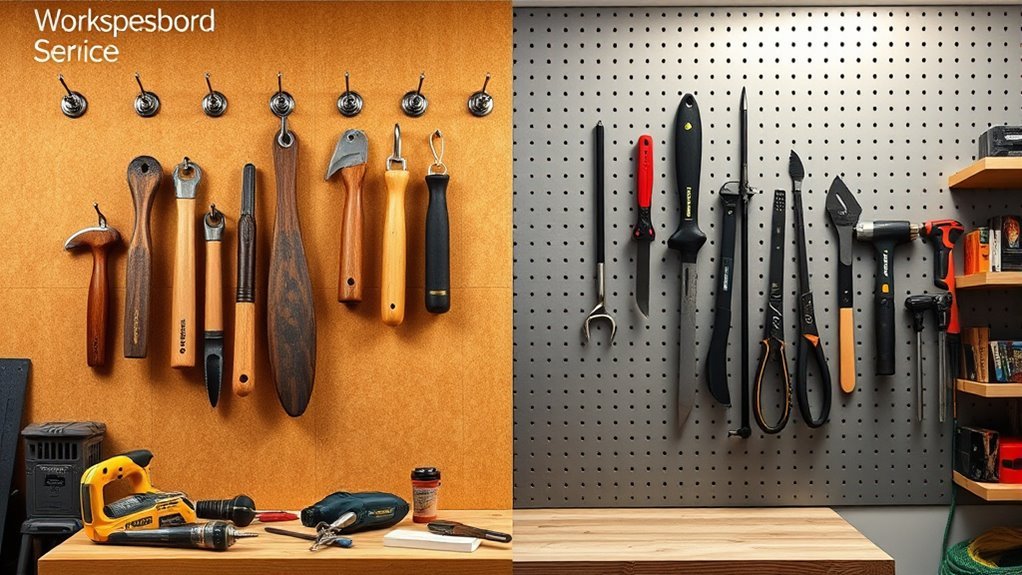
Choosing between fibreboard vs metal pegboard comes down to more than price. Both can turn an empty wall into useful storage, but they differ in strength, moisture resistance, installation, and hook compatibility. Understanding those differences helps you avoid buying a panel that cannot support your tools or fit your space.
Quick Answer
Fibreboard pegboard is an affordable choice for lightweight tools and dry indoor spaces. Metal pegboard generally offers greater strength, better resistance to moisture, and longer-lasting hook openings. However, neither material has one universal weight rating. The safest choice depends on the specific panel, hooks, wall anchors, and installation method.
Last checked: September 26, 2026. Product specifications and cited price examples were checked against manufacturer and retailer sources.
Key Takeaways
- Fibreboard is easy to cut, paint, and customize for home workshops, craft rooms, and light-duty storage.
- Metal pegboard is generally more suitable for heavier tools, frequent hook changes, and demanding workshop conditions.
- Weight capacity depends on the complete installation, not just the material or panel size.
- Traditional fibreboard usually needs spacers or furring strips, while some metal panels have built-in wall clearance.
- Compare hole patterns and accessory compatibility before purchasing hooks, shelves, or storage bins.
Fibreboard vs Metal Pegboard at a Glance
The main difference is how each material performs under load and repeated use. Fibreboard provides economical storage, while steel panels offer a more rigid surface for demanding applications.
| Feature | Fibreboard Pegboard | Metal Pegboard |
|---|---|---|
| Material | Compressed wood fibres, usually hardboard | Commonly steel with a protective finish |
| Typical use | Light hand tools, crafts, and household storage | Workshop tools and heavier storage accessories |
| Weight capacity | Varies with thickness, mounting, and hook design | Generally higher, but still product-specific |
| Moisture resistance | Can swell or warp when exposed to moisture | Does not absorb water like wood fibre, but steel can corrode |
| Installation | Usually requires a supporting frame or spacers | Some panels include built-in mounting flanges |
| Cost | Generally lower upfront panel cost | Usually higher, especially with specialized accessories |
What Is Fibreboard Pegboard?
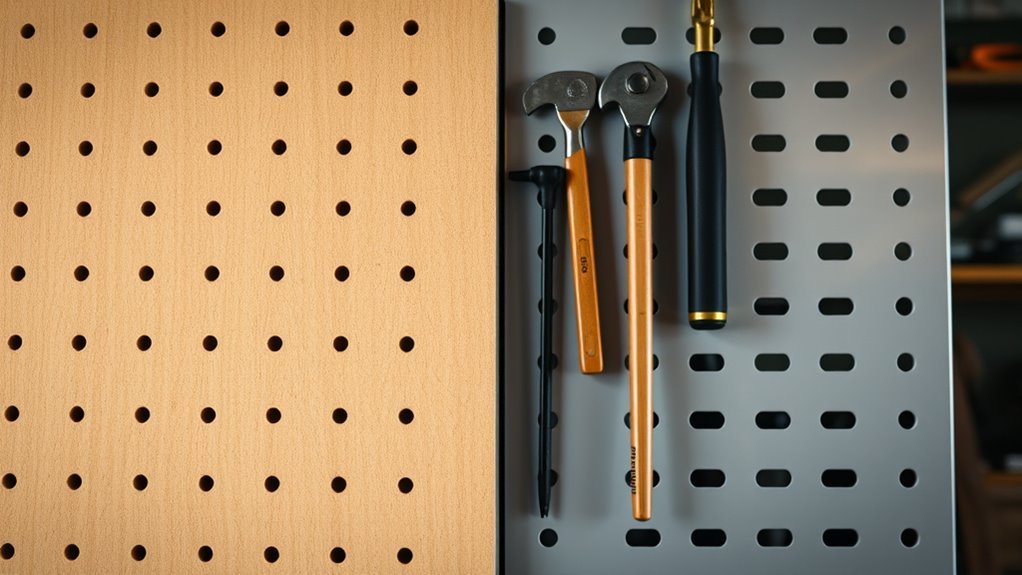
Fibreboard pegboard is a perforated panel made from compressed wood fibres. Its evenly spaced holes accept hooks, brackets, and other storage accessories.
Traditional pegboard is commonly made from hardboard, a dense wood-fibre material also associated with the Masonite name. According to the Composite Panel Association’s hardboard information, manufacturers form hardboard by consolidating wood fibres under heat and pressure.
The result is a smooth, uniform sheet that can be cut, drilled, painted, and shaped using ordinary woodworking tools.
Hole Sizes and Thickness
Fibreboard pegboard commonly has holes designed for either 1/8-inch or 1/4-inch hooks. The hole diameter and spacing determine which accessories will fit.
For example, a hardboard pegboard listed by Lowe’s uses 9/32-inch holes spaced 1 inch apart, measured from the centre of one hole to the next.
That product also provides instructions for mounting the panel to supported framing or furring strips.
Do not assume every board uses identical dimensions. Check the actual panel thickness, hole diameter, and hook specifications before choosing accessories.
Where Fibreboard Works Well
Fibreboard is practical for spaces where tools are relatively light and the wall stays dry.
Common applications include:
- Hanging screwdrivers, pliers, tape measures, and small hand tools.
- Organizing craft supplies, sewing accessories, and household items.
- Creating a storage wall above a workbench.
- Making a custom panel that needs cutting or painting.
Its main weakness is exposure to water. Moisture can affect the wood-fibre structure, especially around exposed edges and holes.
Tempered hardboard can offer improved resistance to wear and moisture, but it should not automatically be treated as waterproof.
How Does Metal Pegboard Compare?
Metal pegboard replaces the wood-fibre panel with a more rigid metal sheet, usually steel. Many systems use galvanized or powder-coated finishes to protect the surface and improve appearance.
Steel panels are generally more resistant to hole wear, sagging, and moisture-related swelling than conventional fibreboard.
They are particularly useful where tools are frequently removed, replaced, or rearranged.
Construction and Durability
Not every metal pegboard is built the same way. Panel thickness, folded edges, mounting design, and protective coating all influence performance.
Some systems use round holes, while others use slots or square openings.
For example, Triton’s LocBoard specifications describe an 18-gauge, epoxy-coated steel system with square holes spaced 1½ inches apart.
Its construction differs from a traditional round-hole fibreboard panel, and it uses a matching locking-hook system.
This illustrates why a metal panel’s strength cannot be judged by material alone.
Maintenance and Appearance
Finished metal pegboard is usually easy to clean with a damp cloth. Its rigid surface also handles repeated contact with tools better than exposed fibreboard edges.
However, metal is not completely maintenance-free.
- Inspect scratches and damaged protective coatings.
- Dry the surface after cleaning or accidental splashes.
- Check mounting screws and accessories for looseness.
- Replace bent hooks or damaged brackets.
Powder-coated metal offers a clean, modern appearance, while galvanized finishes have a more industrial look.
Fibreboard provides a simpler workshop style and can be painted to match surrounding walls or furniture.
Fibreboard Pegboard Vs Metal Pegboard Strength
Metal pegboard generally provides greater load-bearing potential than conventional fibreboard. However, the actual safe load depends on the complete storage system.
A panel’s strength does not tell you how much weight one hook, shelf, bracket, or wall anchor can support.
How Much Weight Can Fibreboard Pegboard Hold?
Conventional fibreboard pegboard is often described as supporting around 10–20 pounds per square foot. However, that figure is not a universal manufacturer rating and should not be used as a guaranteed capacity.
The actual limit changes with board thickness, supporting frame, fastener spacing, wall construction, and the way tools are arranged.
A heavy item hanging from one hook places concentrated stress around a small number of holes. Spreading several lighter items across the panel distributes that load more evenly.
Overloading fibreboard can enlarge holes, damage their edges, or cause the panel to bow.
How Much Weight Can Metal Pegboard Hold?
Metal pegboard can carry substantially heavier loads when the manufacturer has designed and rated the complete system for them.
However, the commonly repeated figure of 75 pounds per square foot should not be treated as a universal steel pegboard rating.
For a documented example, Wall Control’s published load guidance gives the following recommendations for its properly installed panels:
- Up to 100 pounds per panel when installed in conventional drywall using the included anchors.
- Up to 200 pounds per panel when installed into studs or comparable structural support.
- Approximately 5–10 pounds per single-slot hook.
- Approximately 10–15 pounds per hook engaging two slots.
- Approximately 10–20 pounds per shelf assembly with evenly distributed weight.
These figures apply to the manufacturer’s specified system and installation conditions. They are not ratings for every metal pegboard.
Wall Control also states that weight distribution and the distance between the load and panel affect the usable capacity.
A long hook carrying weight near its tip creates more leverage than a short hook carrying the same weight near its base.
Warning: Never assume a panel’s total capacity applies to each individual hook. Check the panel, accessory, and mounting limits separately. Falling tools can cause injury or damage equipment below the pegboard.
Are Fibreboard and Metal Pegboard Hooks Interchangeable?
Some hooks work with both materials, but compatibility is not universal. Hole shape, diameter, spacing, and the locking mechanism all matter.
A traditional round hook may fit a compatible round-hole steel panel, but it will not necessarily work with a square-hole or proprietary slotted system.
Before buying accessories, check these details:
- Hole diameter: Match the hook to the opening specified by the manufacturer.
- Hole spacing: Multi-point accessories need the correct distance between openings.
- Panel thickness: The hook must seat correctly against the board.
- Rear clearance: Conventional hooks need space behind the panel.
- Retention: Locking hooks and clips must engage as designed.
- Load rating: The accessory must support the intended item.
Metal systems sometimes use special hooks that lock into their openings and resist being pulled out with the tool.
That can be useful in a busy workshop, but it may also limit compatibility with accessories from other systems.
If you already own a collection of pegboard hooks, confirm their fit before replacing the panel.
Fibreboard Pegboard Vs Metal Pegboard Cost And Installation
Fibreboard usually costs less upfront, but the final installed price depends on panel size, mounting hardware, and accessories. Metal can cost more, although some steel panels arrive with hardware and built-in mounting clearance.
Compare complete systems rather than judging the materials by panel price alone.
How Much Does Each Type Cost?
Broad estimates often place fibreboard panels around $10–$30 and metal systems around $40–$100. Actual prices vary significantly with dimensions, construction, finish, and included accessories.
Current retail examples show why these ranges should not be treated as fixed minimums or maximums.
| Example | Panel Size | Listed Price |
|---|---|---|
| Lowe’s brown hardboard pegboard | Approximately 2 × 4 feet | $15.89 |
| Lowe’s white hardboard pegboard | Approximately 4 × 8 feet | $24.94 |
| Wall Control steel panel | 16 × 32 inches | $29.97 |
These are examples of listed US prices, not a same-size product comparison. The fibreboard figures come from Lowe’s pegboard listings.
The steel example comes from the manufacturer’s 32-by-16-inch metal pegboard product page.
Prices, stock, and available finishes may vary by location and purchase date.
When calculating your budget, include:
- The required number of panels.
- Furring strips, spacers, or mounting rails.
- Compatible screws and wall anchors.
- Hooks, bins, brackets, and shelves.
- Paint or protective finish if needed.
How Do You Install Fibreboard Pegboard?
Traditional fibreboard pegboard needs a gap behind the panel so the hooks can engage properly. Furring strips provide this clearance and support the board.
The Eucatex pegboard installation guide describes mounting supporting boards over wall studs before attaching the pegboard.
- Measure the wall and mark the intended panel position.
- Locate the wall studs and identify suitable fastening points.
- Cut the supporting strips to the required lengths.
- Secure the strips to the wall using appropriate fasteners.
- Position the pegboard over the supports and check that it is level.
- Attach the panel using the fastening pattern recommended for that board.
- Insert compatible hooks and arrange the tools within the system’s load limits.
Do not mount conventional pegboard flat against the wall without providing the rear clearance required by its hooks.
How Do You Install Metal Pegboard?
Metal pegboard installation depends on the panel design. Some products include formed edges that create their own spacing from the wall.
Those systems may mount directly to studs or suitable wall anchors without a separate wooden frame.
- Identify the wall construction and locate suitable mounting points.
- Position the panel and mark its mounting holes.
- Drill the required pilot holes or prepare the specified anchors.
- Fasten the panel using the manufacturer’s installation instructions.
- Check that the panel is secure and level.
- Install matching accessories and distribute the intended load.
Metal panels are not automatically harder to install. A smaller steel panel with integrated mounting clearance may require fewer steps than a large fibreboard sheet.
However, heavier installations may need additional support, depending on the intended load and wall structure.
Which Pegboard Handles Moisture and Wear Better?
Metal pegboard generally handles damp conditions better because it does not contain wood fibres that can absorb water and swell. A suitable protective finish also helps resist corrosion.
However, neither material should be assumed suitable for prolonged outdoor exposure without checking its specifications.
Fibreboard in Humid Spaces
Fibreboard can work in a dry garage, basement, or utility room. Problems are more likely where condensation, leaks, or repeated wetting affect the panel.
Potential signs of damage include:
- Swelling around holes or exposed edges.
- Bowing or warping.
- Softened or crumbling material.
- Loose hooks caused by enlarged openings.
Painting or sealing a compatible board can improve its finish, but it does not turn ordinary hardboard into a waterproof material.
Metal in Humid Spaces
Galvanized and powder-coated steel offer better resistance to ordinary moisture exposure. They also avoid the swelling problems associated with wood-fibre panels.
Still, scratches, exposed metal, and damaged coatings can allow corrosion to develop.
For either material, choose a product suited to the actual environment rather than relying on appearance alone.
Which Pegboard Is Best For Your Space?
The best pegboard depends on what you need to store, how often you use it, and the conditions around the wall.
For lightweight organization in a dry room, fibreboard can provide everything you need at a modest cost. For heavier tools and frequent rearrangement, a properly rated metal system may offer greater durability.
Choose Fibreboard Pegboard If:
- You want affordable storage for relatively light items.
- Your workshop, garage, or craft room stays dry.
- You prefer a panel that can be cut to a custom shape.
- You want to paint the panel to match the surrounding space.
- Your existing hooks are compatible with the selected board.
Choose Metal Pegboard If:
- You need storage for heavier tools or equipment.
- You regularly change the arrangement of hooks and accessories.
- Your space experiences occasional humidity or splashes.
- You prefer a rigid panel that is easy to wipe clean.
- You want a matched system with locking hooks or specialized brackets.
Check These Details Before Buying
A good purchase starts with your actual storage requirements rather than the material alone.
- List the tools and accessories you plan to hang.
- Check the weight of individual items.
- Measure the available wall space.
- Identify whether the mounting surface is drywall, wood framing, masonry, or another material.
- Compare the manufacturer’s panel and accessory ratings.
- Confirm that the hole pattern works with your intended hooks.
- Choose a finish suitable for the room’s moisture conditions.
After installation, inspect the board for loose fasteners, damaged holes, bending, swelling, or corrosion.
For especially heavy equipment, use a storage system specifically rated for that application rather than assuming an ordinary pegboard will provide enough support.
Frequently Asked Questions
What Is the Best Material for a Pegboard?
The best material depends on your storage needs. Metal is generally more suitable for heavier tools and demanding workshops, while fibreboard provides affordable organization for light-duty use in dry spaces. Compare the actual product ratings, accessories, and mounting requirements before choosing.
Is Metal Pegboard Worth It?
Metal pegboard can be worth the additional cost when you need stronger storage, frequent accessory changes, or better moisture resistance. For lightweight household items, fibreboard may provide sufficient performance without the extra expense. Compare the total installed cost rather than the panel price alone.
Which Type of Pegboard Is the Most Durable?
A properly finished steel pegboard generally offers greater resistance to repeated hook wear, moisture-related swelling, and heavy use than conventional fibreboard. However, its durability still depends on panel thickness, coating quality, installation, and maintenance. Damaged metal finishes can develop corrosion.
Which Type of Pegboard Is Better, Metal or Plastic?
Metal is generally more suitable for demanding tool storage, while plastic can be useful for lightweight organization where moisture resistance matters. Plastic does not rust, but its strength varies by material and construction. Compare the complete product ratings and accessory compatibility before deciding.
Can You Use Metal Pegboard Hooks on Fibreboard?
Some metal hooks work with fibreboard pegboard if their dimensions and attachment design match the panel. However, specialized hooks made for square-hole or slotted steel systems may not fit conventional round-hole fibreboard. Check the manufacturer’s compatibility information before using them.
Can You Paint Fibreboard Pegboard?
Yes, many fibreboard pegboards can be painted to match a room or workshop. Use a finish suitable for the specific board and avoid blocking the holes with excess paint. Follow the manufacturer’s preparation instructions, particularly if the panel has a factory-applied coating.
Conclusion
Metal pegboard generally offers greater strength, durability, and resistance to moisture, making it a practical choice for demanding workshops. Fibreboard remains an affordable, customizable solution for lightweight storage in dry spaces.
Before buying either material, check the panel’s documented capacity, mounting requirements, and accessory compatibility. Choosing a complete system that matches your tools and wall structure matters more than choosing a material based on appearance or a generic weight claim.
Sources
- Composite Panel Association — Hardboard: Hardboard composition, manufacturing, properties, and applications.
- Lowe’s — Hardboard Pegboard Specifications: Hole dimensions, spacing, material properties, and mounting requirements.
- Wall Control — Pegboard Installation and FAQ: Manufacturer load recommendations, accessory compatibility, mounting, and maintenance.
- Triton Products — LocBoard: Steel construction, hole spacing, and compatible locking accessories.
- Eucatex — Installing Pegboard: Fibreboard installation, supporting strips, rear clearance, and hole sizes.
- Lowe’s — Pegboard and Accessories: US hardboard pegboard retail price examples.
- Wall Control — 32-by-16-Inch Metal Pegboard: Steel panel dimensions, construction, accessories, included mounting hardware, and listed price.
