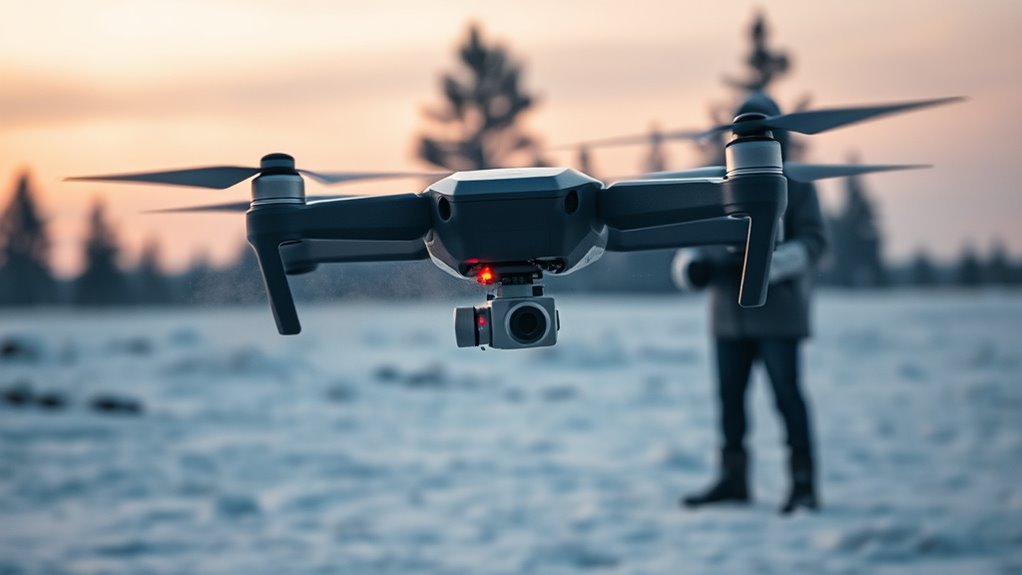
Cold weather changes drone behavior in predictable ways. Lithium-polymer batteries lose capacity, internal resistance rises, and flight time drops faster than many operators expect. Preheating cells to about 20–25°C can improve delivery, but that is only part of the problem. After landing, sealed storage matters because condensation can form as temperatures shift. The critical question is where safe limits begin, and how much performance is lost before the margin disappears.
Why Cold Weather Hurts Drone Batteries
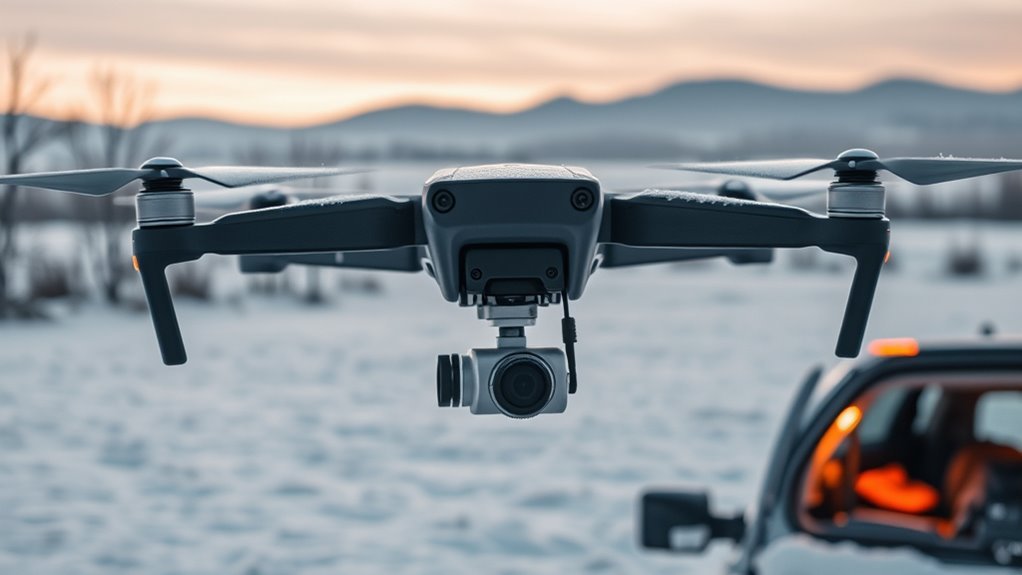
Cold weather substantially degrades LiPo battery performance by slowing the electrochemical reactions that supply power to a drone’s motors and electronics.
In winter months, a cold battery loses usable capacity, often dropping 20–30% at 32°F (0°C) and more than 50% at 14°F (-10°C). Higher internal resistance compounds the problem, causing voltage sag, abrupt power loss, and failure modes that can appear despite a nominally full charge.
Flight duration consequently contracts sharply, frequently falling from 20–25 minutes to 10–15 minutes or less under sustained cold exposure. These constraints reduce operational autonomy and narrow the margin for safe mission completion.
The underlying mechanism is not mystery but physics: reduced ion mobility limits current delivery, while electrical demand from flight control systems remains constant.
Charging a cold battery also increases the risk of lithium plating, accelerating degradation. Effective battery performance in cold conditions requires recognition that temperature, not just state of charge, governs readiness and reliability.
Warm Drone Batteries Before Takeoff
Warming drone batteries to about 75°F (25°C) before takeoff improves LiPo performance by lowering internal resistance and reducing voltage sag under load.
For operators who need reliable, self-directed flight, warm drone batteries should be brought to roughly 20–25°C (68–77°F) before arming the craft. At this battery temperature, lithium-polymer (LiPo) batteries deliver steadier current, with less cold-related capacity loss and more predictable thrust response.
During transport, insulated cases or hand warmers can preserve the target temperature and reduce thermal drift. After launch, a 30–60 second hover warm-up can help stabilize battery temperature further and smooth power output.
This procedure supports safer, more efficient operation without sacrificing mobility or control. The method is especially valuable when ambient conditions would otherwise compress flight time and constrain mission autonomy.
Know Your Cold-Weather Flight Limits
Operational limits for cold-weather drones are tightly constrained, with most models performing best between 32°F (0°C) and 104°F (40°C), while lithium-polymer batteries can lose 20–30% of capacity at freezing and more than 50% near 14°F (-10°C). When flying in cold weather, mission planning should treat temperature as a hard constraint, not a nuisance. Preheated battery packs, held near 68–77°F (20–25°C), help preserve usable output. Operators should also land at 30–40% charge in cold conditions to avoid abrupt voltage sag.
| Factor | Threshold | Effect |
|---|---|---|
| Ambient cold | 32°F / 0°C | Reduced endurance |
| Battery state | 30–40% | Land safely |
| Wind chill/humidity | Variable | Lower performance |
Checking multiple forecasts improves decision quality, because cold, wind chill, and humidity interact. These limits support disciplined, liberated flight through informed restraint, not excess.
Reduce Condensation After Landing
After landing in cold conditions, the drone should remain sealed in a bag until it reaches room temperature, preventing warm air from condensing on chilled components. This controlled change is essential for any drone in cold weather, because condensation can form on motors, sensors, and circuit boards when cold surfaces meet humid air.
The battery warm-up process should also be gradual, with the pack allowed to stabilize indoors before inspection or recharge. Rapid drying methods such as heat guns or hair dryers are technically unsound; they impose thermal shock and may drive moisture deeper into assemblies.
A dry microfiber cloth can remove surface moisture after flight, but only after the unit has warmed. Silica packets in the storage case add passive moisture control and reduce residual humidity. Such measured handling preserves reliability and keeps the system free from avoidable environmental stress.
Cold Weather Drone Checklist for Pilots
With condensation risk controlled after landing, the pilot’s next priority is a preflight checklist tailored to low temperatures.
The Drone Battery should be preheated to 20–25°C before arming, because cold chemistry reduces current delivery and can trigger sudden failure. Each battery must be inspected for swelling, cracked casing, or abnormal voltage, and used only if it meets the manufacturer’s 15°C minimum.
The craft should launch from a landing pad to reduce snow and moisture transfer during takeoff. After liftoff, the aircraft should hover 30–60 seconds so batteries warm and telemetry can confirm stable voltage.
Flight planning must assume shorter endurance; 20–25 minute warm-weather missions may shrink to 10–15 minutes in frost. This discipline protects autonomy, reduces dependence on rescue, and supports a successful drone operation under harsh conditions.
Frequently Asked Questions
What Temperature Is Too Cold for Drones?
Too cold for drones is typically below 32°F (0°C), where drone performance declines and battery lifespan is stressed.
At 14°F (-10°C) and lower, LiPo-powered aircraft face severe capacity loss, higher internal resistance, and possible sudden power failure.
In cold weather, manufacturers generally advise limiting or avoiding flight below this threshold.
A prewarmed battery near 68-77°F (20-25°C) improves operational reliability and preserves usable energy.
How to Get Drone Battery Out of Hibernation Mode?
The battery is best restored from hibernation by warming it gradually to 20–25°C before use.
Hibernation causes typically include discharge below about 3.2V per cell, which activates protective shutdown.
Battery maintenance tips emphasize sealing it in a bag during warm-up to limit condensation.
Warm up techniques should remain slow and controlled, then the pack may be charged only at room temperature, following manufacturer limits and health checks to preserve operational freedom.
What Is the 1:1 Rule for Drones?
The 1:1 rule for drones is a battery management guideline requiring one minute of warm-up for each minute of planned flight time.
Like a machine shaking off frost, it helps preserve drone performance in cold weather by allowing the battery to stabilize before load increases.
It is especially relevant below 32°F (0°C), where power delivery can drop sharply.
A brief hover after takeoff further supports reliable operation and safer, freer flight.
Is It Illegal for My Neighbor to Fly a Drone Over My Property?
It is not automatically illegal, but legality depends on airspace regulations, state law, and the facts of the flight.
FAA rules generally allow a neighbor to fly a drone over private property if the pilot stays within visual line of sight and follows safety limits.
However, drone privacy concerns, trespass claims, and neighbor disputes can arise if the flight is intrusive or unlawful.
Permission is the clearest path to avoid conflict.
Conclusion
Cold weather narrows a drone’s operating envelope like a vice on performance. Battery chemistry, flight endurance, and post-landing moisture control all become critical variables. Preheating lithium-polymer packs to 20–25°C improves output, while conservative flight planning compensates for reduced capacity. After landing, sealed transport and gradual warming limit condensation risk. Pilots who respect these thermal constraints and inspect equipment carefully can maintain reliability, protect hardware, and operate safely in low-temperature conditions.
