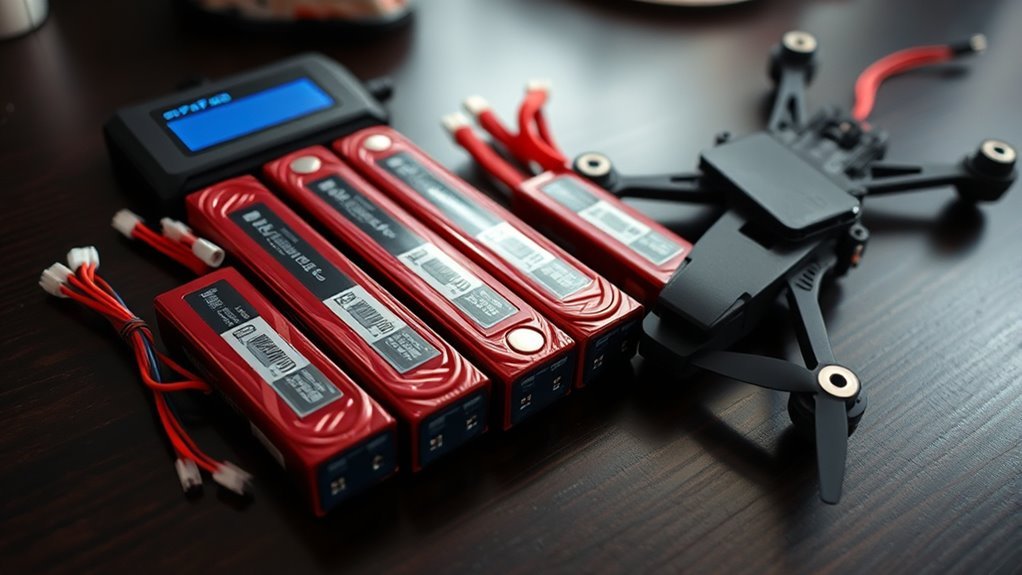
FPV battery selection shapes voltage, thrust, flight time, and safety. Cell count defines how hard a drone can push; C-rating limits current delivery under load; capacity affects endurance and weight; connectors determine whether power flows cleanly and reliably. Each specification changes performance in a different way, and mismatching them can reduce efficiency or damage hardware. The details behind those numbers are easier to miss than they first appear.
How to Read FPV LiPo Battery Specs
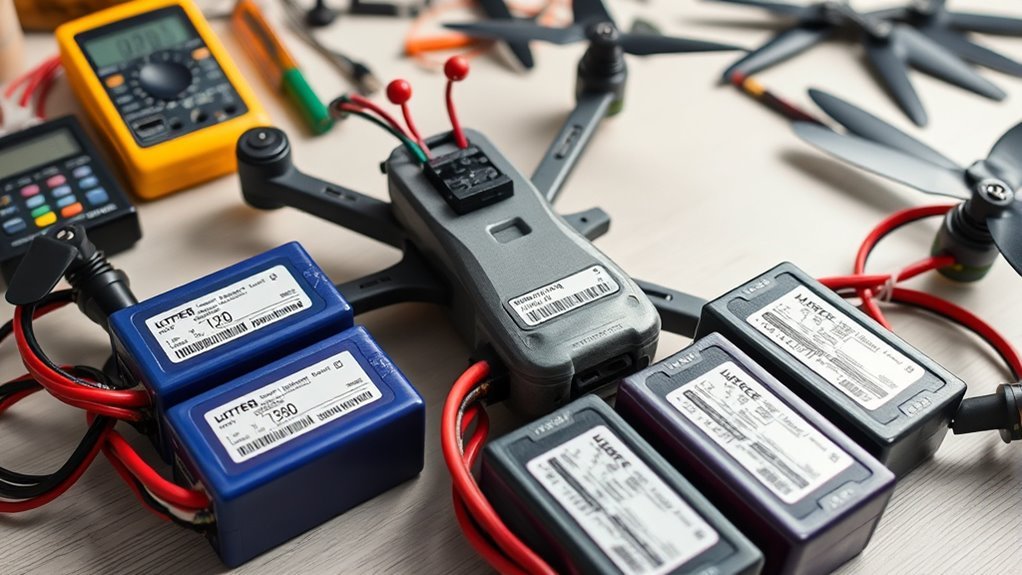
FPV LiPo battery specifications are read by interpreting four core parameters: cell count, capacity, C-rating, and connector type, with voltage limits also defining safe use.
Cell count, shown as “S,” indicates series cells; each cell contributes 3.7V nominal voltage, so a 4S pack totals 14.8V.
Capacity, measured in mAh, describes stored energy; a 1300mAh pack can theoretically supply 1.3A for one hour.
C-Rating defines discharge rate and maximum current by multiplying capacity in Ah by the rating; a 2.2Ah 30C battery can deliver 66A. These figures directly shape battery performance in FPV Drones.
Connectors such as XT60 and XT30 must match the ESC and current demand.
Voltage management remains critical: LiPo cells are typically safe between 3.2V and 4.2V, with about 3.5V per cell as a prudent landing threshold to avoid over-discharge and preserve pack integrity.
Choose the Right Cell Count for Your Drone
Cell count, marked as “S,” is the primary voltage decision for an FPV drone battery, with 4S delivering 14.8V and 6S delivering 22.2V. In LiPo batteries, this choice shapes thrust, responsiveness, and overall performance in FPV drones. By 2025, 6S is the industry standard for high-performance builds because higher voltage supports efficient power delivery and stronger acceleration.
Cell count is the primary voltage decision: 4S for 14.8V, 6S for 22.2V, with 6S now the standard for performance.
– 5″ freestyle and racing drones often use 4S 1500mAh or 6S 1100–1300mAh packs.
Higher cell count can improve discharge behavior and flight stability, but it may increase weight. ESCs, motors, and connectors must match the selected cell count to prevent damage and preserve control.
Capacity should be chosen alongside voltage, not as a substitute for it, since battery mass affects agility. The correct balance lets pilots retain freedom of movement while avoiding underpowered or overstressed systems.
Understand C-Rating and Current Output
C-rating defines the maximum discharge capability of a LiPo battery, making it a direct measure of how much current a pack can supply under load.
In practical terms, a 2200mAh pack at 30C can deliver about 66A, because battery capacity in amp-hours is multiplied by the C rating.
For most FPV flight, continuous C matters more than burst rating, since it reflects sustained maximum continuous output rather than brief spikes.
The selected pack should meet motor current draw without excessive internal resistance, which otherwise causes voltage sag, heat, and performance loss.
A higher C rating can improve current delivery, but only when the motor and ESC are compatible.
To assess fit, divide total load by battery capacity in Ah, then confirm the required C rating exceeds that demand.
This calculation preserves efficiency, protects the pack, and supports freer, more consistent power delivery under aggressive maneuvers.
Pick the Best LiPo Capacity for Flight Time
Battery capacity, measured in milliamp hours (mAh), is one of the main factors governing FPV flight time, since a larger pack can theoretically supply current for a longer period under the same load.
For LiPo packs on FPV drones, 1000mAh to 1500mAh is common, and 1300mAh often gives a practical balance between liberation of handling and endurance. Higher capacity increases flight time, but added weight can reduce agility and raise current draw in aggressive maneuvers.
Battery cells and voltage set the platform’s power level, while C rating and discharge C rating determine whether the pack can meet demand without sag.
- A 1500mAh pack can sustain 1.5A for roughly one hour.
- A 1300mAh, 100C pack can theoretically deliver 130A.
- Selecting capacity should match motor requirements and preserve responsive flight.
Match FPV Battery Connectors and Balance Plugs
Reliable FPV power delivery depends on matching the main discharge connector and balance plug to the drone, charger, and pack configuration. FPV battery packs usually use battery connectors such as XT60 for higher current or XT30 for smaller builds, while the balance connector carries one more wire than the cell count to track the voltage of each cell. This protects each individual cell during charging and limits safety risks from imbalance, swelling, or overdischarge. Chargers and ESCs must accept the same connector standard, wire gauge, and voltage rating; otherwise performance drops. | Pack | Main Plug | Balance Plug | |—|—|—| | 2S | XT30 | 3-pin | | 4S | XT60 | 5-pin | | 6S2P | XT60 | 7-pin | | Parallel packs | matched | matched | | Result | safe current | even charging | A pack’s C rating does not excuse connector mismatch.
Frequently Asked Questions
Does the C Rating on a Lipo Battery Matter?
Yes, the C rating matters because it governs battery discharge capability, voltage sag, and performance impact under load.
Higher ratings improve heat management and can protect LiPo longevity, though weight considerations and flight time may shift. Charging speeds do not change discharge limits.
Quality battery brands often publish conservative figures, so safety precautions remain essential.
Matching the C rating to the craft’s current demand preserves stable power and reliable thrust.
What Does the 30C and 50C Mean on a Lipo Battery?
30C and 50C mark a LiPo battery’s discharge rate, like a valve opening wider under load. Thirty-C means the pack can safely deliver 30 times its capacity in amps; fifty-C, 50 times.
Higher C reduces voltage sag effects and suits high performance applications, but raises temperature effects and battery lifespan factors.
Proper LiPo maintenance tips, battery storage guidelines, charging safety practices, balance charging benefits, and connector types explained all matter.
What Is the C5, C10, and C20 Battery Rating?
C5, C10, and C20 denote a battery’s continuous discharge rate in multiples of capacity: C5 means 5× capacity, C10 means 10×, and C20 means 20×.
These ratings shape battery performance, voltage stability, heat management, and battery lifespan under load. Higher discharge rates suit demanding systems, but weight considerations, cost factors, brand comparisons, charging efficiency, and user experiences should guide selection for liberated, precise power use.
What Is the Highest C Rating for a Lipo Battery?
LiPo batteries can exceed 100C, with top high performance batteries reaching about 130C for racing applications. Such ratings promise aggressive discharge rates, reduced voltage drop, and strong thrust.
Yet battery longevity depends on thermal management, safety precautions, weight considerations, and proper charging techniques. Brand comparisons matter because advertised peaks vary widely.
Continuous current ratings remain the critical metric, while burst figures merely indicate short-lived freedom, not sustained capability.
Conclusion
To summarize, FPV LiPo selection depends on four linked variables: cell count, C-rating, capacity, and connector compatibility. Higher cell counts raise voltage and power delivery, while C-rating determines whether the pack can sustain peak current without excessive sag. Capacity extends flight time but adds weight, reducing agility. One useful reference point is that many 5-inch racers use 4S or 6S packs, with 6S often reducing current for the same power, improving efficiency and control.