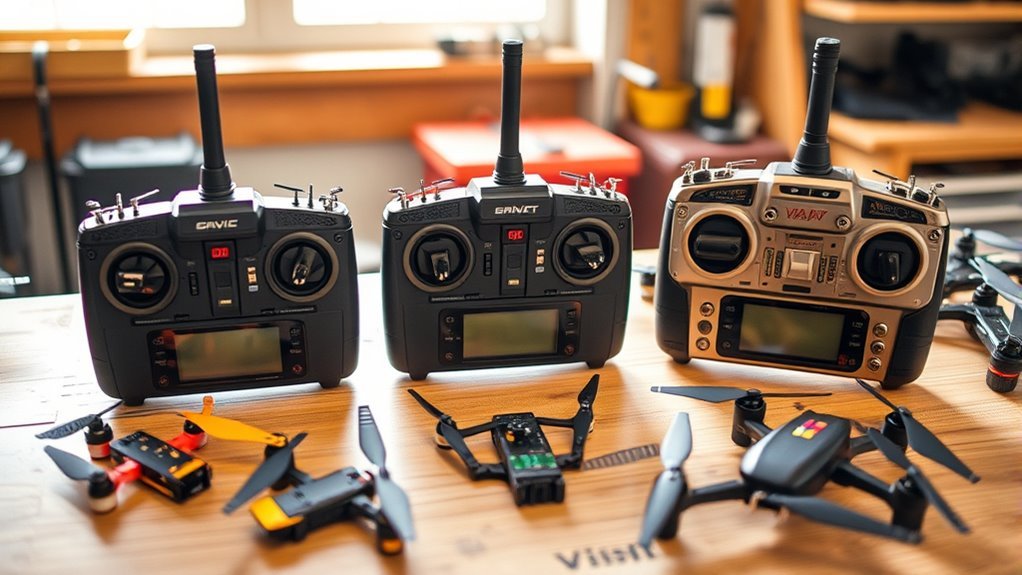
Choosing an FPV radio transmitter starts with the protocol, since ExpressLRS offers low latency and solid range for most pilots. Gimbals matter next, with compact options favoring thumbers and full-size sticks better for pinch grip, ideally with Hall Effect sensors. From there, budget and features narrow the field, from entry-level radios to advanced EdgeTX models with module bays and better switches. The best fit depends on how each part aligns.
Choose the Right FPV Radio Protocol
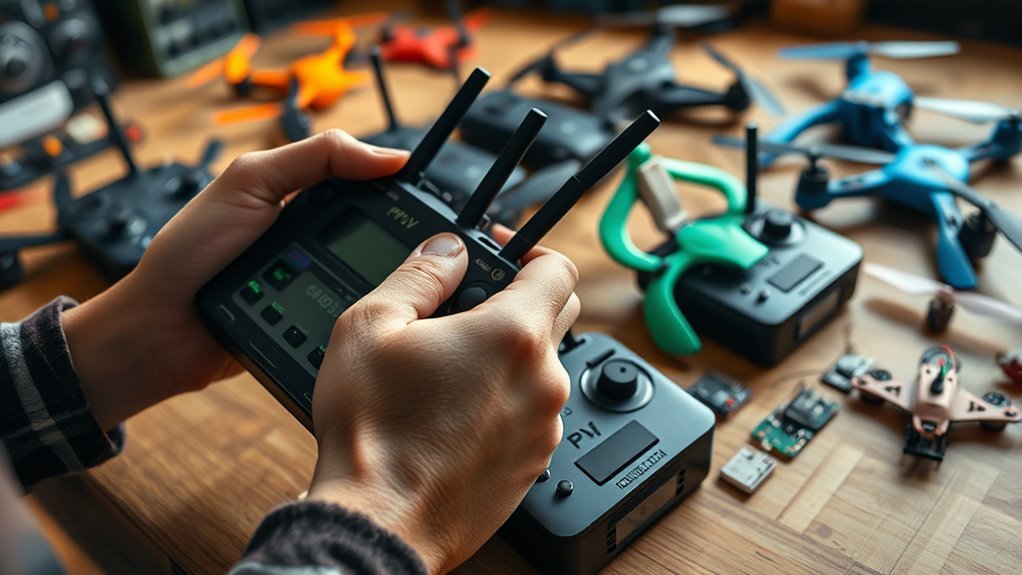
The choice of FPV radio protocol should start with receiver compatibility and performance requirements. ExpressLRS, FrSky, and TBS Crossfire are common protocols, but ExpressLRS is often preferred for FPV pilots who want low latency, strong range, and open control.
FPV radio protocol choice should prioritize receiver compatibility, with ExpressLRS favored for low latency, range, and open control.
Its receiver ecosystem improves compatibility across many builds, reducing dependence on locked hardware. Radios with internal modules are convenient for budget picks and compact setups, while external module bays preserve upgrade freedom and broader protocol support.
For reliable operation, the chosen radio protocol should match the drone receiver exactly, and the firmware should remain actively maintained. EdgeTX support is important because it keeps menus, features, and protocol options current.
In practice, ExpressLRS gives several kilometers of range with minimal delay, making it suitable for racing and long-distance flight. Careful protocol selection protects autonomy by preventing unnecessary replacements and limiting vendor dependence.
Pick Gimbals That Fit Your Grip
Gimbals are the interface that turns pilot input into drone motion, so their quality and shape matter as much as the radio protocol. FPV pilots should match gimbals to grip style before judging any transmitter.
Thumbers often prefer compact, gamepad-like layouts, while pinchers usually gain comfort and leverage from full-size gimbals. Hall Effect units are the stronger choice because they resist wear, hold calibration longer, and preserve precision across temperature changes.
That stability supports responsive control and reduces dead zones, which improves flight performance in tight maneuvers and long sessions. Traditional potentiometer gimbals can work, but they age faster and lose smoothness sooner.
A well-matched transmitter frees the pilot from fighting the sticks and lets input feel direct, consistent, and predictable. For extended use, the best gimbals are the ones that disappear under the fingers while still delivering exact authority.
Choose a Radio for Your Flying Style
A pilot’s radio should match both grip style and control demands, since form factor affects comfort and stick authority as much as gimbal quality. Thumbers often prefer compact RadioMaster units, while pinchers gain steadier leverage from full-size shells.
Within the available gimbal types, hall effect gimbals are the practical choice for smooth response, resistance to wear, and precise centering. Functionality matters next: additional switches, telemetry access, and clear control layout support disciplined maneuvering in freestyle or racing.
Protocol compatibility should also be checked, because a versatile link such as ExpressLRS expands receiver options and keeps the system adaptable. When selecting a controller, budget wisely; beginners and experienced pilots alike benefit from matching cost to required features rather than chasing extras.
The right radio should feel freeing, not restrictive, letting the pilot focus on line choice, recovery, and control confidence.
Best FPV Radio Picks by Budget
Budget narrows the field quickly once grip style, gimbal preference, and protocol support are settled.
For a budget entry, the RadioMaster T8L is the lowest-cost ExpressLRS option, screenless and limited to 10 channels, which suits beginners or a spare transmitter.
The best FPV radio for features and affordability often becomes the RadioMaster Boxer, a balanced choice with a built-in 1W ExpressLRS 2.4GHz module and enough capability for new and experienced pilots.
A mid-range choice is the RadioMaster TX15 at about $139; it adds a color touchscreen, built-in ELRS, and AG02 gimbals in a compact shell.
For a premium pick, the TX16S MKII MAX sits near $250, pairing a 4.3 IPS touchscreen with Hall V4.0 gimbals and dual-band support.
The Zorro remains a practical honorable mention for those who prefer gamepad handling and a competitive price point.
Compare EdgeTX, Switches, and Module Bays
EdgeTX is the dominant open-source firmware for FPV radios because it provides broad device support, deep configuration options, and a workflow that scales from beginner setups to advanced models.
On modern FPV radios, EdgeTX improves access to protocols, gimbals, and model-specific mixing without forcing dependence on closed ecosystems.
The practical minimum for switches is four plus a momentary input: two 2-position, two 3-position, and one momentary switch. This layout supports arming, flight modes, and auxiliary functions with less compromise.
Module bays add freedom by enabling external protocol modules, including ExpressLRS, while preserving compatibility with older receivers and future upgrades.
Radios like the TX16S MKII show how internal multiprotocol hardware and external module bays can coexist.
Premium radios usually pair this flexibility with durable switches rated beyond 100,000 cycles, while budget options may trade longevity for lower cost.
Performance and quality should be judged together.
Frequently Asked Questions
What Is the Best FPV Radio Transmitter?
The best FPV radio transmitter is the RadioMaster TX16S MKII MAX for most advanced users.
Its FPV transmitter features include a large touchscreen, Hall gimbals, and strong Radio protocol compatibility.
Gimbal quality comparison favors its precision, while range performance metrics and battery life considerations remain solid.
Antenna types explained matter for reliability, as do ergonomics in design.
Firmware update importance, user interface design, and Brand reputation analysis also support its lead.
Why Was DJI FPV Discontinued?
DJI FPV was discontinued because market trends shifted, consumer feedback weakened, and competition analysis showed stronger alternatives.
The DJI legacy in FPV gave way to product evolution elsewhere, as technical limitations, regulatory pressure, and poor user experience reduced demand.
Feature comparison favored newer systems like ExpressLRS, shaping future prospects away from DJI.
The industry impact was a market opening, while DJI redirected resources to higher-growth products and safer, more flexible platforms.
Is HDZERO Better Than Analog?
HDZero is better than analog for image clarity and control, but only in specific use cases.
HDZero advantages include sharper detail, better color, and strong HDZero latency for racing.
Analog performance still wins on Analog range, Analog cost, and broader Analog community support.
HDZero compatibility is improving, while Analog signal quality remains practical in harsh conditions.
The preferred setup depends on the pilot’s needs, HDZero user experience, and HDZero future.
What Is the Best Budget Controller for FPV?
The best budget controller for FPV is the RadioMaster T8L. A pilot once swapped a noisy old radio for one and compared it to trading shackles for open air.
Among affordable options, beginner recommendations and brand comparisons favor its screenless setup, web configurability, and solid user reviews.
Essential features include compatibility, range capabilities, ergonomic design, and upgrade paths.
For long term reliability, the Radiomaster Pocket remains close behind.
Conclusion
In the end, choosing an FPV radio transmitter is a balance of protocol, ergonomics, and budget. ExpressLRS remains the sharpest tool for low-latency, reliable control, while Hall Effect gimbals improve long-term precision. Matching the radio to the pilot’s grip and flying style prevents wasted money and discomfort. Budget models can still perform well, but the best transmitter is the one that fits like a glove and supports future upgrades through EdgeTX and module bays.
