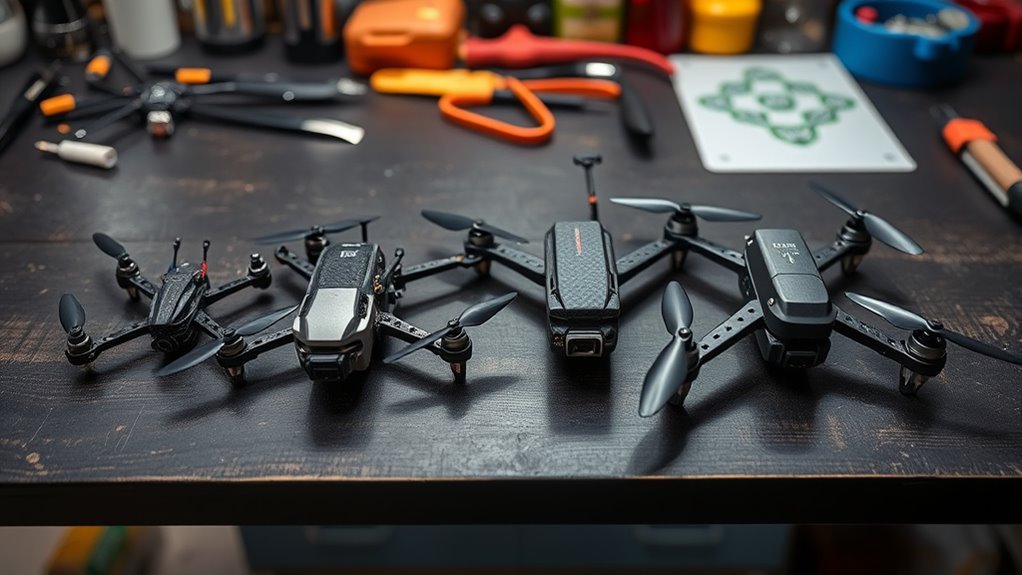
FPV drone frame size sets the tone for everything that follows: control, weight, power draw, and the kind of space a pilot can realistically fly in. A whoop can slip through indoor gaps with ducted props, while a 3-inch build aims for balance. The 5-inch frame remains the freestyle benchmark, and 7-inch rigs trade agility for stability. The real question is how these differences change the entire build.
How FPV Drone Sizes Are Measured
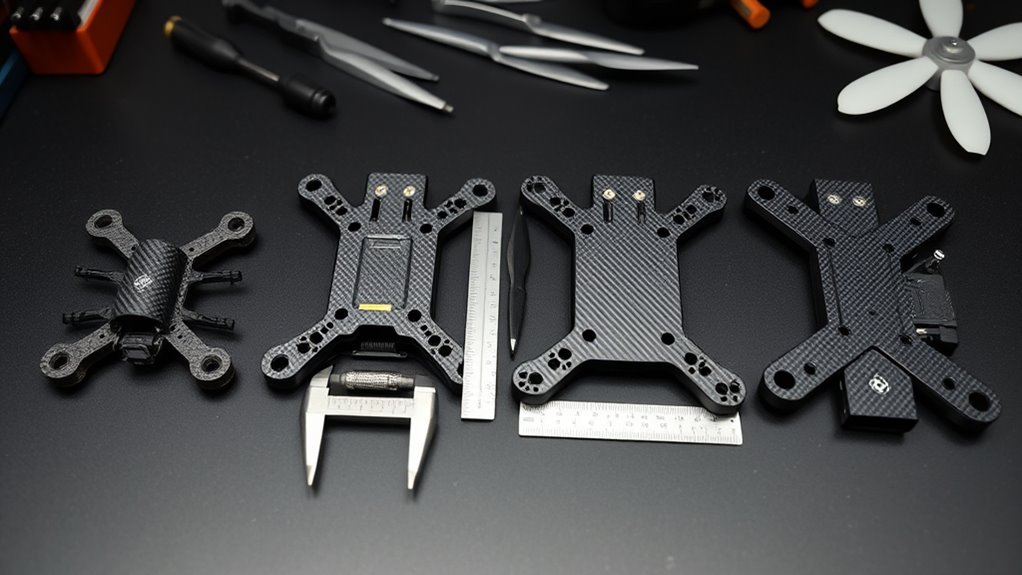
FPV drone size is typically defined by the wheelbase, the diagonal distance between the centers of two opposite motors, since this measurement directly affects frame geometry, stability, and handling.
In technical terms, frame size is consequently not a vague label but a structural specification that establishes propeller clearance, arm span, and the scale of the airframe. A 5-inch or 7-inch craft is classified by the prop size it can efficiently carry, because propeller diameter governs thrust, efficiency, and load capacity.
Smaller frames, measured in millimeters, support compact builds, while larger frames support greater lift and steadier flight. For pilots seeking liberation through precise control, understanding these measurements is essential.
Smaller frames enable compact builds, while larger ones deliver steadier lift and precise control.
It allows informed selection for racing, freestyle, or cinematic use, matching the airframe to the mission rather than accepting imposed limits.
Whoop Frames for Tight Indoor Flying
Whoop frames, typically 65mm to 85mm, are optimized for tight-space maneuvering in indoor environments where compact geometry and low mass improve control.
Their ducted props function as built-in prop guards, reducing impact risk near people and objects while supporting safer close-quarters flight.
For beginner indoor control, the 65mm class is often favored for its responsive handling and suitability for short 3 to 4 minute sessions.
Tight-Space Maneuvering
For pilots needing maximum agility in confined spaces, whoop frames in the 65mm to 85mm range are purpose-built for tight indoor maneuvering.
In this regime, the Whoop platform delivers precise response, allowing controlled lines through hallways, rooms, and obstacle-rich layouts. Its lightweight structure reduces inertia, so attitude changes occur rapidly with minimal lag, supporting racing and freestyle where liberation comes from unbroken flow.
The compact footprint also limits collision energy, making close-quarters operation practical for indoor pilots. Community polling reinforces this utility: 65mm models command roughly 70% preference, reflecting proven effectiveness.
Typical flight durations of 3 to 5 minutes encourage efficient, deliberate use rather than excess weight.
Prop Guard Safety
Beyond agile handling in confined spaces, whoop frames add a direct safety advantage through ducted prop design. This prop guard safety architecture surrounds rotating blades, reducing contact risk with people, furniture, and walls during indoor flight.
In 65mm to 85mm formats, the compact shell preserves freedom of movement while limiting damage if a collision occurs. The 65mm whoop remains the OG choice for pilots seeking controlled indoor liberation.
- Ducts shield prop tips from direct impact.
- Smaller mass lowers kinetic energy on contact.
- Short 3 to 4 minute flights fit confined environments.
- Reduced injury and object damage support repeated practice.
Beginner Indoor Control
Compact control is where whoop frames excel, especially in 65mm to 85mm formats built for tight indoor flight.
A Whoop’s lightweight shell and ducted prop system produce predictable handling in confined rooms, hallways, and practice spaces. The ducts function as integrated guards, lowering strike risk near furniture, walls, and people. For beginners seeking freedom from expensive repairs, this margin matters.
Flight times of roughly 3 to 4 minutes are enough for repetition, orientation, and confidence building without overwhelming battery management. The small size and modest thrust-to-weight ratio limit aggressive freestyle, yet that restraint supports slow, precise control.
Community preference still favors the 65mm Whoop as a proven “OG” platform for first flights indoors and disciplined skill development.
Why 3-Inch FPV Drones Are the Middle Ground
3-inch FPV drones occupy a practical middle ground because they combine enough agility for tight, technical flying with enough stability and payload capacity to remain usable outdoors and with small cameras.
For pilots seeking freedom without excess, 3-inch FPV drones deliver a controlled escape from extremes. Their weight and thrust-to-weight ratio permit precise line changes, while the frame remains light enough to thread gaps that larger platforms cannot.
Typical flight times of 4 to 8 minutes are sufficient for disciplined practice and efficient sorties.
- Balanced indoor and outdoor capability.
- Compact size with usable camera payload.
- Strong maneuverability for advanced control.
- Lower cost and broad parts availability.
This combination makes the format technically versatile and economically accessible. It supports progression from basic hovering to confident acro, yet does not demand the expense, inertia, or risk profile of larger builds.
For many, 3-inch FPV drones represent the most liberated compromise.
5-Inch FPV Drones: The Freestyle Standard
5-inch FPV drones are widely regarded as the freestyle standard because they combine enough agility and speed to satisfy most racing and acrobatic demands while remaining manageable across a broad range of pilot skill levels.
Their high thrust-to-weight ratio gives 5-inch drones the authority to launch into dives, power loops, split-S turns, and rapid recoveries without sacrificing control. This makes them the preferred platform for pilots seeking expressive flight and mechanical freedom.
Typical flight times fall between 3 and 8 minutes, depending on throttle use and battery selection. Their popularity also creates a dense ecosystem of frames, motors, and replacement parts, keeping repairs and upgrades practical and cost-effective.
That versatility supports experimentation and long-term ownership. However, the same performance profile can limit very slow precision work, where smaller frames may respond with finer nuance.
Why 7-Inch FPV Drones Feel So Smooth
Where 5-inch frames are prized for aggressive freestyle, 7-inch FPV drones are favored when smoothness matters most. Their 154-square-inch disc area moves more air, so prop wash is corrected with less effort and the aircraft feels locked in.
Hover current on 6S often falls to 3-5A, which reduces motor strain and extends flight time. The longer arms also shift resonant frequencies lower, damping oscillation and yielding a calmer response in wind and during throttle changes.
On 6S, hover current drops to 3–5A, easing motor strain and calming the frame in wind.
- Larger props recover faster from turbulence.
- Lower hover RPM cuts noise and amp draw.
- Reduced resonance improves attitude stability.
- Payload capacity supports cleaner cinematic footage.
For pilots seeking liberation from jittery control, the 7-inch format delivers measured authority rather than raw aggression. It is a platform built for distance, composure, and sustained precision, where smoothness is not incidental but engineered into the frame.
How Frame Size Changes Motors and KV
Frame size directly determines the motor and KV range a build can use efficiently, because prop diameter and disc area change the load placed on the power system.
On a 5-inch frame, lighter motors with higher KV are common, and 2400-2700KV setups deliver the quick RPM response that supports agile flight.
On a 7-inch frame, that same KV range is excessive; the larger disc area demands stronger motors and lower KV to prevent overheating and wasted energy. A typical 7-inch setup often sits near 1300KV, as seen in motors such as the uavmodel XING2 2807, which can move larger props without forcing excessive RPM.
Using leftover 5-inch motors on a 7-inch build usually produces weak thrust, poor authority, and thermal stress.
Proper frame size and motor pairing consequently preserves efficiency, protects hardware, and restores the pilot’s freedom to choose either sharp maneuverability or relaxed cruising.
Battery, ESC, and Weight Picks by Size
As frame size increases, battery capacity, ESC headroom, and airframe mass must all scale together to preserve performance and reliability.
Smaller frames in the 65mm to 100mm range favor a battery in the 200mAh to 800mAh class, paired with low-mass components and 15C to 30C discharge ratings to protect agility.
Larger platforms, especially 300mm and above, can carry battery packs up to 8000mAh, but only if the frame and hardware absorb the added load without wasting thrust.
- Whoops prioritize minimal mass and fast response.
- Mid-size builds need balanced battery capacity and moderate ESC margin.
- 7-inch systems demand higher-rated ESCs to prevent current spikes and desync.
- Heavier frames should use sturdier materials to support cameras and endurance packs.
This scaling logic gives pilots more autonomy: the machine remains efficient, stable, and able to fly farther without sacrificing control.
Choose the Right FPV Drone Size
Selecting the correct FPV drone size begins with matching the frame to the intended flying style, since racing, freestyle, and long-range use impose different requirements on agility, stability, and endurance.
Budget and build complexity also scale with size, as smaller frames generally use lighter, less expensive components, while larger frames demand more robust hardware and higher-capacity power systems.
The ideal choice balances performance needs against total cost, component availability, and the intended operating environment.
Flying Style Match
Flying style should dictate FPV drone size choice, because airframe dimensions directly affect maneuverability, payload capacity, and flight efficiency. In a proper flying style match, the pilot selects a frame that amplifies intent, not constraint.
- 65mm whoops suit indoor corridors and tight gaps.
- 3-inch Cinewhoops enter narrow spaces with controlled, cinematic precision, yet remain less agile and have shorter endurance.
- 5-inch frames deliver the most balanced response, supporting racing, freestyle, and beginner progression.
- 7-inch drones prioritize long-range cruising and stable cinematic work, carrying heavier cameras while trading away close-quarters agility.
Larger frames also extend flight time, with some 7-inch platforms reaching 15-20 minutes, enabling extended missions and more liberated line choice.
Budget And Build
Budget and build decisions should be matched to the intended airframe size, because frame dimensions determine battery load, motor requirements, and overall efficiency. A disciplined budget favors smaller frames for indoor or racing use, since 65mm-100mm builds use lighter 200mAh-800mAh packs and simpler power systems. Larger platforms demand higher spending, but they reward autonomy and payload capacity for aerial work.
| Size | Typical use | Build impact |
|---|---|---|
| Whoop/3-inch | Indoor, racing | Low-cost, compact |
| 5-inch | Agility, efficiency | Balanced parts cost |
| 7-inch | Long-range, filming | Higher battery and motor expense |
On a 7-inch build, lower-KV motors around 1300KV and 3-5A hover current on 6S protect components and extend flight time. Choosing the right budget enables technical freedom.
Frequently Asked Questions
What Is the Most Popular Size for FPV Drones?
The most popular size for FPV drones is the 65mm whoop. In Size Comparison terms, it leads due to its lightweight frame, agile handling, and strong suitability for indoor flight and racing.
Community data shows roughly 70% preference for this size, with 75mm models trailing behind at 28%. The pattern indicates a clear technical bias toward compact, versatile designs that maximize control, responsiveness, and freedom in confined environments.
Are Tiny Whoops Worth It?
Yes—Tiny Whoops are worth it. For example, a beginner practicing in a small apartment can fly repeatedly without damaging furniture or injuring bystanders.
Their ducted 65mm design provides strong safety margins, predictable handling, and a low-risk path to skill acquisition.
In Performance Comparison, they sacrifice endurance and speed, yet deliver exceptional control in confined spaces.
For pilots seeking autonomy through accessible practice, they remain highly efficient and strategically valuable.
How Much Can a 5 Inch FPV Drone Lift?
A 5-inch FPV drone can typically lift about 200 to 400 grams of payload, with efficient builds reaching roughly 2 to 4 kilograms of hover thrust.
Payload capacity depends on motor KV, propeller pitch, battery weight, and overall tuning. A well-balanced system preserves agility, while overload reduces flight time, increases current draw, and risks motor damage.
For autonomous freedom, a 2:1 thrust-to-weight ratio remains the preferred target.
What Is the Best 5 Inch FPV Drone Frame?
The best 5-inch FPV drone frame is typically a proven freestyle design built from high-grade carbon fiber, with carefully chosen Frame Materials for rigidity, crash resistance, and low weight.
A true top choice balances arm thickness, geometry, and motor protection while preserving agility and authority in flight.
For liberation-minded pilots, the ideal frame is the one that resists limits, accepts common components, and delivers precise control without excess fragility.
Conclusion
Ultimately, frame size quietly dictates nearly every flight characteristic, but the most important choice is still ahead: matching the drone to the mission. Whoops remain the safest answer indoors, 3-inch builds offer uncommon versatility, 5-inch rigs dominate freestyle, and 7-inch platforms deliver the smoothest long-range footage. Yet the wrong motor, battery, or weight balance can ruin any build. The best FPV drone is the one whose size resolves the pilot’s exact flying demands.
