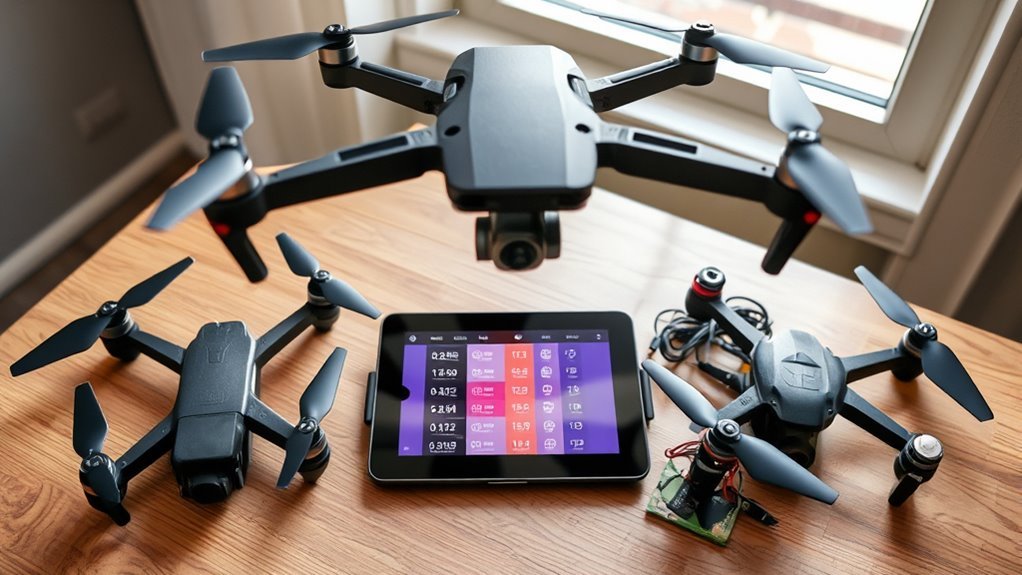
The 2026 drone flight time table shows a clear gap between rated and real-world endurance. Air3 posts the strongest result at 35 minutes 8 seconds, while Mini5 Pro, Mini3 Pro, and Mini4 Pro fall well short of their published figures. Neo2 ends at just 8 minutes 56 seconds. The spread suggests battery size, airframe efficiency, and test conditions may matter more than spec sheets imply, and the next comparison raises a harder question.
How I Tested DJI Flight Time
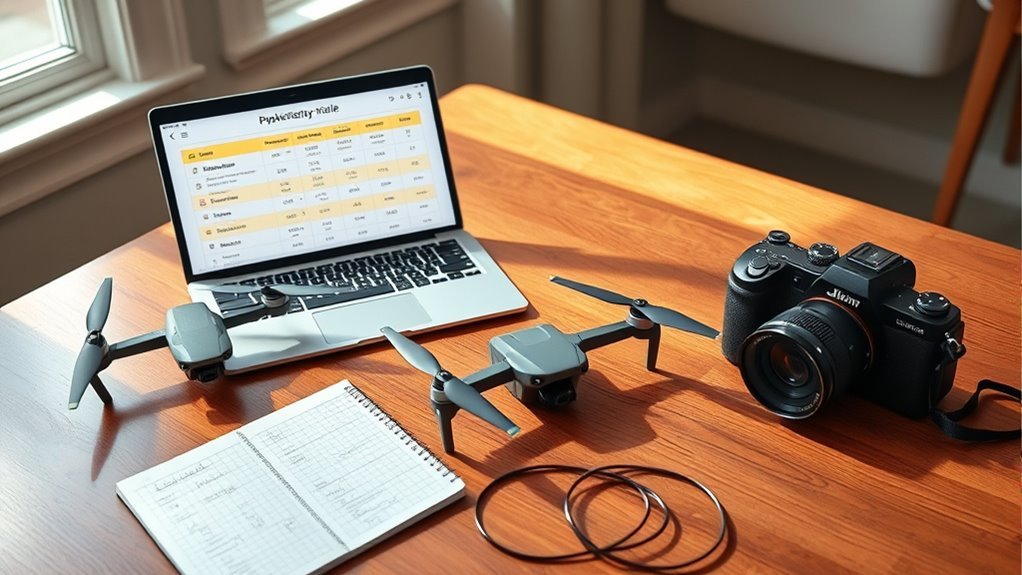
To evaluate DJI flight time consistently, eight drones were run through the same standardized test: each aircraft flew a fixed route over a house while taking a photo every 2 seconds. This method limited operator bias and isolated endurance variables across camera drones.
Every model followed the same power-up sequence, launch procedure, and flight pattern, creating comparable conditions for battery assessment. The route, altitude, and capture interval remained unchanged so that output reflected practical endurance rather than marketing claims.
By enforcing identical handling, the test measured how efficiently each platform converted stored energy into sustained aerial work. The resulting data showed meaningful divergence among models, including cases where older units outlasted newer ones, which is significant for users seeking independence from manufacturer narratives.
Identical handling revealed real-world endurance differences, with some older drones outlasting newer models.
Flight duration was recorded alongside total frames captured, enabling a direct comparison between real-world persistence and imaging output under controlled, repeatable conditions.
DJI Drone Flight Times: Rated vs Real
Rated flight times often diverge from real-world performance, and the DJI lineup makes that gap clear. In testing, the camera drone results formed a hierarchy shaped by efficiency, not marketing claims. The Mini5 Pro reached 25 minutes 18 seconds, improving on the Mini4 Pro’s weaker battery use. The Air3 led the field at 35 minutes 8 seconds, while the Air3S remained close at 32 minutes 28 seconds. Older hardware was not always inferior: the Mini3 Pro held 21 minutes 22 seconds, and the Neo beat the Neo2, suggesting higher power draw in the newer unit.
| Model | Real time | Signal |
|---|---|---|
| Air3 | 35:08 | Highest |
| Mini5 Pro | 25:18 | Efficient |
| Neo2 | 08:56 | Lowest |
RAW plus JPEG recording barely altered endurance, indicating DJI systems can preserve image freedom without a meaningful flight-time penalty.
Which Mini DJI Drone Lasts Longest?
Among DJI’s Mini drones, the Mini 5 Pro records the longest endurance at 25 minutes and 18 seconds, establishing the strongest battery performance in the sub-249 g class. This flight time indicates a clear efficiency advantage for users seeking extended airborne autonomy without heavier licensing constraints.
The ranking is straightforward:
- Mini 5 Pro — 25:18
- Mini 3 Pro — 21:22
- Mini 4 Pro — 18:12
The Mini 3 Pro remains notable, since its discontinued status does not diminish its superior endurance relative to the Mini 4 Pro.
The Mini 4 Pro, by contrast, shows reduced flight time, suggesting that added system demands can offset gains in newer platforms.
Air3 vs Air3S: Which Lasts Longer?
Between the DJI Air3 and Air3S, the Air3 lasts longer in flight, reaching 35 minutes and 8 seconds compared with the Air3S at 32 minutes and 28 seconds. This 2 minute 40 second margin is significant in practical use, especially for pilots seeking more autonomous operation and fewer forced landings.
Although both aircraft use similar battery capacities, the Air3 benefits from a lighter sensor payload and more efficient power routing, allowing it to convert stored energy into usable airtime more effectively. Its flight log of 1,054 frames also indicates sustained photo work without rapid depletion.
The Air3’s lighter sensor payload and efficient power routing help it turn battery capacity into longer usable flight time.
The Air3S remains competitive, but its newer status does not translate into longer endurance. Relative to the Mini 4 Pro, the comparison reinforces that model age alone does not determine endurance; engineering efficiency does.
For users prioritizing liberation from short sorties, the Air3 presents the stronger real-world endurance profile.
What Affects DJI Flight Time Most?
DJI flight time is determined less by battery capacity alone than by the combined effects of payload weight, sensor complexity, and power-path efficiency. In practice, the drone’s autonomy is shaped by how efficiently energy moves from cell to motor, camera, and compute stack.
The Mini 5 Pro illustrates this advantage: lighter airframes and reduced sensor payloads lower draw and extend usable minutes. By contrast, newer units such as the Neo2 may lose endurance relative to the original Neo because added sensing and processing raise consumption.
Mid-sized platforms like the Air3 show the opposite pattern, reaching 35 minutes 8 seconds through balanced mass and disciplined power management.
Three dominant variables emerge:
- Airframe weight and payload load
- Sensor and processor demand
- Electrical-path efficiency and battery tuning
RAW plus JPEG capture has negligible effect, so image format rarely changes endurance. For users seeking operational freedom, these design factors matter more than nominal battery size.
Frequently Asked Questions
What Drones Have a 30-Minute Flight Time?
The DJI Air3 is the only clearly identified drone exceeding the 30-minute threshold, recording 35 minutes and 8 seconds in real-world use.
Its performance indicates superior Battery Efficiency.
The DJI Air3S, by contrast, trails slightly below that mark, while the Mini5 Pro reaches 25 minutes and 18 seconds.
For operators seeking autonomy from frequent landings, the Air3 represents the strongest current option among the listed models.
How Much Does a 20 Minute Drone Show Cost?
A 20-minute drone show typically costs $10,000 to $30,000; consequently, Cost Comparison reveals a wide operational range. The figure depends on drone count, choreography complexity, custom animations, music synchronization, safety measures, and insurance.
Additional expenditures include pilots, planning, setup, and coordination. Economies of scale may reduce per-show expense for larger events.
In this modern Renaissance of aerial display, procurement decisions should prioritize transparency, compliance, and audience liberation.
What Is the Best Hobby Drone in 2026?
The best hobby drone in 2026 appears to be the DJI Air3, due to its superior endurance and balanced performance.
Its 35 minutes and 8 seconds of real-world flight time, combined with strong Camera Quality and lighter sensor payloads, make it technically dominant for extended, autonomous exploration.
The DJI Mini5 Pro remains a compelling alternative, but the Air3 offers the clearest margin for users seeking operational freedom and efficiency.
Why Did the US Ban DJI Drones?
The U.S. moved to ban DJI drones over Privacy Concerns, a curious tribute to flying cameras that can see more than they should.
Officials argued that data transmission, firmware access, and possible foreign-state influence could expose sensitive locations and users.
Technical scrutiny from defense agencies and regulators framed DJI as a national-security risk, leading to restrictions aimed at preserving autonomy, limiting surveillance exposure, and reducing dependency on contested foreign hardware.
Conclusion
The 2026 flight-time table shows a clear gap between advertised and real-world endurance. Air3 delivered the strongest tested result at 35 minutes 8 seconds, well ahead of Mini5 Pro at 25 minutes 18 seconds and Mini3 Pro at 21 minutes 22 seconds. Mini4 Pro and Neo2 lagged further behind, at 18 minutes 12 seconds and 8 minutes 56 seconds. In practice, battery claims are often a lighthouse, not the shoreline.
