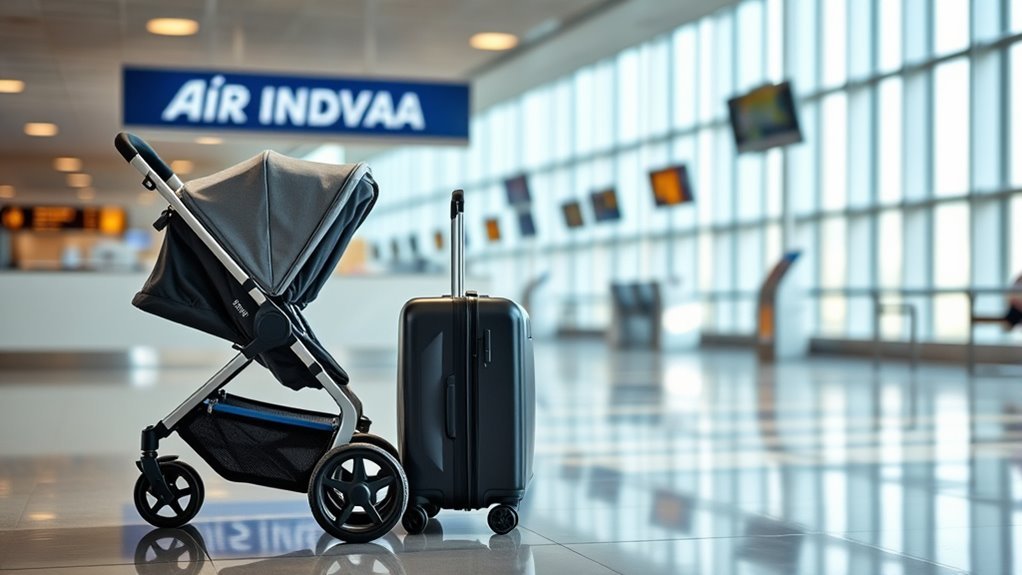
Air India allows infant travel equipment, but its current stroller rules are different from its normal cabin-baggage limits. Parents may bring one collapsible stroller, carrycot, or infant car seat for an infant, while Air India’s current infant-travel guidance says strollers are not allowed onboard the aircraft. In practice, parents should plan to check the stroller or hand it to staff near the aircraft when airport procedures permit.
Quick Answer
Air India currently allows one collapsible stroller, carrycot, or infant car seat as infant travel equipment, but its infant guidance says strollers are not allowed onboard. Do not rely on the normal 55 x 40 x 20 cm cabin-bag limit for stroller approval. Plan for check-in or aircraft-door handoff instead.
Key Takeaways
- Air India’s current infant-travel guidance says strollers are not allowed onboard the aircraft.
- The familiar 55 x 40 x 20 cm and 7 kg limits apply to standard Economy and Premium Economy cabin baggage, not a published stroller cabin allowance.
- Air India lists one collapsible stroller, carrycot, or infant car seat as an infant equipment entitlement.
- Strollers can often be used up to the aircraft door, but the exact handoff and collection procedure depends on the airport.
- Infant checked baggage is currently listed as 10 kg in Economy, 12 kg in Premium Economy, and 15 kg in Business and First Class.
What Is Air India’s Baby Buggy Size?
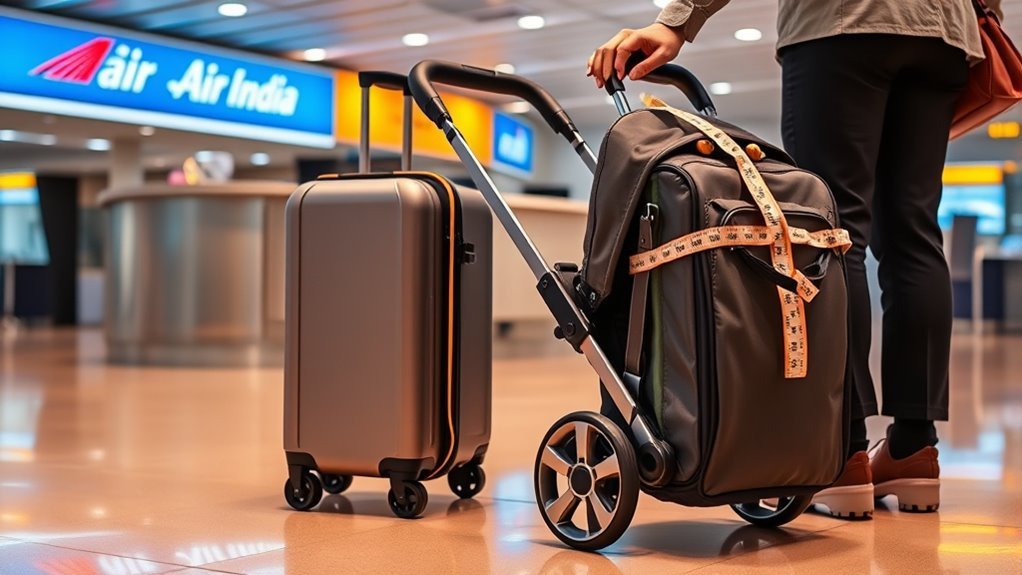
Air India does not currently publish a special baby-buggy size that guarantees cabin carriage. Its dedicated infant travel guidance states that strollers are not allowed on the flight.
The frequently quoted 55 x 40 x 20 cm and 7 kg figures come from Air India’s standard Economy and Premium Economy cabin baggage rules. They should not be interpreted as an automatic stroller allowance.
Air India instead lists an infant as being entitled to one collapsible stroller, carrycot, or infant car seat. A compact, quick-fold stroller can still make airport handling easier, but compact dimensions do not guarantee overhead-bin acceptance.
Warning: Do not buy or pack a stroller solely because it measures 55 x 40 x 20 cm or weighs less than 7 kg. Those figures are standard cabin-bag limits, while Air India’s current infant page separately says strollers are not allowed onboard.
Can You Carry a Stroller in Cabin on Air India?
Under Air India’s current dedicated infant guidance, no: parents should not assume that a stroller can travel in the passenger cabin, even when it folds to ordinary carry-on dimensions.
This is important because older Air India material and some general baggage information have used broader language about fully collapsible strollers. The current infant-specific page is more restrictive and should be checked before travel.
| Item | Current Practical Treatment |
|---|---|
| Collapsible stroller | Plan for check-in or aircraft-door handoff |
| Carrycot | Listed as an infant equipment option |
| Infant car seat | Listed as an infant equipment option; onboard use has separate requirements |
| Normal cabin bag | Subject to the applicable cabin size and weight limits |
Air India also states that strollers can often be used up to the aircraft door, depending on airport procedures. That can preserve mobility through much of the terminal even when the stroller cannot enter the cabin.
Gate-Check vs Check-In for Air India Strollers
A stroller may be accepted at the check-in counter or allowed to remain with the family until closer to boarding. The exact procedure depends on the departure airport, aircraft, ground-handling arrangements, and the instructions printed on the baggage tag.
Parents should not assume that every stroller will be returned at the aerobridge. Depending on the airport, it may be delivered near the aircraft, at an oversized-baggage point, or through the baggage reclaim area.
Gate-Check Process
Air India says strollers can often be used up to the aircraft door, depending on airport procedures. When this service is available, staff may tag the stroller before boarding and ask the parent to fold and surrender it near the aircraft.
| Step | What to Do |
|---|---|
| At check-in | Tell staff you are travelling with a stroller |
| Before boarding | Confirm whether you may use it to the aircraft door |
| At handoff | Fold it, secure loose parts, and check the baggage tag |
| Before departure | Ask exactly where it will be returned after landing |
The collection point matters. A stroller handed over near the aircraft is not automatically guaranteed to be returned at the same location after landing.
Check-In Handling
If airport staff require the stroller to be checked at the counter, it becomes unavailable during the walk from check-in through security and to the gate.
- Tell the agent that the item is an infant stroller.
- Confirm that the correct baggage or special-item tag has been attached.
- Remove loose toys, cup holders, hooks, and other detachable accessories.
- Fold and lock the frame securely.
- Ask whether collection will be at the baggage belt or oversized-baggage area.
Air India’s checked-baggage guidance lists an infant entitlement of one collapsible stroller, carrycot, or infant car seat. Parents should confirm how that entitlement is being applied to their specific ticket and itinerary.
Pro Tip: Put your name, phone number, destination, and flight details inside a stroller travel bag or on a durable luggage tag. Photograph the stroller before handoff so its pre-flight condition is documented.
Cabin Eligibility
The original 55 x 40 x 20 cm / 7 kg test should not be used to determine stroller eligibility. Those measurements describe standard Economy and Premium Economy cabin baggage.
For infant carry-on necessities, Air India currently allows personal and infant cabin items weighing up to a combined 5 kg. These may include food for the flight, feeding bottles, and a carry-on tote for food and bottles. Air India lists maximum dimensions of 40 x 30 x 20 cm for these small items before they begin affecting the normal cabin allowance.
A stroller is treated separately under Air India’s infant-equipment policy and should be prepared for checked or aircraft-door handling.
Do Compact Strollers Get Cabin Access on Air India?
A compact stroller can make airport travel easier, but a manufacturer’s “cabin-size” or “airline approved” description does not override an airline’s own policy. Air India’s current infant guidance says strollers are not permitted onboard.
The models cited in the original article illustrate why exact variant checking matters:
- Babyzen YOYO2 — widely promoted as an ultra-compact travel stroller, but its compact fold does not create an Air India cabin entitlement.
- GB Pockit+ — specifications vary by version. For example, GB has published different folded measurements and weights for the Pockit+ All-Terrain and Pockit+ All-City, so a generic “Pockit+” specification can be misleading.
- LuvLap Sunshine — current manufacturer listings show different weights and specification data across variants, so the earlier 50 x 30 x 25 cm / 7.5 kg claim should not be used as an airline test.
- Hababy Ultra — the manufacturer currently lists a stroller weight of about 6.8 kg and markets it for airline travel, but airline-specific acceptance still depends on Air India’s rules.
The practical buying rule is simple: choose a stroller because it is easy to fold, protect, and carry through the airport—not because its dimensions appear to match Air India’s normal hand-baggage allowance.
Air India Baby Buggy Rules on Domestic Flights
For domestic Air India travel, plan for the stroller to be checked or handed over before entering the aircraft. Air India lists one collapsible stroller, carrycot, or infant car seat as infant travel equipment.
| Rule | Current Guidance |
|---|---|
| Infant equipment | One collapsible stroller, carrycot, or infant car seat |
| Stroller in passenger cabin | Do not plan on cabin carriage |
| Aircraft-door use | May be available depending on airport procedures |
| Infant cabin essentials | Up to 5 kg combined under current cabin guidance |
| Collection after landing | Confirm with staff; location varies |
A one-handed or quick-fold design remains useful because parents may need to collapse the stroller at security, at a check-in point, or immediately before aircraft-door handoff.
Air India Baby Buggy Rules on International Flights
Air India’s basic stroller guidance also applies to international travel: parents should plan for the stroller to travel outside the passenger cabin and confirm the handling procedure at check-in.
International trips add another consideration: connecting and codeshare flights may be operated by a different airline with different stroller, cabin baggage, and infant-equipment rules.
Cabin Size Limits
Air India’s standard Economy and Premium Economy cabin-bag allowance is up to 55 x 40 x 20 cm and 7 kg. Business and First Class have different weight allowances under the airline’s current cabin policy.
These are ordinary hand-baggage limits. They should not be presented as an Air India stroller-size allowance because the airline’s dedicated infant page currently says strollers are not allowed on the flight.
Note: Older airline documents can remain searchable online after a policy has changed. Check Air India’s current infant and baggage pages shortly before departure, particularly if an older document appears to permit a collapsible stroller in the cabin.
Gate Check Rules
When airport procedures permit, a stroller may remain with the family until the aircraft-door area. Staff can then take the folded stroller for loading.
Do not assume that an aircraft-door handoff guarantees aircraft-door return. Ask the agent where the stroller will be delivered at the destination and check that its tag reflects the intended handling.
If a connection involves another airline, confirm the stroller procedure with the operating carrier as well as Air India.
Infant Baggage Allowance
Air India’s dedicated infant guidance and baggage FAQ currently list the following checked-baggage allowances for infants:
- Economy: 10 kg / 22 lb
- Premium Economy: 12 kg / 26 lb
- Business: 15 kg / 33 lb
- First Class: 15 kg / 33 lb
Air India also lists one collapsible stroller, carrycot, or infant car seat as infant equipment.
Some general Air India booking pages have displayed simplified 10 kg infant-baggage wording, so the safest approach is to verify the allowance shown against the passenger’s booking and current baggage rules before departure.
What Baby Baggage Does Air India Allow?
Air India provides both checked baggage and limited cabin space for infant necessities. The current allowance is more specific than the original article suggested.
| Item | Allowance | Important Condition |
|---|---|---|
| Economy infant checked baggage | 10 kg | Current Air India infant allowance |
| Premium Economy infant checked baggage | 12 kg | Current Air India infant allowance |
| Business/First infant checked baggage | 15 kg | Current Air India infant allowance |
| Infant cabin essentials | Up to 5 kg combined | May include food, bottles, and an infant tote |
| Infant equipment | 1 item | Collapsible stroller, carrycot, or infant car seat |
Air India’s cabin guidance specifically mentions food for the infant, feeding bottles, and a carry-on tote for food and bottles. The policy does not support treating an unlimited diaper bag and separate milk bag as additional unrestricted cabin pieces.
Infant food, medication, and liquids can also be subject to airport security procedures. Carry only what is reasonably required for the journey and follow instructions from the security authority at the departure airport.
How to Fold and Tag a Baby Buggy
Tell Air India staff about the stroller at check-in, even if you hope to use it until the aircraft door. This gives staff a chance to issue the correct tag and explain where the stroller must be surrendered.
- Remove loose toys, drink holders, hooks, rain covers, and accessories that could detach.
- Empty the storage basket.
- Fold the stroller completely and engage its folding lock.
- Attach a durable identification tag with your contact details.
- Use a protective stroller bag if practical.
- Keep the airline baggage or gate tag visible.
- Ask where the stroller will be collected after landing.
At security, follow the instructions of airport screening staff. A compact stroller may need to be folded for screening, while procedures for larger models can vary by checkpoint.
What Parents Should Do at the Airport
Parents should tell Air India staff about the stroller when checking in so the item can be routed correctly.
The most important airport question is not “Will it fit overhead?” but “Where do I hand over the stroller, and where will I get it back?”
Use this sequence:
- At check-in: declare the stroller and confirm whether it can remain with you until boarding.
- At security: follow the local screening procedure and be ready to fold the stroller.
- At the gate: verify the tag and handoff instructions.
- Before surrendering it: remove loose accessories and photograph its condition.
- On arrival: go to the collection point specified by Air India staff rather than assuming it will appear at the aerobridge.
Airport handling can differ between domestic and international stations, so instructions given for one trip should not be assumed to apply at every Air India airport.
What About Codeshare and Connecting Flights?
Stroller rules become more complicated when another airline operates part of the itinerary. Air India’s baggage guidance tells passengers on applicable codeshare flights to check the operating carrier’s baggage rules.
Before a connecting journey, confirm:
- whether the stroller must be collected during the connection;
- whether it will be tagged through to the final destination;
- whether the operating airline allows aircraft-door handoff;
- where the stroller will be returned after each flight; and
- whether the infant-equipment allowance differs from Air India’s policy.
The operating carrier’s rule can matter even when the ticket was purchased from Air India.
What If Air India Damages Your Stroller?
If a checked or handed-over stroller is damaged, inspect it as soon as it is returned. Report visible damage to Air India personnel at the arrival airport before leaving whenever possible.
Air India advises passengers to file a Property Irregularity Report (PIR) for baggage damage and keep supporting information such as baggage tags and photographs.
Report Damage Immediately
Prompt reporting creates a record of the stroller’s condition and makes later follow-up easier.
- Report the damage to Air India baggage staff at the arrival airport.
- Ask for assistance filing a Property Irregularity Report.
- Photograph the stroller from several angles.
- Keep the boarding pass and baggage or gate-check tag.
- Keep receipts or other evidence of the stroller’s value when available.
- Do not discard damaged parts until Air India has explained the claims procedure.
Normal wear such as small scratches or scuffs may be treated differently from functional damage, so document anything that prevents safe or normal stroller use.
Claim Reimbursement Process
After reporting the damage, follow Air India’s baggage-claims instructions and provide the PIR, photographs, baggage tags, purchase evidence, and any requested repair information.
Air India’s current Conditions of Carriage state that a complaint concerning damage to checked baggage must be made promptly after discovery and, at the latest, within seven days of receipt. The complaint must be made in writing within the applicable period.
Repair, replacement, or other compensation is not automatic. Air India assesses claims under its Conditions of Carriage, applicable liability rules, the nature of the damage, and the documentation supplied.
Frequently Asked Questions
Are Baby Strollers Allowed on Air India Flights?
Air India allows infant travel equipment and lists one collapsible stroller, carrycot, or infant car seat as an infant entitlement. However, its current infant-travel guidance says strollers are not allowed onboard the aircraft, so parents should plan for check-in or aircraft-door handoff.
What Size Buggy Can I Take on an Air India Plane?
Air India does not currently publish a stroller size that guarantees passenger-cabin carriage. The 55 x 40 x 20 cm and 7 kg figures apply to standard Economy and Premium Economy cabin bags, while current infant guidance says strollers are not allowed onboard.
What Size of Stroller Is Allowed in Cabin Baggage?
Under Air India’s current infant-specific guidance, parents should not plan to carry a stroller in the passenger cabin based on its dimensions alone. Even an ultra-compact stroller should be prepared for checked or aircraft-door handling.
Can I Bring a Full Size Stroller on a Plane?
A full-size stroller can travel as infant equipment, subject to Air India’s acceptance and airport handling procedures, but it should not be expected to travel in the passenger cabin. Larger models are especially likely to require check-in rather than aircraft-door handling.
Can I Use My Stroller Until the Aircraft Door?
Often, yes. Air India states that strollers can often be used up to the aircraft door, depending on airport procedures. Confirm this at check-in because some airports may require earlier handoff.
Will Air India Return My Stroller at the Aerobridge?
Not necessarily. Return procedures vary by airport. The stroller may be delivered near the aircraft, at oversized baggage, or through the normal baggage-reclaim area. Confirm the retrieval point before handing it over.
Conclusion
Air India permits infant travel equipment, but parents should not treat 55 x 40 x 20 cm and 7 kg as an Air India stroller cabin allowance. Those measurements belong to standard Economy and Premium Economy cabin baggage, while Air India’s current infant guidance states that strollers are not allowed onboard.
The safest plan is to travel with a stroller that folds securely, tell staff about it at check-in, confirm whether it can be used to the aircraft door, and ask exactly where it will be returned. Also verify the infant baggage allowance for the booked cabin: Air India currently lists 10 kg in Economy, 12 kg in Premium Economy, and 15 kg in Business and First Class.
Sources
- Air India — Expectant Mothers and Infants — current stroller-onboard guidance and infant checked-baggage allowances.
- Air India — Cabin Baggage — standard cabin dimensions, weight limits, and infant cabin-item allowance.
- Air India — Checked Baggage Allowance — infant stroller, carrycot, or car-seat entitlement and baggage rules.
- Air India — Baggage FAQs — infant baggage allowances and damaged-baggage procedures.
- Air India — Lost or Damaged Baggage — reporting and claims guidance.
- Air India — Conditions of Carriage — seven-day written complaint deadline for damaged checked baggage.