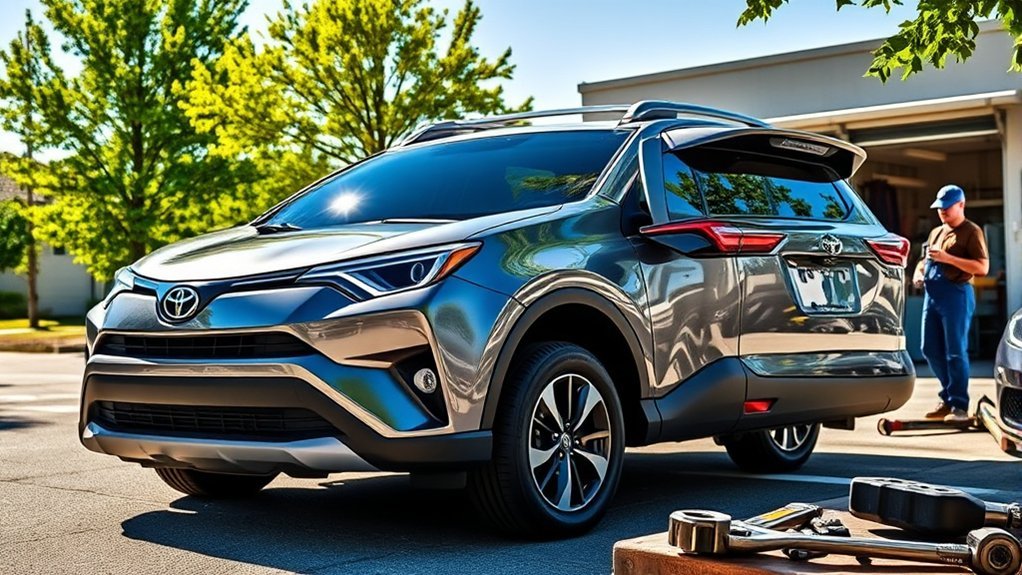
Toyota RAV4s are generally not expensive to maintain compared with many SUVs, but the answer depends on what you measure. Published averages combine different model years, repair types, and ownership periods, so an annual repair estimate should never be compared directly with a 10-year ownership projection. Your model year, mileage, powertrain, driving conditions, service history, and local labor rates ultimately determine what you pay.
Quick Answer
Toyota RAV4 maintenance costs are generally competitive. RepairPal estimates about $429 per year for repairs and maintenance across RAV4 model years, versus $521 for compact SUVs. CarEdge separately projects about $6,004 over the first 10 years. Those figures use different methodologies, so treat them as planning estimates rather than guaranteed costs.
Key Takeaways
- RepairPal lists average RAV4 repair and maintenance costs at about $429 per year across model years.
- CarEdge projects approximately $1,938 during the first five years and $6,004 during the first ten years.
- The 2026 U.S. RAV4 lineup is fully electrified, with HEV and PHEV powertrains rather than a conventional gas-only version.
- A hybrid battery does not have a scheduled 7- to 10-year replacement interval; qualifying Toyota hybrid batteries carry long warranty coverage.
- Your exact model year, mileage, driving environment, labor market, and maintenance history matter more than any national average.
What Routine Maintenance Should RAV4 Owners Expect?
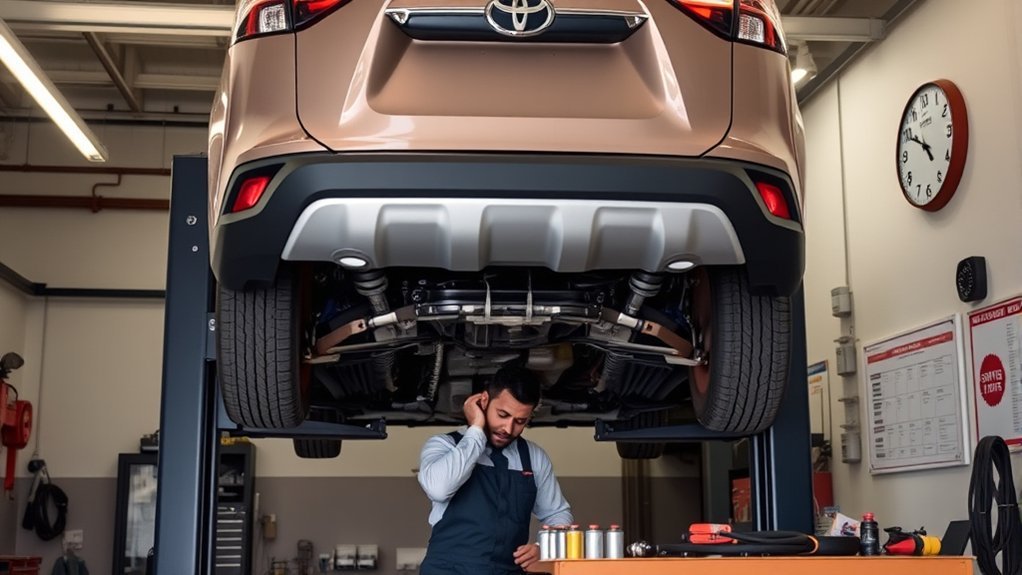
Routine Toyota RAV4 maintenance normally includes tire rotations, inspections, fluid checks, engine-oil and filter changes, air-filter service, brake inspections, and other mileage- or time-based items. Toyota says many of its vehicles use scheduled maintenance visits every 5,000 miles or six months, although the work required at each visit depends on the exact model year and powertrain.
Do not assume that every 5,000-mile service requires an oil change. On many recent RAV4 model years, normal-operation oil and filter replacement can occur at longer intervals, while certain demanding operating conditions can require more frequent oil service. Your exact Toyota Warranty & Maintenance Guide takes priority over a generic online schedule.
Toyota’s official maintenance schedule is the best starting point for determining what your specific RAV4 needs.
Note: Short trips, repeated cold-weather operation, dusty roads, heavy loading, towing, extensive low-speed driving, and similar demanding conditions can change service requirements. Follow the maintenance guide for your exact year, powertrain, and use.
ToyotaCare can also reduce initial scheduled-maintenance costs on a new RAV4. Toyota’s general ToyotaCare materials describe complimentary factory-scheduled maintenance for qualifying new vehicles, although current coverage terms and regional offers should be checked for the specific vehicle because Toyota’s 2026 promotional materials contain transitional wording.
The most important rule is simple: follow the factory schedule and keep records. Preventive service cannot eliminate every future repair, but it can reduce avoidable wear and make developing problems easier to identify before they become more expensive.
How Do Toyota RAV4 Ownership Costs Compare to Competitors?
The RAV4’s maintenance and repair costs compare favorably with many SUVs, but it is misleading to say that it is always cheaper than every rival. The result changes depending on which vehicle, source, age range, and cost definition you use.
Maintenance Cost Comparison
RepairPal currently estimates average RAV4 repairs and maintenance at about $429 per year across model years. Its compact-SUV benchmark is approximately $521 per year.
Using the same source makes competitor comparisons more meaningful:
| Vehicle | Average Annual Repair & Maintenance Cost | Source |
|---|---|---|
| Honda CR-V | About $407 | RepairPal |
| Toyota RAV4 | About $429 | RepairPal |
| Mazda CX-5 | About $447 | RepairPal |
| Subaru Forester | About $632 | RepairPal |
This shows why “cheaper than its competitors” needs qualification. The RAV4’s estimate is lower than the Forester’s and slightly lower than the CX-5’s, but RepairPal currently places the CR-V slightly below the RAV4.
Long-term projections tell a different story. CarEdge currently estimates approximately $1,938 in maintenance and repairs during the first five years and about $6,004 during the first ten years. Its projected 10-year RAV4 total is roughly $2,508 below its SUV-segment benchmark.
The useful comparison is not $429 versus an $8,000-plus figure. Compare annual estimates with annual estimates, or 10-year projections with other 10-year projections.
Reliability Rankings Overview
RepairPal gives the RAV4 a 4.0-out-of-5 reliability rating and currently places it among the stronger compact SUVs. Its $429 average annual cost is one part of that rating; repair frequency and severity also matter.
CarEdge uses a different model. It currently estimates a 7.76% cumulative probability of a major repair within five years and 16.61% by year ten. CarEdge defines a major repair differently from RepairPal, so percentages from the two services should not be treated as interchangeable.
No reliability score can predict the condition of one used RAV4. A well-maintained higher-mileage vehicle with complete records may be a better purchase than a lower-mileage example with neglected fluids, collision damage, corrosion, or unresolved warning lights.
Resale Value Insights
Resale value also affects the total cost of ownership. RAV4s have historically retained value well, but resale estimates depend strongly on original price, age, mileage, condition, location, trim, and market demand.
For example, CarEdge’s depreciation calculator using a $38,000 starting value projects roughly $10,194 of depreciation after five years and a resale value around $27,806. That is an example based on specific assumptions, not a guaranteed future value for every RAV4.
When comparing vehicles, consider depreciation alongside fuel, insurance, financing, scheduled maintenance, tires, repairs, and taxes rather than judging ownership cost from maintenance alone.
How Reliable Is Your Toyota RAV4?
The RAV4 has a strong overall reliability reputation, but there is no official mileage at which every RAV4 will fail or reach the end of its useful life. High-mileage examples can remain serviceable for many years when maintained correctly, while neglected vehicles can develop expensive problems much earlier.
Your RAV4’s reliability depends on factors such as:
- model year and powertrain;
- maintenance history;
- mileage and age;
- climate and corrosion exposure;
- towing, heavy loading, or off-road use;
- previous collision repairs;
- quality of replacement parts and previous repair work; and
- whether warning signs were addressed promptly.
Warranty coverage also matters when evaluating the cost of a newer RAV4. Toyota lists a 36-month/36,000-mile basic new-vehicle warranty and 60-month/60,000-mile powertrain coverage for applicable new vehicles. Toyota also states that qualifying hybrid batteries beginning with the 2020 model year are covered for 10 years or 150,000 miles, whichever comes first.
You can review the applicable terms through Toyota’s Manuals and Warranties portal.
Common RAV4 Problems and Costs

RAV4 problems vary substantially by generation and model year. A concern that is common on an older RAV4 may have little relevance to a newer hybrid or plug-in hybrid, so avoid treating one list of problems as universal.
RepairPal lists EVAP-system issues among commonly reported historical RAV4 problems. Some older model years also have owner complaints involving oil consumption, emissions-system warnings, transmission behavior, suspension wear, or other age-related components. The appropriate diagnosis depends on the exact year and symptoms.
Common Mechanical Issues
As a RAV4 ages, the areas most likely to affect your budget include normal wear items and systems exposed to heat, vibration, weather, and mileage. Examples can include:
- EVAP and emissions components: A check-engine light can be caused by anything from a loose cap or small leak to a failed valve, canister, sensor, or other component. Diagnose the fault before replacing parts.
- Brakes and suspension: Pads, rotors, bearings, struts, bushings, and related components wear according to mileage, driving environment, corrosion, and road conditions.
- 12-volt battery: Battery life varies with climate, use, age, and electrical demand.
- Cooling and air-conditioning systems: Leaks, pumps, compressors, valves, sensors, and hoses can produce very different repair bills.
- Hybrid components: Hybrid models contain additional high-voltage hardware, but that does not mean the traction battery must be replaced on a fixed schedule.
Warning: Never work on orange high-voltage hybrid cables, connectors, battery components, or related systems unless you have the required training and safety equipment. High-voltage hybrid systems can cause serious injury or death.
Repair Cost Estimates
There is no honest universal price for an EVAP failure, catalytic-converter warning, transmission problem, or hybrid-system repair. The same dashboard warning can have several causes, and labor rates vary widely by location.
A more useful way to budget is to understand the likely cost impact and the factors that control the final bill:
| Service or Repair | Typical Budget Impact | Main Cost Variables |
|---|---|---|
| Oil, filters, inspections, tire rotation | Low and recurring | Oil specification, service interval, shop rate, filters |
| 12-volt battery | Low to moderate | Battery specification, climate, installation, warranty |
| Brake service | Moderate | Pads, rotors, corrosion, axle, labor, part quality |
| Suspension or wheel-bearing work | Moderate to high | Number of parts, alignment, rust, labor time |
| Cooling or air-conditioning repair | Moderate to high | Leak source, component failure, refrigerant, diagnostic time |
| Hybrid-system or traction-battery repair | Potentially high outside warranty | Failed component, warranty status, model year, parts and specialist labor |
Ask for an itemized estimate that separates diagnosis, labor, parts, fluids, shop supplies, taxes, alignment, programming, and other charges. That makes it much easier to compare quotes fairly.
Pro Tip: A trouble code identifies the system that detected a fault; it does not automatically identify the part that must be replaced. Paying for proper diagnosis can prevent unnecessary parts replacement.
Key Factors Influencing Maintenance Costs for the Toyota RAV4

No national average can describe every RAV4. These factors usually have the greatest effect on what you actually spend:
- Model year: Different generations have different engines, transmissions, electronics, known trouble areas, recalls, and parts prices.
- Age and mileage: Rubber parts, seals, bearings, dampers, batteries, cooling components, and other wear items become more relevant as a vehicle ages.
- Powertrain: Conventional older RAV4s, hybrids, and plug-in hybrids have different components and service needs. The U.S.-market 2026 RAV4 is offered only as an HEV or PHEV.
- Driving conditions: Short trips, road salt, dust, extreme temperatures, traffic, towing, and heavy loading can accelerate wear or trigger additional maintenance requirements.
- AWD equipment: AWD versions include additional drivetrain components that require inspection and, on some model years or operating schedules, fluid service.
- Labor market: Dealer and independent-shop labor rates can differ substantially between cities.
- Maintenance history: A complete service history can reduce uncertainty and help prevent neglected problems from becoming larger repairs.
What About Hybrid Battery Costs?
A hybrid traction battery is potentially expensive if it fails outside warranty, but it should not be treated like a timing belt or filter that requires replacement at a fixed age.
Toyota states that qualifying hybrid batteries beginning with the 2020 model year are covered for 10 years or 150,000 miles, whichever comes first, subject to warranty terms. Other hybrid-related components can have different coverage periods.
Battery condition depends on factors such as age, temperature, mileage, charging and operating patterns, cell health, cooling-system condition, and the particular battery design. Some batteries can last well beyond their warranty period; others may require repair sooner.
2026 RAV4 Powertrain Changes
The 2026 RAV4 starts the model’s sixth generation and is a major departure from previous years. Toyota made the U.S. lineup 100% electrified, offering Hybrid Electric Vehicle and Plug-in Hybrid Electric Vehicle configurations instead of a conventional gas-only model.
This matters when estimating maintenance because older gas-only RAV4 cost histories do not perfectly predict the long-term cost profile of a newly redesigned 2026 HEV or PHEV.
How to Minimize Your Toyota RAV4 Maintenance Costs?
You cannot eliminate maintenance, but you can reduce avoidable repair costs by taking a consistent approach.
- Follow the correct Toyota schedule. Use the guide for your exact model year and powertrain rather than a generic mileage chart.
- Do not postpone warning lights. A small leak, weak battery, worn tire, or minor suspension noise can become more expensive if ignored.
- Check tires regularly. Correct cold inflation pressure, rotation, alignment, and tread condition can improve tire life and reduce unnecessary wear.
- Keep service records. Records help with warranty questions, resale, diagnosis, and determining which work is actually due.
- Request itemized estimates. Compare the same repair scope, parts quality, warranty, and labor operation rather than comparing only the final number.
- Use a qualified shop. A reputable independent Toyota specialist may offer lower labor rates for routine work, while some warranty, recall, software, or hybrid procedures may be better handled through Toyota.
- Check recalls by VIN. Recall repairs are different from normal maintenance and may be performed at no charge when the vehicle qualifies.
You can check Toyota campaigns through Toyota’s owner resources and safety recalls through the National Highway Traffic Safety Administration.
Does Fuel Economy Offset Maintenance Costs?
Fuel is separate from maintenance, but it is a major ownership expense. For 2026, Toyota lists HEV fuel-economy ratings that vary by trim and drivetrain, with some configurations rated as high as 47 mpg city and 40 mpg highway. Woodland and higher-performance AWD grades carry different ratings.
That can lower fuel spending compared with many less-efficient SUVs, but fuel savings should not be confused with maintenance savings. Insurance, depreciation, financing, tires, registration, electricity for PHEVs, and repairs also contribute to total ownership cost.
Related Guides
Frequently Asked Questions
What Is the Average Fuel Efficiency of a Toyota RAV4?
It depends on the model year, powertrain, drivetrain, and trim. The U.S.-market 2026 RAV4 is HEV or PHEV only. Toyota lists some 2026 HEV versions at up to 47 mpg city and 40 mpg highway, while AWD and Woodland configurations have different ratings. Check the exact trim rather than using one average for every RAV4.
How Long Do Toyota RAV4s Typically Last?
There is no official mileage that defines the lifespan of every RAV4. A well-maintained vehicle can remain useful into high mileage, but longevity depends on model year, service history, climate, corrosion, driving conditions, previous repairs, and how quickly emerging problems are addressed.
Are There Extended Warranties Available for RAV4s?
Yes. Toyota Financial Services offers optional Vehicle Service Agreements for eligible vehicles. Available coverage, mileage limits, term length, covered components, deductibles, exclusions, transfer rules, and eligibility depend on the plan and vehicle. Read the agreement itself before buying rather than relying only on a sales summary.
How Does Driving Style Affect RAV4 Maintenance Costs?
Frequent hard acceleration, abrupt braking, pothole impacts, towing, heavy loading, short trips, and sustained operation in severe conditions can increase wear on tires, brakes, suspension, fluids, and other components. Smoother driving and following Toyota’s applicable severe-service recommendations can help control avoidable wear.
What Are the Best Practices for RAV4 Winter Maintenance?
Check cold tire pressure regularly because pressure falls as temperatures drop. Inspect tread, sidewalls, wipers, washer fluid, lights, battery condition, coolant protection, and brakes. NHTSA advises drivers to consider winter tires where conditions justify them and to maintain greater following distance on snow or ice.
Does a RAV4 Hybrid Battery Need Replacement After 7 to 10 Years?
No fixed replacement age applies. A traction battery is replaced or repaired when its condition requires it, not simply because it reaches a certain birthday. Toyota provides qualifying hybrid batteries with coverage of 10 years or 150,000 miles from original use, whichever comes first, subject to warranty terms.
Do I Have to Use a Toyota Dealer for Every Maintenance Service?
Routine maintenance can often be performed by a qualified independent shop, but the technician should follow the correct Toyota specifications and service procedures. Dealer service can be particularly useful for recalls, warranty work, software-related procedures, and specialized hybrid diagnostics.
Conclusion
Toyota RAV4 maintenance and repair costs are generally competitive, but one number does not tell the whole story. RepairPal’s roughly $429 annual average and CarEdge’s roughly $6,004 ten-year projection measure costs in different ways and should not be compared as though they represent the same period.
Your actual expenses depend on the RAV4’s model year, powertrain, age, mileage, condition, local labor rates, driving environment, and maintenance history. Following the correct Toyota service schedule, keeping records, checking recalls, obtaining itemized estimates, and addressing warning signs early are the most practical ways to keep ownership costs under control.
Sources
- RepairPal — Toyota RAV4 Reliability — annual repair and maintenance cost, compact-SUV comparison, and reliability data.
- CarEdge — Toyota RAV4 Maintenance Costs — five-year and ten-year projected costs and major-repair probabilities.
- Toyota — Maintenance Schedule — official maintenance-schedule guidance.
- Toyota — Manuals and Warranties — new-vehicle, powertrain, hybrid-component, and hybrid-battery warranty information.
- Toyota — 2026 RAV4 Specifications — current powertrain and fuel-economy information.
- National Highway Traffic Safety Administration — Winter Driving Tips — official tire and winter-preparation guidance.
