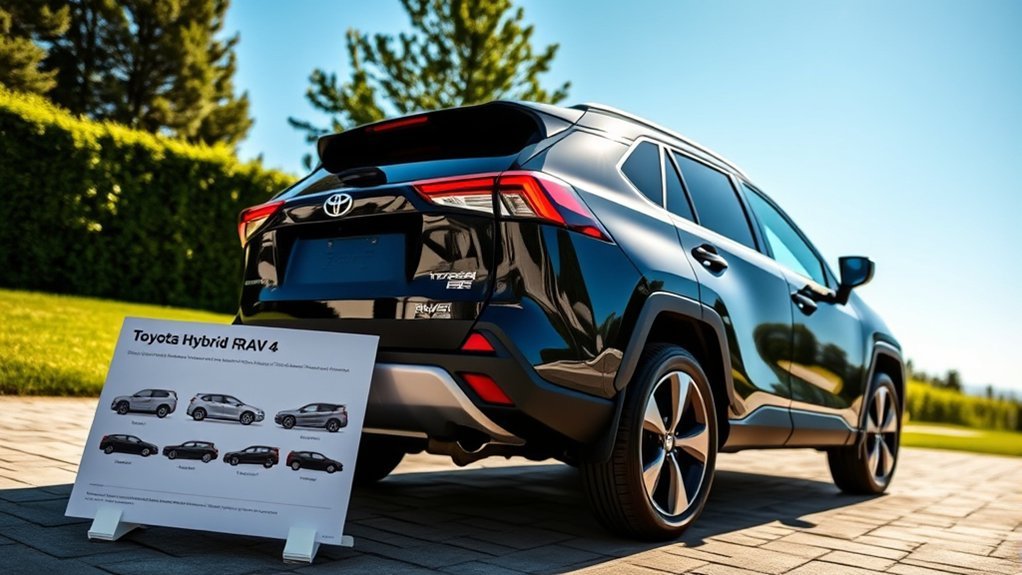
Yes. Toyota makes a hybrid RAV4, and for the U.S.-market 2026 model year every RAV4 is electrified: either a conventional Hybrid Electric Vehicle (HEV) or a Plug-in Hybrid Electric Vehicle (PHEV). The standard RAV4 Hybrid combines a 2.5-liter gasoline engine with electric motors, charges its traction battery while driving, and never needs to be plugged into an outlet.
Quick Answer
Yes. Every 2026 Toyota RAV4 uses either a conventional hybrid or plug-in hybrid powertrain. The standard RAV4 Hybrid does not require external charging, produces 226 horsepower with front-wheel drive or 236 horsepower with all-wheel drive, and reaches up to an EPA-estimated 47 MPG city, 40 MPG highway, and 43 MPG combined.
Key Takeaways
- The 2026 RAV4 lineup includes conventional hybrid and plug-in hybrid models but no gas-only version.
- A standard RAV4 Hybrid charges its battery while driving and never needs to be connected to an outlet.
- Front-wheel-drive hybrids produce 226 horsepower, while all-wheel-drive hybrids produce 236 horsepower.
- Fuel economy, towing capacity, price, and drivetrain availability vary by trim.
- The standard hybrid does not qualify for a federal New Clean Vehicle Credit, and that federal credit is unavailable for vehicles acquired after September 30, 2025.
Last updated: September 19, 2026. Current specifications and federal-credit rules were rechecked against Toyota, NHTSA, and IRS sources.
Overview of the 2026 Toyota RAV4 Hybrid
The 2026 Toyota RAV4 Hybrid begins the RAV4’s sixth generation. It uses Toyota’s fifth-generation hybrid system and adds new technology, styling, and drivetrain choices. Unlike the 2025 lineup, the 2026 RAV4 no longer offers a gas-only powertrain.
According to Toyota’s official 2026 RAV4 product announcement, front-wheel-drive hybrid models produce 226 combined system horsepower. All-wheel-drive hybrid models produce 236 horsepower and use a separate rear electric motor to power the rear axle when additional traction is needed.
For 2026, the RAV4 is no longer offered with a gas-only powertrain. Buyers choose between a conventional hybrid and a plug-in hybrid.
The 219-horsepower and 41-city/38-highway MPG figures commonly associated with the RAV4 Hybrid apply to the outgoing 2025 generation, not every current RAV4. Used-vehicle shoppers should therefore check the specification sheet for the exact model year they are considering.
What Changed From the 2025 RAV4 Hybrid to the 2026 Model?
| Item | 2025 RAV4 Hybrid | 2026 RAV4 Hybrid |
|---|---|---|
| Generation | Fifth generation | All-new sixth generation |
| Hybrid drivetrain | AWD standard on the Hybrid | FWD or AWD, depending on trim |
| Combined system output | 219 hp | 226 hp FWD; 236 hp AWD |
| Best city/highway MPG | 41/38 | 47/40 |
| RAV4 lineup | Gas, Hybrid, and Plug-in Hybrid available | Hybrid or Plug-in Hybrid only |
How the RAV4 Hybrid System Works
The conventional RAV4 Hybrid combines a 2.5-liter gasoline engine, one or more electric motors, a high-voltage battery, and an electronically controlled continuously variable transmission. The vehicle automatically switches between gasoline power, electric assistance, and a combination of both.
You do not plug the standard hybrid into a wall outlet. Its battery receives energy from the gasoline engine and from regenerative braking, which captures some of the energy that would otherwise be lost as heat when the vehicle slows down.
The RAV4 Plug-in Hybrid works differently. It has a larger battery that can be charged from an external power source, allowing it to travel on electricity for more of a typical daily trip. After its usable electric charge is depleted, it continues operating as a hybrid.
Note: “Hybrid” and “plug-in hybrid” are not interchangeable. Choose the conventional hybrid when you want improved fuel economy without charging. Consider the plug-in hybrid when you can charge regularly and expect to use its electric-driving capability.
2026 RAV4 Hybrid Trims, Prices, and MPG
The 2026 RAV4 Hybrid is available in six trims. The table below summarizes Toyota’s published starting MSRPs and estimated city/highway fuel economy. Prices exclude destination charges, taxes, registration, options, accessories, and dealer fees.
| Trim | Starting MSRP | Drivetrain Availability | EPA-Estimated City/Highway MPG | Best Suited For |
|---|---|---|---|---|
| LE | $31,900 | FWD or AWD | FWD 47/40; AWD 46/39 | Value and maximum fuel economy |
| SE | $34,700 | FWD or AWD | FWD 47/40; AWD 46/39 | Sportier styling at a moderate price |
| XLE Premium | $36,100 | FWD or AWD | FWD 47/40; AWD 45/38 | Additional comfort and convenience |
| Woodland | $39,900 | AWD | 41/35 | Rough roads and outdoor-oriented use |
| XSE | $41,300 | AWD | 43/37 | Sport appearance with premium equipment |
| Limited | $43,300 | AWD | 43/37 | Maximum comfort and technology |
The table uses EPA city/highway ratings for the listed 2026 configurations. LE and SE AWD are rated 46/39 MPG, XLE Premium AWD is 45/38 MPG, XSE and Limited AWD are 43/37 MPG, and Woodland AWD is 41/35 MPG. Feature availability can change with packages and production updates, so confirm the window sticker for the exact vehicle.
Fuel Efficiency and Performance
The most efficient 2026 RAV4 Hybrid configurations—the LE, SE, and XLE Premium with front-wheel drive—are rated at 47 MPG city, 40 MPG highway, and 43 MPG combined. LE and SE AWD are rated 46/39/42, XLE Premium AWD 45/38/41, XSE and Limited AWD 43/37/41, and Woodland AWD 41/35/38.
Actual fuel economy depends on temperature, speed, terrain, tire pressure, passenger and cargo weight, trip length, climate-control use, and driving style. Short winter trips may produce noticeably lower results because the gasoline engine must warm up and the battery is less efficient when cold. For a deeper trim-by-trim breakdown, see the Toyota RAV4 MPG guide.
The 2026 hybrid system produces:
- 226 combined horsepower with front-wheel drive.
- 236 combined horsepower with all-wheel drive.
AWD models use an electric motor at the rear axle rather than a conventional mechanical driveshaft connecting the front and rear axles. The system can add rear-wheel power when accelerating or when additional traction is needed, but it does not turn the RAV4 into a heavy-duty off-road vehicle.
Towing capacity depends on drivetrain and grade. For 2026, all FWD RAV4 Hybrid models and the LE AWD are rated at 1,750 pounds. The XLE Premium AWD, SE AWD, Woodland AWD, XSE AWD, and Limited AWD can tow up to 3,500 pounds when properly equipped. Use the exact vehicle’s manual and labels, and see the RAV4 towing-capacity guide for a model-year breakdown.
Warning: Never determine towing safety from the advertised maximum alone. Include the trailer, passengers, cargo, accessories, and tongue weight in your calculations, and do not exceed any vehicle, axle, tire, hitch, or trailer rating.
What Do Independent Tests Show?
Independent testing adds context that EPA and manufacturer figures cannot provide. Car and Driver measured 0–60 mph in 7.1 seconds in an AWD Limited and recorded 36 MPG on its 75-mph highway test. Consumer Reports reported 40 MPG overall in its purchased 2026 RAV4 Hybrid, while Edmunds observed 38.7 MPG over the first 3,092 miles of its long-term FWD XLE Premium. These tests use different routes, speeds, vehicles, and methods, so they should be read as real-world context rather than substitutes for EPA ratings.
Ownership Costs and Financial Considerations
There is no single reliable five-year ownership-cost figure for every RAV4 Hybrid owner. Total cost depends on the trim, negotiated purchase price, financing, annual mileage, gasoline prices, insurance profile, maintenance, taxes, registration, repairs, and resale value.
| Cost Factor | What to Use in Your Estimate |
|---|---|
| Purchase price | The signed out-the-door price, including destination, options, taxes, documentation fees, and registration—not MSRP alone. |
| Financing | Down payment, loan amount, annual percentage rate, term, and total interest. |
| Fuel | Expected annual mileage divided by realistic MPG, multiplied by the gasoline price you expect to pay. |
| Insurance | Written quotes for the exact VIN, drivers, address, deductibles, limits, and optional coverage. |
| Maintenance and repairs | Scheduled services, tires, wear items, local labor rates, warranty coverage, and a repair reserve. |
| Depreciation | Expected resale or trade-in value for the exact model year, trim, mileage, condition, and local market. |
Pro Tip: Estimate annual gasoline cost with this formula: annual miles ÷ expected MPG × local price per gallon. Use your current driving pattern rather than the highest advertised MPG figure.
For example, a buyer who drives mostly in city traffic may benefit more from the hybrid system than a low-mileage driver who mainly takes steady highway trips. A higher trim may also consume more of the potential fuel savings through its larger purchase price and insurance premium.
2026 RAV4 Hybrid vs. Plug-in Hybrid—and Older Gas Models
The comparison depends on the model year. The 2026 RAV4 is not offered with a gas-only powertrain, so new-vehicle shoppers compare the conventional hybrid with the plug-in hybrid. Buyers considering a 2025 or older used RAV4 can still compare a gas-only model with a hybrid from the same model year.
Note: Do not compare a 2025 gasoline RAV4 with a 2026 hybrid using only headline specifications. The redesign changed the powertrain, trim lineup, technology, pricing, and equipment.
Performance Comparison
The outgoing 2025 RAV4 Hybrid used a 219-horsepower hybrid system. The redesigned 2026 model increases combined system output to 226 horsepower with FWD and 236 horsepower with AWD.
For a current new vehicle, the conventional hybrid is the simpler choice because it never needs charging. The 2026 RAV4 Plug-in Hybrid produces 324 net combined horsepower, and Toyota lists an EPA-estimated 54 miles of all-electric range for the SE. It is designed for buyers who can recharge regularly and want to complete more daily driving on electricity. Test-driving both is useful because throttle response, braking feel, ride quality, and cabin noise cannot be judged from specifications alone.
Fuel-Efficiency Differences
A hybrid is usually most advantageous in stop-and-go driving, where regenerative braking and low-speed electric assistance can recover energy and reduce engine use. Highway savings may be smaller because the gasoline engine operates more continuously at higher speeds.
A plug-in hybrid can reduce gasoline use further when it begins trips with a charged battery. However, an owner who rarely charges it may carry the added cost and weight of the larger battery without receiving the full benefit.
When comparing used vehicles, use the official fuel-economy rating for the exact model year, trim, drivetrain, and wheel configuration. Do not assume the 2025 rating applies to the 2026 redesign.
Cost of Ownership
The hybrid’s financial advantage depends on how much extra it costs compared with the alternative and how much fuel it saves in the owner’s actual use. Consider:
- Purchase difference: Compare out-the-door prices after discounts, fees, and options.
- Fuel or electricity: Estimate costs from annual mileage, realistic efficiency, gasoline prices, charging frequency, and electric rates.
- Insurance: Obtain quotes for both vehicles before signing a purchase agreement.
- Maintenance: Compare the manufacturer’s service schedule and likely tire costs.
- Resale value: Use current local market data rather than a generic national dollar figure.
A hybrid may save money for a high-mileage urban driver but take much longer to repay a price difference for someone who drives only a few thousand highway miles each year.
Maintenance and Insurance for RAV4 Hybrid Owners
The RAV4 Hybrid still has a gasoline engine, so it requires engine oil, filters, coolant inspections, tire service, and other scheduled maintenance. Its high-voltage components should be serviced only according to Toyota procedures by qualified personnel.
Insurance Cost Estimates
Insurance premiums cannot be predicted accurately from the model name alone. Rates depend on location, driver age, driving record, annual mileage, coverage limits, deductibles, claims history, lender requirements, repair costs, and the exact trim.
Request quotes using the VIN whenever possible. An estimate for a base FWD LE may differ significantly from a quote for an AWD Limited or plug-in hybrid with more expensive equipment.
Ask each insurer whether it offers discounts for safety equipment, low annual mileage, multiple policies, vehicle tracking, or other qualifying programs. A “hybrid discount” should never be assumed until the insurer confirms it in writing.
Maintenance Expense Overview
Regenerative braking can reduce use of the friction brakes in some driving conditions, which may help brake pads last longer. Brake life is not guaranteed, however, because corrosion, driving style, terrain, climate, towing, and maintenance also matter.
To control maintenance costs:
- Follow the service schedule for the exact model year.
- Maintain correct tire pressure and rotate tires at the recommended intervals.
- Use the specified engine oil, coolant, brake fluid, and replacement parts.
- Keep the hybrid-battery cooling intake unobstructed and follow the owner’s manual for cleaning guidance.
- Address warning lights promptly rather than continuing to drive with an unresolved fault.
- Keep service records to support warranty claims and resale value.
Warranty Coverage and ToyotaCare
Toyota lists the following coverage for the 2026 RAV4:
- Basic limited warranty: 3 years or 36,000 miles.
- Powertrain warranty: 5 years or 60,000 miles.
- Hybrid-related component warranty: 8 years or 100,000 miles.
- Hybrid battery warranty: 10 years or 150,000 miles, transferable to subsequent owners.
- Corrosion-perforation coverage: 5 years with unlimited mileage.
Toyota’s updated 2026 information states that ToyotaCare includes normal factory-scheduled maintenance for one year or 10,000 miles and roadside assistance for two years with unlimited mileage. For the separate warranty terms and exclusions, see the Toyota RAV4 warranty guide and the warranty booklet supplied with the specific vehicle.
Long-Term Resale Value of the RAV4 Hybrid

The RAV4 Hybrid has characteristics that can support used-vehicle demand, including practical cargo space, fuel efficiency, available AWD, and Toyota’s transferable hybrid-battery warranty. Nevertheless, no fixed depreciation amount or resale ranking applies to every vehicle.
Resale value depends on:
- Model year and trim.
- Original transaction price.
- Mileage and mechanical condition.
- Accident and ownership history.
- Exterior and interior condition.
- Service documentation.
- Regional demand for hybrid and AWD vehicles.
- Gasoline prices and new-car incentives at the time of sale.
- Changes in technology and competing vehicle prices.
To estimate depreciation, compare the actual purchase price with current retail and trade-in values for similar vehicles in your market. Recheck the estimate periodically because used-car prices can change quickly.
Incentives and Rebates for Hybrid Buyers
Warning: The conventional Toyota RAV4 Hybrid is not a plug-in vehicle and does not qualify for the federal New Clean Vehicle Credit. The IRS also states that this federal credit is unavailable for vehicles acquired after September 30, 2025.
The federal rules should not be confused with manufacturer incentives or state and local programs. Depending on location and timing, buyers may find:
- Manufacturer financing or lease offers.
- Dealer discounts.
- State or local rebates for qualifying plug-in vehicles.
- Reduced registration fees or other local benefits.
- Utility programs related to home charging, generally for plug-in vehicles rather than conventional hybrids.
Check the IRS clean-vehicle guidance before relying on a federal incentive. For RAV4-specific context, see the RAV4 Hybrid federal tax-credit guide. State, municipal, utility, manufacturer, and dealer programs have separate rules and can change.
Is the RAV4 Hybrid Right for You?
The conventional RAV4 Hybrid is likely to suit drivers who want a practical compact SUV, improved city fuel economy, and no charging requirement. It can also be appealing to drivers who want available AWD without moving to a larger vehicle.
The plug-in hybrid may be a better fit when you:
- Can charge at home or work consistently.
- Want to complete more local driving on electricity.
- Accept a higher purchase price in exchange for additional electric capability.
- Have confirmed insurance and charging-installation costs.
Before choosing a trim, compare seating comfort, outward visibility, cargo space, controls, ride quality, road noise, driver-assistance features, towing needs, and the out-the-door price. Toyota lists up to 37.8 cubic feet of cargo space behind the rear seats, but bringing your own stroller, luggage, mobility equipment, or outdoor gear to a test fit provides a more useful answer than a published volume alone.
The 2026 RAV4 also includes Toyota Safety Sense 4.0 as standard equipment. Driver-assistance systems can help in certain situations, but they have operating limits and do not replace attentive driving.
Frequently Asked Questions
What is the warranty coverage for the 2026 RAV4 Hybrid?
Toyota lists a 3-year/36,000-mile basic warranty, a 5-year/60,000-mile powertrain warranty, an 8-year/100,000-mile hybrid-component warranty, and a transferable 10-year/150,000-mile hybrid-battery warranty. Review the official warranty booklet for exclusions and complete terms.
Can the RAV4 Hybrid tow a trailer?
Yes. For 2026, all FWD RAV4 Hybrid models and the LE AWD are rated at 1,750 pounds. XLE Premium AWD, SE AWD, Woodland AWD, XSE AWD, and Limited AWD can tow up to 3,500 pounds when properly equipped. Account for passengers, cargo, accessories, tongue weight, and every component limit.
What color options are available for the RAV4 Hybrid?
Toyota offers multiple colors, with availability varying by trim. Published 2026 choices include Ice Cap, Wind Chill Pearl, Midnight Black Metallic, Ruby Flare Pearl, Blueprint, Meteor Shower, Everest, Storm Cloud, and the Woodland-exclusive Urban Rock. Some trims may also offer contrasting roof combinations.
Does the RAV4 Hybrid come with all-wheel drive?
AWD is available but not universal on the 2026 hybrid. LE, SE, and XLE Premium can be configured with FWD or AWD. Woodland, XSE, and Limited hybrid trims use AWD. Confirm the drivetrain on the window sticker before buying.
What safety rating does the RAV4 Hybrid receive?
As of September 19, 2026, NHTSA lists the 2026 RAV4 Hybrid among the vehicles selected for its 5-Star Safety Ratings testing program. A completed 2026 star rating was not verified for this update, so do not carry forward an older RAV4 score to the redesigned model. Toyota Safety Sense 4.0 is standard, but driver-assistance equipment and crash-test ratings measure different things.
Does the standard RAV4 Hybrid need to be plugged in?
No. The conventional hybrid charges its battery through the gasoline engine and regenerative braking. Only the RAV4 Plug-in Hybrid is designed to receive power from an external charger.
Is there a gas-only 2026 Toyota RAV4?
No. Toyota offers the redesigned 2026 RAV4 with either a conventional hybrid or plug-in hybrid powertrain. Gas-only RAV4 models remain available in earlier model years on the used market.
Conclusion
The Toyota RAV4 is available as a hybrid, and the redesigned 2026 lineup makes electrification standard across every trim. The conventional hybrid is the straightforward choice for drivers who want strong fuel economy without plugging in, while the PHEV is better suited to drivers who can charge regularly and want to use more electricity.
Choose by comparing the exact trim, drivetrain, out-the-door price, realistic fuel or charging costs, insurance quote, towing requirement, and available equipment. Model-year accuracy is especially important: the familiar 219-horsepower and 41/38-MPG specifications describe the outgoing 2025 hybrid, while the 2026 model uses a new powertrain and different ratings.
Sources
- Toyota 2026 RAV4 product page — current trims, starting prices, fuel-economy estimates, cargo capacity, towing maximum, and Toyota Safety Sense 4.0.
- Toyota 2026 RAV4 Plug-in Hybrid product page — current PHEV horsepower, electric range, pricing, and capability.
- Toyota 2026 RAV4 announcement — powertrain output, drivetrain availability, warranties, ToyotaCare, colors, and model-year changes.
- Toyota 2025 RAV4 Hybrid archive — outgoing-generation 219-horsepower and fuel-economy context.
- Internal Revenue Service clean-vehicle guidance — federal credit eligibility and the September 30, 2025 acquisition deadline.
- NHTSA 2026 vehicles selected for testing — confirms the 2026 RAV4 Hybrid was selected for 5-Star Safety Ratings testing.
- Car and Driver 2026 RAV4 Hybrid test — independent acceleration and 75-mph highway fuel-economy results.
- Consumer Reports 2026 RAV4 Hybrid road test — independent overall fuel-economy and road-test context.
- Edmunds 2026 RAV4 Hybrid long-term test — observed fuel economy and long-term ownership context.