
The 2026 Toyota RAV4 Plug-in Hybrid is rated at 324 net combined horsepower, and Toyota does not publish a lower horsepower rating simply because the plug-in battery’s EV range has been used up. When charge available for EV driving becomes low, the vehicle automatically switches to HV mode and continues operating as a hybrid. That distinction matters because zero displayed EV range does not mean the traction battery is physically empty.
Quick Answer
Toyota rates the 2026 RAV4 Plug-in Hybrid at 324 net combined horsepower and does not publish a reduced rating for normal low-charge HV operation. When EV-use charge becomes low, the RAV4 PHEV automatically switches to hybrid mode while retaining battery energy for hybrid operation. Actual instantaneous power can still vary with operating conditions.
Key Takeaways
- The current U.S. specification is 324 net combined horsepower.
- Toyota does not say 324 hp is available only when the plug-in battery is fully charged.
- When EV-driving charge becomes low, the vehicle automatically changes to HV mode.
- Zero displayed EV range does not mean the entire traction battery has been discharged.
- The 2026 model uses a larger battery of about 22.7 kWh, replacing the previous-generation 18.1-kWh pack.
- Temperature, battery protection, traction limits and other operating conditions can affect instantaneous performance even though the official system rating remains 324 hp.
Does the 2026 RAV4 PHEV Keep 324 Horsepower Low on Charge?
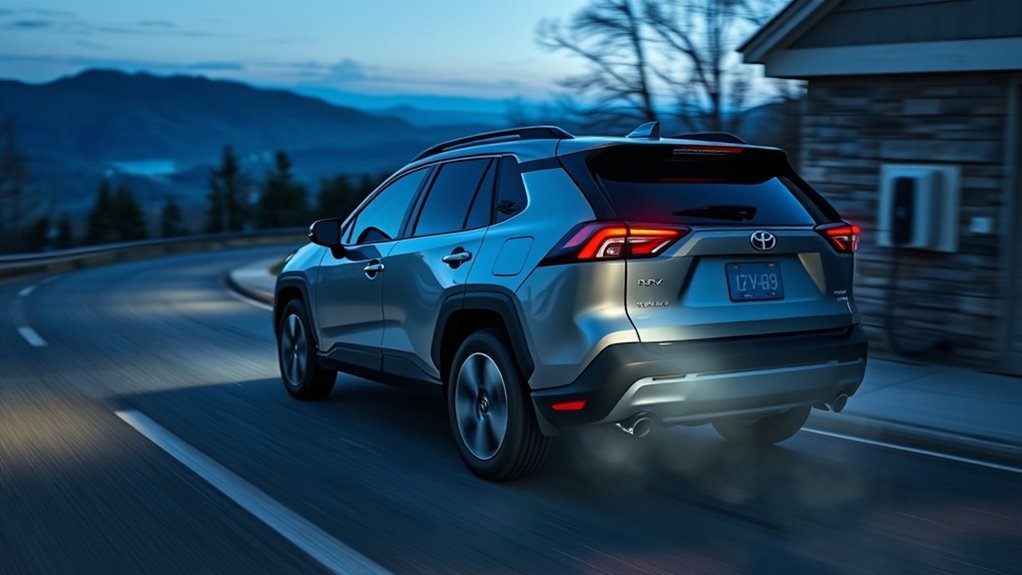
The best-supported answer is that the 324-horsepower figure remains Toyota’s official net combined system rating. Toyota does not provide a second, lower horsepower specification for the vehicle after its displayed EV range reaches zero.
That does not mean the drivetrain produces exactly 324 hp during every second of driving. Horsepower ratings describe the powertrain’s rated maximum output under specified conditions. Actual output at any instant depends on accelerator demand, motor speed, engine speed, traction, temperatures, battery-management limits and other conditions.
What should not be assumed is that using the plug-in portion of the battery automatically turns the 324-hp RAV4 PHEV into a much weaker vehicle. According to Toyota’s operating logic, low EV charge causes the system to transition into HV mode, where the gasoline engine and electric drive system continue working together.
Zero displayed EV range means the plug-in EV-driving portion has been depleted; it does not mean the traction battery has been completely emptied.
Note: Toyota does not publish a normal low-state-of-charge horsepower curve for the 2026 RAV4 PHEV. Claims that it automatically loses a specific amount of horsepower at 10%, 5% or zero displayed EV range should therefore be treated cautiously unless supported by instrumented testing.
What Does 324 Net Combined Horsepower Mean?
Toyota lists the 2026 RAV4 Plug-in Hybrid at 324 net combined horsepower. This is a system rating for the complete plug-in hybrid powertrain rather than a simple addition of every individual engine and motor peak.
The powertrain combines a 2.5-liter four-cylinder gasoline engine with Toyota’s sixth-generation plug-in hybrid system, front motor-generators and a dedicated rear electric motor for standard electronic all-wheel drive.
Electric motors and the gasoline engine do not necessarily reach their individual peak outputs at the same rotational speeds, so combined system horsepower is calculated as a coordinated system specification. For that reason, adding the published output of each component is not the correct way to calculate total horsepower.
How the RAV4 PHEV Delivers Power in Hybrid Mode
When the battery has enough charge for plug-in operation, the RAV4 PHEV can drive electrically for substantial distances. When the charge available for EV driving becomes low, the system automatically switches to HV mode.
In HV mode, the vehicle behaves more like a conventional Toyota hybrid. The gasoline engine and electric motor system are controlled together according to speed, accelerator demand, battery state and driving conditions. The engine can also generate electricity, while regenerative braking returns some energy to the traction battery during deceleration.
This is why the phrase “the battery is dead” is misleading when the dashboard shows no remaining EV miles. The system maintains a working battery range for hybrid operation rather than allowing the traction battery to be routinely discharged to a true electrochemical zero.
| Battery / Operating State | What Happens |
|---|---|
| High EV charge | EV driving is available, and AUTO EV/HV can bring in the gasoline engine when additional power is required. |
| EV-driving charge becomes low | The system automatically changes to HV operation. |
| Zero displayed EV range | The plug-in EV portion is depleted, but battery energy remains managed for hybrid operation. |
| Abnormal temperature or protection condition | The battery-management system can restrict operation to protect components; available instantaneous performance may differ from normal conditions. |
What 324 Horsepower Means in Daily Driving
The 2026 RAV4 PHEV is one of the more powerful versions of the RAV4. Toyota advertises a 0-to-60-mph time of 5.4 seconds, along with 324 net combined horsepower.
That gives the vehicle strong acceleration for highway entry, passing and everyday driving. Standard all-wheel drive can also use the rear electric motor to support traction without requiring a mechanical driveshaft from the gasoline engine to the rear axle.
The 2026 model’s larger battery also increases its useful electric driving capability. Toyota’s current U.S. page lists an EPA-estimated 54 miles of all-electric range for the SE. Range varies with model configuration, temperature, speed, climate-control use and other conditions.
The traction battery itself is now approximately 22.7 kWh, substantially larger than the previous-generation RAV4 PHEV’s approximately 18.1-kWh battery.
How Acceleration Changes When the Battery Is Charged
A charged battery gives the driver the greatest amount of available EV-only driving range, but that is not the same as Toyota saying the RAV4 PHEV’s official horsepower rating disappears when EV range reaches zero.
In AUTO EV/HV operation, the gasoline engine can start when the driver requests substantial power, such as during strong acceleration or while climbing a hill. In HV mode, the engine and electric system continue working together after the plug-in EV portion of the charge has been consumed.
Toyota’s published 5.4-second 0-to-60-mph claim should therefore be treated as a manufacturer performance specification, not as proof that every acceleration run at every temperature, battery state, elevation or road condition will produce exactly the same result.
Pro Tip: Charge regularly if you want to maximize EV-only mileage and minimize gasoline use. Charging is valuable primarily for electric range and efficiency; it should not be described as a requirement for preserving the vehicle’s published 324-hp system rating.
How the RAV4 PHEV Handles Passing and Merging
The RAV4 PHEV’s 324-hp system and advertised 5.4-second 0-to-60-mph performance indicate substantial acceleration capability for merging and overtaking.
When extra power is requested, Toyota’s hybrid controls can operate the gasoline engine and electric drive system together. In AUTO EV/HV mode, strong accelerator input can start the gasoline engine even when substantial EV charge remains.
When EV-driving charge has already been depleted, the vehicle operates in HV mode instead of relying on the gasoline engine alone. Electric assistance remains part of the hybrid system as battery state and operating conditions permit.
Drivers should still allow normal passing distance and never assume the maximum rated output will be available regardless of road surface, temperature or system conditions.
Which 2026 RAV4 PHEV Trim Feels Quickest?
The 2026 RAV4 Plug-in Hybrid lineup includes SE, Woodland, XSE and GR SPORT. Toyota lists the plug-in hybrid system at 324 net combined horsepower rather than advertising a higher-output engine for one particular trim.
The GR SPORT is engineered to feel more performance-focused. Toyota gives it GR-tuned suspension, GR-tuned electric power steering, additional chassis bracing and performance-oriented tires. Those changes can make steering response and cornering feel sharper, but they should not be confused with a higher horsepower rating.
Toyota’s consumer page advertises 5.4 seconds from 0 to 60 mph for the RAV4 Plug-in Hybrid as a model line. It does not provide a separate published 0-to-60 figure for each individual trim, so calling one trim definitively quicker in straight-line acceleration would go beyond Toyota’s published specifications.
| Trim | PHEV Output | Charging Hardware | Notable Point |
|---|---|---|---|
| SE | 324 net combined hp | 7-kW AC, J1772 | EPA-est. 54-mile EV range |
| Woodland | 324 net combined hp | 11-kW AC, CCS1 with DC fast charging | Off-road-oriented equipment |
| XSE | 324 net combined hp | 11-kW AC, CCS1 with DC fast charging | Higher-content sport trim |
| GR SPORT | 324 net combined hp | 7-kW AC, J1772 | GR-tuned chassis and steering |
Does Cold Weather Reduce RAV4 PHEV Power?
Cold weather can affect a plug-in hybrid battery’s efficiency, charging behavior and usable EV range. Toyota specifically notes that actual electric range and charging performance vary with factors that include outside temperature.
That does not justify assigning the RAV4 PHEV a made-up lower winter horsepower number. Toyota does not publish a simple table showing, for example, 324 hp at one temperature and a specific reduced output at another.
The more accurate explanation is that battery-management systems protect the traction battery when conditions are outside its preferred operating range. Under unusual thermal or protective conditions, electric input or output may be restricted, which can affect instantaneous drivetrain behavior.
Cabin heating also consumes energy and can reduce EV range. Once the battery and drivetrain reach more favorable operating temperatures, normal efficiency and electric operation generally improve.
How Regenerative Braking Helps Keep It Charged
Regenerative braking converts some of the vehicle’s kinetic energy during deceleration into electrical energy and sends it back to the traction battery.
That recovered energy improves overall efficiency and supports continued electric assistance. It does not, however, turn ordinary braking into the equivalent of plugging the vehicle into an external charger.
Regenerative Braking Basics
When the driver releases the accelerator or applies the brakes, the electric drive system can operate as a generator. Instead of wasting all of the vehicle’s kinetic energy as heat in the friction brakes, part of that energy is converted into electricity.
- Recovers part of the vehicle’s kinetic energy
- Returns electricity to the traction battery
- Reduces energy waste
- Can reduce use of the friction brakes in normal driving
- Supports efficient hybrid operation
Regeneration is managed automatically and depends on battery state, vehicle speed, braking demand and system conditions.
Energy Recapture in Traffic
Stop-and-go traffic creates frequent opportunities for regenerative braking because the vehicle repeatedly accelerates and decelerates.
The 2026 RAV4 PHEV’s approximately 22.7-kWh lithium-ion traction battery is substantially larger than the previous model’s pack. Recovered braking energy can help maintain charge, but the amount recovered during normal traffic is only a fraction of what a full external charging session supplies.
Regeneration therefore improves efficiency rather than guaranteeing that the battery will return to a high plug-in state of charge during ordinary driving.
Charge Benefits in Driving
Energy recovered through regeneration can later be reused by the electric motors. That is especially useful in urban driving, where repeated slowing gives the system more opportunities to recover energy than long periods of constant-speed cruising.
- regenerative braking recovers energy that would otherwise be lost as heat
- recovered energy can support later electric assistance
- EV and hybrid efficiency can improve in stop-and-go driving
- friction-brake use may be reduced during moderate deceleration
- external charging remains the primary way to restore the plug-in portion of the battery
What Changes RAV4 PHEV Power Over Time?
The most important long-term battery change is gradual capacity loss. As a lithium-ion traction battery ages, it can store less energy than when new.
For the RAV4 PHEV, that mainly means the distance available in EV or AUTO EV/HV operation may decline. Toyota’s 2026 owner information specifically states that although traction-battery capacity gradually decreases, vehicle performance does not significantly become worse simply because of normal capacity reduction.
Battery Age and Capacity
Battery degradation depends on time, temperature, charging patterns and vehicle use. Toyota advises owners to avoid practices that unnecessarily stress the battery, including leaving a fully charged vehicle parked for extended periods in very high temperatures.
Battery aging therefore should not be described as a predictable horsepower countdown. A more accurate expectation is gradual loss of usable EV range.
Toyota also provides a 10-year/150,000-mile hybrid-battery warranty for the 2026 RAV4 in the United States, whichever comes first. That warranty period is not the same thing as a guaranteed battery lifespan; a battery can remain serviceable beyond its warranty period.
Weather and Range Impact
Hot and cold weather affect battery efficiency and EV range. Climate-control use, sustained highway speeds, terrain, payload and driving style can also change the distance available on electricity.
Steep climbs increase power demand, while descents can return some energy through regenerative braking. These changes affect energy consumption much more predictably than they affect Toyota’s published horsepower rating.
For owners, the most useful metric to watch over time is therefore EV range and energy efficiency, rather than assuming every reduction in battery capacity equals an equal reduction in horsepower.
Driving Style Effects
Driving style strongly affects energy consumption. Rapid acceleration, high speeds and repeated heavy power demand use battery energy faster, while smoother acceleration generally improves efficiency.
- Smooth accelerator use generally improves efficiency.
- Regenerative braking recovers some energy during deceleration.
- High sustained speeds reduce EV range.
- Extreme temperatures can reduce usable electric range.
- Routine maintenance helps the vehicle operate as designed.
These factors change energy use and the frequency with which the gasoline engine operates. They do not justify claiming that ordinary spirited driving permanently reduces the vehicle’s rated horsepower.
Why the RAV4 PHEV Still Feels Strong at Low Charge
The 2026 RAV4 PHEV can remain responsive after the displayed EV range is depleted because the vehicle does not simply abandon its electric drive system. Instead, it switches to hybrid operation and manages the gasoline engine, front electric drive system, rear electric motor and traction battery together.
| Attribute | Practical Effect |
|---|---|
| 324 net combined horsepower | Official Toyota system rating |
| HV mode | Maintains gas-electric hybrid operation after EV-use charge is low |
| 22.7-kWh battery | Provides substantial plug-in energy plus managed hybrid operation |
| Regenerative braking | Recovers part of the energy lost during deceleration |
| Standard AWD | Rear electric motor supports traction and propulsion |
The key distinction is between rated output and instantaneous output. Toyota’s 324-hp number is the official maximum combined system rating. Actual power delivered at any moment can vary, but Toyota does not publish a normal low-EV-charge derating figure.
Frequently Asked Questions
How Much Horsepower Does the 2026 Toyota RAV4 PHEV Have?
Toyota rates the 2026 RAV4 Plug-in Hybrid at 324 net combined horsepower. All U.S. PHEV grades use the same basic 324-hp plug-in hybrid powertrain.
Does Zero EV Range Mean the RAV4 PHEV Battery Is Empty?
No. When charge available for EV driving becomes low, the vehicle automatically switches to HV mode. The hybrid system continues managing battery energy for electric assistance rather than routinely discharging the traction battery to a true zero state of charge.
How Long Will the 2026 RAV4 Plug-in Hybrid Battery Last?
Toyota does not publish a fixed battery lifespan. Capacity naturally declines with time and use, and the rate depends on conditions and driving habits. In the U.S., Toyota covers the hybrid battery for 10 years or 150,000 miles, whichever comes first. That warranty period should not be interpreted as the battery’s maximum service life.
How Long Can a Toyota RAV4 PHEV Sit Undriven?
For long-term storage, Toyota’s 2026 RAV4 PHEV manual says to prevent the traction battery from becoming extremely low by externally charging it or starting the hybrid system at least once every two or three months. The 12-volt battery can discharge separately, so its condition should also be considered during storage.
How Do You Break In a 2026 RAV4 Plug-in Hybrid?
Toyota recommends avoiding sudden stops for the first 200 miles, avoiding trailer towing for the first 500 miles, and for the first 600 miles avoiding extremely high speeds, sudden acceleration, prolonged low-gear driving and extended driving at one constant speed.
Does Battery Degradation Reduce the RAV4 PHEV’s Horsepower?
Normal battery aging primarily reduces usable EV capacity and range. Toyota’s 2026 owner information says that as traction-battery capacity decreases, EV driving distance falls but vehicle performance does not significantly become worse. Toyota does not publish a horsepower-loss schedule based on battery age.
Conclusion
The 2026 Toyota RAV4 Plug-in Hybrid is officially rated at 324 net combined horsepower. Toyota does not state that this rating applies only with a fully charged plug-in battery, nor does it publish a lower normal horsepower figure after the displayed EV range reaches zero.
Instead, when charge available for EV driving becomes low, the vehicle automatically transitions to HV mode. The gasoline engine, electric motors and managed traction-battery reserve continue working as a hybrid system. Battery temperature, protection limits, traction and other conditions can affect instantaneous output, but ordinary depletion of the EV-driving portion should not be described as an automatic loss of the RAV4 PHEV’s official 324-hp rating.
Sources
- Toyota — 2026 RAV4 Plug-in Hybrid — current 324-hp, 5.4-second acceleration and EPA-estimated SE electric-range specifications.
- Toyota USA Newsroom — 2026 RAV4 product information — powertrain, charging hardware, trims, towing and warranty information.
- Toyota — RAV4 Plug-in Hybrid specifications and comparison data — 22.7-kWh battery and current powertrain specifications.
- Toyota Owners — Manuals and Warranties — official owner-manual and warranty reference portal.
