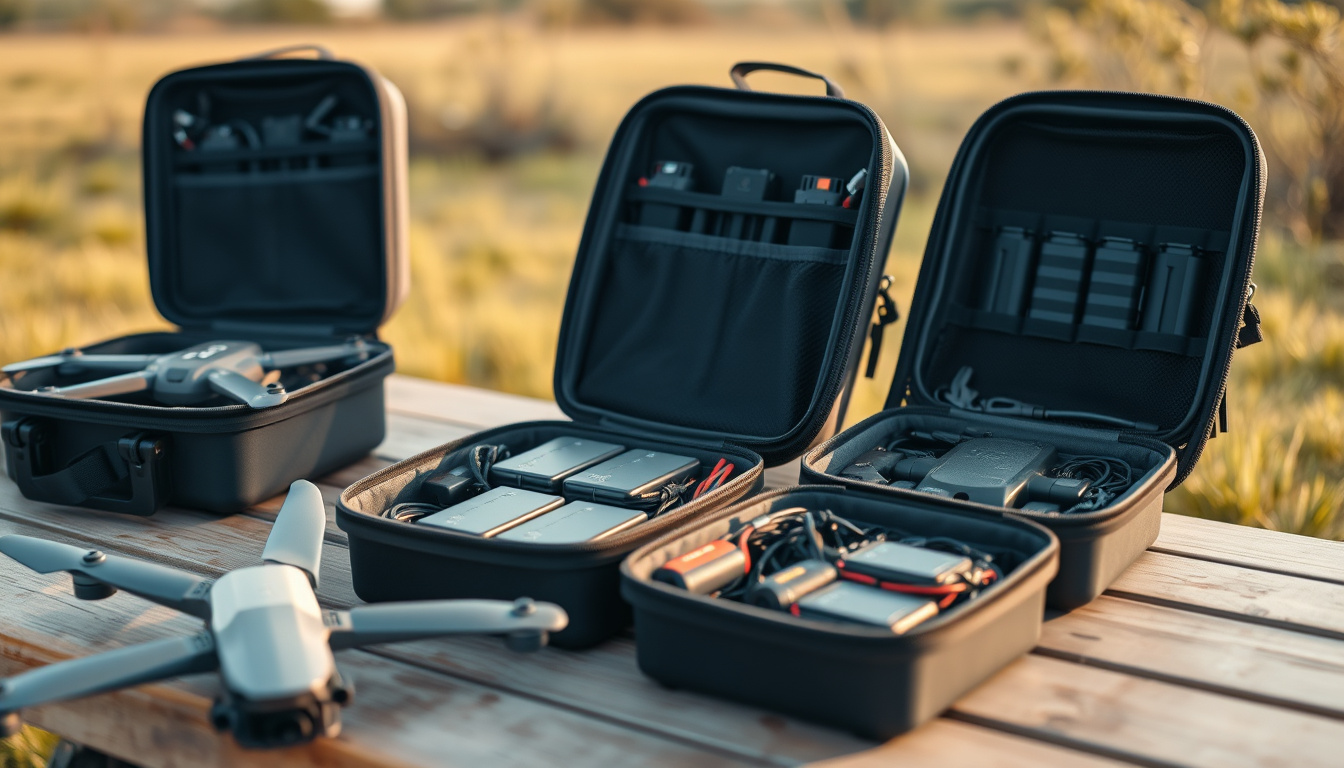
Drone batteries need more than an empty pocket in your backpack. A well-designed LiPo battery storage bag keeps packs organized, protects them from everyday damage, and adds a layer of fire-resistant material between batteries and surrounding gear. It cannot guarantee containment of a battery fire, but it can be a useful part of safer storage and transport.
For most pilots, the STARTRC LiPo Safe Bag is the most versatile starting point because of its roomy construction and adjustable organization. If you carry larger battery loads, consider the NAIBAOSD LiPo Battery Bag.
We compared six options for capacity, construction, closure design, portability, and practical fit, using available product information and battery-handling guidance.
Best Drone LiPo Battery Storage Bags Compared
| Product | Best for | Dimensions | Organization | Original Score |
|---|---|---|---|---|
| Best overall | 21.5 × 15 × 14 cm | Adjustable dividers | 90 | |
| Large battery loads | 11 × 8 × 6.5 in | Large main storage area | 88 | |
| Layered construction | 10.6 × 6.3 × 9.1 in | Main area and accessory pocket | 91 | |
| Compact kits | 4.33 × 4.33 × 2.76 in | Small single compartment | 85 | |
| Slim storage | Confirm linked variant | Compact pouch | 93 | |
| Mavic Air 2 batteries | Model-specific fit | Individual battery pockets | 89 |
Scores above are carried over from the original comparison. They are not laboratory fire-resistance ratings, and the original scoring method was not provided.
Best Drone LiPo Battery Storage Bags: Our Top Picks
1. STARTRC LiPo Safe Bag

Bottom line: The STARTRC LiPo Safe Bag is our top all-around choice for pilots who carry different battery sizes. Its roomy construction and adjustable interior make daily organization easier.
Key Specs
- Size: 21.5 × 15 × 14 cm, suitable for a mixed battery kit.
- Construction: Layered fire-resistant fabric designed for battery storage.
- Organization: Adjustable internal dividers for flexible packing.
- Carrying: Reinforced handle and zippered closure.
The main advantage is flexibility. You can arrange the internal partitions around different battery shapes rather than forcing every pack into one fixed compartment. This helps when you own more than one drone or carry hobby LiPo packs alongside DJI batteries.
There is also space for smaller accessories, such as protected charging leads. Keep loose metal items away from battery terminals, and do not assume a fabric divider alone provides electrical insulation.
STARTRC markets this style of bag for charging, storage, and transport. Its materials can provide an additional barrier, but they do not make charging unattended or battery failures harmless.
Reader Sentiment Graphic
The following graphic appeared in the original roundup. Its underlying review sample and calculation method were not provided, so it should not be treated as independently verified performance data.

How It Helps
- Field preparation: Arrange charged and depleted batteries in clearly marked groups.
- Home storage: Keep protected packs together in a cool, dry storage location.
- Travel: Fit the soft organizer inside a larger drone backpack.
- Equipment changes: Reconfigure the interior as your battery collection changes.
Pros and Cons
- Adaptable interior layout
- Room for multiple battery shapes
- Convenient handle and zipper
- Fire-resistant layered materials
- Soft construction offers less crush protection than a hard case
- Dividers do not replace individual terminal protection
- Takes more room than a single-battery sleeve
2. NAIBAOSD LiPo Battery Bag

Bottom line: The NAIBAOSD LiPo Battery Bag suits pilots who need space for larger battery packs and want a shoulder strap for carrying the load.
Key Specs
- Size: 11 × 8 × 6.5 inches, with a generous main storage area.
- Construction: Layered fiberglass, aluminum foil, and silicone materials.
- Organization: Large flexible compartment for batteries and accessories.
- Carrying: Detachable shoulder strap and double metal zipper.
The NAIBAOSD stands out because of its capacity. You can arrange larger battery packs inside and use the shoulder strap when moving between your vehicle, charging station, and flight area.
Its flexible shape makes packing convenient, but it does not provide the same structural protection as a rigid equipment case. Batteries should have insulated contacts and enough spacing that they cannot crush or rub against one another.
The layered construction is designed to resist heat exposure. However, a soft battery bag should never be described as an explosion-proof guarantee, regardless of the wording used in marketing.
Reader Sentiment Graphic
This original sentiment chart is retained for editorial review. The data and methodology require confirmation before it is used to support a purchasing claim.

How It Helps
- Large battery kits: Offers room to organize bulkier packs.
- Weekend flying: The detachable strap helps you carry the bag between locations.
- Home storage: Creates a dedicated place for batteries away from loose equipment.
- Charging preparation: Keeps charger accessories together when they are not in use.
Pros and Cons
- Generous storage space
- Detachable shoulder strap
- Double metal zipper
- Layered fire-resistant materials
- Large size is less convenient for a small drone kit
- Soft shell does not prevent crushing
- Requires careful packing to limit battery movement
3. Tamfile Fireproof LiPo Battery Bag

Bottom line: The Tamfile Fireproof LiPo Battery Bag is a useful option when layered materials, extra storage space, and separate accessory organization matter more than minimum size.
Key Specs
- Size: 10.6 × 6.3 × 9.1 inches.
- Construction: Silicone-coated fiberglass and aluminum-foil fiberglass layers.
- Organization: Main storage area with additional accessory space.
- Carrying: Handle and adjustable detachable shoulder strap.
Tamfile uses multiple fire-resistant material layers and a larger carrying format. This design gives you room for several batteries while providing a separate location for leads and smaller charging accessories.
The carrying strap helps when moving equipment between locations. Its wider design also makes it easier to reach items than a narrow sleeve.
The materials are marketed for high-temperature resistance, but material heat ratings are not proof that a closed bag can fully contain a large LiPo thermal-runaway event. Never rely on a temperature claim alone to judge battery safety.
Reader Sentiment Graphic
The original sentiment visualization is retained below. It should be checked against its source data before publication.

How It Helps
- Battery storage: Provides a dedicated area for multiple packs.
- Accessory organization: Keeps smaller leads away from the main battery storage area.
- Field operations: Carry handles and a shoulder strap simplify transport.
- Charging preparation: Helps keep your charging equipment organized between sessions.
Pros and Cons
- Multiple fire-resistant material layers
- Separate accessory storage
- Useful carrying options
- Large internal space
- Bulky for small battery collections
- Not a substitute for certified fire-containment equipment
- Less impact protection than a rigid case
4. HOBBYMATE Mini LiPo Bag

Bottom line: The HOBBYMATE Mini LiPo Bag is ideal when you want to store small LiPo packs without carrying a full-size organizer.
Key Specs
- Size: 4.33 × 4.33 × 2.76 inches.
- Construction: Nylon exterior with fire-resistant bag construction.
- Organization: Compact main compartment.
- Carrying: Lightweight design with hook-and-loop closure.
The HOBBYMATE takes a different approach from larger battery bags. Its compact size fits pilots who travel light and do not need room for a charger, several large batteries, and additional accessories.
It is also useful for separating small packs from tools or other loose gear inside a backpack. Check the inside dimensions carefully, because even a compact drone battery may be too large for this particular pouch.
The hook-and-loop closure is quick to open, but it should be kept clean and fully closed during storage. As with every LiPo bag here, the pouch is an additional precaution, not a guarantee against a battery fire.
Reader Sentiment Graphic
This graphic comes from the original article. Its sentiment figures have not been independently validated.

How It Helps
- Short flights: Keeps a small supply of compatible packs together.
- Daily carrying: Fits more easily into a compact equipment bag.
- Home organization: Separates small batteries from loose accessories.
Pros and Cons
- Very compact shape
- Lightweight construction
- Quick hook-and-loop closure
- Simple storage for small packs
- Too small for many larger drone batteries
- Limited accessory storage
- No rigid impact protection
5. PDTXCLS LiPo Battery Bag

Bottom line: The PDTXCLS LiPo Battery Bag is presented in the original article as a compact storage pouch for DJI-style batteries. The linked listing’s brand information needs confirmation, so buyers should check the actual product name and dimensions.
Key Specs
- Size: Linked product information references a compact 185 × 75 × 60 mm pouch.
- Construction: Fire-resistant flexible battery pouch design.
- Organization: Slim storage format for compatible packs.
- Carrying: Lightweight design suited to larger equipment bags.
A smaller LiPo pouch makes sense when you already own a protective drone backpack and only need a separate place for battery storage.
The main benefit is reduced bulk. However, do not assume every DJI Mavic or Phantom battery fits. Those drone families use different battery shapes, and the linked listing should be checked against the exact battery measurements.
Because the supplied name and linked product information do not clearly agree, we cannot confidently identify the precise model variant from the available evidence.
Reader Sentiment Graphic
The original reader-sentiment graphic is retained. Its source data and model association need editorial confirmation.

How It Helps
- Compact transport: Adds a separate battery pouch inside a backpack.
- Field organization: Keeps compatible packs together between flights.
- Home storage: Provides a dedicated space away from loose metal accessories.
Pros and Cons
- Compact battery storage format
- Easy to place inside another case
- Designed for portable battery organization
- Exact model identity needs verification
- Limited room for bulky packs
- Not a rigid protective case
6. BOANJU Mavic Battery Bag

Bottom line: The BOANJU Mavic Battery Bag is intended for pilots who want a compact, model-focused organizer for DJI Mavic Air 2-style batteries.
Key Specs
- Size: Model-specific pouch; check fit against your exact batteries.
- Construction: Soft nylon-style battery organizer.
- Organization: Individual pockets for up to three compatible packs, as described in the source.
- Carrying: Slim design with a compact carrying handle.
Individual battery pockets make this style of organizer convenient when you carry several similar packs. You can keep the batteries in a consistent order and find a replacement quickly during a flight session.
The bag also uses less space than a large rectangular storage case. That makes it useful for fitting batteries inside an existing camera or drone backpack.
Its main limitation is compatibility. A pouch made for Mavic Air 2 batteries should not automatically be assumed to fit Mavic 3, Air 3, or other DJI battery generations. It also does not replace individual contact protection or airline battery rules.
Reader Sentiment Graphic
The following original sentiment image is preserved, but the underlying data requires verification.

How It Helps
- Field flights: Separates compatible batteries for easier swapping.
- Backpack storage: Uses a slim pouch instead of a larger equipment box.
- Air travel: Provides organized carry-on storage when airline rules allow the batteries.
- Home organization: Keeps a matching battery set in one location.
Pros and Cons
- Purpose-focused storage for matching batteries
- Individual battery pockets
- Compact, portable shape
- Useful for organized travel packing
- Limited compatibility with other battery generations
- Little room for charging accessories
- Soft construction provides limited crush protection
STARTRC vs NAIBAOSD: Which Should You Get?
The STARTRC favors flexible organization, while the NAIBAOSD offers a larger main storage area and a shoulder strap. Neither option replaces proper battery inspection, separate contact protection, or safe charging practices.
- Battery variety: STARTRC is easier to configure around different pack shapes.
- Storage space: NAIBAOSD offers more room for bulkier equipment.
- Portability: STARTRC suits a compact mixed kit; NAIBAOSD is better suited to carrying a larger load.
- Physical protection: Both use soft construction, so neither is a substitute for a rigid crush-resistant case.
Which Drone LiPo Battery Storage Bag Should You Buy?
- For everyday drone flying: Get the STARTRC LiPo Safe Bag.
- For larger battery collections: Choose the NAIBAOSD LiPo Battery Bag.
- For a layered material design: Consider the Tamfile Fireproof LiPo Battery Bag.
- For small RC batteries: Pick the HOBBYMATE Mini LiPo Bag.
- For compact Mavic Air 2 storage: Consider the BOANJU Mavic Battery Bag after confirming fit.
How We Chose
- Battery fit: We prioritized dimensions, flexibility, and model compatibility.
- Materials: We reviewed available descriptions of fire-resistant fabric and layered construction without assuming complete fire containment.
- Organization: We compared partitions, pockets, zippers, and carrying options.
- Practical limitations: We considered capacity, soft-shell protection, and ease of access.
- Safety information: We used FAA guidance for air travel and reviewed accessible product information. We did not conduct physical fire or impact tests.
How to Choose a Drone LiPo Battery Storage Bag
Choose the Correct Size
Measure your battery’s length, width, and height, including exposed connectors. Allow enough space for the battery to fit without pressure on its housing. If you own several drone models, a flexible organizer such as the STARTRC LiPo Safe Bag may be more convenient than a model-specific sleeve.
Understand Fire-Resistant Materials
Many LiPo bags use fiberglass, silicone coatings, or foil layers to resist heat and flame exposure. However, material resistance is not the same as proving that a finished bag can safely contain battery thermal runaway. A pouch may fail at seams, closures, or openings during a severe event.
Look for clear construction details rather than treating words such as “fireproof” or “explosionproof” as absolute guarantees.
Consider Internal Separation
Battery terminals must be protected from short circuits. Dedicated pockets and dividers help organize packs, but insulating the exposed terminals remains essential. Avoid storing loose keys, tools, screws, or other metal objects beside unprotected batteries.
Decide Between a Pouch and a Hard Case
A soft LiPo pouch saves space and is easy to carry. A rigid case can provide better protection against crushing and impact, although its fire behavior depends on its design. For rough field conditions, you may benefit from using appropriately protected batteries inside a suitable outer equipment case.
Check the Closure and Carrying Design
Zippers, flaps, and hook-and-loop closures affect how easily you can access batteries. Larger bags may benefit from handles or shoulder straps. Check that the closure fully engages and that any charging-cable opening matches the manufacturer’s instructions.
Mistakes to Avoid When Buying a LiPo Battery Bag
- Assuming fireproof means fire-safe: Never treat a pouch as a guarantee against thermal runaway.
- Ignoring battery dimensions: Check the exact pack size before buying.
- Mixing loose terminals with metal: Insulate contacts individually.
- Overpacking: Leave enough room to avoid compressing battery housings.
- Assuming every pouch meets airline rules: Check battery watt-hours and your airline’s requirements.
Safe Storage, Charging, and Airline Travel
Safe Home Storage
Store drone batteries in a cool, dry location away from direct sunlight, heaters, and combustible clutter. Inspect packs regularly for swelling, punctures, damaged wiring, or unusual heat. Follow the battery manufacturer’s storage-charge instructions when the batteries will not be used for an extended period.
Charging Precautions
Use a charger compatible with your battery chemistry and follow the manufacturer’s charging instructions. Charge on a suitable noncombustible surface while you are present and alert. Never charge a swollen, punctured, overheated, or otherwise damaged pack.
Only use a LiPo bag for charging if the bag’s manufacturer allows it and provides instructions for cable routing, closure, and ventilation. Do not assume that charging inside a bag eliminates fire risk.
Flying With Spare Drone Batteries
Under FAA rules, spare lithium batteries must travel in carry-on baggage rather than checked luggage, and their terminals must be protected from short circuits.
Rechargeable lithium-ion batteries up to 100 Wh are generally permitted for personal use. Batteries above 100 Wh and up to 160 Wh need airline approval and are limited to two larger spares per passenger. Batteries exceeding 160 Wh are generally prohibited on passenger aircraft. Airlines may impose stricter limits.
Use the official FAA PackSafe lithium battery guidance and check the airline before departure. A fire-resistant pouch does not provide an exemption from the rules.
FAQs
Do I Need a Fireproof Bag for Drone Batteries?
A fire-resistant LiPo bag is a useful additional precaution, but it is not a universal requirement for ordinary home battery storage. Its main practical benefits are organization, separation, and some resistance to external heat or flame exposure. You still need proper terminal insulation, suitable storage conditions, and safe handling practices.
Can I Charge Drone Batteries Inside a LiPo Bag?
Some LiPo bags are designed for charging, but not every bag is suitable for every charger or battery. Follow both manufacturers’ instructions, provide any required cable access or ventilation, and charge on a safe surface while supervising the process. Never leave batteries charging unattended, even inside a fire-resistant pouch.
Can a LiPo Bag Stop a Battery Fire?
No ordinary LiPo storage pouch should be assumed to stop every battery fire. Fire-resistant materials may reduce exposure to heat and flame, but a severe thermal-runaway event can release hot gases, flames, and debris. The finished bag’s performance depends on its materials, construction, closure, and the battery involved.
Can I Carry LiPo Batteries on an Airplane?
Yes, many consumer drone batteries are permitted in carry-on baggage when they meet the airline’s watt-hour limits. Spare lithium batteries must not go into checked baggage, and exposed terminals must be protected from short circuits. Check battery capacity, airline approval requirements, and international restrictions before traveling.
How Do I Calculate Battery Watt-Hours?
Multiply the battery’s nominal voltage by its capacity in amp-hours. If capacity is listed in milliamp-hours, divide that figure by 1,000 first. For example, a 14.8 V battery rated at 3,000 mAh has a nominal energy of 44.4 Wh. Use the manufacturer’s marked rating when available.
Should Drone Batteries Be Stored Fully Charged?
For extended storage, follow the battery manufacturer’s recommended storage level rather than leaving batteries fully charged for long periods. Some DJI intelligent batteries manage their charge automatically during inactivity, while hobby LiPo packs may require a compatible charger with a storage mode. The correct procedure depends on your exact battery model.
Can I Put Several Batteries in One Bag?
Yes, if the organizer has enough capacity and the batteries are individually protected from shorts and damage. Use compartments or separate sleeves where suitable, and avoid forcing packs together. A larger bag such as the NAIBAOSD LiPo Battery Bag may help with larger collections.
Is a Hard Battery Case Better Than a Soft LiPo Bag?
Neither design is automatically best in every situation. A hard case can offer better protection against crushing and impacts, while a soft pouch is lighter and easier to pack. Fire resistance depends on the individual construction rather than whether a product is hard or soft. Choose based on your storage environment and transport needs.
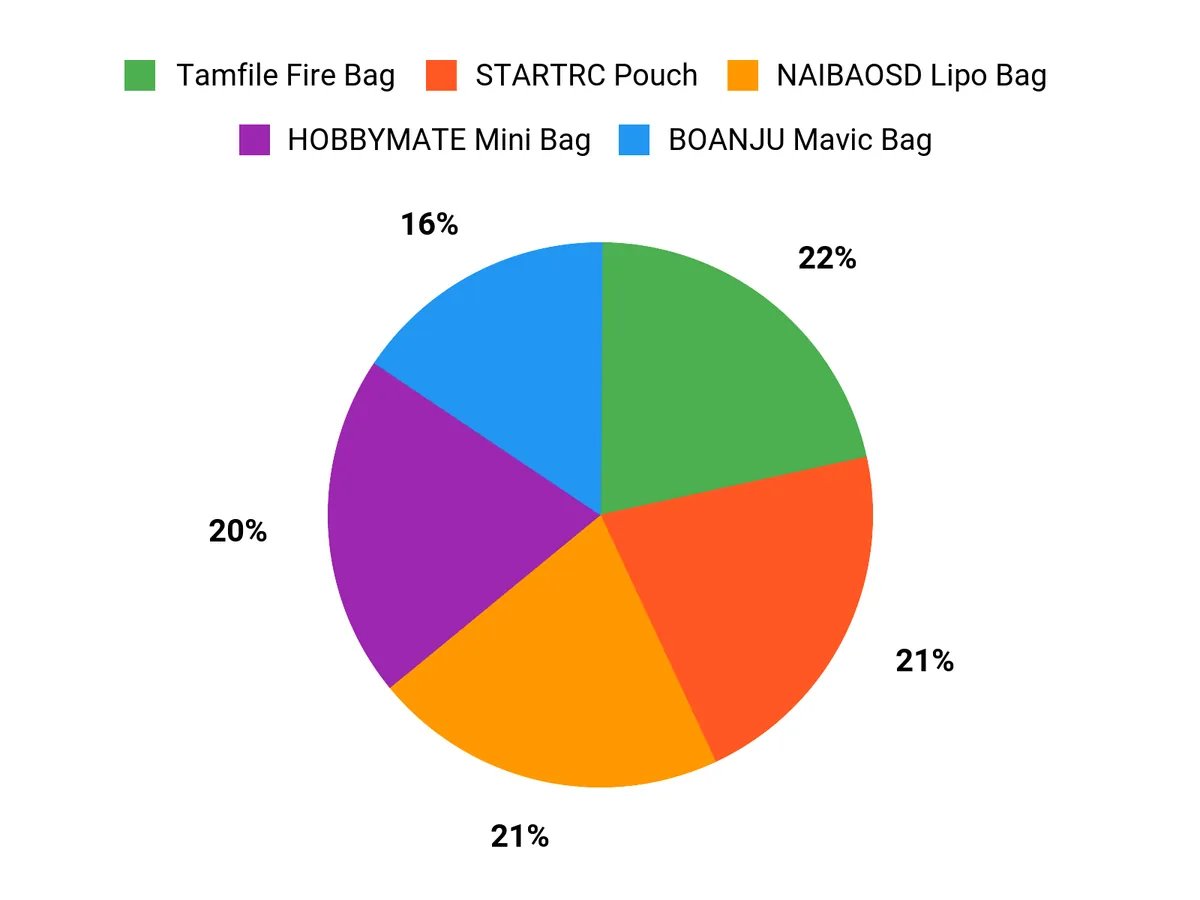
Customer Preferences
The original roundup compared capacity, portability, and material construction as key buying priorities. Those are useful selection factors, but preferences should not be presented as measured customer findings without supporting survey or review data.
Final Verdict
The best drone LiPo battery storage bag depends on how many packs you carry and how you use them. For a versatile everyday organizer, we favor the STARTRC design. If you need a larger main compartment, NAIBAOSD is worth comparing.
For larger batteries, consider the NAIBAOSD LiPo Battery Bag. For compact hobby packs, the HOBBYMATE Mini LiPo Bag is the smaller alternative.
| Product Name | Image | Rating | Material | Dimensions (L x W x H) | Number of Compartments |
|---|---|---|---|---|---|
| STARTRC Lipo Safe Bag Fireproof |
|
See reviews on Amazon | Aluminum | 21.5 x 15 x 14 cm | 1 |
| Fireproof Lipo Battery Bag |
|
See reviews on Amazon | Fiberglass, Aluminum Foil, Silicone | 11 x 8 x 6.5 in | 1 |
| Tamfile Fireproof Lipo Battery Bag |
|
See reviews on Amazon | Non-itchy Silicone Coated Fiberglass | 10.6 x 6.3 x 9.1 in | 2 |
| HOBBYMATE Lipo Charging Bag |
|
See reviews on Amazon | Nylon | 4.33 x 4.33 x 2.76 in | 1 |
| Lipo Battery Bag Fireproof |
|
See reviews on Amazon | N/A | N/A | 1 |
| Battery Safe Bag Case for DJI Mavic Air 2 |
|
See reviews on Amazon | Nylon | 6.69 x 4.33 x 0.59 in | 1 |

