
As an Amazon Associate I earn from qualifying purchases.
Portable power stations can keep essential electronics, refrigeration, tools, and communication gear running during outages, camping trips, RV travel, and off-grid work. The right model depends on three numbers first: usable battery capacity in watt-hours, continuous AC output in watts, and the starting surge required by your highest-draw device.
Quick verdict: Choose the BLUETTI Elite 200 V2 when you need the strongest combination of capacity and continuous output, the EcoFlow DELTA 2 when you want a lighter 1kWh unit with fast wall charging and expandable storage, or the Anker SOLIX F2000 when an RV outlet, rolling design, and 2kWh-class capacity matter most.
Before You Buy
- Add the running wattage of devices you will use at the same time, then leave headroom below the station’s continuous-output limit.
- Check starting or compressor surge requirements for refrigerators, pumps, power tools, and other motor-driven equipment.
- Estimate runtime with usable watt-hours rather than battery capacity alone because inverter losses and standby draw reduce real-world runtime.
- For medical or safety-critical equipment, confirm compatibility, transfer-time requirements, and backup procedures with the device manufacturer.
Top Picks
|
Category |
Product |
Why It Stands Out |
|---|---|---|
|
🔋 Best Overall For Heavy Loads |
2,073.6Wh LFP capacity, 2,600W continuous AC output, and strong power-to-weight performance. |
|
|
⚡ Best For Fast Everyday Recharging |
1,024Wh LFP capacity, 1,800W output, fast AC charging, and expandable storage. |
|
|
🚐 Best For RV And Rolling Portability |
2,048Wh LFP capacity, 2,400W output, an RV outlet, wheels, and a retractable handle. |
How We Picked
We prioritized published specifications that directly affect real use: battery capacity, continuous AC output, recharge speed, battery chemistry and cycle-life claims, weight, port selection, solar input, expansion options, UPS or backup behavior, warranty coverage, and overall fit for home, RV, camping, and mobile-work needs. We also favored products whose current Amazon listings clearly match the model and specifications discussed. No hands-on testing is claimed in this article.
The Elite 200 V2 is the strongest all-around match in this group for shoppers who need long runtime and enough continuous output for heavier appliances or tools. Its 2,073.6Wh battery and 2,600W AC rating give it more headroom than the smaller DELTA 2, while its listed weight of about 53.35 pounds is lower than the Anker SOLIX F2000.
BLUETTI advertises fast charging through several supported input combinations. Recharge time depends on the mode, available AC or DC input, battery temperature, and whether optional charging equipment is used, so buyers should compare the exact charging setup included with the listing rather than relying on the fastest headline figure alone.
Why You’ll Like It
You get a useful balance of high capacity, high AC output, LFP battery chemistry, app-based monitoring, and UPS functionality. It is a practical choice for refrigerator backup, RV appliances, workshop tools, communications gear, and other mixed loads where a 1kWh station may run out too quickly.
Buyer Feedback Themes
Positive themes commonly focus on capacity, output, recharge flexibility, and the relatively compact footprint for a 2kWh-class unit. The main limitation is still weight: at more than 53 pounds, it is portable in the sense that it can be moved, but it is not a casual one-hand carry for many buyers.
Review note: The chart below was supplied with the source article and is not a live rating, review count, or independently verified sentiment study. Check recent verified-purchase reviews for current quality-control and support patterns.

Situational Benefits
|
Situation |
How It Helps |
|---|---|
|
Home Power Outage |
Its large battery and high AC output can support several household essentials, provided their combined running and starting wattage stays within the unit’s limits. |
|
RV And Camping |
It can power refrigeration, lighting, electronics, and selected small appliances without the exhaust and fuel handling of a gas generator. |
|
Workshop Or Jobsite |
The 2,600W continuous rating offers more room for tools than lower-output stations, though starting surge and tool-specific requirements still need checking. |
|
Solar-Paired Use |
Supported solar input can extend off-grid use when panel voltage, current, connectors, placement, and weather conditions are suitable. |
Who Should Buy This
Buy it when you need high continuous output and roughly 2kWh of storage for outages, RV travel, off-grid work, or heavier mixed loads.
Who Should Avoid This
Skip it when your main needs are phone and laptop charging, short weekend trips, or frequent carrying over long distances. A smaller station will be easier to transport and may cost less.
Key Benefits
- 2,073.6Wh LFP battery for extended runtime
- 2,600W continuous AC output for demanding mixed loads
- App control and UPS support for easier backup management
- Strong capacity-to-weight balance within this three-product comparison
Check Current Amazon Availability
The DELTA 2 is the easiest model here to move regularly. Its listed 27-pound weight is substantially lower than the two 2kWh-class options, while the 1,800W inverter still covers many common household and camping loads. EcoFlow lists a 1,024Wh LFP battery, 15 outputs, up to 500W solar input, and expansion support up to 3kWh with compatible extra batteries.
Its wall-charging speed is a major practical advantage when grid power is available between uses. EcoFlow lists approximately 0–80% charging in 50 minutes and a full charge in about 80 minutes under supported AC conditions. Faster charging can create more fan noise and heat than slower modes, so use the app settings that best match your schedule and battery-care priorities.
Why You’ll Like It
You get enough output for many refrigerators, kitchen appliances, electronics, and campsite devices without carrying a 50- to 67-pound unit. Expansion support also lets you start with 1,024Wh and add compatible storage later instead of buying the largest system immediately.
Buyer Feedback Themes
Common positives include fast AC charging, a broad port selection, app controls, and useful output for the size. Common tradeoffs include fan noise during fast charging, a capacity ceiling that may feel limited during long outages, and the added cost and bulk of expansion batteries.
Review note: The chart below was supplied with the source article and is not a live rating, review count, or independently verified sentiment study. Check recent verified-purchase reviews for current quality-control and support patterns.

Situational Benefits
|
Situation |
How It Helps |
|---|---|
|
Short Home Outage |
It can keep selected essentials running and recharge quickly when utility power or generator power becomes available. |
|
Camping And RV Travel |
The 27-pound weight is easier to manage than the larger models while still supporting refrigeration, lighting, and device charging. |
|
Mobile Office Or Studio |
Its 100W USB-C port and multiple AC and USB outputs make it practical for laptops, displays, cameras, networking gear, and chargers. |
|
Expandable Backup |
Compatible extra batteries can extend runtime when your needs grow, although they add cost, weight, and storage requirements. |
Who Should Buy This
Choose it for camping, RV trips, mobile work, or shorter outages when portability and fast recharging matter more than maximum built-in capacity.
Who Should Avoid This
Look at a larger model if you expect multi-day outages, need to run several high-draw appliances together, or do not want to manage optional expansion batteries.
Key Benefits
- 1,024Wh LFP battery and 1,800W continuous AC output
- Fast AC charging for quick turnaround between uses
- Expandable storage with compatible extra batteries
- 27-pound listed weight and broad outlet selection
Check Current Amazon Availability
The SOLIX F2000 combines a 2,048Wh LFP battery with 2,400W continuous output and ports for up to 12 devices. Its dedicated RV outlet, wheels, and retractable handle make more sense for RV use and rolling transport than for frequent lifting. At about 67.2 pounds, it is the heaviest station in this comparison.
Anker lists approximately 0–80% AC charging in 1.4 hours under supported conditions. It also lists a five-year full-device warranty. Buyers should confirm exactly which cables, solar accessories, expansion batteries, and regional outlet configuration are included with the selected Amazon variation.
Why You’ll Like It
The F2000 solves a common problem with large power stations: moving a heavy battery from storage to an RV, garage, or work area. Wheels and a retractable handle reduce lifting, while the 2,400W output, RV outlet, and broad port selection support varied loads without a tangle of adapters.
Buyer Feedback Themes
Positive themes commonly center on output, port selection, rolling mobility, and the dedicated RV connection. The clear downside is bulk: even with wheels, stairs, vehicle loading, soft ground, and tight storage spaces can make a 67-pound unit difficult to manage.
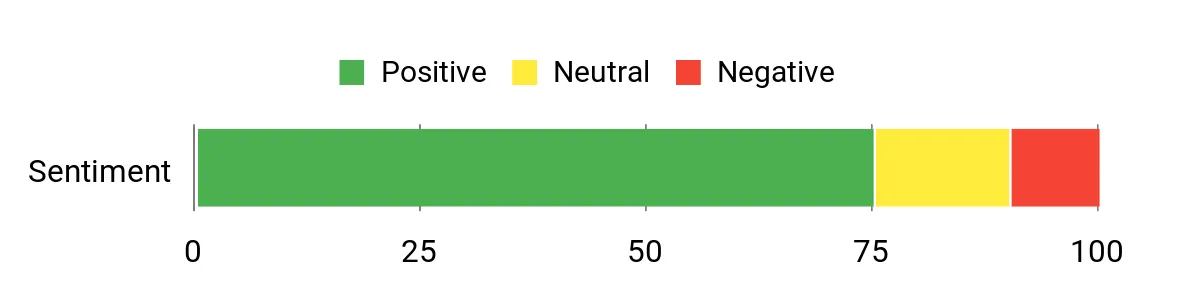
Review note: The chart below was supplied with the source article and is not a live rating, review count, or independently verified sentiment study. Check recent verified-purchase reviews for current quality-control and support patterns.
Situational Benefits
|
Situation |
How It Helps |
|---|---|
|
RV And Overlanding |
The RV outlet, high AC output, and rolling design make it well suited to campsites and vehicle-based travel. |
|
Home Backup |
Its 2,048Wh capacity can support selected appliances and communications gear during an outage when total load is managed carefully. |
|
Outdoor Event |
Multiple AC, USB, car, and RV connections can support lighting, audio, displays, and charging stations from one battery system. |
|
Portable Workshop |
The 2,400W output can run many tools and chargers, subject to each tool’s starting surge and operating requirements. |
Who Should Buy This
Choose it when you need an RV-friendly 2kWh system, plan to move the station mostly on level surfaces, and value the dedicated outlet and extensive port selection.
Who Should Avoid This
Avoid it when you must carry the station upstairs, lift it into a vehicle alone, or prioritize compact storage. The BLUETTI offers similar capacity at a lower listed weight, while the DELTA 2 is much easier to carry.
Key Benefits
- 2,048Wh LiFePO4 battery and 2,400W continuous output
- Dedicated RV outlet plus AC, USB, and car outputs
- Wheels and retractable handle reduce lifting on level surfaces
- Five-year full-device warranty listed by the manufacturer
Check Current Amazon Availability
Portable Power Station Buying Guide
Capacity: Start With Watt-Hours
Battery capacity is measured in watt-hours. A rough runtime estimate is battery watt-hours multiplied by an efficiency allowance, then divided by the device’s running watts. Because conversion losses, temperature, battery-management limits, and standby draw vary, use a conservative allowance rather than expecting the full nameplate capacity at the AC outlet.
Output: Check Running And Starting Watts
Continuous output tells you how much equipment the inverter can run steadily. Starting or surge demand can be much higher for refrigerators, compressors, pumps, and power tools. Confirm both values before buying, and do not assume a “power lifting” or boost mode behaves like normal pure-sine continuous output for every appliance.
Battery Chemistry And Cycle Life
All three remaining picks use LFP or LiFePO4 battery chemistry. Manufacturers generally position LFP packs as longer-lived than older nickel-manganese-cobalt designs, but advertised cycle life depends on depth of discharge, temperature, charging behavior, storage conditions, and the capacity threshold used in the claim.
Charging Options
Compare standard AC charging, maximum solar input, car charging, and any optional alternator or dual-input accessories. The fastest advertised time may require ideal conditions or extra hardware. Also check whether solar panels, adapters, and expansion batteries are included or sold separately.
Portability And Placement
A built-in handle does not make every station easy to carry. Consider stairs, vehicle loading height, storage dimensions, wheel clearance, ventilation space, cable access, and whether one person can safely move the unit. Never block cooling vents or place the station where it can be exposed to standing water or excessive heat.
UPS And Sensitive Equipment
UPS labels and transfer times are not identical across brands or operating modes. Confirm whether the station supports the voltage, waveform, grounding, transfer speed, and continuous load required by your equipment. For medical, life-safety, or other critical devices, follow the equipment manufacturer’s approved backup guidance and maintain a separate contingency plan.
FAQ
How Do I Choose The Right Capacity?
List every device you want to run, record its running wattage, estimate daily operating hours, and account for starting surge. Multiply watts by hours to estimate watt-hour demand, then add a reserve for inverter losses and unexpected use. Choose a larger battery or compatible expansion system when your estimated demand is close to the station’s rated capacity.
Can I Use These Units Indoors Safely?
Battery power stations do not produce engine exhaust during normal operation, so they are commonly used indoors. They still require airflow and careful placement. Follow the manufacturer’s instructions, keep vents clear, use undamaged cables, avoid moisture and extreme temperatures, and do not exceed outlet or inverter limits.
How Do Solar Panels Work With Power Stations?
Solar panels feed DC power into the station’s charge controller. Charging speed depends on panel wattage, voltage range, current limit, connector type, sun angle, shading, temperature, and weather. Use panels and adapters that stay within the manufacturer’s supported input range; a panel’s advertised wattage is not a guarantee of constant real-world input.
Can A Portable Power Station Run A Refrigerator?
Often, yes, but you must check the refrigerator’s running wattage, compressor startup surge, and expected duty cycle. Runtime varies widely by refrigerator size, room temperature, door openings, and station efficiency. Test the setup before relying on it during an emergency.
Which Model Is Easiest To Move?
The EcoFlow DELTA 2 has the lowest listed weight in this comparison at 27 pounds. The BLUETTI Elite 200 V2 is about 53.35 pounds, while the Anker SOLIX F2000 is about 67.2 pounds but includes wheels and a retractable handle for movement on suitable surfaces.
Wrapping Up
Choose the BLUETTI Elite 200 V2 for the best overall mix of roughly 2kWh capacity, 2,600W output, and comparatively manageable weight. Choose the EcoFlow DELTA 2 when portability, rapid wall charging, and expandable 1kWh storage are the priorities. Choose the Anker SOLIX F2000 when an RV outlet, extensive port selection, wheels, and a retractable handle matter more than low lifting weight.
Before ordering, verify the current Amazon variation, included accessories, warranty terms, plug configuration, solar compatibility, and return restrictions. Match the station to your real load plan rather than buying solely on the largest wattage number.
| Product Name | Image | Battery Capacity | Output Wattage | Weight | Best For |
|---|---|---|---|---|---|
| BLUETTI Elite 200 V2 Portable Power Station |
 |
2,073.6Wh | 2,600W | 53.35 lbs | High-draw appliances and extended backup |
| EF ECOFLOW Portable Power Station DELTA 2 |
 |
1,024Wh | 1,800W | 27 lbs | Portable 1kWh power and fast AC charging |
| Anker SOLIX F2000 Portable Power Station |
 |
2,048Wh | 2,400W | 67.2 lbs | RV use and rolling transport |
Affiliate disclosure: This roundup is reader-supported. When you click qualifying links, we may earn a referral commission at no additional cost to you. Product specifications, included accessories, seller terms, and availability can change, so verify the current listing before purchase.

