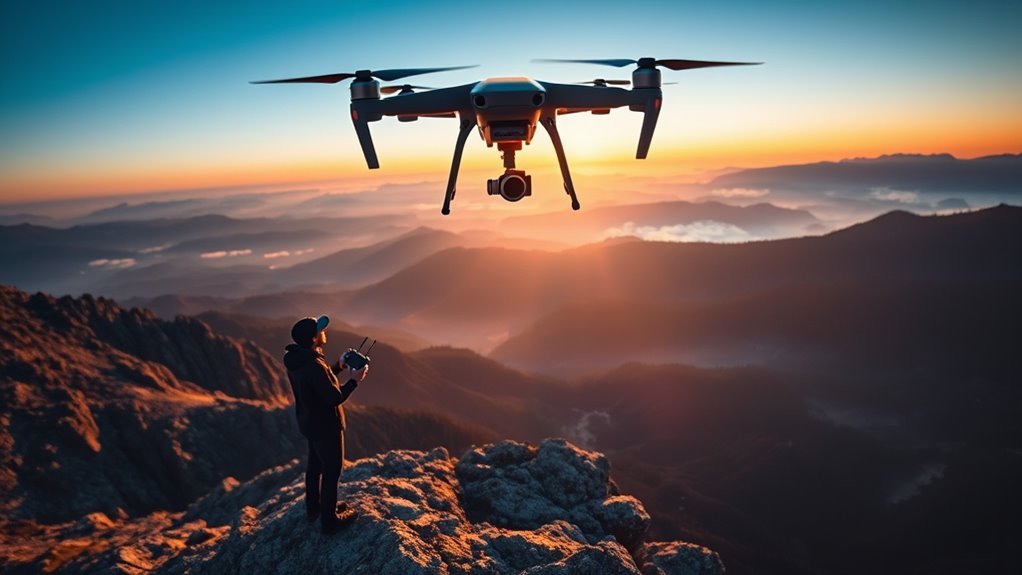
A drone’s true flight range depends on hardware, battery capacity, signal system, weather, terrain, and legal limits. The best way to explore it is to compare the manufacturer’s range spec with real battery performance, then test in open, obstacle-free space. During flight, monitor GPS, signal strength, and voltage, and log the results for analysis. Safe range evaluation also requires pre-flight checks and compliance with FAA rules. More detail clarifies how far it can reliably go.
Key Takeaways
- Check your drone’s hardware, communication system, and advertised range, since real-world distance is often lower than maximum specifications.
- Account for wind, terrain, interference, and weather, which can sharply reduce safe and reliable flight range.
- Verify battery capacity, health, and flight time before testing, because range depends heavily on efficient power use.
- Test range in open, obstacle-free areas while monitoring GPS, signal strength, and battery levels throughout the flight.
- Follow FAA rules and visual line-of-sight limits, and use flight logs to analyze actual distance and improve future planning.
How Far Can a Drone Fly?
How far a drone can fly depends on a combination of hardware, communication system, and operating conditions. Consumer models show wide variation, with some platforms reaching about 9.3 miles, or 15 km, under ideal conditions.
In drone flying, range is tied to stable control links, efficient battery life, and low-loss airframes. Long-range systems may use technologies such as OcuSync to preserve connection quality during flying over extended distances.
Flight time and range are not identical, yet better battery efficiency generally extends both. Wind, terrain, and weather can reduce practical distance even when specifications appear high.
For a commercial drone, legal flight limits often matter more than theoretical maximums, since many jurisdictions restrict operations to 1–2 miles beyond visual line of sight.
The result is a clear distinction between advertised capability and lawful use, shaping how pilots plan legal flight with precision and autonomy.
What Affects Drone Range Most
Drone range is shaped most by the communication link, battery efficiency, and aircraft weight, with environmental conditions and autonomous systems also playing important roles.
Signal transmission determines how reliably commands and telemetry move between controller and aircraft; RF, Wi‑Fi, and proprietary links such as OcuSync differ greatly in resilience and distance.
Strong battery efficiency extends flight duration, allowing more distance before power limits intervene.
Drone weight matters because heavier frames demand more energy to stay aloft, reducing range and increasing drag.
Environmental conditions can narrow operational reach through wind, rain, and terrain interference, all of which weaken signal transmission and accelerate power loss.
Autonomous features, including Return to Home and waypoint navigation, do not create extra energy, but they broaden practical drone range by preserving control, reducing pilot dependence, and enabling farther missions with safer recovery.
For users seeking mobility without unnecessary constraint, these factors define the real boundary between nominal capability and usable distance.
Check Your Drone’s Battery and Specs
Before flight, a drone’s battery capacity and specification sheet should be checked against the intended mission range, because insufficient power can sharply reduce usable distance. Operators should check your drone’s battery, confirm battery capacity, and compare it with published flight times. Long-range systems often use lithium polymer (LiPo) batteries, so C rating and voltage must match the airframe’s demand.
| Spec | Meaning | Effect |
|---|---|---|
| Battery capacity | mAh reserve | Longer endurance |
| Voltage | Power output | Stable propulsion |
| C rating | Discharge ability | Peak performance |
| Flight time | Max airborne duration | Range ceiling |
| Firmware status | Software condition | Efficiency gains |
Keep firmware updated, since manufacturers may improve battery management and efficiency. It is also prudent to inspect battery health and charging cycles regularly, because degraded cells can shorten range and trigger sudden power loss. A disciplined specification review preserves operational freedom by aligning energy supply with mission distance.
Test Drone Range Safely in Open Areas
Drone range testing should begin in an open area well clear of people, buildings, and obstacles to reduce interference and maintain regulatory compliance.
Before flight, the drone should be checked for battery status, GPS lock, and updated firmware to minimize the risk of malfunction.
During the test, signal strength and battery consumption should be monitored as distance increases gradually from the launch point.
Open Testing Locations
Open fields and other spacious outdoor areas offer the safest conditions for evaluating drone range, since they reduce the risk of collisions with people, buildings, and other obstacles.
These open testing locations support safe operation by giving the aircraft room to travel without environmental clutter. Selection should comply with local regulations and remain well away from airports and populated areas.
Minimal signal interference in remote fields helps reveal the true limits of the control link and telemetry system. Ideal weather conditions, especially calm winds and clear skies, improve stability and measurement accuracy.
Before any long-range attempt, a pre-flight checklist should confirm battery levels and connection integrity. Such disciplined site selection enables precise range assessment while preserving operational freedom and reducing avoidable constraint.
Pre-Flight Safety Checks
A range test in a spacious outdoor area is only as reliable as the safety checks completed beforehand. A disciplined pre-flight checklist confirms that every component functions and that calibration is correct, reducing the chance of in-flight faults.
Weather should be assessed, since wind and unstable conditions can degrade drone performance and narrow the effective range. Take-off zones and landing areas must remain clear of people, vehicles, and obstacles so the aircraft can depart and recover without constraint.
Initial trials should occur in open terrain, far from buildings and interference sources, to preserve a clear signal. Battery levels should also be checked before launch, with a low-voltage alarm set to support a safe return.
This preparation grants controlled freedom while protecting the aircraft and operator.
Monitor Signal And Battery
Signal strength and battery voltage should be tracked continuously during range testing in open areas, where reduced obstacles help isolate true transmission limits.
To monitor signal, the pilot should watch telemetry on the controller and app for weak signals that warn of edge-of-range conditions. Battery voltage levels must be checked throughout each flight, because distance can accelerate drain and reduce return capabilities.
A low voltage alarm should be enabled to prevent over-discharge and protect LiPo cells.
- Confirm maximum range before launch.
- Track signal bars and latency.
- Log battery voltage levels at intervals.
- Abort immediately when weak signals or alarms appear.
These range tests remain safer when executed with clear recovery margins, disciplined observation, and respect for the drone’s specifications.
Track Distance With GPS Logs
GPS logs record coordinate data that can be used to calculate a drone’s traveled distance with high precision.
Many drones store this information through onboard GPS modules, while compatible apps and software present the data for post-flight review.
Analyzing the resulting flight track helps identify route efficiency, distance compliance, and performance patterns.
GPS Log Basics
During a flight, onboard logging records the drone’s precise position at regular intervals, creating a detailed track of distance, route, altitude, and speed for later analysis. These gps logs are standard in modern aircraft systems and give drone pilots a factual record of performance.
- They capture flight distance automatically.
- They preserve route and altitude data.
- They connect to mobile apps for map display.
- They support compliance and flight safety.
After landing, software can present the path clearly, allowing drone pilots to optimize routes for future missions.
For long-range operations, this record is essential because it verifies location history and helps maintain regulatory discipline.
Used correctly, GPS logging gives operators practical freedom through measured control, accurate planning, and dependable awareness of every flight.
Analyzing Flight Tracks
By reviewing stored flight logs, pilots can measure the exact distance a drone traveled and reconstruct its route with precision. Analyzing flight tracks through GPS logs reveals the flight path, altitude shifts, speed, and duration, supporting rigorous performance evaluation. Most modern drones retain this data for post-flight review, enabling software to calculate distance traveled and map the route.
| Metric | Source | Use |
|---|---|---|
| Distance | GPS logs | Range analysis |
| Speed | Flight software | Efficiency check |
| Path | Track map | Compliance review |
This method helps pilots identify technique gaps, refine flight planning, and verify compliance with distance limits. For long-range operations, careful analysis of flight tracks promotes operational efficiency, informed decision-making, and greater autonomy over each mission.
Improve Your Drone’s Range and Battery Life
Extending a drone’s range and flight time depends on a combination of power efficiency, structural design, and signal reliability. To improve your drone’s range, battery life, and autonomy, operators should prioritize lightweight materials, efficient signal transmission, maintenance checks, and ideal thrust-to-weight ratios for liberated, longer missions.
Drone range and flight time improve through efficient power use, lightweight design, reliable signal transmission, and careful maintenance.
- Select high-capacity LiPo packs with an appropriate C rating so current delivery remains stable under load.
- Build with lightweight materials and remove unnecessary accessories; reduced mass lowers power demand and extends endurance.
- Use efficient signal transmission, including OcuSync or 5G, to preserve link quality and operational range.
- Tune the flight controller for ideal thrust-to-weight ratios, ideally near 2:1, then perform maintenance checks on batteries and components.
Each adjustment improves efficiency without sacrificing control. Together, these measures help a drone fly farther, stay responsive, and preserve usable energy across demanding routes.
Know the Rules Before You Fly Far
Longer flight endurance and improved range are only part of the operational equation; legal limits also shape how far a drone can be flown. To know the rules, operators should review FAA regulations before departure, especially the visual line of sight requirement. VLOS usually keeps a drone within the pilot’s direct observable range, often limiting practical distance to 1–2 miles beyond sight.
Any aircraft over 250 grams must be registered with the FAA, supporting accountable long-range use. BVLOS missions require an FAA waiver, particularly for commercial flights seeking freedom beyond visual limits.
Altitude restrictions also matter: standard operations are capped at 400 feet above ground level unless specific authorization is granted. A disciplined pre-flight checklist should confirm airspace status, weather, battery condition, and communications integrity.
When these controls are respected, extended flight can remain both liberated and compliant, allowing distance to be explored without sacrificing safety or legality.
Frequently Asked Questions
What Is the 1:1 Rule for Drones?
The 1:1 rule says a drone’s horizontal distance should not exceed its altitude, preserving flight safety and visual line of sight. It guides drone regulations, battery life, airspace restrictions, drone types, and beginner tips.
Is It Illegal for My Neighbor to Fly a Drone Over My Property?
Generally, no—like a bird gliding above a fence, a neighbor’s drone overflight is lawful if airspace regulations and flight permissions are respected. Drone privacy, neighbor disputes, drone trespassing claims, and legal consequences depend on intrusion or misuse.
How Far Can a $500 Drone Fly?
A $500 drone typically flies 1–5 miles, depending on drone range, battery life, flight conditions, signal interference, camera quality, and user experience. Open terrain and calibration can improve performance, while obstacles reduce distance considerably.
What Should I Do Before Flying My Drone for the First Time?
A first-time pilot should complete a pre flight checklist, verify local regulations, review weather considerations, practice flight training, follow drone safety tips, and confirm battery management, calibration, controls, and secure power-up sequence before takeoff.
Conclusion
Ultimately, a drone’s flight distance depends on battery capacity, signal strength, weather, terrain, and legal limits. By checking manufacturer specs, testing in open areas, and reviewing GPS logs, pilots can measure range more accurately and safely. Would pushing farther matter if control and compliance are lost? The most effective approach combines careful preparation, efficient battery management, and respect for regulations, ensuring every flight remains both productive and secure.