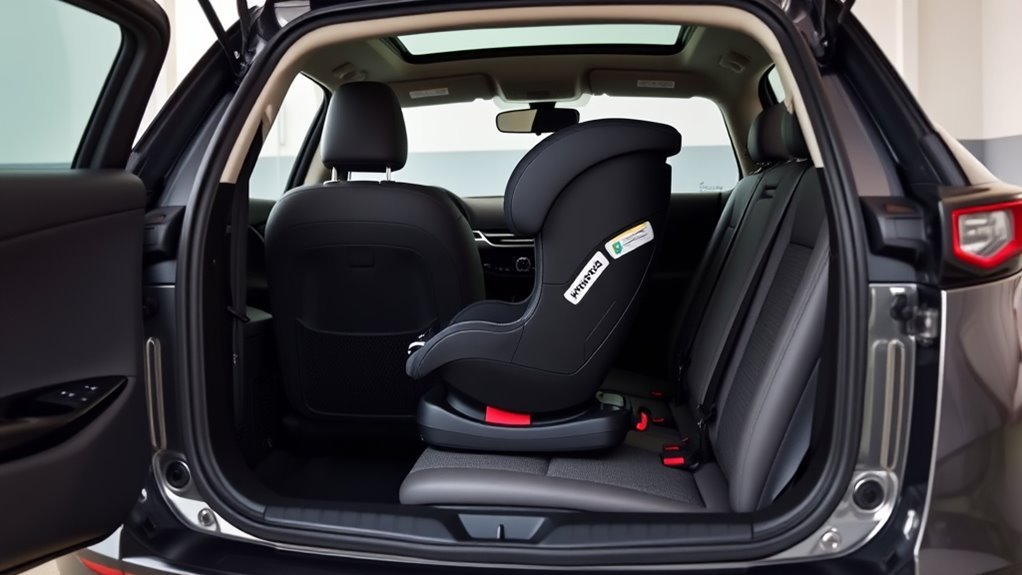
The Nuna PIPA Lite LX can be a practical infant car seat for the Mazda CX-30, but its fit depends on the installation position, base, and available front-seat space. The CX-30 is a compact SUV, so a rear-facing carrier may require adjustments to the front passenger seat. Before buying, it helps to understand the installation restrictions and what a proper test fit should show.
Quick Answer
The Nuna PIPA Lite LX may fit in the Mazda CX-30’s rear seating area, particularly behind the front passenger. However, the combination has not been confirmed as a universal fit. The seat requires a compatible base, proper recline, and clearance from the vehicle interior. A physical installation is necessary before confirming compatibility.
Last checked: September 26, 2026. Dates and figures were verified against official sources.
Key Takeaways
- The US-market model is called the Nuna PIPA Lite LX, rather than simply PIPA LX.
- The original PIPA Lite LX requires a compatible base for vehicle installation.
- Mazda prohibits rigid LATCH attachments in the CX-30’s rear center seating position.
- A correctly installed base should move no more than one inch when tested at the belt path.
- Front-seat comfort depends on the actual installation angle and the height of the front occupant.
- Other Nuna PIPA models may offer different installation options, but none has a guaranteed fit in every CX-30.
Can the Nuna PIPA Lite LX Fit in the Mazda CX-30?
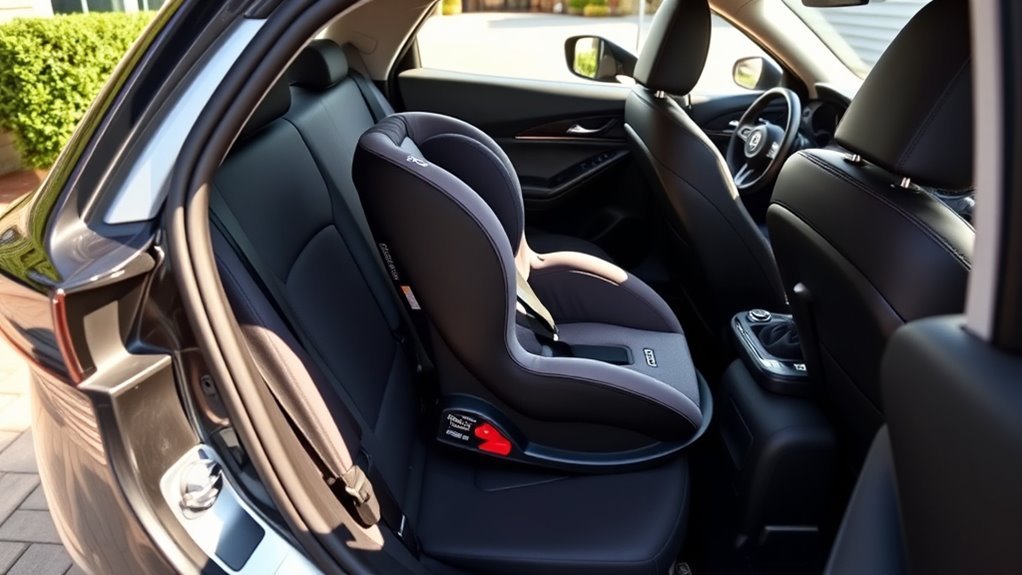
Yes, the Nuna PIPA Lite LX may fit in a Mazda CX-30, provided you can achieve a secure rear-facing installation while maintaining the required clearance.
However, there is an important distinction between a seat physically fitting inside a vehicle and being correctly installed. A carrier can fit through the rear door yet still interfere with the front seat or fail to achieve its required recline angle.
The original US-market PIPA Lite LX is a rear-facing infant carrier that must be used with its compatible base. Its installation requirements are explained in the Nuna PIPA Lite series instruction manual.
For a CX-30, the main compatibility questions are:
- Can the base sit securely on the rear bench?
- Can the carrier lock into the base without touching the front seat or vehicle interior?
- Can you achieve the required recline angle?
- Does the front occupant retain a suitable seating position?
- Can you use the intended LATCH anchors or vehicle seat belt correctly?
The rear passenger-side position is a sensible starting point for a test installation. It lets you assess passenger legroom without immediately changing the driver’s normal seating position.
However, the passenger-side position is not automatically the correct choice for every family. A properly installed child restraint in an approved seating position matters more than convenience alone.
How Much Front Seat Space Does It Leave in the CX-30?
The Nuna PIPA Lite LX may reduce front-seat legroom in the Mazda CX-30, particularly when installed behind a tall driver or passenger.
According to Mazda’s published specifications, the 2026 CX-30 provides 36.3 inches of rear legroom and 41.7 inches of front legroom. These are passenger-space measurements, not guaranteed car-seat clearance dimensions.
You can review the measurements in Mazda’s official CX-30 specifications.
The important measurement is the distance between the installed carrier and the front seatback. This changes when you adjust the front seat or the infant seat’s recline position.
Installing Behind the Front Passenger
The front passenger may need to slide forward or adjust the seatback to provide adequate clearance.
For shorter adults, this adjustment may have little effect on comfort. Taller passengers may notice reduced knee space, especially during longer journeys.
Check that the passenger can still sit upright, keep both feet on the floor, and wear the seat belt correctly.
Do not move the front passenger seat into an awkward position simply to make the infant carrier fit.
Installing Behind the Driver
Behind the driver, the available space depends heavily on the driver’s height and preferred seating position.
Start with the driver seated normally. Then install the child seat without moving the driver forward to create artificial clearance.
The driver must still be able to reach the pedals comfortably, steer properly, and maintain the correct distance from the steering wheel and airbags.
If the carrier interferes with the driver’s seat, another approved rear seating position may be more practical.
How Do You Install the Nuna PIPA Lite LX in the CX-30?
Install the PIPA Lite LX rear-facing, using its compatible base and the instructions for your exact model. The base can be secured using approved lower anchors or the vehicle seat belt.
The original base includes rigid LATCH connectors, a seat-belt lock-off, a recline indicator, and a stability leg.
Warning: Never install a rear-facing infant seat in the CX-30’s front passenger position. Also, do not install the original PIPA Lite LX carrier without its approved base. Installation instructions for newer PIPA models are not interchangeable.
Step 1: Choose an Approved Rear Seating Position
Start with a rear outboard position and locate the lower anchors if you plan to use LATCH.
Mazda’s 2025 CX-30 LATCH instructions identify the approved anchor locations and explain their use.
Remove any objects that could interfere with the base or lower anchors.
Step 2: Position and Level the Base
Park the vehicle on level ground before checking the recline indicator.
Place the base on the rear seat and adjust its recline mechanism until the bubble reaches the required position shown in the Nuna manual.
Use the base’s adjustment mechanism to achieve the correct angle. Do not use the stability leg as a substitute for the recline adjustment.
Step 3: Secure the Base
For a rigid LATCH installation, connect both attachments to the approved lower anchors. Confirm that the connectors are locked and their indicators show the correct status.
For a seat-belt installation, route the vehicle belt through the base’s designated belt path. Tighten it and close the integrated lock-off as directed.
The original Nuna manual permits both installation methods. Follow the instructions for your particular base rather than assuming that procedures for other car seats apply.
Step 4: Check the Stability Leg
If the stability leg is permitted in your selected position, extend it until it makes firm contact with the vehicle floor.
Its indicator should show green. The leg must not lift the base away from the vehicle seat.
The original Nuna manual also permits installation with the stability leg stored, provided the other installation requirements are met.
Step 5: Attach the Infant Carrier
Lower the carrier onto the base until it clicks into place.
Gently pull upward on the carrier to confirm that it has locked correctly.
Check that neither the carrier nor its handle contacts the front seat, vehicle door, or another part of the interior.
Step 6: Perform the Final Safety Check
Grip the installed base at its belt path and move it from side to side and front to back.
It should move no more than one inch at that location. Movement at the carrier’s upper end is not the correct way to judge base tightness.
This check is also explained in the NHTSA car seat installation guidance.
Finally, confirm the recline indicator, carrier attachment, and harness fit before traveling.
For rear-facing infants, the shoulder straps should sit at or below shoulder level. Keep the chest clip at armpit height and tighten the harness until you cannot pinch excess webbing at the shoulder.
Can You Install the PIPA Lite LX in the CX-30’s Center Seat?
A center installation requires special attention because the CX-30’s center seating position has different restrictions from its rear outboard positions.
Mazda prohibits rigid LATCH attachments in the center position. This means you cannot simply use the original PIPA base’s rigid connectors with the adjacent outboard anchors.
Mazda’s child-restraint seating guidance also prohibits a support leg in the rear center position.
A center installation may therefore require the vehicle seat belt and the stability leg stored, if the exact Nuna base manual permits that combination and a secure installation can be achieved.
The original PIPA Lite series manual permits the stability leg to be stored during approved base installations.
However, the center position is not automatically suitable just because a seat belt is available.
Confirm the requirements in both manuals, including the seating position, base contact, and any restrictions specific to your model year.
Do Other Nuna PIPA Models Fit the CX-30 Better?
Other Nuna PIPA models may provide greater installation flexibility, but a different carrier does not guarantee more front-seat legroom.
The overall fit depends on the carrier, base, recline setting, and shape of the Mazda’s rear bench.
For example, the PIPA RX offers a baseless installation option, while the older PIPA Lite LX requires a compatible base.
PIPA Lite LX vs. PIPA RX
The PIPA Lite LX and PIPA RX are different products, not simply two trim levels of the same seat.
The older Lite LX must be installed with a compatible base. The PIPA RX supports installation with its compatible base or directly with an approved vehicle seat belt.
This makes the RX more flexible when traveling in another vehicle or using transportation where a base is unavailable.
However, the RX’s installation flexibility does not establish that it occupies less space in the CX-30.
PIPA Aire and Other PIPA Models
The PIPA Aire and PIPA Aire RX are additional infant-seat options within Nuna’s lineup.
They use different carrier and base combinations, so their installed dimensions should be checked individually.
A lighter carrier can make lifting and carrying easier, but carrier weight alone does not determine how much room remains for the front passenger.
Does a Different Nuna Base Improve the Fit?
A different compatible base may change how the carrier sits on the rear bench.
For example, Nuna’s PIPA RELX base offers adjustable rigid LATCH connectors, multiple recline positions, and an adjustable stability leg.
Nuna lists compatibility with its PIPA series infant carriers, excluding the baseless PIPA Urbn.
However, base compatibility does not remove Mazda’s seating-position restrictions.
Do not assume that a different base permits center-seat rigid LATCH or support-leg use.
Also, check the limits printed on the actual carrier and base. Older PIPA Lite LX instructions and newer base documentation may specify different child-size limits.
What Should You Check Before Buying a Car Seat for the CX-30?
Before buying, check the installed seat’s front clearance, base stability, recline, and ease of use.
For families who use a stroller regularly, confirm the exact adapter combination as well.
Measure Front Seat Clearance
Front-seat clearance is the most useful measurement for predicting daily comfort in the CX-30.
Start with the front seat in the position normally used by its occupant. Then place the infant carrier on its installed base.
Check the following:
- Clearance between the carrier and front seatback.
- Clearance between the carrier handle and vehicle interior.
- Available knee space for the front occupant.
- Access to the rear door and infant harness.
- Whether the carrier can be removed without awkward twisting or interference.
Remember that the manufacturer’s published carrier dimensions do not directly equal the space required inside the vehicle.
The installed angle and vehicle seat shape can change the overall footprint.
Test Rear-Facing Fit
A proper test fit should use the actual carrier and compatible base, not just a display model placed loosely on the rear bench.
Use this checklist during the trial:
- Place the base in the intended rear seating position.
- Set the correct recline using its built-in indicator.
- Secure the base using an approved installation method.
- Check movement at the belt path.
- Attach the infant carrier and verify its lock.
- Confirm clearance from the front seat and vehicle interior.
- Have the front occupant sit normally and evaluate comfort.
- Remove and reinstall the carrier to check everyday usability.
A secure base is only part of the test. You should also be able to place your baby in the seat, adjust the harness, and remove the carrier without struggling against the front seat or door opening.
Pro Tip: When testing behind the passenger seat, have the tallest regular passenger sit in front. This gives you a more realistic picture of the space available during everyday trips.
Check Stroller Adapter Compatibility
Stroller compatibility is separate from vehicle compatibility.
The PIPA Lite LX can work with compatible Nuna strollers and approved adapters for certain other stroller brands.
However, not every stroller accepts every PIPA model or adapter.
Confirm the exact car seat model, stroller model, and adapter part before purchase.
After attaching the carrier to the stroller, verify that it has locked correctly using the manufacturer’s instructions.
Do not use unapproved adapters or assume that hardware designed for another infant carrier is interchangeable.
Which Compact Infant Seats Are Best for the CX-30?
Several infant seats are worth comparing for a Mazda CX-30, particularly if the PIPA Lite LX leaves insufficient front-seat space.
However, no single model can be declared the best fit without testing its installed position in your vehicle.
The following options offer different installation methods and travel features.
| Infant Car Seat | Key Feature | What to Check in the CX-30 |
|---|---|---|
| Nuna PIPA Lite LX | Lightweight carrier with required base installation | Base compatibility, recline, and front-seat clearance |
| Nuna PIPA RX | Base or approved baseless installation | Installed depth with the chosen method |
| Chicco KeyFit 30 | Adjustable base and leveling indicators | Base position and passenger legroom |
| Graco SnugRide SnugFit | Adjustable base and anti-rebound bar | Installed footprint and base stability |
| Doona Car Seat Stroller | Integrated stroller wheels | Rear-door clearance and folded-carrier fit |
Chicco KeyFit 30
The Chicco KeyFit 30 includes a stay-in-car base, recline adjustment, and bubble level indicators.
It is a separate product from Graco’s infant-seat lineup. The original article incorrectly identified it as a Graco model.
For a CX-30, test the carrier’s installed depth and check whether the front passenger retains enough space.
Graco SnugRide SnugFit
The Graco SnugRide SnugFit offers an adjustable base and anti-rebound bar.
Its installation features make it another option to compare with the Nuna and Chicco models.
However, its advertised dimensions should not be treated as proof that it fits behind a particular front-seat position.
Doona Car Seat Stroller
The Doona car seat stroller combines an infant carrier and stroller in one product.
Its integrated wheels can simplify transitions between the car and sidewalk without carrying a separate stroller frame.
For CX-30 owners, the relevant checks include rear-door access, folded-carrier clearance, and secure installation using the approved method.
Its integrated design does not automatically make it smaller inside the vehicle than a conventional infant seat.
What If the Infant Seat Does Not Fit Properly?
If you cannot achieve a correct installation, do not force the seat into place.
Start by reviewing the recline adjustment and installation method. A base that is set incorrectly may occupy more room or sit poorly against the vehicle bench.
If the installation remains unsuitable:
- Try another approved rear seating position.
- Confirm that the correct base is being used.
- Check whether a different approved installation method is available.
- Compare another infant seat with a different installed footprint.
- Ask a certified child passenger safety technician to inspect the installation.
Note: If you are unsure about the recline angle, anchor use, stability leg, or front-seat clearance, consult a certified Child Passenger Safety Technician. A professional inspection can help identify installation errors that are not obvious from appearance alone.
Frequently Asked Questions
Does a Car Seat Fit in a Mazda CX-30?
Yes, infant and convertible car seats can fit in the Mazda CX-30. However, compatibility depends on the restraint model, installation position, and available space. Rear-facing infant seats may require adjustments to the front passenger seat. Always confirm that the installation meets both manufacturers’ instructions.
Is the Nuna PIPA Lite LX Discontinued?
The PIPA Lite LX is an older Nuna model and is not listed among the current infant seats in Nuna’s US product lineup. Nuna still provides documentation for the original model. Confirm its retail status directly with Nuna if purchasing remaining stock or a replacement component.
What Is the Difference Between the Nuna PIPA RX and LX?
The PIPA RX supports installation with a compatible base or directly with an approved vehicle seat belt. The older PIPA Lite LX requires a compatible base. The models also differ in materials and included features. Neither model is guaranteed to provide more clearance in the Mazda CX-30 without a test installation.
Will the Nuna PIPA Fit in My Car?
A Nuna PIPA may fit your vehicle if its installation requirements can be met. Check the exact model, compatible base, approved seating position, recline, and clearance. Vehicle dimensions alone cannot confirm compatibility. A physical installation is the most useful way to determine whether the seat works in your car.
Can I Install the PIPA Lite LX Without Its Base?
No. The original US-market PIPA Lite LX requires an approved base for vehicle installation. Do not use baseless installation instructions from the PIPA RX or another model. If you need a replacement base, confirm its compatibility and applicable child-size limits with Nuna.
Can I Use the Center Seat in the Mazda CX-30?
A center installation may be possible using an approved seat-belt method, but the CX-30 prohibits rigid LATCH attachments and support-leg use in that position. The original PIPA Lite LX base allows its stability leg to be stored. Both manuals must permit the complete installation, and the base must pass the required checks.
Conclusion
The Nuna PIPA Lite LX may fit in the Mazda CX-30, but a secure installation and sufficient front-seat clearance must be confirmed in the actual vehicle. Pay particular attention to the required base, recline indicator, center-seat restrictions, and carrier clearance.
Before purchasing, test the complete seat and base with the front passenger in their normal seating position. If the installation remains unsuitable, compare another approved infant seat rather than compromising either occupant comfort or child-restraint safety.
Sources
- Nuna PIPA Lite Series Instruction Manual: Original model requirements, base installation, recline, stability leg, and carrier attachment.
- Mazda CX-30 Specifications: Published front and rear passenger-space measurements.
- Mazda CX-30 LATCH Installation Instructions: Lower-anchor locations and center-seat rigid LATCH restrictions.
- Mazda Child-Restraint Seating Guidance: Approved seating positions and support-leg restrictions.
- NHTSA Car Seat Installation Tips: Installation checks, movement limits, and correct harness positioning.
- Nuna PIPA RELX Base: Base features and compatible infant carriers.
- Nuna PIPA RX: Installation options and product features.
- Chicco KeyFit 30: Correct product identity and installation features.
- Graco SnugRide SnugFit: Product specifications and installation features.
- Doona Car Seat Stroller: Integrated stroller design and product specifications.
