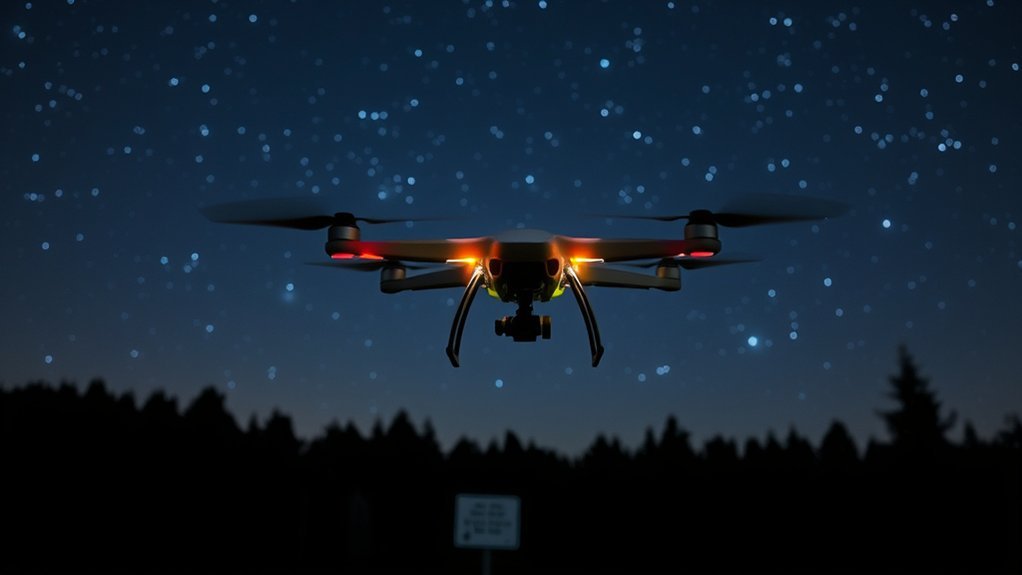
Picture a drone gracefully maneuvering through the night sky, its anti-collision lights cutting through the darkness. Flying a drone at night is allowed in many situations under FAA regulations, but it is not a casual “launch and go” activity. You need the right training, lighting, visibility, airspace approval when required, and a clear plan before takeoff.
Quick Answer
Yes, you can fly a drone at night if you follow FAA rules. Part 107 pilots need current night-operation training, and the drone must use flashing anti-collision lights visible for at least three statute miles. Recreational pilots must follow FAA safety rules, CBO guidance, airspace restrictions, and visual line-of-sight requirements.
Key Takeaways
- Part 107 drone pilots may fly at night without a waiver if they meet current FAA training and equipment rules.
- Your drone must have flashing anti-collision lights visible for at least three statute miles during night operations.
- Night begins 30 minutes after sunset and ends 30 minutes before sunrise under FAA rules.
- Controlled airspace still requires authorization, usually through LAANC when available.
- Safe night flights depend on daylight scouting, strong lighting, visual line of sight, battery planning, and clear emergency procedures.
At a Glance
| Time Required | 15 to 30 minutes for pre-flight checks, plus extra time for daylight scouting if the location is unfamiliar. |
| Difficulty | Moderate, because low light makes distance, orientation, obstacles, and landing zones harder to judge. |
| Tools Needed | Drone, controller, fully charged batteries, flashing anti-collision light, launch pad, flashlight or headlamp, and airspace-checking app. |
| Cost | Usually low if you already own a drone, though FAA-compliant anti-collision lights and spare batteries may add cost. |
New FAA Rules for Night Flying
As the sun sets, you may wonder which FAA rules allow drone pilots to operate at night. Since April 21, 2021, Part 107 pilots have been able to fly at night without requesting a separate night waiver, as long as they meet the updated night-operation requirements.
Under 14 CFR § 107.29, a small unmanned aircraft may operate at night only when the remote pilot has completed the required night training and the aircraft has an anti-collision light visible for at least three statute miles. The light must also flash in a way that helps reduce collision risk.
For newer Part 107 pilots, night operations are covered through the updated initial aeronautical knowledge testing process. Existing certificated pilots must stay current through FAA recurrent training that includes night operations. This matters because night flying adds real challenges, including reduced depth perception, harder obstacle detection, and a higher chance of losing orientation.
You must also maintain visual line of sight, avoid careless or reckless operation, and follow all applicable airspace limits. The FAA rule change made night operations easier to access, but it did not remove the need for careful planning and safe judgment.
Warning: Do not assume a bright camera light, landing light, or decorative LED meets the FAA anti-collision lighting rule. The light must be visible for at least three statute miles and must flash.
Training Requirements for Part 107 Pilots
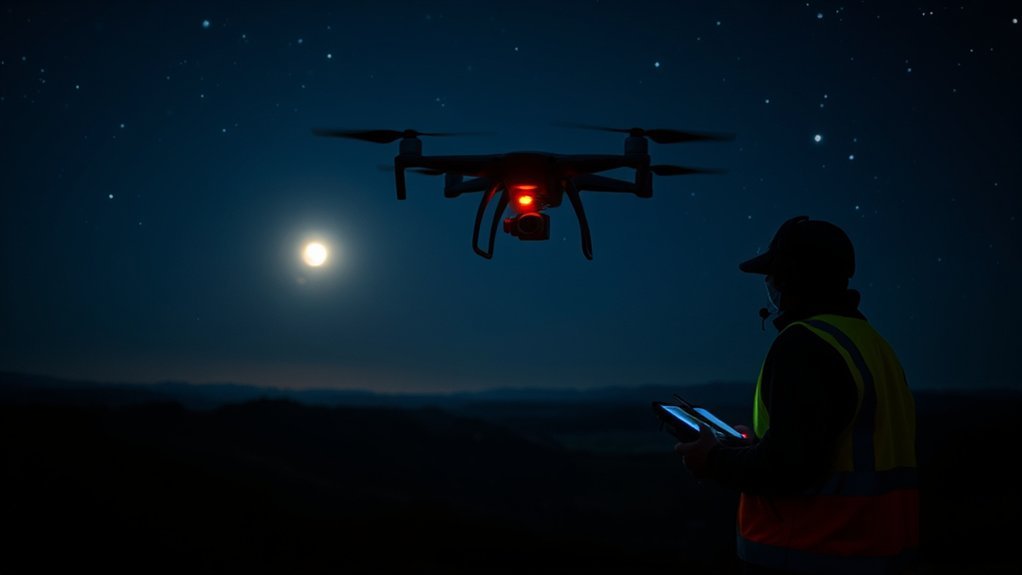
As a Part 107 pilot, you must complete specific training before legally operating a drone at night. This training helps you understand the human, technical, and airspace risks that become more serious after dark.
Night operation training covers topics such as night physiology, visual illusions, obstacle avoidance, aircraft lighting, and the importance of preserving night vision. It also reinforces the need to identify your operating area before the flight begins.
Ensuring compliance with these training requirements is essential for safe night flying and avoiding potential violations. If your certificate is current but your recurrent training is not, update it before planning a night operation.
Night Flight Training Essentials
To legally fly a drone at night as a Part 107 pilot, you need training that reflects the unique challenges of night operations. Flying after dark can make objects look farther away, closer, higher, or lower than they really are.
As of April 21, 2021, pilots certificated before the rule change need to complete updated recurrent training or testing that includes night operations. Pilots certificated after that date receive night-operation content as part of the updated initial certification process.
The updated knowledge areas include obstacle avoidance, aircraft lighting, night physiology, and safe decision-making. You should understand how your eyes adapt to darkness, how bright screens can reduce night vision, and why red or dim lighting at the ground station can help.
Your drone must also be equipped with anti-collision lights visible for at least three statute miles. Those lights must flash at a rate that helps other aircraft see and avoid your drone.
Non-compliance with training and equipment requirements can lead to enforcement action, fines, or certificate issues. More importantly, it can create avoidable risk for people, property, and other aircraft.
Updated Knowledge Test Requirements
While maneuvering through the rules for night flying, it’s vital for Part 107 pilots to understand the updated knowledge requirements introduced with the FAA’s night-operation rule changes.
Here’s what you need to know:
- If you obtained your certificate before April 21, 2021, you must complete current recurrent training or testing that includes night operations.
- New pilots certificated after April 21, 2021, receive night-operation topics through the updated initial knowledge process.
- Anti-collision lights are essential. They must be visible for at least three statute miles and flash to minimize collision risks.
- Staying current with your training helps you comply with FAA regulations and improves safety during night flights.
- You should review airspace, weather, obstacle, and emergency procedures before each night operation.
Make sure you’re up to date before flying legally and safely at night.
Essential Anti-Collision Lighting Guidelines

When flying a drone at night, it’s crucial to follow specific anti-collision lighting guidelines for safety and FAA compliance. Drones operating at night under Part 107 must use anti-collision lights visible for at least three statute miles.
These lights must flash at a rate that helps prevent collisions. Static lights, decorative arm LEDs, and camera fill lights may help you see the drone, but they do not automatically satisfy the anti-collision requirement.
Mounting location also matters. A light mounted where the drone body blocks it from certain angles may reduce visibility. Ideally, place the anti-collision light where it can be seen from as many directions as possible, often on top of the aircraft when the mount allows it.
Here’s a quick reference table on anti-collision lighting:
| Requirement | Details | Example Products |
|---|---|---|
| Visibility | Minimum of three statute miles | LumeCube |
| Flash Rate | Sufficient to prevent collisions | LumeCube |
| Mounting Location | On top of the drone for best visibility | Various mounting options |
| Training Requirement | FAA online recurrent course if certified pre-April 2021 | FAA website |
| Compliance | Must meet FAA regulations | LumeCube with discount code |
Following these guidelines helps ensure your night flight is both safer and legal. Before takeoff, turn the aircraft in several directions and confirm the light remains visible from your standing position.
Pro Tip: Test your anti-collision light at home before your first night flight. Check battery life, attachment strength, flash mode, and whether the propellers or drone body block visibility.
Understanding the Definition of Night

To understand night operations for drone flying, you need to know how the FAA defines “night.” This definition affects when night training and anti-collision lighting requirements apply.
Under FAA rules, night begins 30 minutes after sunset and ends 30 minutes before sunrise. That time between sunset and full night, or between night and sunrise, is commonly tied to civil twilight conditions.
Recognizing this timeframe is essential for flight planning. It helps you decide when to attach anti-collision lights, when to use extra caution, and when the flight falls under night-operation rules.
FAA Night Definition
Understanding the FAA’s definition of night is vital for any drone operator intending to fly after sunset. The FAA defines night as the period starting 30 minutes after sunset and ending 30 minutes before sunrise.
To fly legally and safely during this time, you must follow specific requirements:
- Equip your drone with anti-collision lighting visible from at least three statute miles.
- Use flashing lights that reduce collision risk.
- Maintain visual line of sight at all times, even if your screen shows the drone’s camera view.
- Check local sunset and sunrise times for the exact location where you plan to fly.
- Stay aware that compliance with these regulations is important for both legality and safety.
Civil Twilight Explained
Civil twilight occurs near sunrise and sunset, when lighting conditions change quickly. This transition period matters because visibility may seem good in one direction but poor in another.
According to the FAA’s night definition, night starts 30 minutes after sunset and ends 30 minutes before sunrise. During low-light periods, anti-collision lights help ensure your drone remains visible to you and other airspace users.
Understanding this definition is vital for complying with FAA regulations regarding night flying, as it dictates when you can legally operate your drone under night rules. You must also maintain visual line of sight at all times during this period.
Be aware that visibility can fluctuate greatly. A drone may remain easy to see against a bright horizon, then become difficult to track when it crosses trees, buildings, or dark terrain.
Safety Tips for Night Drone Operations

Flying a drone at night presents unique challenges that require careful preparation and awareness. Low light can make it harder to judge altitude, distance, speed, and nearby obstacles.
Flying a drone at night requires careful preparation, reliable anti-collision lighting, and constant awareness of your surroundings.
To improve your safety during night operations, consider the following tips:
- Confirm your drone has anti-collision lights visible for at least three statute miles and flashing according to FAA requirements.
- Scout the flight area during daylight to identify trees, wires, towers, buildings, uneven ground, and safe landing zones.
- Use a visual observer when possible to help maintain visual line of sight and spot obstacles in low light.
- Regularly check your lighting system before each flight to confirm it is charged, secure, visible, and set to the correct flash mode.
- Preserve your night vision by using red or dim lights at your ground station and reducing screen brightness where practical.
- Keep the first night flight short, close, and simple until you understand how your drone looks and responds after dark.
- Set a clear return-to-home altitude that avoids known obstacles in your area.
Also give yourself a wider safety margin than you would during daylight. Fly slower, keep the aircraft closer, and avoid complicated maneuvers near trees, buildings, or people.
Note: Your drone’s camera view is not a substitute for visual line of sight. You still need to see the drone with your own eyes or with help from a qualified visual observer.
Night Flying in Controlled Airspace
Night operations in controlled airspace require additional planning and adherence to specific regulations. If your planned area falls near an airport or within controlled airspace, check the airspace before you travel to the launch site.
In many locations, you can submit airspace authorization requests through the FAA LAANC system. Your request should reflect the planned altitude, location, and operating time. This step is essential for compliance and safety.
Remember, all regulations governing night operations still apply, including the requirement for anti-collision lights. Your drone needs lights visible for at least three statute miles, and those lights must flash to help prevent collisions.
According to the FAA, night is defined as the period from 30 minutes after sunset to 30 minutes before sunrise. Use that definition when planning your night flights, especially when your flight starts near sunset or ends close to sunrise.
Careful preparation and adherence to regulations will help ensure a safer night flying experience. If LAANC is not available for your specific area or operation, you may need to use the FAA’s authorization process instead of launching without approval.
Recreational Drone Pilots and Night Flying
Recreational drone pilots can fly at night when they follow FAA recreational flyer rules, airspace restrictions, and safety guidance from an FAA-recognized community-based organization. Night flying is not limited to commercial pilots, but recreational pilots still have responsibilities.
Here are essential considerations for night flying:
- Use anti-collision lights visible for at least three statute miles to improve visibility.
- Take and pass The Recreational UAS Safety Test if you fly recreationally in the United States.
- Follow the safety guidelines of an FAA-recognized community-based organization.
- Check airspace before launch and get authorization when flying in controlled airspace.
- Conduct thorough pre-flight checks to ensure your lighting systems are functioning correctly.
- Maintain situational awareness to avoid trees, buildings, power lines, people, vehicles, and other aircraft in low-light conditions.
Strobe lights, while not always described the same way across recreational guidance, are strongly recommended in low-light and well-lit urban areas so your drone is easier to see. You should also comply with local rules, maximum altitude limits, and visual line-of-sight requirements.
Technical Considerations for Night Flights
As you prepare for a night flight, understanding the technical considerations can greatly improve safety and performance. A drone that feels easy to fly during the day may feel very different after dark.
First, verify your drone is equipped with anti-collision lights, as FAA regulations require these for visibility from at least three statute miles during Part 107 night operations. The lights should flash in a way that effectively reduces collision risk.
Next, familiarize yourself with obstacle avoidance sensors during daylight. Some sensors work poorly or not at all in low-light conditions, depending on the aircraft model. Do not rely only on automated obstacle avoidance at night.
Adjusting your camera settings for low-light conditions is also important. Slower shutter speeds, higher ISO settings, and darker scenes can affect image quality and make the live view harder to interpret. If your screen looks noisy or laggy, slow down and keep more distance from obstacles.
Conduct thorough pre-flight checks to confirm all lights are functional and mounted properly, ideally where the drone remains visible from multiple directions. Check the light battery separately from the drone battery if it uses its own power source.
Finally, remember that cold weather may impair battery performance. Always start with fully charged batteries, keep spares warm when practical, and return with extra battery margin instead of flying down to your usual daytime limit.
Night Drone Pre-Flight Checklist
Before you take off, run through a simple night-flight checklist. This helps you catch problems before they become difficult to solve in the dark.
- Confirm your remote pilot training or recreational requirements are current.
- Check airspace, local restrictions, temporary flight restrictions, and weather.
- Scout the location in daylight or review it carefully before flying.
- Attach and test anti-collision lights before powering up for launch.
- Set return-to-home altitude above known obstacles.
- Confirm GPS lock, compass status, home point, controller signal, and battery level.
- Choose a clear launch and landing area with enough lighting to recover safely.
- Brief your visual observer if you use one.
- Plan an emergency landing area in case GPS, lighting, or battery issues occur.
Recommended Anti-Collision Light Products
When flying your drone after dark, selecting the right anti-collision lights is essential for safety and compliance. The FAA mandates that these lights must be visible for at least three statute miles and flash to enhance visibility.
Selecting the right anti-collision lights for night drone flights is crucial for safety and FAA compliance.
Here are some recommended anti-collision light products that meet these requirements:
- LumeCube: Known for strong visibility and drone-friendly mounting options.
- FireHouse Arc V: A popular option among drone pilots who need bright anti-collision lighting.
- FireHouse Arc 2: Another compact choice designed to improve night-flight visibility.
- Customizable LED lights: Consider options that let you choose a clear flashing mode and secure mounting system.
Ensure that you mount these lights properly, ideally on top of your drone when possible, to maximize visibility. Also check the manufacturer’s instructions for attachment methods, battery runtime, and weather resistance.
When comparing lights, focus on practical details instead of brightness claims alone. Look for visibility rating, flash mode, weight, mounting method, runtime, charging type, and whether the light blocks sensors, vents, GPS reception, or propeller clearance.
Common Night Flying Mistakes to Avoid
Many night-flight problems come from small planning mistakes. Avoiding them can make your flight safer and less stressful.
- Launching from an unfamiliar site: Visit the area in daylight so you can spot wires, branches, fences, slopes, and landing hazards.
- Flying too far away: At night, orientation becomes harder. Keep the drone closer than you normally would during the day.
- Trusting the screen too much: First-person camera views can hide obstacles outside the frame. Keep visual line of sight.
- Ignoring light battery life: A separate strobe or anti-collision light may die before the drone battery does.
- Forgetting local restrictions: Parks, cities, airports, and special event areas may have extra limits even when FAA rules allow night operations.
- Using return-to-home without planning: Set the return altitude before takeoff so the aircraft avoids trees, buildings, and towers.
The safest approach is to keep your first few night flights simple. Practice takeoff, hovering, slow turns, orientation, and landing before attempting long-distance flights or complex camera moves.
Frequently Asked Questions
How do you fly a drone at night legally?
To fly a drone at night legally, follow FAA rules for your operation type. Part 107 pilots need current night-operation training, flashing anti-collision lights visible for at least three statute miles, visual line of sight, and airspace authorization when required.
What does the FAA consider night flying?
The FAA defines night as the period starting 30 minutes after sunset and ending 30 minutes before sunrise. During this time, night-operation requirements apply, including anti-collision lighting rules for Part 107 operations.
What happens if I fly a drone at night without following the rules?
If you fly a drone at night without meeting FAA requirements, you may face enforcement action, fines, certificate issues, or restrictions on future operations. More importantly, non-compliance can increase the risk of collisions, property damage, and unsafe flight conditions.
How late can you fly a drone?
You can fly a drone during the night when the operation follows FAA rules, airspace limits, lighting requirements, and visual line-of-sight requirements. Night continues until 30 minutes before sunrise, so use local sunrise and sunset times for your specific location.
Do recreational drone pilots need anti-collision lights at night?
Recreational pilots should use strong anti-collision lighting for night flights and must follow FAA recreational flyer rules, CBO safety guidance, airspace requirements, and visual line-of-sight rules. Bright flashing lights make the drone easier to see and help reduce risk.
Can I fly at night in controlled airspace?
Yes, but only when you have the required airspace authorization and meet night-operation requirements. Many pilots request authorization through LAANC when it is available for the location and altitude they plan to use.
Conclusion
As you navigate the night sky with your drone, think of it as guiding a small aircraft through dark, changing conditions. By following FAA regulations, keeping your training current, and equipping your aircraft with bright flashing anti-collision lights, you make each flight safer and more responsible.
Night operations can be rewarding, especially for cityscapes, light trails, inspections, and creative video. Still, they demand more planning than daytime flights. Scout the area, check airspace, protect your night vision, keep the drone close, and leave yourself more battery and distance margin than usual.
With the right preparation, every night flight becomes less of a gamble and more of a controlled operation. The goal is simple: enjoy the view, capture the shot, and bring your drone home safely.
Sources
- 14 CFR § 107.29 — FAA night-operation rule for small unmanned aircraft.
- FAA Become a Drone Pilot — Part 107 certification and recurrent training guidance.
- FAA LAANC — airspace authorization information for drone operations.
- FAA Recreational UAS Safety Test — recreational pilot knowledge test guidance.
- FAA B4UFLY — airspace awareness resources for drone pilots.
