There is no single safe jogging age for every baby or every jogging stroller. Six months is the earliest running threshold used by some manufacturers, while other models require 8 months or even 12 months. Before you run, your baby should meet the minimum age and developmental requirements in the exact stroller manual and have enough head and neck control to stay stable during movement. If you are unsure about your baby’s readiness, ask your pediatrician before the first run.
Last updated: September 11, 2026 — manufacturer jogging-age and safety guidance rechecked.
Quick Answer
Do not treat 6 months as an automatic green light for jogging. Some manufacturers allow running from about 6 months, BOB Gear models may use an 8-month minimum, and the Chicco Activ3 specifies 12 months for jogging or off-road use. Follow the rule for your exact stroller, wait for strong head and neck control, and never jog with a newborn or with an infant car seat or bassinet attached unless the manufacturer explicitly approves that running configuration.
Key Takeaways
- Do not jog with a newborn. Newborn travel-system, car-seat, or bassinet configurations are for walking when the manufacturers approve them.
- Jogging age varies by model. Six months is an earliest threshold for some strollers, while others require 8 months, 12 months, or more.
- Your baby also needs steady head and neck control, stable positioning in the stroller seat, and a correctly fitting harness.
- Use the manufacturer-approved jogging wheel setting, a snug 5-point harness, wrist strap, working brakes, properly maintained tires, and a predictable route.
- The exact stroller manual overrides a general age rule. If the manual requires a later age, wait even if your baby appears developmentally ready.
At a Glance
| Earliest Jogging Age | About 6 months on some models, but other strollers specify 8 or 12 months. Always follow the exact manual. |
| Must-Have Readiness Signs | Steady head and neck control, stable positioning without repeated slumping, correct harness fit, and every developmental requirement in the stroller manual. |
| Use With Newborns | Not for jogging. Some models allow ordinary walking with an approved infant car seat, bassinet, or other newborn configuration. |
| Safety Gear | 5-point harness, manufacturer-approved jogging wheel position, wrist strap, parking brake, maintained tires, and weather protection. |
Jogging Stroller Age Guidelines Vary by Model
The safest age depends on the exact stroller, not just your baby’s birthday. Current manufacturer instructions show why a single 6-to-8-month rule is too broad. These examples are useful for comparison, but the manual for your exact stroller remains the controlling instruction.
| Guidance Source | Jogging Guidance |
|---|---|
| Thule | Recommends a minimum age of about 6 months before running and advises pediatrician consultation when appropriate. |
| UPPAbaby Ridge V2 | Recommends waiting until at least 6 months and requires the child to hold their head up unassisted before running. |
| BOB Gear Rambler | Specifies 8 months for jogging or off-road stroller use. |
| Chicco Activ3 | Allows stroller-seat walking from 6 months but specifies at least 12 months for jogging or off-road use. |
| Consumer Reports | Uses a more conservative safety position and recommends waiting until the child is 1 year old before running in a stroller. |
Bottom line: age is a minimum requirement, not automatic clearance. Follow the later or stricter rule when your stroller manual, your baby’s development, or your pediatrician indicates that you should wait.
Understanding Infant Readiness for Jogging Strollers
Age is only one part of deciding whether your infant is ready for a jogging stroller. Your baby also needs enough head and neck control to keep the head stable while the stroller accelerates, stops, turns, and rolls over small surface changes. Stable trunk positioning and a correct harness fit also matter because running creates more motion than an ordinary walk.
A baby who repeatedly slumps, tips hard to one side, cannot keep the head steady, or needs frequent repositioning is not ready for jogging. Do not use extra unapproved padding to compensate for poor readiness. Instead, keep the stroller in an approved walking configuration until your child meets both the developmental and model-specific requirements.
Before your first run, check three things: your baby’s development, your exact stroller manual, and any pediatric guidance relevant to your child. A general online age recommendation should never override a stricter manufacturer instruction.
Warning: Do not jog with a newborn in a jogging stroller. A car-seat adapter, bassinet, or newborn-approved configuration may make a stroller suitable for walking, but it does not automatically make that setup suitable for running.
When Can a Baby Use a Jogging Stroller?
For actual running, treat six months as an earliest model-dependent threshold, not a universal starting age. Some manufacturers permit jogging from around six months when the child has sufficient head and neck control. Other stroller manuals require eight months, 12 months, or another age. Always use the rule for your exact model.
Minimum Age Guidelines
Using a jogging stroller safely requires both age and developmental readiness. Reaching six months does not automatically mean your baby is ready, and good head control does not override a stroller manual that specifies a later minimum jogging age.
The difference between walking and running is important. Some strollers allow a younger baby to ride during ordinary walks with a compatible infant car seat, bassinet, or approved stroller-seat configuration. That approval applies only to the activities described by the manufacturer.
If the manual says “walk only” at your baby’s age, keep the stroller in walking use. Do not assume that better suspension, a reclined seat, or an infant car seat makes running safe earlier.
Developmental Milestones Consideration
Babies develop at different rates, so age should be combined with the developmental requirements in the stroller manual. For running, the most important practical sign is that your baby can keep the head and neck stable and remain securely positioned in the seat during normal stroller movement.
Look for these readiness signs before jogging:
- Your baby meets the minimum jogging age and other requirements in the exact stroller manual.
- Your baby can hold their head steady without repeated bobbing or flopping.
- Your baby can remain centered and stable in the stroller seat without repeatedly slumping forward or hard to one side.
- The 5-point harness fits correctly across the shoulders, waist, and between the legs.
- Your pediatrician has no concerns about your baby’s head control, muscle tone, development, or ability to tolerate the activity.
For younger infants, use only a manufacturer-approved walking setup. An infant car seat or bassinet may be appropriate for walking with some stroller systems, but it should not be treated as permission to jog.
Expert Recommendations Summary
The clearest safety rule is to follow the exact stroller rather than a generic age. Current guidance ranges from about six months on some Thule and UPPAbaby running setups to eight months on the BOB Rambler and 12 months on the Chicco Activ3 for jogging or off-road use.
Independent safety guidance can be more conservative. Consumer Reports recommends waiting until a child is 1 year old before taking them for a run in a stroller. These differences are exactly why “six months” should not be treated as automatic clearance.
If your baby meets the manufacturer’s minimum age but still has poor head control, unstable positioning, or another developmental concern, wait. If the child looks ready but the manual requires an older age, follow the manual.
Key Features of Jogging Strollers
Jogging strollers are designed around stability and control at faster speeds. Exact designs vary, so use the features and settings specified for your model rather than assuming every jogging stroller works the same way.
- Tire Types: Larger running-oriented tires are common. Many models use air-filled tires, while others use foam-filled or never-flat designs.
- 5-Point Harness: A properly adjusted restraint keeps your child positioned at the shoulders, waist, and between the legs.
- Handle Adjustments: Adjustable handlebars can help runners of different heights maintain better control and posture.
- Fixed or Lockable Front Wheel: Dedicated joggers commonly use a fixed front wheel or a swivel wheel that locks into a manufacturer-approved running position.
- Suspension System: Suspension helps control movement over surface irregularities, although it does not make a too-young infant ready for running.
- Wrist Strap and Brakes: A tether helps keep the stroller connected to you, while parking and, on some models, hand-operated brakes improve control.
These features make a true jogging stroller more suitable for running than a stroller designed only for walking. They do not replace the manufacturer’s age limits, developmental requirements, or operating instructions.
Pro Tip: Before buying or using a jogging stroller, check the manual for the minimum walking age, minimum jogging age, approved infant accessories, child weight or height limits, front-wheel setting, tire guidance, and any activity-specific warnings.
Differences Between Jogging and Regular Strollers
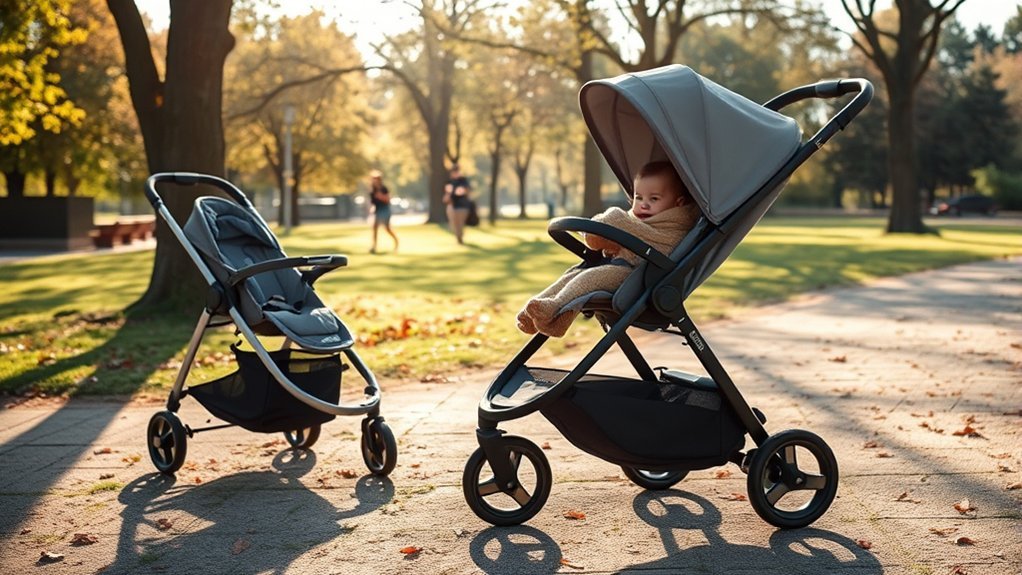
A jogging stroller is designed for faster forward movement and typically adds running-focused wheel, frame, suspension, and control features. A regular stroller is usually optimized for walking, errands, tighter turns, folding, and everyday maneuverability. Do not run with a stroller unless its manufacturer specifically approves running or jogging.
Safety Features Comparison
Both ordinary and jogging strollers should securely restrain the child. The major difference is that a true jogging stroller adds design features intended to improve control during faster movement.
- Harness Systems: Use the complete restraint system specified by the manufacturer. A secure 5-point harness is an important stroller-safety feature.
- Wheel Design: Jogging strollers commonly have larger running-oriented wheels and a front wheel designed to stay fixed or lock for straight-line stability.
- Braking Systems: Dedicated joggers commonly include a parking brake and wrist tether, and some also have a hand-operated deceleration brake.
- Frame and Suspension: Running-oriented frames and suspension systems are designed to provide stability and controlled movement at jogging speeds.
The stroller’s label, manual, and intended use matter more than its appearance. A three-wheel stroller that looks sporty is not automatically approved for running.
Design and Functionality Differences
Jogging strollers commonly use larger tires, running-oriented suspension, and a fixed or lockable front-wheel design. Tire construction varies: some use pneumatic tires for cushioning, while others use foam-filled or maintenance-free designs.
Regular strollers generally prioritize easy folding, storage, low-speed maneuverability, and tight turns in stores or crowded areas. Unless the manufacturer specifically approves running, treat a regular stroller as walking-only.
The front-wheel configuration is especially important. A swivel wheel is convenient for walking and tight turns, while many true jogging strollers require the wheel to be locked or placed in a dedicated jog mode before running. Follow your exact manual.
Safety Guidelines for Jogging With an Infant
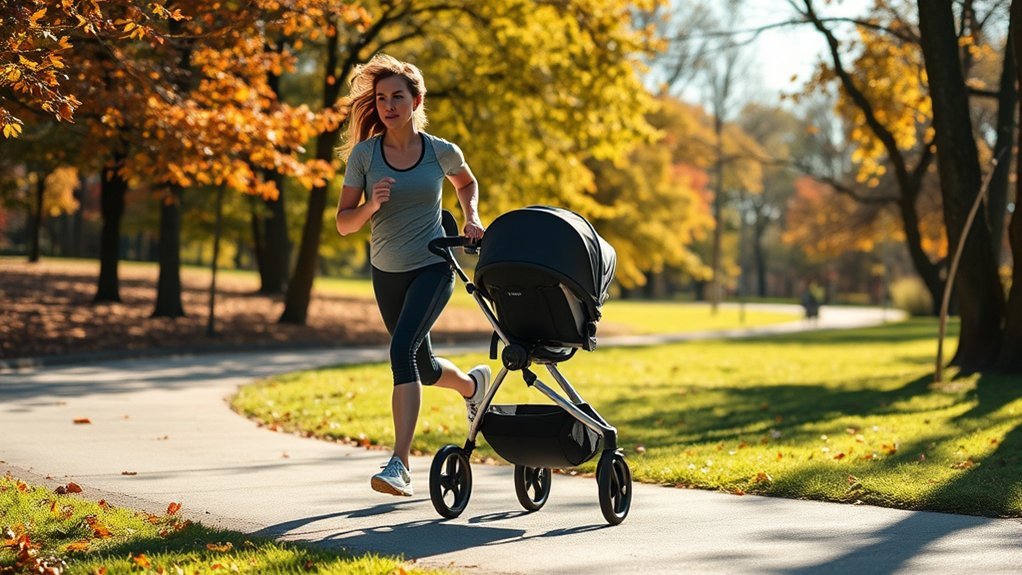
Once your child meets the stroller’s jogging requirements, repeat the same safety checks before every run. Running increases speed, stopping distance, and the consequences of a loose wheel, incorrect harness, or poor route choice.
- Wait for model-specific readiness: Meet the minimum jogging age, developmental requirements, and child-size limits in the exact stroller manual.
- Secure your child: Fasten the complete restraint system every time and adjust it according to the manual.
- Set the front wheel correctly: If your stroller uses a lockable swivel wheel, place it in the manufacturer-approved jogging position before running.
- Use the wrist strap: Keep the tether attached as instructed so the stroller stays connected to you if your grip slips.
- Choose predictable routes: Start on smooth, flat, uncrowded surfaces with good visibility.
- Protect from weather: Use the canopy and appropriate clothing, and avoid conditions that could expose your child to excessive heat, cold, sun, or wind.
- Inspect the stroller: Check the tires, wheels, brakes, harness, frame locks, and other running-related components before use.
Note: Approval to walk with an infant car seat, bassinet, or newborn accessory does not automatically approve that configuration for jogging. Follow the activity rules for the exact stroller and attachment.
Preparing Your Stroller for a Run
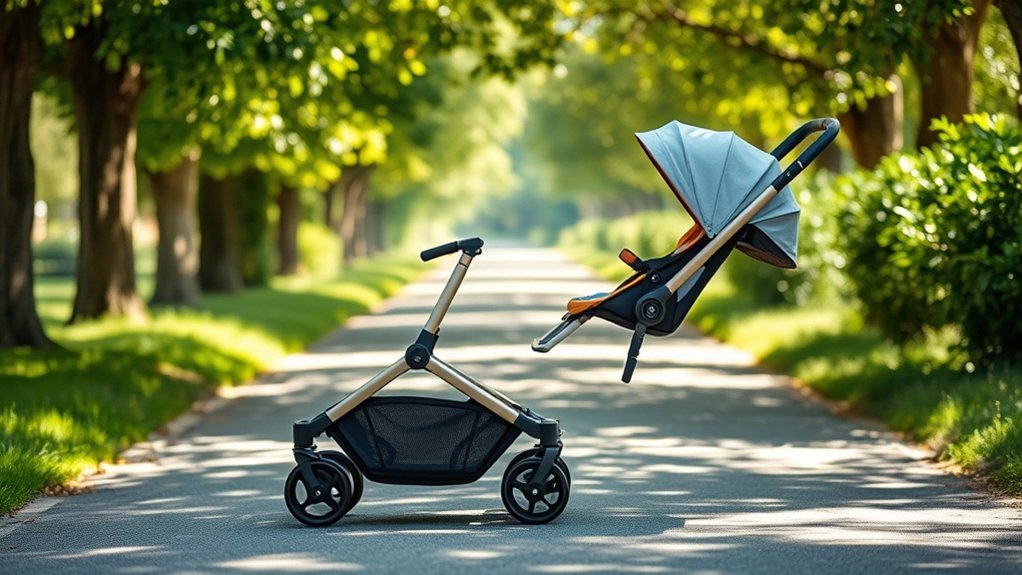
Before you hit the pavement, perform a short stroller inspection. Speed can magnify problems such as poor tracking, loose wheels, underinflated pneumatic tires, incorrect wheel settings, or an improperly fitted harness.
| Task | Importance |
|---|---|
| Check the exact manual | Confirm jogging age, child limits, wheel setting, accessories, and warnings |
| Set front wheel for jogging | Use the fixed or locked position required by the manufacturer |
| Check tires and wheel attachment | Maintain predictable handling and confirm each wheel is secure |
| Test brakes | Confirm the stroller remains secure when parked |
| Check harness fit | Keep your child securely positioned in the seat |
If the stroller veers on a flat surface and the model includes a tracking adjustment, set it according to the manual. Engage the parking brake before placing your child in the stroller or taking them out. For a borrowed or secondhand stroller, identify the exact model, obtain its instructions, inspect for missing or damaged parts, and check whether the model is subject to a safety recall.
Tips for Running With a Jogging Stroller
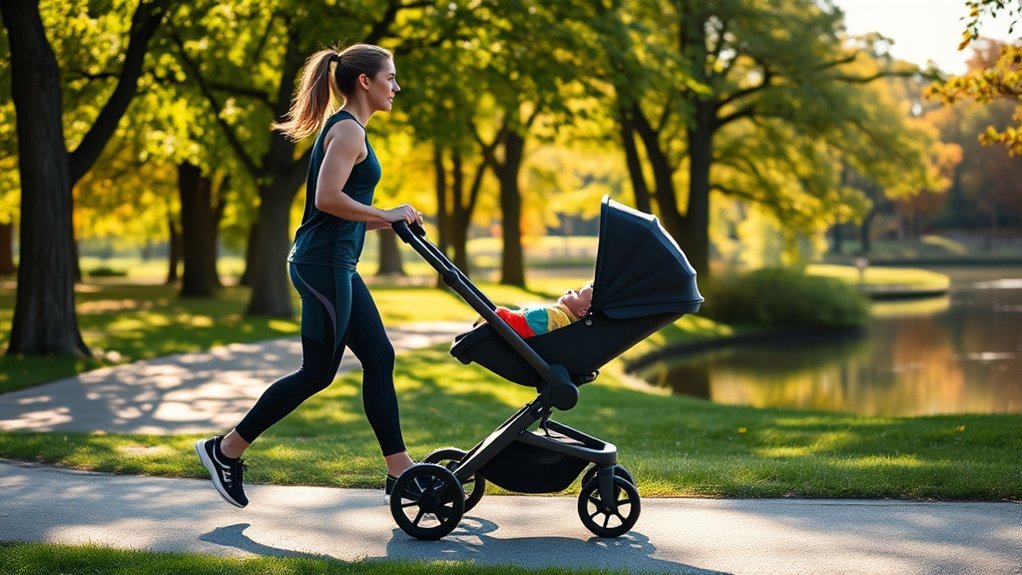
Running with a stroller changes your normal stride, arm swing, turning radius, stopping distance, and visibility immediately in front of you. Begin with a short, easy route while you learn how your particular stroller handles.
- Secure Your Child: Use the complete harness every time and adjust it as the manufacturer instructs.
- Use Jog Mode: Set the front wheel or other running controls to the position specified by the stroller manual.
- Use the Wrist Strap: Keep the tether around your wrist as instructed.
- Start Slowly: Begin with a short, easy run so you can practice pushing, turning, slowing, and stopping.
- Maintain Control: Keep enough contact with the stroller to react immediately to a turn, bump, pedestrian, driveway, or crossing.
- Avoid Crowded Routes: Choose wide paths with enough room to slow down and maneuver safely.
- Watch Your Baby: Stop if your child repeatedly slumps, becomes unusually distressed, appears too hot or cold, or cannot remain comfortably positioned.
Continue checking the stroller’s tires, wheel attachment, brakes, tracking, harness, and frame condition as part of regular maintenance.
Best Surfaces for Jogging With a Stroller
Start on a smooth, flat, predictable surface. Suspension and large tires reduce some vibration, but they do not eliminate bumps or sudden movement. A simple route also gives you more time and space to learn the stroller’s handling.
- Best starting surfaces: smooth sidewalks, paved park loops, flat paved paths, and quiet streets where pedestrian use is permitted and traffic exposure is low.
- Use extra caution: gravel, packed dirt, uneven pavement, grass, mild slopes, wet surfaces, and routes with frequent driveways or crossings.
- Avoid when conditions are unsuitable: rocky trails, steep descents, deep sand, mud, potholes, large curbs, heavy traffic, and crowded paths.
Do not assume that an “all-terrain” label means every terrain is appropriate for a young child. Follow the stroller’s jogging/off-road age rules and reduce speed before turns, crossings, bumps, and downhill sections.
Common Mistakes to Avoid
Most stroller-running mistakes are preventable. Before each run, make sure you are not relying on any of these unsafe assumptions:
- Treating six months as automatic clearance: Some strollers permit jogging around this age, while other models require 8 or 12 months.
- Confusing walking approval with jogging approval: A stroller seat, infant car seat, or bassinet that is approved for walking may still be prohibited during running.
- Using the wrong front-wheel setting: Put the wheel in the jogging position specified by your exact stroller manual.
- Skipping the wrist strap: Use the tether as directed so the stroller stays connected to you if you lose your grip.
- Using loose harness straps: An incorrectly fitted restraint can allow your child to shift or slump during movement.
- Ignoring tire or wheel maintenance: Poor pressure on pneumatic tires, loose wheels, damage, or incorrect tracking can reduce control.
- Ignoring weather and route conditions: Heat, cold, strong sun, slippery surfaces, traffic, blind crossings, and crowded routes can add avoidable risk.
Community Opinions on Jogging With Infants
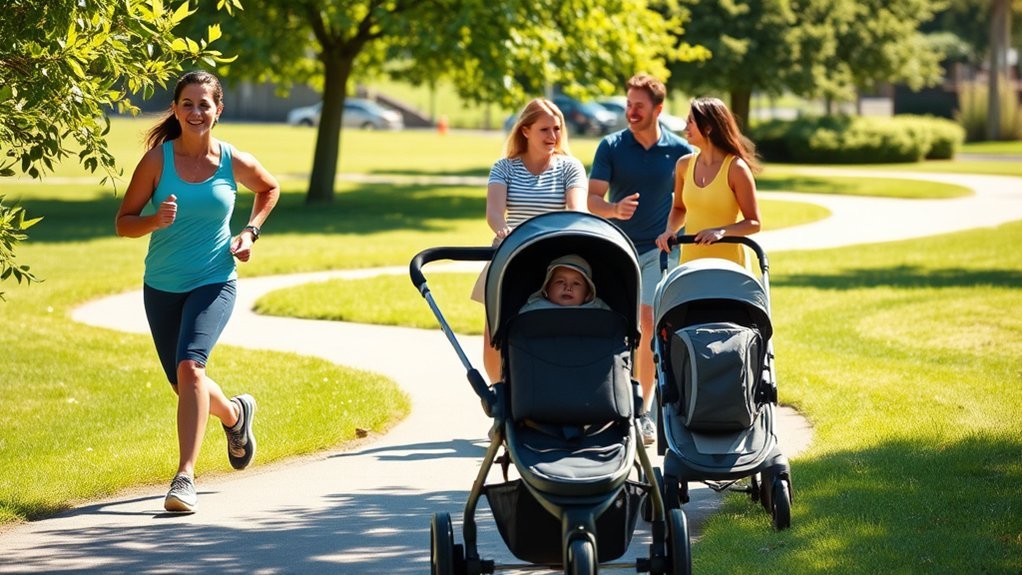
Parents often share different experiences about when they started running with a baby. Those stories can be useful for practical ideas about routes, weather, packing, or getting used to pushing a stroller, but they should not determine the minimum jogging age.
A child who appeared comfortable during someone else’s early stroller run does not change the instructions for your stroller or your baby’s developmental readiness. Manufacturer limits are based on the product’s intended use, and children do not develop head and neck control at identical rates.
Use parent experiences for convenience tips, not as permission to ignore a later minimum age, an activity restriction, or a pediatric concern.
Practical Recommendations for Your First Runs
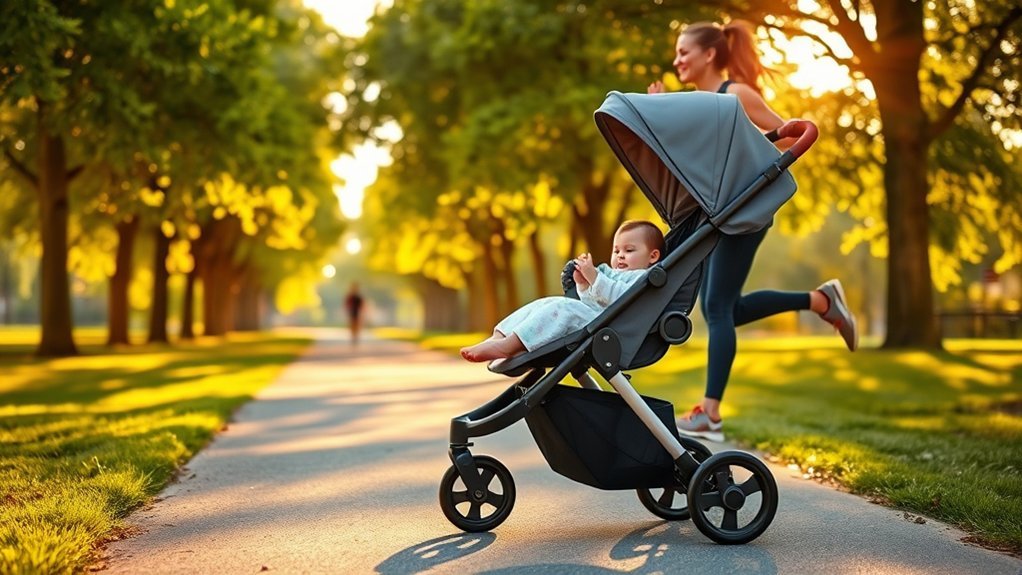
Once your child meets the stroller’s jogging requirements, make the first sessions about control and comfort rather than pace or distance. A short, predictable route gives you a chance to check how the stroller tracks and how your child responds.
- Inspect before starting: Check the wheel setting, tire condition, harness, frame locks, brakes, and wrist strap.
- Choose a simple route: Use a smooth, flat path with good visibility and enough room to slow or stop.
- Monitor comfort: Keep your baby protected from the weather and watch their posture throughout the run.
- Begin with a short session: Increase time or distance only after you are comfortable controlling the stroller.
- Stop when needed: End the run if your baby cannot stay comfortably positioned or if weather, traffic, surface conditions, or stroller handling become unsuitable.
Sources Used for This Safety Update
This September 2026 update cross-checked the article against current or currently published guidance from Thule, BOB Gear, the UPPAbaby Ridge V2 manual, the Chicco Activ3 owner’s manual, Consumer Reports, and HealthyChildren.org/American Academy of Pediatrics general stroller-safety guidance. Manufacturer instructions differ, so the manual for the exact stroller you own remains the most important product-specific reference.
Related Guides
Frequently Asked Questions
Can I use a jogging stroller for newborns?
Not for jogging. Some jogging-stroller systems can be used for ordinary walks with a newborn when an approved infant car seat, bassinet, or other newborn configuration is installed. Follow the stroller and accessory instructions exactly, and do not treat walking approval as running approval.
Is 6 months always safe for jogging with a baby?
No. Six months is an earliest jogging threshold used by some manufacturers, not a universal rule. BOB Gear has models that specify 8 months for jogging, while the Chicco Activ3 specifies 12 months. Your baby must also meet the developmental requirements in the exact stroller manual.
Can I jog with an infant car seat attached?
Do not assume that an infant car seat makes jogging safe. Infant-car-seat adapters are commonly intended to let younger babies use the stroller for walking. BOB Gear, for example, specifically says not to jog with an infant car seat attached. Follow the activity restrictions for both the stroller and the attached car seat or accessory.
What are the risks of jogging with an infant?
Running adds speed, vibration, turns, stopping forces, and surface impacts. A child who is too young or lacks sufficient head and neck control may not stay safely positioned. Other risks include stroller instability, falls, loose wheels, poor harness fit, unsafe terrain, traffic, and excessive heat or cold.
Do jogging strollers have safety harnesses?
Dedicated jogging strollers commonly use a 5-point harness. Fasten the complete restraint system every time and adjust the straps according to the stroller instructions so your child remains securely positioned.
How do I choose a jogging stroller?
Choose a stroller whose manufacturer specifically approves running. Compare its jogging-age requirements, front-wheel design, restraint system, suspension, tires, brakes, wrist tether, child limits, handlebar fit, terrain guidance, storage, folding size, and compatible infant accessories if you need a walking setup for a younger baby.
Can I jog on rough terrain with my stroller?
Only use rough or off-road terrain when the stroller manufacturer permits it at your child’s age and you can maintain control. Some manufacturers use a later minimum age for jogging or off-road use. Begin on smooth, predictable surfaces and avoid steep, rocky, muddy, or badly broken routes.
Is walking with a jogging stroller safer than running?
Walking generally creates less speed and impact than running, which is why many jogging-stroller systems allow approved walking configurations before they permit jogging. The exact walking age and setup still depend on the stroller and accessory instructions.
Should the front wheel be locked when jogging?
For jogging strollers with a lockable swivel front wheel, manufacturers commonly require the wheel to be locked or switched into a dedicated jogging position before running. Follow your exact model’s instructions because wheel systems vary.
Conclusion
There is no universal age when every baby can safely use every jogging stroller for running. Six months is the earliest threshold used by some manufacturers, but other models specify 8 months or 12 months, and more conservative safety guidance recommends waiting until 1 year.
Use the exact stroller manual as your starting point, then consider your baby’s head and neck control, stable seat positioning, harness fit, and any pediatric concerns. Never treat a newborn walking setup or infant-car-seat adapter as automatic permission to jog. Once both your child and stroller meet the requirements, begin on a smooth route, use the correct jogging settings, and repeat the same stroller safety check before every run.