Yes. You can take a jogging stroller on an airplane, but you should usually plan to check it rather than carry it into the cabin. Whether you can gate-check it or must leave it at the ticket counter depends on the airline, how the stroller folds, its size and weight, and sometimes the airport or aircraft. Because jogging strollers have larger wheels and frames than compact travel strollers, check your airline’s current child-equipment policy before departure, measure the stroller when folded, and have a backup plan if it must be checked before security.
Last updated: September 11, 2026. Airline and TSA policies were checked against current official sources.
Quick Answer
Yes, you can usually take a jogging stroller on an airplane. Most families should expect to check a full-size jogging stroller at the gate or ticket counter rather than place it in an overhead bin. The exact process is airline-specific, so confirm the current stroller policy, fold and secure the stroller, remove loose accessories, and use a protective travel bag when practical.
Key Takeaways
- Many U.S. airlines check strollers as child equipment without a standard stroller fee, but the drop-off rules vary by carrier.
- Do not use a normal carry-on dimension or a 20-pound number as a universal jogging-stroller rule; cabin, gate-check, and counter-check policies are separate.
- Remove loose accessories and, if needed, quick-release wheels; secure the folded frame and protect it with a travel bag.
- TSA screens strollers and other child equipment, so empty baskets and pockets before reaching the checkpoint.
- A compact travel stroller, baby carrier, car seat-stroller setup, or destination rental may be easier when the jogging stroller is not essential to the trip.
At a Glance
| Best Option | Plan to check a full-size jogging stroller; use gate check only when your airline permits it for your stroller. |
| Difficulty | Moderate, because jogging strollers are typically bulkier than compact travel strollers. |
| Helpful Gear | Stroller travel bag, luggage tag, secure folding strap, wheel covers, and a hand pump if your stroller uses air-filled tires. |
| Best Backup | A compact travel stroller, baby carrier, car seat-stroller setup, or stroller rental at your destination. |
What Do Airlines Allow for Jogging Strollers?
When you’re planning to travel with a jogging stroller, start with your operating airline’s current stroller or child-equipment policy. Many U.S. carriers check strollers without a standard stroller charge, but they do not all use the same rules for gate checking, counter checking, cabin storage, stroller wagons, or non-collapsible models.
| Airline | Current Stroller Guidance Checked September 11, 2026 |
|---|---|
| American Airlines | American allows one stroller and one car seat to be checked free when traveling with a child. Its children page says non-collapsible strollers and certain stroller wagons must be checked at the ticket counter. Because American’s published pages use different wording about other stroller handling, verify your specific stroller before travel. |
| Delta Air Lines | Delta says strollers and child safety seats do not count toward the standard baggage allowance and can be checked free at curbside, the ticket counter, or the gate. |
| Southwest Airlines | Southwest allows an accompanying customer traveling with children to check a stroller and car seat without the standard child-equipment charge. The stroller can be checked at curbside where available, the ticket counter, or the gate. |
| Alaska Airlines | Alaska says a child’s stroller and car seat travel free as checked baggage. You can check them with your other baggage or wait until the gate. |
This comparison shows why there is no single jogging-stroller rule for every airline. If your carrier is not listed above, use its official family-travel or child-equipment page rather than relying on another airline’s limits.
A small stroller may be accepted at the gate or even in the cabin when the airline specifically permits it and it fits available storage. A larger jogging stroller is more likely to need checking because large wheels and a long folded frame take more handling space. Non-collapsible models may face stricter rules.
Do not confuse normal cabin-bag limits with stroller rules. For example, American lists 22 x 14 x 9 inches for a standard carry-on, while Southwest lists 24 x 16 x 10 inches. Those dimensions describe cabin baggage on those airlines; they are not universal gate-check dimensions for jogging strollers.
Note: Check the policy for the airline actually operating your flight, especially on codeshare or partner-airline itineraries. Airport and aircraft handling can also affect where a checked stroller is returned after landing.
You’ll also want to think about airport maneuverability. A jogging stroller can be comfortable for long walks, but its bulk can make elevators, boarding areas, shuttle buses, and crowded security lines harder to manage.
How Do You Prepare a Jogging Stroller for Air Travel?
Prepare the stroller at home before you leave for the airport. Fold it into its smallest normal configuration, measure the folded frame, and compare those measurements with your airline’s current rules. If you want more detail about measuring a stroller for air travel, see this guide to stroller size limits on an airplane.
If your stroller has quick-release wheels, remove a wheel only when doing so makes transport easier and the manufacturer’s design allows it. Put detached wheels and other removable parts inside the stroller bag or another secure bag so they cannot separate from the frame.
Use the stroller’s built-in folding latch first. If extra restraint is needed, use a secure luggage strap or similar restraint and keep loose ends contained, preferably inside the travel bag. Add identification to both the bag and stroller frame. If your stroller uses air-filled tires, a compact hand pump can be useful at your destination.
| Preparation Step | Description |
|---|---|
| Check Airline Policies | Verify the airline’s current stroller, gate-check, counter-check, and cabin-storage rules before leaving home. |
| Remove Quick-Release Wheels if Needed | Make the folded package smaller when your stroller is designed for easy wheel removal. |
| Secure the Folded Frame | Use the built-in latch or a secure strap so the stroller cannot unfold during handling. |
| Use Protective Bag | Protect the frame, fabric, wheels, and handlebar from dirt and minor scuffs and keep detached parts together. |
| Pack Useful Accessories | Bring identification tags and, for air-filled tires, a suitable hand pump if you expect to need one after landing. |
Pro Tip: Photograph the stroller from several angles before handing it to the airline, and photograph the baggage or gate-check tag. Those images can help document its pre-flight condition if something is damaged or misplaced.
A few minutes of preparation at home makes the stroller easier to fold, screen, identify, and hand over at the airport.
What Are the Size and Weight Rules for a Jogging Stroller?
There is no single airline-wide size or weight limit for jogging strollers. The important distinction is whether you want to carry the stroller into the cabin, gate-check it, or check it at the ticket counter. Each option can have different rules.
Cabin baggage dimensions should not be treated as universal stroller limits. American’s normal carry-on limit is 22 x 14 x 9 inches, while Southwest’s is 24 x 16 x 10 inches. A stroller that exceeds a cabin-bag limit may still be accepted as checked child equipment under that airline’s separate stroller policy.
The same caution applies to weight. A 20-pound number is not a universal gate-check cutoff. Airline policies differ, and even an airline’s rules can distinguish among cabin storage, collapsible strollers, non-collapsible strollers, stroller wagons, and checked child equipment.
Warning: Measure and weigh your stroller when fully folded, including wheels or other parts that remain attached. Then compare those numbers with the policy of your operating airline instead of applying a generic stroller limit.
If you are specifically trying to bring a compact stroller into the cabin, see the separate guide on taking a stroller as a carry-on. For a full-size jogging stroller, planning for checked handling is usually more realistic.
Can You Gate-Check a Jogging Stroller or Must You Counter-Check It?
You can gate-check some jogging strollers, but you should not assume every airline will accept every jogging model at the gate. The answer depends on the carrier’s policy and how your stroller folds.
Gate-checking lets you use the stroller through most of the terminal. You obtain the airline’s tag, fold the stroller before boarding, and leave it at the location specified by the gate staff. Depending on the airline, airport, and flight, the stroller may be returned near the aircraft or sent to another collection point.
Ticket-counter checking means handing the stroller over with checked items before security. This can be required for non-collapsible or otherwise restricted strollers, and it can also be the simpler choice when your jogging stroller is bulky and you already have another way to carry your child.
If you want a detailed walkthrough of the two processes, see the guide to checking a stroller at the airport.
If your child is very young, a baby carrier can make the rest of the airport easier after counter checking. For a toddler, a compact backup stroller may be useful if your full-size stroller must be handed over early.
How Do You Get a Jogging Stroller Through Airport Security?
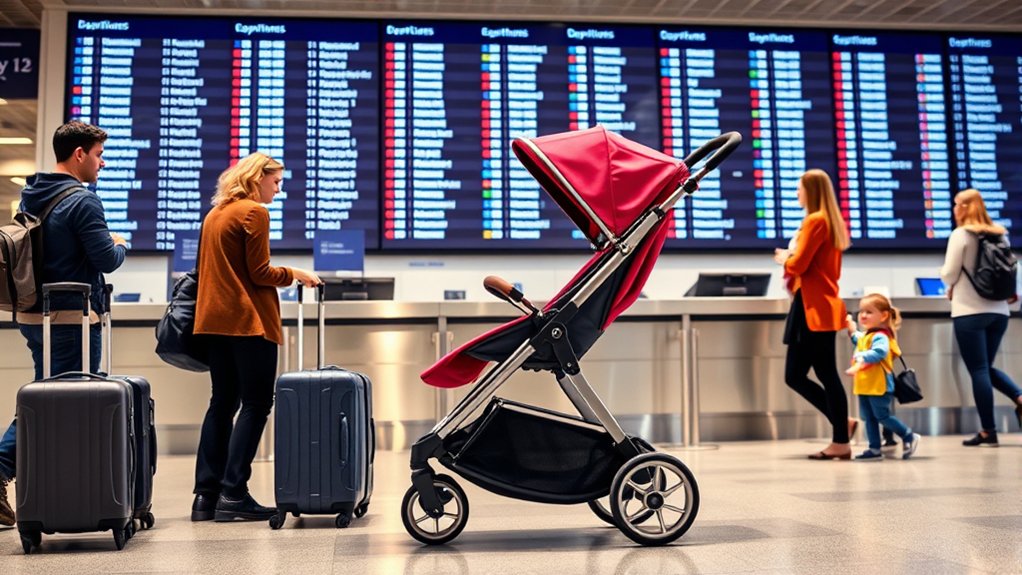
Arrive with enough time for stroller tagging, security screening, bathroom breaks, and boarding. A jogging stroller adds another large item to manage, so emptying it before the checkpoint can save time.
According to the Transportation Security Administration, strollers and similar child equipment are screened by X-ray when they fit. Equipment that is too large for the X-ray machine receives a visual or physical inspection instead.
Before you reach the scanner, remove bags, snack cups, toys, blankets, and loose accessories from stroller baskets and pockets. Keep important items together so you are not unloading the stroller piece by piece while standing at the checkpoint.
If your stroller folds, practice the folding process at home. Know where the release mechanism, wheel locks, and frame latch are located. This is especially useful when security officers ask you to collapse the stroller quickly.
Use family or early boarding when your airline offers it and it helps your situation. Extra time can make it easier to fold a gate-checked stroller, organize your child’s items, and board without rushing.
Note: Avoid hanging heavy luggage from the stroller handle. The balance changes when your child gets out, and a loaded handle can make a stroller easier to tip backward.
Preparing the stroller before you reach security reduces unnecessary handling and keeps the process simpler for both you and the screening staff.
How Do You Protect a Jogging Stroller From Airline Damage?
Jogging strollers are designed for outdoor use, but baggage handling can still expose the frame, wheels, fabric, handlebar, and accessories to impacts and abrasion. A fitted or appropriately sized protective travel bag can keep loose parts together and reduce dirt and minor surface damage.
Before checking the stroller, remove cup holders, snack trays, parent organizers, rain covers, fans, toys, and other clip-on accessories. Pack those pieces separately so they cannot snap off or disappear during handling.
Lock the folded frame and secure removable wheels or other parts inside the travel bag. Put identification on both the bag and the stroller itself so the stroller can still be identified if the outside tag or bag becomes separated.
Inspect the stroller as soon as you receive it. If you find damage, photograph it and contact the airline promptly. The U.S. Department of Transportation’s damaged-baggage guidance says passengers should file a baggage claim with the airline as soon as possible when covered damage occurs. Keep your baggage or gate-check documentation until the issue is resolved.
What Are the Best Alternatives to Flying With a Jogging Stroller?
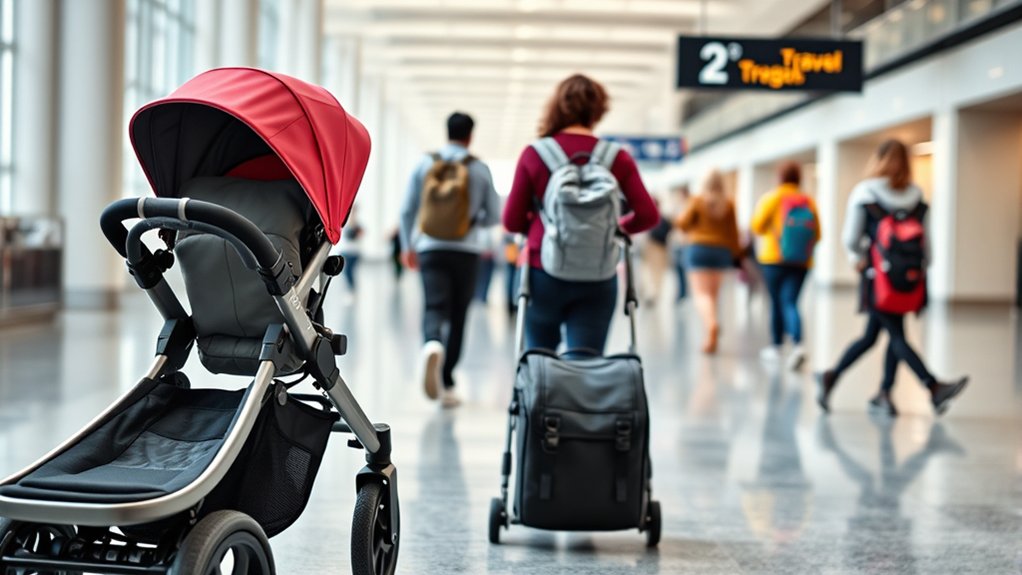
If your jogging stroller is more equipment than you need for the trip, a compact travel stroller can make airport movement easier. Smaller models generally fold faster, take less storage space, and are easier to lift through terminals and ground transportation.
Baby carriers, including slings and soft-structured carriers, can provide a hands-free backup when the stroller must be checked at the ticket counter. They can also be useful during connections or while waiting for a checked stroller to be returned.
Integrated car seat-stroller setups can reduce the number of separate pieces you move between the car and terminal. If you plan to use a child restraint aboard the aircraft, confirm that it meets the airline and applicable aircraft-use requirements.
You can also rent a stroller at your destination when you only need one after landing. That can make sense for theme parks, city trips, beach trips, or short visits where hauling a large jogging stroller through two airports adds little benefit.
When Is a Jogging Stroller Worth Bringing on a Flight?
A jogging stroller is most useful when the destination includes long outdoor walks, uneven surfaces, parks, running routes, gravel, or rough sidewalks. It may also be worth the extra airport handling when your child naps reliably in that stroller or you depend heavily on its storage during daily outings.
It is less attractive for short urban trips, tight hotel rooms, frequent public transportation, or itineraries with several flight connections. In those situations, a compact stroller or baby carrier can reduce both bulk and the number of times you need to hand equipment to airline staff.
Before flying, ask three practical questions: Will you use the jogging stroller enough after landing to justify carrying it through the trip? Can you manage the airport if the airline requires counter checking? And is the stroller valuable or difficult enough to replace that you should use extra protection?
Related Guides
Frequently Asked Questions
Can I check my jogging stroller as luggage?
Yes. Jogging strollers can generally travel as checked child equipment, but the exact drop-off process depends on the airline. Some carriers allow gate checking, while certain stroller types may need to be left at the ticket counter. Check your operating airline’s current policy before departure.
Are there additional fees for bringing a stroller?
Many major U.S. airlines currently check a stroller as child equipment without a standard stroller fee, but policies differ by carrier and itinerary. Do not assume the same rule applies to every international airline, partner carrier, oversized item, or stroller wagon.
What if my stroller gets damaged during travel?
Inspect the stroller when it is returned. If you find damage, take photos and file a claim with the airline as soon as possible. Keep your baggage or gate-check documentation and any photos showing the stroller’s condition before the flight.
Can I use my stroller at the airport?
Usually, yes, if your airline allows you to keep it until the gate. If your jogging stroller must be checked at the ticket counter, you will need another way to carry or guide your child through security and the terminal.
Can I bring stroller accessories on the plane?
Small stroller accessories can generally travel when they comply with your airline’s carry-on rules and security requirements. Remove detachable cup holders, trays, toys, fans, organizers, and other loose parts before checking the stroller so they are less likely to break or disappear.
Can I gate-check a jogging stroller?
Sometimes. Several airlines allow strollers to be checked at the gate, but rules differ by carrier and stroller type. A bulky, non-collapsible, or otherwise restricted model may need to be checked at the ticket counter, so confirm the policy before relying on gate check.
Should I deflate jogging stroller tires before flying?
You normally do not need to deflate stroller tires just because you are flying. Follow the stroller or tire manufacturer’s pressure instructions and any specific requirement from your airline. A small hand pump can be useful after landing if your stroller uses inflatable tires.
Conclusion
Yes, you can travel with a jogging stroller, but the safest plan is to expect checked handling unless your airline clearly allows your stroller at the gate or in the cabin. Check the operating carrier’s current policy, measure the folded stroller, remove loose parts, secure the frame, and prepare for TSA screening.
If the stroller is essential for running, rough paths, or long walks at your destination, the extra preparation may be worthwhile. If not, a compact stroller, carrier, or destination rental can make the airport much easier. Recheck the airline’s policy shortly before departure because stroller and baggage rules can change.

