
A Toyota RAV4 can develop oil-use, shifting, emissions, electrical, or warning-light problems, but the likely cause depends on its model year, engine, powertrain, mileage, and service history. Start with the VIN and stored diagnostic codes instead of replacing the part named in a code description. A careful diagnosis can prevent an inexpensive leak, wiring fault, or maintenance issue from turning into a major repair.
Quick Answer
Common Toyota RAV4 concerns include excessive oil use in certain older 2.4-liter models, harsh or delayed shifting, EVAP leaks, oxygen-sensor codes, and catalytic-efficiency faults. Confirm the year, engine, VIN, trouble codes, fluid levels, leaks, and recall status before replacing parts. Stop driving for overheating, low oil pressure, smoke, severe slipping, or a flashing check-engine light.
Key Takeaways
- The RAV4 name covers several generations, engines, automatic transmissions, hybrids, and regional specifications. A problem associated with one version may not apply to another.
- An OBD-II code identifies a system, circuit, or operating condition. It does not prove that the component named in the code has failed.
- Check oil level, coolant level, battery condition, visible leaks, wiring, fluid condition, and freeze-frame data before approving major repairs.
- Use Toyota’s maintenance guide for your exact model year instead of following one oil-change interval for every RAV4.
- Check open recalls and service campaigns by VIN because eligibility depends on the individual vehicle and its repair history.
Understanding Common Toyota RAV4 Problems
Before diagnosing a RAV4 problem, record the model year, 17-digit VIN, engine size, gasoline or hybrid powertrain, drivetrain, mileage, and recent service history. You can find model-specific manuals and maintenance information through the Toyota Manuals and Warranties portal.
Note: Model-year ranges in online problem lists can be misleading. Production dates, engines, transmissions, markets, and VIN ranges may differ even when two vehicles share the same model year.
| Symptom | Possible Areas | First Checks |
|---|---|---|
| Oil level drops between services | External leak, PCV system, incorrect fill, internal oil consumption | Verify level correctly, inspect for leaks, record mileage and added oil |
| Harsh, delayed, or slipping shifts | Fluid condition, battery voltage, wiring, ECM, solenoid, valve body, internal wear | Scan all modules, inspect fluid where applicable, review freeze-frame and live data |
| Check-engine light with poor fuel economy | Air-fuel sensor, O2 sensor, vacuum leak, misfire, fuel delivery, exhaust leak | Read codes and freeze-frame, inspect intake and exhaust, review fuel trims |
| Fuel-cap or EVAP code | Loose cap, damaged seal, hose leak, purge valve, vent valve | Inspect and tighten the cap, check hoses, perform an approved smoke test if needed |
| P0420 or P0430 code | Catalyst efficiency, exhaust leak, misfire, oil burning, fuel mixture, sensor data | Repair upstream engine faults and test the exhaust and sensor signals before replacing the converter |
A diagnostic trouble code tells you what the vehicle detected. It does not, by itself, tell you which part to replace.
Common Transmission Issues in the RAV4
Transmission symptoms can include delayed engagement, harsh shifts, slipping, engine-speed flaring, failure to downshift, shuddering, or a warning light. These symptoms do not share one universal cause across every RAV4 generation.
Some early-2000s RAV4s have been associated with ECM-related shifting complaints, while other vehicles may have low system voltage, wiring damage, a faulty speed or throttle signal, a solenoid circuit problem, valve-body wear, incorrect fluid, or internal transmission damage. Check model-specific Toyota service information through the Toyota Technical Information System before applying a repair intended for another year.
How to Diagnose RAV4 Shifting Problems
- Confirm the symptom. Record whether the problem occurs cold, hot, under load, while turning, or at a specific speed.
- Check battery and charging voltage. Low voltage can disrupt electronic control modules and create misleading faults.
- Scan every relevant module. Record stored, pending, and permanent codes before clearing anything.
- Save freeze-frame and live data. Review commanded gear, input and output speed, throttle position, temperature, and solenoid commands where supported.
- Inspect fluid correctly. Some transmissions have specific temperature and level-check procedures. Do not add a generic fluid without confirming the required specification.
- Inspect connectors and wiring. Look for corrosion, fluid intrusion, loose grounds, damaged harnesses, and previous repairs.
- Test before replacing. Electrical, hydraulic, software, and mechanical faults can produce similar symptoms.
Warning: Stop driving if the transmission slips badly, will not remain in gear, produces a strong burning smell, leaks fluid rapidly, or causes unsafe hesitation in traffic. Continued driving can increase internal damage.
Diagnosing Excessive Oil Consumption in RAV4 Models
Excessive oil consumption is most closely associated with certain older RAV4s equipped with the 2.4-liter 2AZ-FE engine, including some U.S.-market 2006-2008 vehicles. Do not assume that every 2004-2008 RAV4 has the same engine or piston-related condition.
Possible signs include repeated oil top-ups, a low dipstick reading, blue-gray exhaust smoke, oil-fouled spark plugs, deposits in the tailpipe, or low-oil-related engine noise. The check-engine light may appear if oil burning causes misfires, sensor contamination, or catalytic-converter problems, but it is not a direct oil-level warning.
Perform a Basic Oil-Consumption Check
- Park on level ground and follow the owner’s manual procedure for checking the dipstick.
- Confirm that the engine contains the specified oil grade and the correct amount.
- Inspect the drain plug, oil filter, oil pan, timing-cover area, valve-cover area, and the ground beneath the vehicle for leakage.
- Check the PCV system and intake for conditions that may draw excess oil vapor into the engine.
- Record the odometer, dipstick level, and every amount of oil added.
- Recheck the level at consistent intervals using the same procedure.
- Ask a qualified technician to perform a documented consumption test if the level continues to fall without a visible leak.
Pro Tip: Photograph the dipstick and record the date, mileage, oil grade, and quantity added. A consistent log is more useful than saying the engine “uses a lot of oil.”
Internal repair may involve pistons, rings, cylinder inspection, valve seals, or other engine work, depending on test results. Piston-ring replacement should not be the first step before checking external leaks, filling procedure, PCV operation, engine condition, and the applicable Toyota service information.
Follow the maintenance interval in your exact Toyota Warranty and Maintenance Guide. Oil type alone does not establish one universal interval for every RAV4.
Warning: If the red oil-pressure warning remains on while the engine is running, shut the engine off as soon as you can do so safely. Adding oil may not correct a pressure-system failure, and continued operation can destroy the engine.
How to Diagnose Catalytic Converter Errors
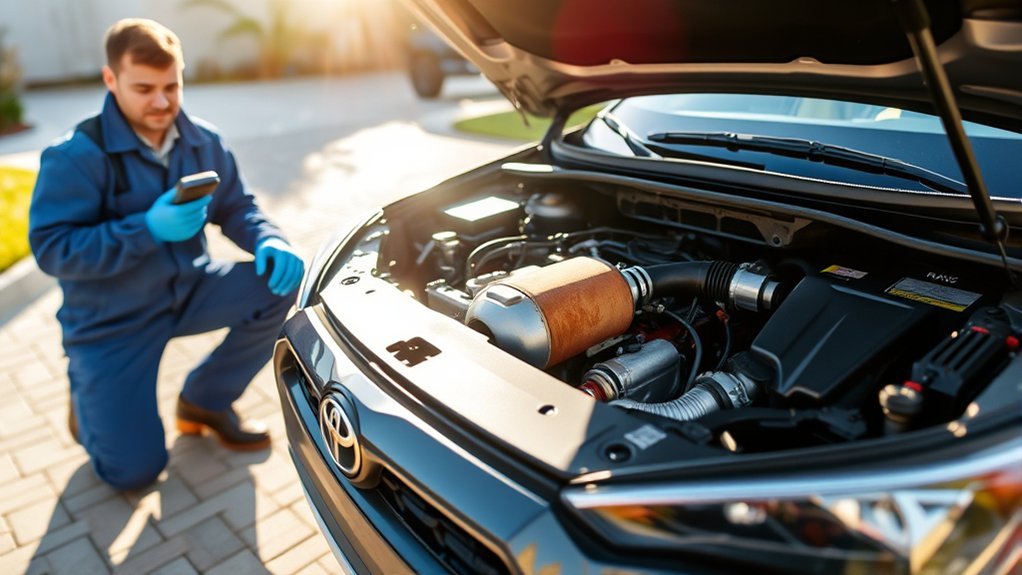
The catalytic converter reduces harmful exhaust emissions, but a code such as P0420 or P0430 does not automatically prove that the converter has failed. The engine computer evaluates catalyst performance using sensor data and operating conditions, so faults elsewhere can affect the result.
Check for the following before replacing the converter:
- Current or recent misfire codes
- Excessive oil consumption or coolant entering the combustion chamber
- Rich or lean fuel-mixture conditions
- Exhaust leaks ahead of or near the oxygen sensors
- Damaged sensor wiring or connectors
- Incorrect air-fuel or oxygen-sensor signals
- Fuel-injector, ignition, compression, or air-leak problems
- Physical impact, rattling, overheating, or exhaust restriction
A technician may compare upstream and downstream sensor activity, inspect fuel trims, test for exhaust leaks, check converter temperature under controlled conditions, and measure exhaust backpressure when restriction is suspected. Replacing the converter without repairing an oil-burning, misfire, or fuel-mixture problem can damage the new unit.
Catalytic converters do not have a universal 10-year or 100,000-mile replacement age. In the United States, the EPA states that specified major emissions components, including catalytic converters, the emissions ECU, and the OBD computer, generally receive federal coverage for 8 years or 80,000 miles, whichever occurs first. Review the exact warranty booklet and eligibility requirements before authorizing a covered repair through an independent shop.
See the EPA’s vehicle emissions warranty guidance for federal coverage information. Removing, hollowing out, or electronically defeating a catalytic converter is not a legal repair for a road vehicle in the United States.
Solutions for O2 Sensor and Air-Fuel Sensor Codes
RAV4 gasoline engines may use air-fuel-ratio sensors, conventional oxygen sensors, or both, depending on the year and engine. A sensor-related trouble code can result from a failed sensor, but it may also point to wiring damage, heater-circuit faults, an exhaust leak, contamination, or an engine that is genuinely running too rich or too lean.
What to Check Before Replacing a Sensor
- Read the complete code definition, including bank, sensor position, and circuit description.
- Inspect the harness near hot exhaust components and moving parts.
- Check connectors for corrosion, loose terminals, water, oil, or damaged locks.
- Inspect for exhaust leaks that can draw outside air into the system.
- Review short-term and long-term fuel trims.
- Check for intake leaks, weak fuel pressure, leaking injectors, misfires, or oil burning.
- Compare sensor response and heater operation with Toyota’s specifications.
Use a replacement that is designed for the exact VIN, engine, emissions certification, sensor position, and connector. A Toyota-branded part may simplify fitment, but the essential requirement is a correct, legal, application-specific component that meets the required specification.
Diagnosing RAV4 EVAP System Faults
The EVAP system stores fuel vapor and routes it into the engine instead of releasing it into the atmosphere. A loose fuel cap is one possible cause of an EVAP code, but purge valves, vent valves, hoses, seals, wiring, and the charcoal canister can also fail.
- Inspect the fuel cap and sealing surface for damage, dirt, or an incorrect cap.
- Tighten the cap as directed and avoid clearing the code before recording diagnostic information.
- Inspect visible vapor hoses and connectors for cracking or disconnection.
- Test purge and vent-valve operation with the correct service procedure.
- Use an approved low-pressure smoke test when a small leak cannot be found visually.
Warning: Fuel vapor is flammable. Do not smoke, create sparks, use unapproved pressure, or work near an open flame while testing the fuel or EVAP system.
How to Use OBD-II Codes Without Misdiagnosing the Problem
An inexpensive scanner can provide useful information, but diagnosis should not stop after reading one code. Use this order:
- Record all codes. Include stored, pending, permanent, manufacturer-specific, transmission, ABS, AWD, hybrid, and body-module codes when your tool supports them.
- Save freeze-frame data. Note engine speed, load, coolant temperature, vehicle speed, and fuel trims at the time of the fault.
- Check related codes first. A misfire or mixture code may explain a later catalyst-efficiency code.
- Inspect simple causes. Check fluid levels, loose connectors, damaged wiring, intake hoses, grounds, fuses, and visible leaks.
- Test the suspected system. Follow Toyota’s model-specific electrical and mechanical procedures.
- Repair the cause. Do not replace every component mentioned in a code description.
- Verify the repair. Clear codes only after recording them, complete the required drive cycle, and confirm that monitors run without the fault returning.
RAV4 Warning Signs That Need Immediate Attention
Arrange towing or stop driving when continuing could cause engine damage, loss of control, fire, or unsafe loss of power. Urgent signs include:
- A flashing check-engine light, especially with shaking or power loss
- A red oil-pressure warning that remains illuminated
- Overheating, steam, or a rapidly rising temperature gauge
- Heavy smoke or a burning odor
- A strong fuel smell or visible fuel leak
- Severe transmission slipping or failure to engage
- Brake, steering, or charging-system warnings with abnormal operation
- A hybrid-system warning accompanied by reduced power, smoke, damage, or overheating
Do not touch orange high-voltage cables, connectors, battery components, or damaged hybrid-system parts. Hybrid and plug-in-hybrid repairs require the correct training, protective equipment, shutdown procedures, and test instruments.
Checking RAV4 Recalls and Service Campaigns
A model-year list cannot tell you whether your individual RAV4 has an open recall. Eligibility may depend on the VIN, production date, installed component, market, and whether the repair was already completed.
Enter the VIN in both the Toyota Safety Recalls and Service Campaigns lookup and the NHTSA recall lookup. Contact a Toyota dealer if the result is unclear or if ownership records need updating.
A safety recall, service campaign, warranty enhancement, and technical service bulletin are not the same:
- Safety recall: Addresses a safety defect or regulatory noncompliance, normally with a no-cost remedy for affected vehicles.
- Service campaign: Offers an inspection or repair for a specific product or customer-satisfaction issue under stated conditions.
- Warranty enhancement: Extends coverage for a defined condition, vehicle group, time, or mileage.
- Technical service bulletin: Gives technicians diagnostic or repair information. It does not automatically provide a free repair.
Maintenance That Can Help Your RAV4 Last Longer
- Follow the maintenance guide for your exact year, engine, and market.
- Check engine oil regularly, especially if the vehicle has a known history of oil use.
- Investigate coolant loss instead of repeatedly topping up the reservoir.
- Use the specified engine oil, coolant, transmission fluid, brake fluid, and differential or transfer-case lubricant.
- Maintain correct tire pressure and rotate tires according to the applicable schedule.
- Keep the 12-volt battery secured and its terminals clean.
- Replace worn spark plugs and filters at the specified intervals.
- Repair misfires promptly to protect the catalytic converter.
- Keep invoices and record dates, mileage, fluid specifications, and parts used.
- Check recall status after buying a used RAV4 and periodically afterward.
Frequently Asked Questions
What are the most reliable RAV4 model years?
No model year is automatically the most reliable for every buyer. Compare the engine and transmission, VIN-specific recalls, service records, accident history, rust, oil usage, warning lights, fluid condition, and a professional pre-purchase inspection. A well-maintained vehicle from a year with reported concerns may be a better purchase than a neglected example from a highly rated year.
How can I extend my RAV4’s lifespan?
Follow the model-specific maintenance guide, keep fluids at the correct levels, repair leaks and warning lights promptly, avoid driving while overheating or low on oil, maintain the battery and tires, and keep detailed service records. Smooth driving and avoiding excessive loads also reduce stress on the powertrain and brakes.
What maintenance should I prioritize for my RAV4?
Prioritize engine-oil level and changes, coolant condition, brakes, tires, the 12-volt battery, filters, spark plugs, and any transmission, differential, transfer-case, or hybrid-system inspections listed in the applicable guide. Your driving conditions and exact powertrain determine the required intervals.
Are there known safety recalls for specific RAV4 models?
Yes. Different RAV4 years and VIN ranges have been included in safety recalls and service campaigns. Use Toyota’s and NHTSA’s VIN lookup tools for the current status of your vehicle rather than relying only on a model-year list.
How do I find a trustworthy RAV4 mechanic?
Look for a licensed or certified shop with Toyota experience, proper scan equipment, access to service information, clear written estimates, and a willingness to test before replacing parts. Ask the technician to explain the codes, measurements, failed tests, recommended repair, warranty, and whether any recall or emissions coverage may apply.
Does a P0420 code always mean the catalytic converter is bad?
No. P0420 indicates that the computer detected catalyst efficiency below its expected threshold. Misfires, oil burning, fuel-mixture problems, exhaust leaks, wiring faults, and incorrect sensor data should be checked before the converter is condemned.
Does an O2 sensor code mean I need a new sensor?
Not necessarily. The code may describe a sensor circuit, heater, response, or mixture condition. Check the wiring, connector, exhaust system, fuel trims, intake leaks, ignition, fuel delivery, and sensor data before replacing the sensor.
Conclusion
Common Toyota RAV4 problems are easier to manage when you identify the exact vehicle and diagnose the system in the correct order. Check the VIN, engine, fluid levels, warning lights, stored codes, freeze-frame data, visible leaks, wiring, maintenance history, and recall status before approving expensive parts.
Do not ignore overheating, low oil pressure, severe slipping, fuel odors, smoke, or a flashing check-engine light. Prompt testing can protect the engine, transmission, catalytic converter, hybrid system, and your safety while helping you avoid repairs based on guesswork.
Sources
- Toyota Manuals and Warranties — model-specific owner manuals, warranty information, and maintenance guides.
- Toyota Technical Information System — Toyota repair procedures, service information, and technical bulletins.
- Toyota Safety Recalls and Service Campaigns — VIN-based Toyota recall and campaign lookup.
- National Highway Traffic Safety Administration Recall Lookup — current U.S. recall information by VIN.
- U.S. Environmental Protection Agency Transportation FAQ — federal emissions warranties and catalytic-converter tampering requirements.
