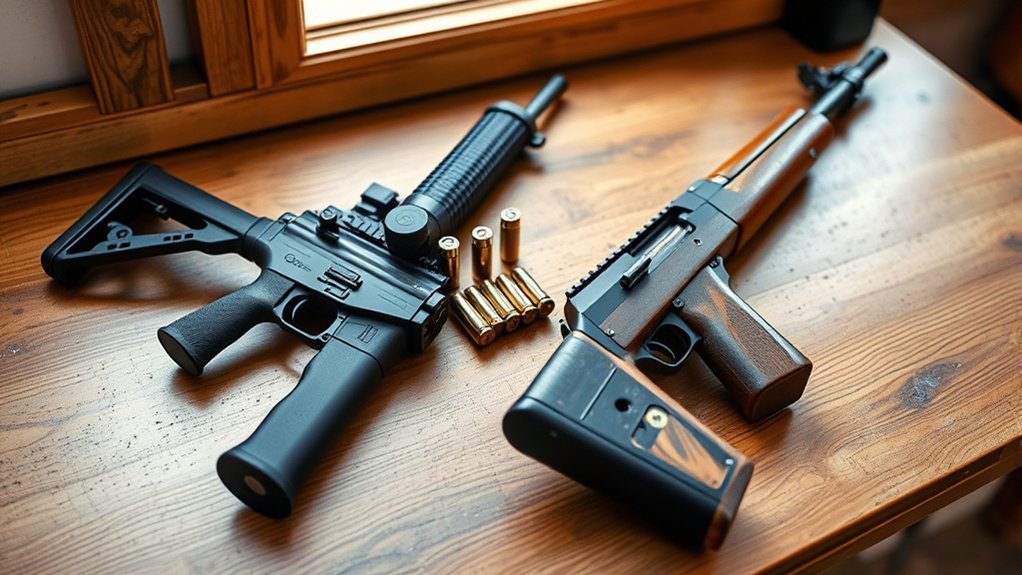
The difference between an assault rifle and a battle rifle is mainly the ammunition they use and the way they were designed for military service. Their firing modes, recoil, weight, and effective ranges also differ. However, these categories are not defined by size or appearance alone, and some modern designs blur the line between them.
Quick Answer
An assault rifle is a selective-fire military rifle that uses an intermediate-power cartridge, such as 5.56×45mm NATO or 7.62×39mm. A battle rifle generally uses a full-power cartridge, such as 7.62×51mm NATO, and may be semiautomatic or selective-fire. Battle rifles often have greater recoil and weight, but exact performance depends on the model.
What’s the Difference: Assault Rifle vs. Battle Rifle?
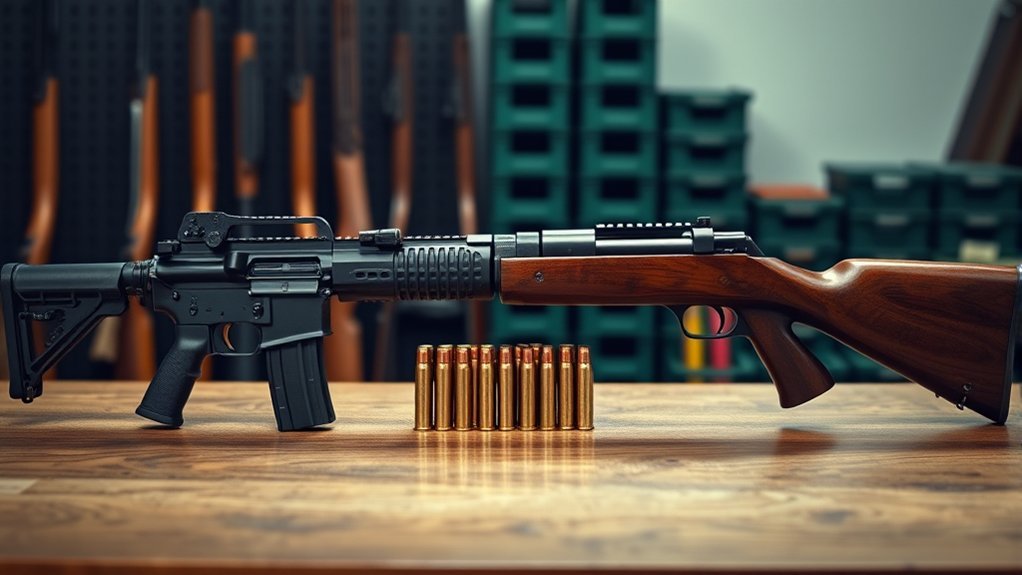
The most important distinction is cartridge power. Assault rifles use intermediate cartridges, while battle rifles use full-power rifle ammunition.
An intermediate cartridge falls between a typical pistol cartridge and a traditional full-power rifle cartridge in energy. This distinction affects rifle design, weight, recoil, and ammunition size.
A second difference involves the firing mechanism. An assault rifle, in the strict military sense, must have selective fire. This means it can switch between semiautomatic fire and an automatic or burst setting. A battle rifle may be semiautomatic only or capable of selective fire.
The AK-47 and M16 are established assault rifle examples. The AK-47 uses 7.62×39mm ammunition, while military M16 variants use 5.56mm ammunition. Both are intermediate-power cartridges.
The FN FAL and M14 are classic battle rifles associated with the full-power 7.62×51mm NATO cartridge.
| Feature | Assault Rifle | Battle Rifle |
|---|---|---|
| Ammunition | Intermediate-power rifle cartridge | Full-power rifle cartridge |
| Common cartridge examples | 5.56×45mm NATO; 7.62×39mm | 7.62×51mm NATO; .30-06 Springfield |
| Firing mode | Selective-fire | Semiautomatic or selective-fire |
| Typical design emphasis | Manageable recoil and lighter ammunition | Full-power cartridge performance |
| Weight | Often lighter, depending on configuration | Often heavier, but ranges overlap |
| Well-known examples | AK-47, M16, M4A1 | FN FAL, M14, G3 |
The categories describe broad design characteristics, not fixed performance guarantees. For example, the U.S. Army’s M4/M4A1 specifications identify the M4 family as 5.56mm carbines and list a range of 500 meters.
Historical Evolution: Assault vs. Battle Rifles
The development of assault rifles reflects a major change in military small-arms design during the twentieth century. Earlier infantry rifles commonly used full-power ammunition, while later designs increasingly favored lighter cartridges.
During World War I, bolt-action service rifles were widespread. Semiautomatic and early automatic designs existed, but they were less common.
The Royal Armouries’ World War I firearms collection documents several early rifle designs, including the Fedorov automatic rifle, showing that the development of automatic shoulder weapons began before World War II.
During World War II, the American M1 Garand and Soviet SVT-40 represented an important stage in semiautomatic service-rifle development. They used full-power rifle cartridges rather than the intermediate ammunition associated with later assault rifles.
A major turning point came with Germany’s Sturmgewehr 44 (StG 44), introduced during World War II. It used the 7.92×33mm Kurz intermediate cartridge and allowed both semiautomatic and automatic fire.
The StG 44 is widely recognized as the first successful assault rifle to establish the modern concept. Historical U.S. military intelligence reports from 1944 describe the weapon and its selective-fire mechanism.
After the war, the Soviet AK-47 became one of the best-known examples of the intermediate-cartridge concept. It combined a selective-fire action with the 7.62×39mm cartridge.
The United States followed a different path. The M14, adopted in 1957, retained the full-power 7.62×51mm NATO cartridge. The lighter 5.56mm M16 subsequently replaced it as the standard infantry rifle.
The U.S. Army’s historical review of the M14-to-M16 transition explains how ammunition weight, military requirements, and institutional decisions influenced that change.
Battle rifles did not disappear. Designs such as the FN FAL, M14, and G3 continued to serve military forces, and some remained useful in specialized roles.
Tactical Applications: Range and Use Cases
Assault rifles and battle rifles have historically served different infantry requirements. Assault rifles emphasize intermediate-power ammunition and manageable weapon weight. Battle rifles retain the characteristics of full-power rifle cartridges.
The original distinction helped military planners balance ammunition supply, weapon dimensions, and performance across different environments.
How Far Can Each Rifle Type Be Effective?
Assault rifles are often associated with effective ranges of roughly 300–500 meters. Traditional battle rifles are frequently associated with 500–800 meters, especially in discussions of longer-range military roles.
However, these figures are not universal limits. Published effective range depends on the rifle model, ammunition, sighting equipment, target criteria, and how the military defines effective range.
For example, the U.S. Army lists a 500-meter range for the M4 family. Its published M14 Enhanced Battle Rifle specifications list a range of 800 meters for that particular configuration.
These are specifications for specific systems. They should not be treated as proof that every battle rifle is more accurate than every assault rifle.
What Were Their Different Military Roles?
The two categories reflect different historical military priorities:
- Mobility: Many intermediate-cartridge rifles weigh less than comparable full-power service rifles.
- Ammunition load: Smaller cartridges generally weigh less, affecting how much ammunition can be transported.
- Recoil: Intermediate cartridges usually produce less recoil than full-power cartridges in otherwise comparable firearms.
- Distance: Full-power cartridges have historically been favored where retained energy at longer distances mattered.
- Specialized service: Some full-power rifles remained in designated marksman roles after assault rifles became standard infantry weapons.
These distinctions explain military development and procurement choices. They do not establish one category as universally superior.
Power and Precision of Assault and Battle Rifles
Battle rifles generally use cartridges with greater recoil and energy than intermediate-cartridge assault rifles. However, cartridge power and rifle precision are not the same thing.
The 7.62×51mm NATO cartridge, commonly associated with the FN FAL and M14, represents the full-power category. The 5.56×45mm NATO and 7.62×39mm cartridges represent common intermediate-power designs.
Does a Battle Rifle Always Have Greater Accuracy?
No. A battle rifle is not automatically more accurate simply because it fires a larger cartridge.
Accuracy depends on the complete rifle system, its condition, ammunition consistency, and the standards used for measurement. A well-made intermediate-cartridge rifle can be more precise than a poorly maintained full-power rifle.
Also, effective range and mechanical accuracy describe different things. Mechanical accuracy concerns shot grouping under controlled conditions. Effective range is an operational measure that depends on several factors.
Does a Larger Cartridge Always Perform Better?
No. Larger cartridges often carry more energy, but bullet design, ammunition construction, and the particular performance measure can change the comparison.
Claims about universal stopping power or penetration are especially misleading. A cartridge’s diameter alone cannot establish its effectiveness in every situation.
This is why it is better to compare documented cartridge specifications and individual rifle designs rather than assume that every battle rifle has superior precision or performance.
Design Features and Weight Considerations
Assault rifles are often lighter and more compact than traditional battle rifles. Their intermediate cartridges generally need less space and produce less recoil than full-power rifle ammunition.
Battle rifles were commonly built around larger cartridges and, in many historical examples, longer and heavier components. However, modern materials and compact configurations create significant overlap between categories.
Several design characteristics affect the comparison:
- Receiver and action: Rifle mechanisms must accommodate the cartridges they use.
- Stock design: Fixed, folding, and adjustable stocks affect a rifle’s overall dimensions.
- Modularity: Both categories include models with interchangeable components and accessory mounting systems.
- Recoil: Cartridge characteristics and overall firearm weight both influence felt recoil.
- Ammunition size: Smaller cartridges generally reduce the weight of an equivalent ammunition supply.
How Much Do Assault Rifles and Battle Rifles Weigh?
There is no universal weight range that separates assault rifles from battle rifles. Individual models, variants, and accessories can change the total considerably.
For example, the U.S. Army lists the M4A1 at 7.62 pounds with a sling and loaded magazine. Armament Research Services lists the standard FN FAL 50.00 at approximately 9.37 pounds unloaded.
These examples use different load conditions, so they are not a direct weight comparison. They demonstrate why published specifications must identify the configuration.
| Rifle Type | Weight Range |
|---|---|
| Assault Rifles | Varies; M4A1 example: 7.62 lb with sling and loaded magazine |
| Battle Rifles | Varies; FN FAL 50.00 example: approximately 9.37 lb unloaded |
The Armament Research Services FN FAL field guide documents several variants with different weights. Some fall below 10 pounds, so the claim that all battle rifles weigh more than 10 pounds is incorrect.
Weight alone also cannot identify a firearm’s category. Its cartridge and operating characteristics are more useful indicators.
Choosing the Right Rifle for Your Needs?
Understanding rifle classifications starts with identifying their cartridge, firing mechanism, and original design purpose. Appearance, model names, and marketing labels are not enough.
For historical research or technical comparisons, these characteristics help distinguish a military assault rifle from a traditional battle rifle or a civilian semiautomatic rifle.
Purpose and Functionality
Assault rifles and battle rifles are both shoulder-fired rifles, but their defining characteristics differ.
- An assault rifle uses an intermediate-power cartridge and has selective-fire capability.
- A battle rifle uses a full-power rifle cartridge and may be semiautomatic or selective-fire.
- The AK-47 and M16 are examples of military assault rifles.
- The FN FAL and M14 are established examples of battle rifles.
- The civilian AR-15 is normally semiautomatic, so it does not meet the strict military definition of an assault rifle.
Semiautomatic operation means one shot is fired per trigger pull, with the firearm automatically cycling the next cartridge. Selective fire means the mechanism provides an additional firing mode.
It is also important not to confuse the technical term “assault rifle” with the legal or political term “assault weapon.” They are used in different contexts and do not always describe the same firearms.
Weight and Maneuverability
Weight and overall dimensions can help explain a rifle’s design history, but they do not determine its classification.
For example, the M4 is a compact member of the M16 family, whereas the traditional FN FAL has a longer service-rifle profile. Other variants can differ substantially.
Modern full-power rifles may use lighter materials, adjustable stocks, and modular construction. Some intermediate-cartridge rifles can also become relatively heavy when fitted with additional equipment.
For accurate comparisons, use documented specifications for the exact variant rather than relying on a category-wide weight estimate.
Note: Firearm classifications do not establish whether a particular model is legal to own or use. Laws differ by jurisdiction. For possession, handling, storage, or legal questions, consult the relevant authority and a qualified firearms professional.
Frequently Asked Questions
Is an AR-15 Considered a Battle Rifle?
No. A typical civilian AR-15 is a semiautomatic rifle that uses an intermediate-power cartridge, commonly .223 Remington or 5.56mm NATO. It is not generally classified as a battle rifle. Because it lacks selective-fire capability, it also differs from an assault rifle under the strict military definition.
Is the AK-47 a Battle Rifle?
No. The original military AK-47 is an assault rifle because it uses the intermediate-power 7.62×39mm cartridge and has selective-fire capability. Although its cartridge is larger in diameter than the M16’s 5.56mm cartridge, that does not make it a full-power battle rifle.
Is the AR-10 a Battle Rifle?
The AR-10 is generally associated with the battle-rifle category because the original design uses the full-power 7.62×51mm NATO cartridge. However, modern civilian AR-10-pattern rifles are commonly semiautomatic only. The battle-rifle label describes their broad design family, not a guarantee of automatic-fire capability.
Is a Battle Rifle an Assault Rifle?
No. The categories are distinct under their usual technical definitions. Assault rifles use intermediate-power cartridges and selective-fire mechanisms. Battle rifles use full-power cartridges and may have either semiautomatic or selective-fire operation. Their designs can look similar, but appearance does not determine classification.
Can a Semiautomatic Rifle Be a Battle Rifle?
Yes. Battle rifles do not necessarily require automatic-fire capability. The semiautomatic M1 Garand is a well-known historical example. The National Park Service also documents how the M14 National Match model differs from the standard military M14 through the removal of automatic-fire capability.
The National Park Service’s Springfield Armory collection provides historical information about these U.S. service-rifle variants.
Conclusion
The main difference between assault rifles and battle rifles is their ammunition and design classification. Assault rifles use intermediate cartridges and selective-fire mechanisms, while battle rifles use full-power rifle cartridges and may be semiautomatic or selective-fire.
Weight, recoil, range, and precision can vary substantially between individual models. Understanding these distinctions makes historical and technical firearm comparisons more accurate.
Sources
- U.S. Army PEO Soldier: M4/M4A1 Carbine: Official M4 family specifications, weight, caliber, and published range.
- Armament Research Services: FN Herstal FAL Rifle Field Guide: FN FAL history, cartridge, models, and unloaded weights.
- Royal Armouries: Arms of the First World War: Historical rifle development and early automatic rifle designs.
- American Rifleman: What American GIs Thought of the StG 44: Historical U.S. military reports describing the German rifle.
- U.S. Army Military Review: Speed versus Quality: Historical development and transition from the M14 to the M16.
- U.S. Army PEO Soldier Equipment Portfolio: Published specifications for the M14 Enhanced Battle Rifle.
- National Park Service: Springfield Armory National Matches: Historical M1 and M14 variants and firing-mode distinctions.

