As an Amazon Associate I earn from qualifying purchases.
Yes—stroller fans can improve airflow and comfort, but a fan by itself does not necessarily lower the air temperature inside a stroller. In a 2023 field study conducted across 16 hot summer days, a battery-powered fan used alone did not significantly reduce in-stroller air temperature compared with a closed-stroller control, although it produced a small improvement in a heat-stress measure. The safest approach is to use a securely mounted, finger-guarded fan as one part of a broader heat-safety plan that includes shade, light clothing, cooler outing times, age-appropriate feeding or hydration, and frequent checks for heat illness. See the stroller-cooling study on PubMed.
Last updated: September 11, 2026.
Quick Answer
Stroller fans work best as airflow and comfort tools. They can move stagnant air around the stroller, but a fan alone should not be treated as proof that the stroller is cooler or that hot conditions are safe. Choose a fan with a protective grille and secure mount, keep it outside your baby’s reach, and combine it with shade, light clothing, cooler outing times, and regular heat-safety checks.
Key Takeaways
- A stroller fan improves air movement and may improve comfort, but fan-only use did not significantly lower stroller air temperature in one field study.
- Dry blankets or cloths draped over a stroller can trap heat; a fan does not automatically make a covered stroller safe.
- Choose a fan with a finger-resistant grille, secure mount, enclosed battery compartment, and no loose cords within reach.
- Use shade, light clothing, cooler outing times, breaks in cooler places, and age-appropriate feeding or hydration along with the fan.
- Extreme heat changes the decision: do not rely on a stronger fan to make an otherwise unsafe outing acceptable.
Understanding Stroller Fans
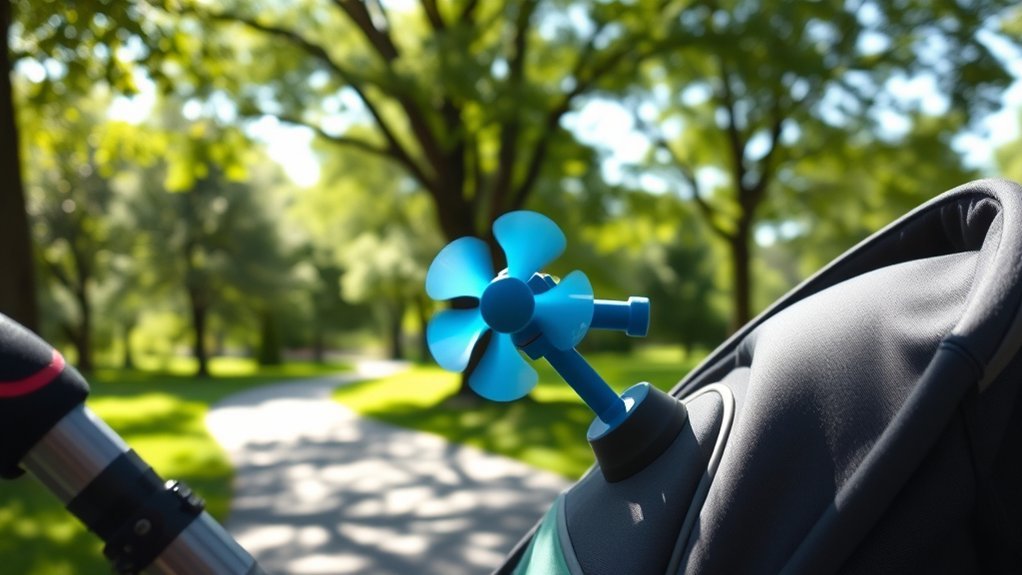
Stroller fans are small portable fans designed to increase air movement around a stroller. They are commonly used during summer walks, park visits, travel days, outdoor events, and errands when the air feels warm and still.
The important distinction is that moving air is not the same as removing heat. A fan can reduce the stuffy feeling around a stroller and may support evaporation from skin or damp surfaces, but it does not refrigerate the air like an air conditioner.
A 2023 University of Sydney field study tested eight stroller configurations across 16 hot summer days. The average outdoor air temperature during testing was 33.3°C, with substantial variation between days. A fan used by itself did not significantly reduce in-stroller air temperature compared with the closed-stroller control, although the researchers measured a small 0.6°C reduction in wet-bulb globe temperature, or WBGT, a measure of environmental heat stress.
| Tested Setup | What the Study Found |
|---|---|
| Fan only | No significant reduction in in-stroller air temperature; WBGT was about 0.6°C lower than control |
| Dry muslin cover | End-trial stroller air temperature was 2.6°C higher than control |
| Dry flannelette cover | End-trial stroller air temperature was 3.7°C higher than control |
| Fully moistened muslin plus fan | End-trial air temperature was 4.7°C lower and WBGT 1.4°C lower than control under the tested conditions |
These results are useful, but they do not establish one universally safe stroller setup or temperature. The study tested specific materials and conditions, and infants have limited ability to manage heat. Treat the fan as an accessory rather than a substitute for getting out of dangerous heat.
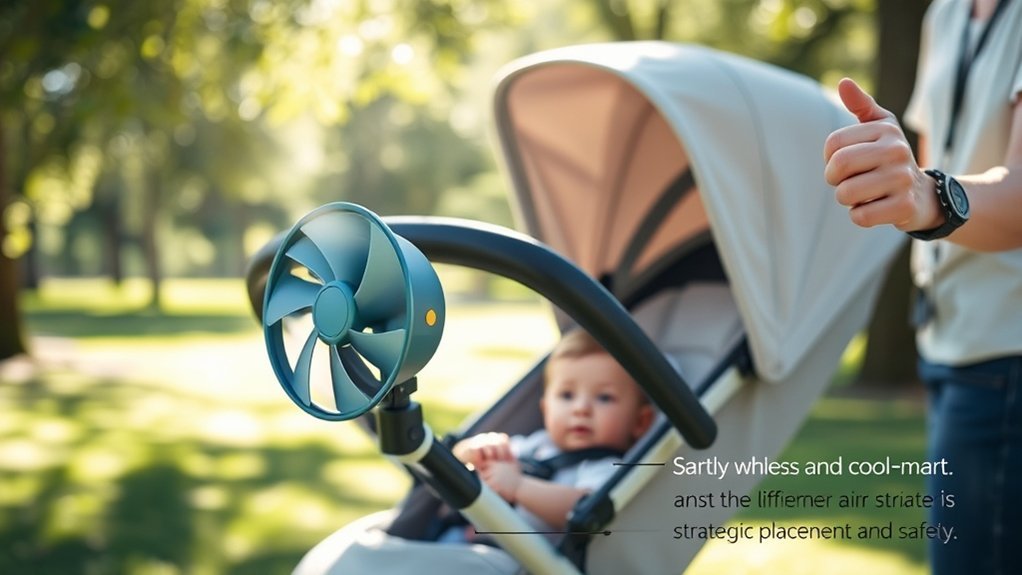
You’ll find several common styles, including clip-on fans, bendable-leg fans, bladeless fans, foam-bladed fans, misting fans, and handheld clamp fans. The right design depends on whether it can be mounted securely, kept outside your baby’s reach, and aimed without interfering with the stroller.
Safety features should come before maximum airflow or battery capacity. Look for a tight protective grille, a stable mounting system, smooth edges, secure controls, and a battery compartment that cannot easily open during use.
Proper placement matters too. Position the fan so it moves air through the stroller area without sitting close to your baby’s face or fingers. It should not interfere with the harness, brakes, folding mechanism, canopy hinges, or your grip on the stroller.
Benefits of Using Stroller Fans
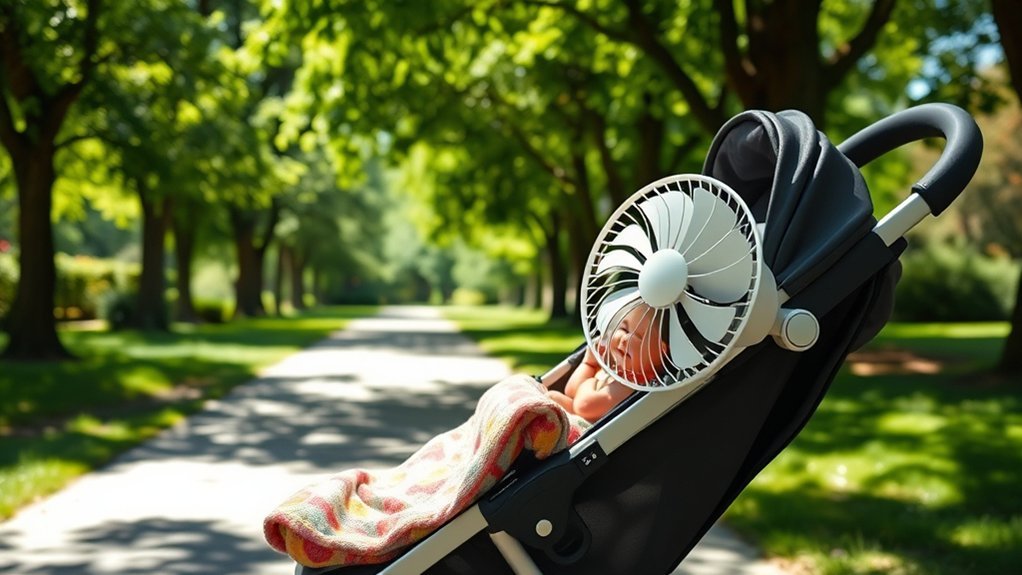
The clearest benefit of a stroller fan is better air movement. When air around a stroller is still, a small portable fan can make the seating area feel less stagnant and can move warm air through an open, ventilated stroller space.
That comfort benefit should not be confused with guaranteed cooling. In the 2023 stroller study, fan-only use did not lower the measured air temperature inside the stroller. The fan therefore works best as part of a larger strategy rather than as the main protection against heat.
A rechargeable stroller fan can also be convenient during travel and errands because you can reposition it as the stroller angle, shade, and seating position change. Adjustable speed and tilt controls help you create gentle circulation without placing the fan close to your child.
For caregivers, portability is another practical advantage. Some fans can move from a stroller frame to a picnic table or other supervised setting. Wherever you use one, the guard, battery, cord, and mounting point should remain inaccessible to the child.
Warning: A stroller fan does not make extreme heat safe. The American Academy of Pediatrics says a heat index of 90°F or higher can be dangerous, especially for babies and young children. If your baby becomes unusually sleepy, difficult to wake, breathes faster or deeper than normal, vomits, develops a fever, stops urinating for many hours, or otherwise seems seriously unwell after heat exposure, move to a cooler environment and seek medical help. Read the AAP heat-safety guidance.
How Stroller Fans Work
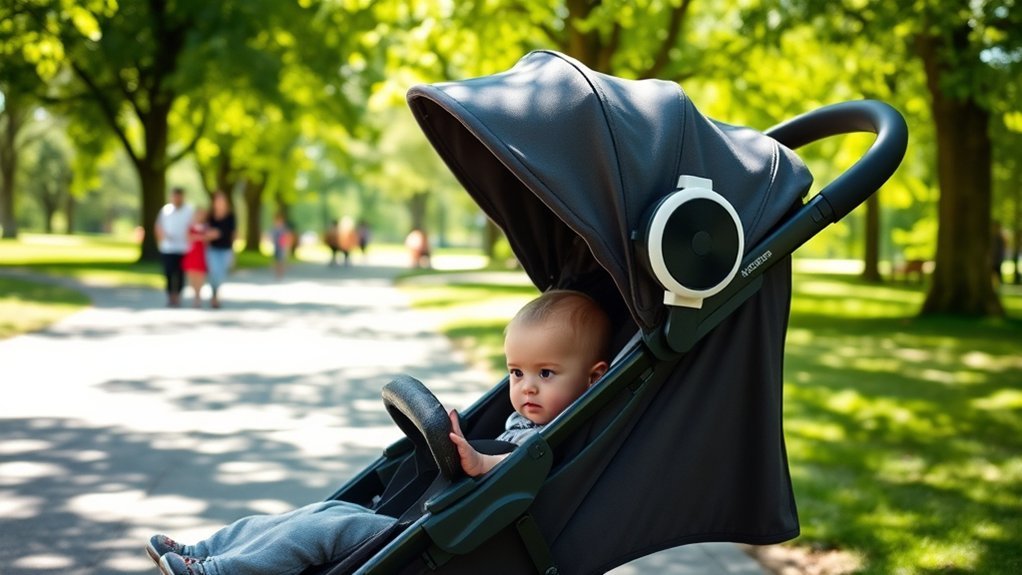
Stroller fans work mainly by circulating air. Moving air can support convective and evaporative heat transfer, but the fan itself does not remove heat from the air. If the surrounding air is hot, the fan is still moving hot air.
This distinction matters for babies because infants do not regulate heat exactly like adults. The stroller seat also blocks airflow across part of the body, which limits how much of the baby’s skin is exposed to moving air.
Most stroller fans use a small electric motor powered by rechargeable or replaceable batteries. Many models include adjustable speed settings, flexible necks, rotating heads, or oscillation so you can control the direction and strength of airflow.
For routine warm-weather use, aim for circulation across the stroller area rather than placing a strong stream of air close to your baby’s face. In extreme heat, changing the outing time or moving to an air-conditioned space is more important than turning the fan to a higher speed.
What Does Research Show About Stroller Fan Cooling?
The most useful stroller-specific evidence comes from the 2023 field study published in Ergonomics. Researchers compared eight stroller configurations during hot, moderately humid weather. Fan-only use resulted in essentially the same in-stroller air temperature as the closed-stroller control.
The same study found that dry fabric covers made conditions hotter. A dry muslin covering raised end-trial in-stroller air temperature by 2.6°C relative to the control, while a flannelette covering raised it by 3.7°C. Adding a fan to dry fabric reduced some of that heating but did not outperform the uncovered control.
The strongest cooling in that experiment came from a fully moistened light-colored muslin combined with a clip-on fan, which reduced end-trial air temperature by 4.7°C and WBGT by 1.4°C versus control. That result demonstrates the importance of evaporation, but it should not be interpreted as a universal recommendation to cover a baby’s stroller. Weather, material, airflow, moisture, stroller shape, and supervision all matter.
Types of Stroller Fans
Different stroller-fan designs solve different mounting and portability problems. The safest choice is the one that stays stable on your stroller and keeps blades, cords, batteries, and small parts outside your child’s reach.
| Type of Fan | Main Trade-Off |
|---|---|
| Clip-On Fans | Quick to move, but clamp security depends on the stroller bar |
| Bendable Leg Fans | Wrap around frame tubes but still need a stability check |
| Misting Fans | Add evaporative moisture but require more cleaning and careful use |
| Handheld Clamp Fans | Portable and versatile but may have less stroller-specific guarding |
| Foam Blade Fans | Softer blades can reduce contact injury but do not remove the need for supervision |
Clip-on fans attach quickly and can be moved between mounting points. Test the clamp by gently pulling and twisting it before putting your child in the stroller.
Bendable leg fans wrap around stroller bars and may work well where a standard clamp cannot grip. Check the legs regularly because repeated bending and stroller vibration can change how securely they hold.
Misting fans add moisture as well as airflow. They may feel more comfortable in some dry conditions, but stroller-specific evidence for individual misting products is limited. Avoid soaking the child, harness, or stroller and follow the manufacturer’s cleaning directions.
Handheld clamp fans can be useful beyond the stroller. Foam-blade fans may reduce the severity of blade contact, but the fan should still remain outside the child’s reach.
Which Stroller Fan Safety Features Matter Most?
Safety is more important than maximum airflow. A good stroller fan should improve circulation without adding a finger, falling-object, cord, battery, or interference hazard.
The protective grille deserves particular attention. In March 2025, the U.S. Consumer Product Safety Commission recalled about 33,600 Nuby stroller fans because children could reach the blades through the housing. CPSC reported seven incidents involving finger access and six laceration injuries. See the CPSC recall notice.
That recall is a useful reminder that a product being marketed as a “stroller fan” does not automatically make its guard child-safe. Inspect the grille from the front, back, and sides and keep the entire unit outside your child’s normal reach.
Also check for rattling, cracked plastic, loose flexible legs, damaged charging ports, swollen or unusually hot battery housings, and weak clamps. Stop using a fan that appears damaged.
Safety Features to Look For
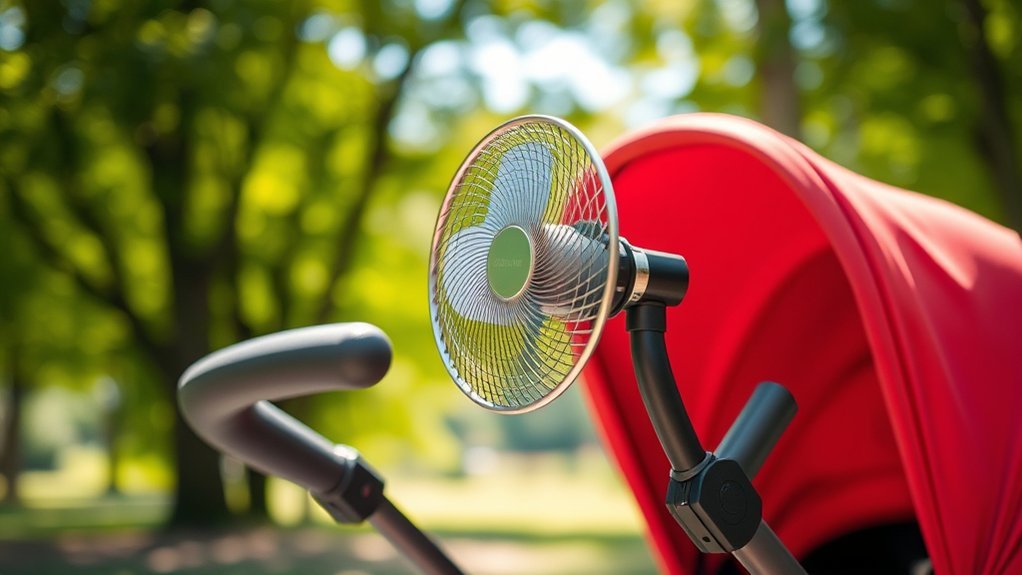
Choose a stroller fan by its guard and mounting security first, then compare airflow, battery life, noise, and convenience. A strong breeze is not useful if a child can reach the blades or the fan can fall into the seat.
Prioritize these features for better fan blade safety and toddler protection:
- A protective grille with openings too small for little fingers to reach the blades.
- A stable clamp or flexible mount that stays fixed when lightly pulled or twisted.
- Smooth edges and a housing without cracked or detachable pieces.
- Adjustable tilt so airflow can move across the stroller without placing the fan beside the child’s face.
- Firm controls that are difficult for a child to activate accidentally.
- No loose wires, dangling charging cables, sharp edges, or detachable small parts within reach.
- A battery compartment that stays securely closed.
- A lightweight design that does not pull down the stroller canopy or destabilize its mounting point.
- A design that does not interfere with the harness, brakes, folding joints, canopy mechanism, or caregiver handle.
Before every walk, tug the fan lightly after mounting it. If it slips, twists, or feels loose, move it to a stronger attachment point. Recheck it after folding the stroller, climbing curbs, traveling over rough pavement, or changing the seat position.
Note: Avoid attaching a fan where your baby can kick it, pull it, chew it, grab its charging cable, or reach through the grille. A protective guard reduces risk but does not replace safe placement and supervision.
Ideal Situations for Using Stroller Fans
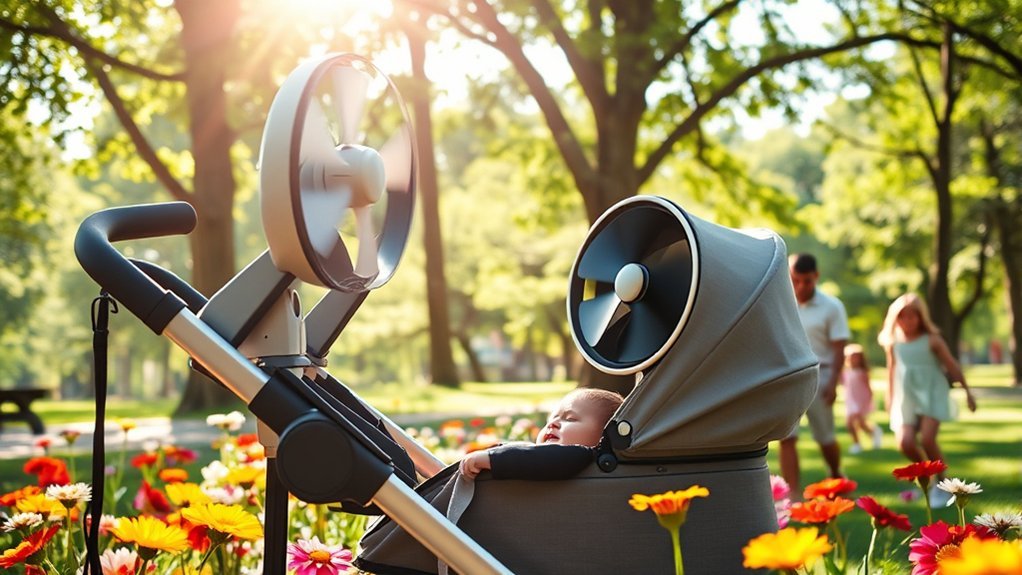
Stroller fans are most useful when outdoor conditions are still reasonable for your baby and you simply want more airflow. Think of the fan as an extra comfort layer, not a reason to extend an outing through dangerous heat.
Useful situations can include shaded walks, park visits, travel days, outdoor queues, and brief errands when natural airflow is limited.
| Situation | Realistic Benefit |
|---|---|
| Shaded Beach Breaks | Adds airflow while the stroller remains out of direct sun |
| City Strolls | Improves air movement when buildings block natural breeze |
| Supervised Stroller Naps | Provides gentle airflow without enclosing the stroller |
| Travel Days | Adds portable airflow between cooling breaks |
| Outdoor Queues | Moves still air while you seek shade and monitor your child |
For beach outings, keep the stroller in shade when possible. Sand, salt, and moisture can also shorten a fan’s life, so inspect and clean it afterward according to the manufacturer’s directions.
For city strolls, reflected heat from pavement can make conditions harder even when the air temperature seems manageable. Earlier-morning and later-day outings can reduce heat exposure.
For naptime, keep the stroller open enough for ventilation and check your baby regularly. Do not drape a dry blanket over the stroller opening simply because a fan is running underneath it.
For long trips, plan cooling breaks rather than relying on battery runtime alone. A fully charged fan is useful, but access to shade or air conditioning matters more.
Which Stroller Fan Type Fits Your Situation?
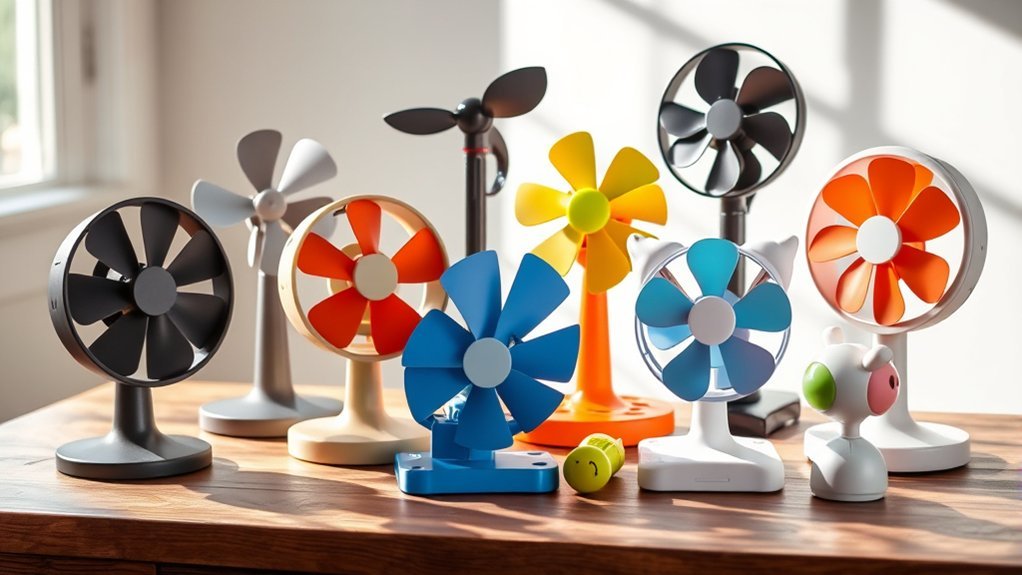
Choose the mounting style around your actual stroller rather than assuming one design is best for every family.
- Compact travel stroller: A small clip-on model may be easiest to pack, provided the clamp grips a rigid frame point securely.
- Jogging or all-terrain stroller: A bendable-leg model may wrap more securely around a thicker frame tube, but test it for movement before every outing.
- Older baby or toddler: Prioritize grille spacing and distance from the seat because a mobile child can reach farther than a newborn.
- Long travel day: Battery runtime and USB charging convenience become more important after guard and mount safety are satisfied.
- Dusty, sandy, or snack-heavy use: Choose a fan whose grille and exterior can be cleaned without complicated disassembly.
Bladeless fans can reduce access to a traditional spinning blade, but “bladeless” does not automatically mean child-proof. Check the air openings, stability, battery enclosure, size, and mounting system just as carefully as you would with a conventional fan.
If you want model-by-model comparisons after deciding which design fits your stroller, see GoMyReview’s portable stroller fan picks for babies.
Tips for Choosing the Right Stroller Fan
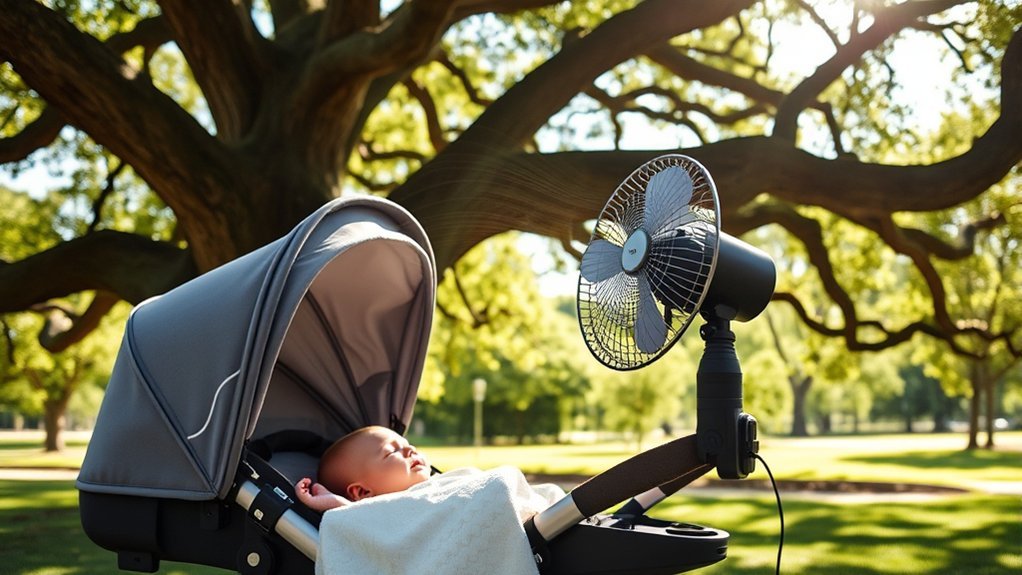
Choose a stroller fan in this order: guard safety, mounting security, battery enclosure, airflow control, runtime, noise, and cleaning. That order keeps convenience from outranking the hazards that matter most.
Start with the grille. Check whether little fingers could reach a blade from the front, back, or sides. Then attach the fan to your stroller and test whether the clamp or flexible legs can rotate, slide, or loosen with moderate hand pressure.
Next, think about battery life. Listed runtime varies widely by model and often changes with fan speed, oscillation, lights, or misting. Treat manufacturer runtime as a planning estimate rather than a safety feature.
Look for adjustable speed settings and a head that tilts or rotates. These controls let you spread airflow through the stroller area without mounting the fan immediately beside the child.
Consider the fan’s noise level and cleaning design. Rattling or new vibration can signal a loose or damaged part. A removable or accessible outer grille can also make regular cleaning easier.
Pro Tip: Test the complete setup at home. Attach the fan, put the stroller through its normal recline and canopy positions, fold and unfold it if appropriate, and confirm that your baby cannot reach the fan from the seat.
How to Use a Stroller Fan Safely
Safe installation matters as much as the fan you buy. A well-guarded fan can still become a falling-object or entanglement hazard if the mount or charging cable is poorly positioned.
Follow these steps before and during each outing:
- Charge the fan before leaving so a charging cable does not need to run through the stroller seating area.
- Attach it to a firm stroller frame point rather than loose fabric.
- Keep the fan, grille, battery area, and any cord outside your baby’s reach.
- Aim for airflow through or across the stroller area instead of mounting the fan close to the face.
- Start with a gentle setting and increase airflow only as needed for comfort.
- Check the mount after bumps, curbs, folding, transport, or stroller adjustments.
- Stop using the fan if it becomes unusually hot, smells abnormal, rattles, cracks, or develops damaged wiring or a swollen battery housing.
- Use shade, light clothing, age-appropriate feeding or hydration, and regular cooling breaks along with the fan.
Do not cover the stroller opening with a dry blanket or cloth in an attempt to create shade. In the stroller-cooling study, dry muslin and flannelette covers increased in-stroller temperatures, and adding a fan did not make the dry-cover configurations better than the control setup. Use the stroller’s own canopy or an airflow-conscious accessory intended for the stroller instead.
What Signs Suggest Your Baby May Be Too Hot?
A stroller fan can make the stroller feel breezier, so do not use the presence of airflow as your test for whether your baby is handling the heat safely. Check your child directly and take heat exposure seriously.
Possible warning signs after heat exposure include:
- Unusual sleepiness, extreme tiredness, or difficulty waking.
- Breathing faster or deeper than normal.
- Nausea or vomiting.
- Fever or feeling unusually hot.
- Going many hours without urinating.
- Marked behavior changes, unusual fussiness, or appearing seriously unwell.
If your baby appears overheated, move to a cooler or air-conditioned environment, remove unnecessary layers, and offer feeding or fluids appropriate for age. For young infants, especially those under 6 months, breast milk or formula is generally used rather than plain water unless a healthcare professional advises otherwise. Contact your pediatrician if symptoms are concerning or do not improve quickly in a cool environment. If your child becomes unresponsive or extremely difficult to wake, seek emergency medical care.
Maintenance and Care for Stroller Fans
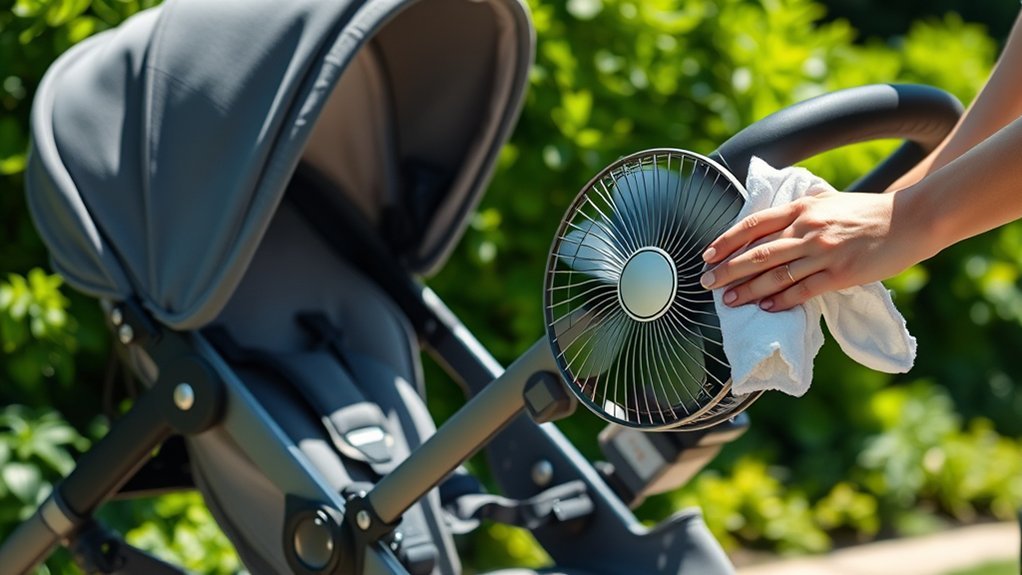
Maintaining your stroller fan helps with performance, hygiene, and safety. Dust, lint, crumbs, hair, sand, and outdoor debris can build up around the grille, blades, motor area, clamp, and charging port.
Use these maintenance steps:
- Follow the manufacturer’s instructions before removing covers or disassembling any part.
- Turn the fan off and disconnect charging cables before cleaning.
- Clean removable parts only when the manufacturer says they are designed to be removed.
- Wipe the outer grille, clamp, housing, and flexible legs with an appropriate soft cloth.
- Follow the manufacturer’s charging and battery-storage instructions.
- Inspect clamps and flexible mounts for cracks, weakening, or loss of grip.
- Check for loose screws, damaged wires, unusual heat, swelling, vibration, or new noise.
- Store the fan in a cool, dry place when it is not being used.
For misting fans, empty and dry the water reservoir according to the product instructions after use. If a model uses replaceable batteries, follow its instructions for long-term storage and battery removal.
Evidence-Based Recommendations and Insights
The available evidence points to a simple rule: airflow can help comfort, but environmental heat still determines whether the outing is appropriate. The stroller study did not find a meaningful air-temperature reduction from fan-only use, while dry stroller coverings clearly worsened the thermal environment.
The American Academy of Pediatrics advises parents to take extra precautions during extreme heat, including keeping children cool and hydrated, choosing lightweight clothing, taking indoor cooling breaks, and recognizing that a heat index of 90°F or above can be dangerous, particularly for babies and young children.
Product safety matters independently of heat safety. The 2025 CPSC stroller-fan recall shows why parents should inspect the protective grille and keep the fan out of children’s reach instead of assuming every product sold for strollers has equally safe guarding.
What Do Pediatric Heat-Safety Guidelines Say About Fans?
The American Academy of Pediatrics says fans may help with cooling when air conditioning is unavailable, but they should be kept at a safe distance from children. Its extreme-heat guidance also cautions against directing hot fan airflow at a person when room temperatures are above 90°F because dry blowing air can increase dehydration risk.
For a stroller, the practical takeaway is not to search for a stronger fan when conditions become extreme. Instead:
- Reduce direct sun exposure and seek shade.
- Use light, loose-fitting clothing appropriate for the conditions.
- Take regular breaks in an air-conditioned or otherwise cooler space.
- Give infants breast milk, formula, or other fluids appropriate for their age and medical guidance.
- Watch for unusual sleepiness, vomiting, fever, faster breathing, reduced urination, and other heat-illness symptoms.
- Do not treat airflow as proof that the stroller environment is safe.
What Is the Safest Way to Use a Stroller Fan?
Mount the fan on a rigid stroller point where it cannot fall into the seat or interfere with the harness, brakes, canopy mechanism, folding joints, or caregiver handle. Check the attachment before each use and again after rough surfaces or stroller adjustments.
Choose a guard that prevents small fingers from reaching the blades, keep charging cables and battery compartments inaccessible, and stop using damaged equipment. A fan with soft or enclosed blades still requires supervision.
Finally, keep the stroller ventilated. Do not use a dry blanket or cloth to enclose the stroller opening simply because a fan is running inside. If outdoor heat is becoming difficult to manage, move the child to a cooler environment instead of relying on the fan.
Related Guides
Frequently Asked Questions
Do stroller fans actually cool babies?
Stroller fans can improve airflow and comfort, but fan-only use did not significantly lower in-stroller air temperature in a 2023 field study. The fan produced a small improvement in WBGT, a heat-stress measure. Use a fan as part of a heat-safety plan rather than as proof that the stroller itself is cooler.
Can a stroller fan prevent a baby from overheating?
No stroller fan can guarantee prevention of overheating. A fan may improve air movement, but shade, avoiding dangerous heat, light clothing, cooling breaks, age-appropriate feeding or hydration, and monitoring your baby remain more important.
Are stroller fans suitable for newborns?
A stroller fan can be used around a newborn when the manufacturer permits the intended use and the fan is mounted securely outside the baby’s reach. Prioritize a tight protective grille, stable attachment, intact battery housing, gentle airflow, and frequent supervision.
Where should I place a stroller fan?
Mount the fan on a rigid stroller point where it cannot fall or be reached by your baby. It should not interfere with the harness, brakes, canopy, folding mechanism, or your grip on the stroller. Test the mount by gently pulling and twisting it before the outing.
Should a stroller fan blow directly on a baby?
For ordinary warm-weather use, position the fan far enough away to circulate air through the stroller rather than placing a strong stream immediately beside the baby’s face. In extreme heat, moving to a cooler environment is more important than increasing direct airflow.
Is it safe to cover a stroller with a blanket if a fan is running?
Do not assume a fan makes a dry stroller cover safe. In a 2023 stroller study, dry muslin and flannelette coverings increased in-stroller air temperature, and adding a fan to dry covers did not outperform the uncovered control setup. Use the stroller’s canopy or an appropriate ventilated shade solution instead.
What temperature is too hot to rely on a stroller fan?
There is no single stroller-fan temperature that guarantees safety because humidity, sunlight, airflow, clothing, age, health, and exposure time all matter. The American Academy of Pediatrics warns that a heat index of 90°F or above can be dangerous, especially for babies and young children. In extreme heat, shorten or skip the outing rather than relying on a fan.
Are misting stroller fans safe?
Misting adds moisture that can increase evaporative cooling under some conditions, but individual stroller-fan designs vary. Follow the manufacturer’s instructions, avoid soaking your baby or the harness, clean the water system carefully, and never use misting as a reason to stay outside during dangerous heat.
Conclusion
A stroller fan can be useful, but its main job is moving air rather than making hot weather safe. The best stroller-specific evidence found that a fan alone did not significantly reduce air temperature inside the stroller, even though it produced a small improvement in a heat-stress measure.
Use a fan only as one layer of protection. Choose a finger-resistant grille and secure mount, keep the unit outside your child’s reach, leave the stroller ventilated, seek shade, use light clothing, take cooling breaks, and watch your baby for signs of heat illness.
If the weather is becoming extreme, change the outing rather than relying on more airflow. If conditions are reasonable and you now want to compare specific designs, use GoMyReview’s portable stroller fan comparison to evaluate models by mounting style, battery capacity, airflow controls, and child-safety features.