
Last updated: September 22, 2026 — reviewed against current CPSC, CDC, American Academy of Pediatrics, and manufacturer guidance.
A stroller can be useful from birth through the toddler years, but there is no single stroller age limit that applies to every child or every model. For a newborn, use only a stroller configuration the manufacturer approves from birth. Around 6 months, many babies begin transitioning to a more upright seat as head, neck, and trunk control improve. Around age 3, many families start using a stroller less for routine short outings, but travel, long distances, fatigue, disability, medical needs, and crowded environments can justify longer use. Always follow your stroller’s specific age, height, weight, and configuration limits.
Quick Answer
Use a stroller from birth only when the manufacturer approves that exact setup for a newborn, such as a bassinet, compatible infant car seat, or sufficiently reclined stroller seat. Many babies move to a more upright regular seat around 6 months when they have steady head and neck control and the stroller manual permits it. Around age 3 is a useful time to reassess routine stroller use, but there is no universal birthday when a child must stop. The stroller’s own age, height, weight, and configuration limits remain the hard limits.
Key Takeaways
- Newborns need a stroller configuration specifically approved from birth; do not assume every fully reclined seat is newborn-safe.
- Around 6 months, many babies can begin using a more upright seat when they have steady head and neck control, adequate trunk support, and a secure harness fit.
- Toddlers often benefit from lightweight, easy-fold strollers for errands, travel, naps, and long walking days.
- Around age 3, many families can begin reducing routine stroller use as walking stamina and safety awareness improve, but there is no universal stop age.
- Travel, crowded places, long outings, fatigue, disability, developmental needs, and medical needs can justify stroller use beyond the typical toddler period.
At a Glance
| Birth to About 6 Months | Use only a manufacturer-approved newborn setup, such as a bassinet, compatible infant car seat, or stroller seat approved from birth. |
| Around 6 Months and Up | A more upright seat may be appropriate when the manual allows it and your baby has steady head and neck control without persistent slumping. |
| Toddler Years | Use the stroller as needed for distance, naps, travel, crowds, and safety while giving your child appropriate opportunities to walk. |
| Around Age 3 | A useful point to reassess routine use. Many children can walk more during short outings, but there is no universal stop age. |
| Hard Safety Limit | Do not exceed the stroller manufacturer’s age, height, weight, seating, or configuration instructions. |
| Core Safety Features | Correct harness use, reliable brakes, a fully locked frame, stable loading, age-appropriate positioning, and compliance with the stroller manual. |
Strollers for 0- to 6-Month-Olds
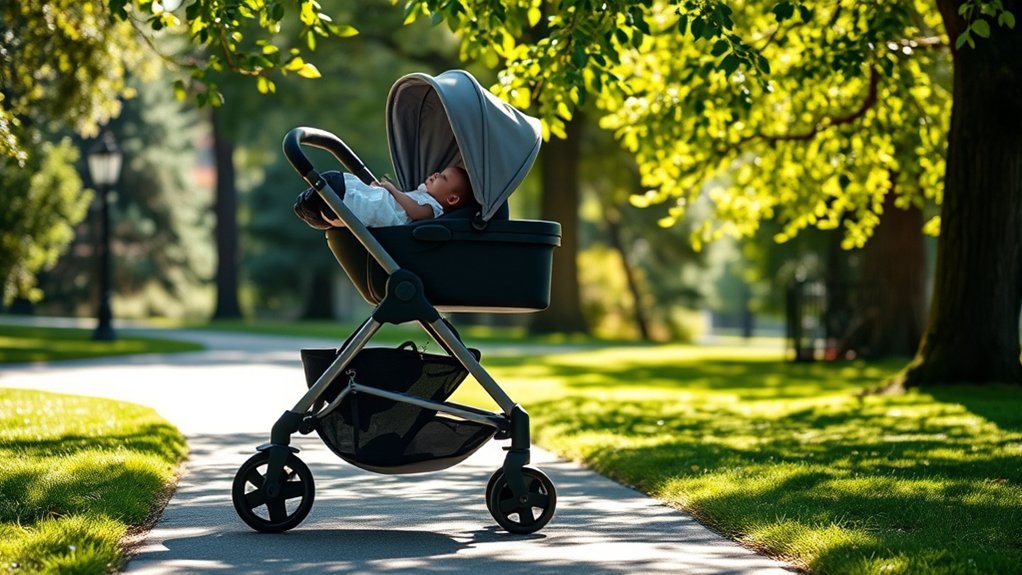
For a newborn, age alone does not make a stroller seat safe. Use only a configuration that the stroller manufacturer specifically approves from birth. Depending on the model, that may be a bassinet, a compatible infant car seat attached to the stroller, or a stroller seat designed to provide the positioning required for newborn use.
Do not assume that every seat described as “reclining” is suitable for a newborn. Check the manual for the minimum age, approved seating mode, harness instructions, and any required infant insert or accessory. If the regular stroller seat is intended only for an older baby, wait until your child meets those requirements.
A travel system can make short car-to-stroller transfers convenient because the compatible infant car seat attaches to the stroller frame without rebuckling your baby. However, an infant car seat or stroller should not become a routine sleep space. The American Academy of Pediatrics advises moving a baby who falls asleep in a stroller, car seat, swing, carrier, or sling to a firm, flat sleep surface on their back as soon as practical. See the AAP safe-sleep guidance.
For a more detailed setup checklist, see our guide on how to use a stroller for a newborn safely.
Warning: Never place a newborn in an upright stroller seat unless the stroller manual specifically approves that configuration from birth. Always use the required restraint system, fully open and lock the stroller frame, engage the brakes before loading or unloading your baby, and follow all age and weight limits.
For this age group, the most important question is not which stroller has the longest feature list. It is whether the exact configuration is approved for a newborn and whether you are using it exactly as directed.
Strollers for 6- to 12-Month-Olds
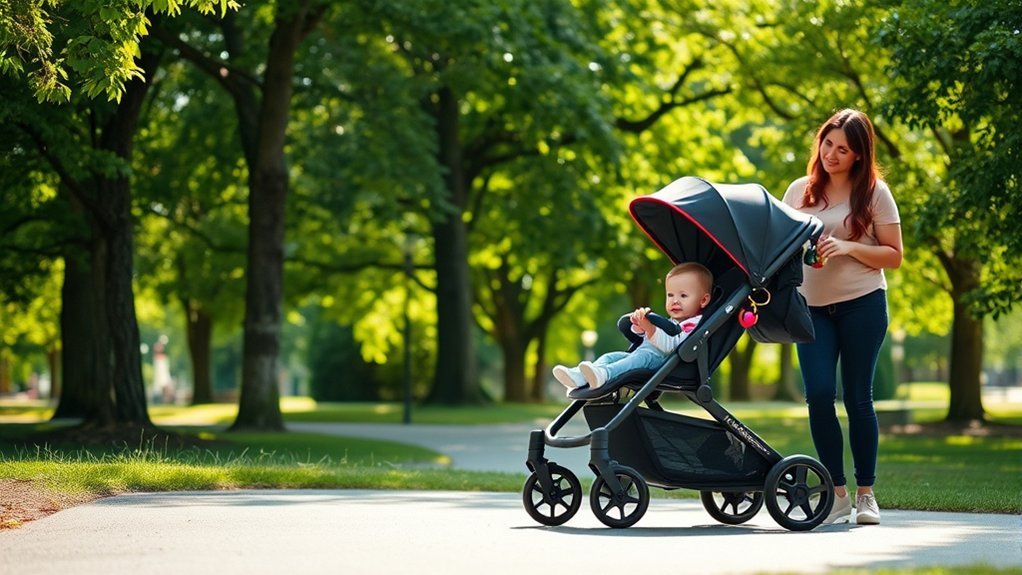
Around 6 months, many babies develop enough head, neck, and trunk control to use a more upright stroller seat, but the calendar is not the only test. Your stroller manual must allow the seating mode, and your baby should remain well supported without persistent head flopping, chin-to-chest slumping, or sliding out of position.
Look for a supportive seat, adjustable recline, sun coverage, a correctly fitting harness, and a seat size that lets your baby remain centered. Recline is still useful because a baby who handles an upright position when alert may become less stable when tired.
A reversible seat can also be useful. Parent-facing mode makes it easier to observe a younger baby, while forward-facing mode lets an older baby see more of the surroundings. Neither direction changes the need to follow the stroller’s age and configuration requirements.
If you are deciding whether your baby is ready for a regular or forward-facing seat, see our detailed guide to when a baby can sit forward in a stroller.
Jogging is a separate decision from ordinary stroller riding. Do not run with a stroller merely because your baby can sit upright. Use a stroller designed for jogging and follow that model’s minimum age and developmental requirements for running mode.
Note: Keep using the required harness even after your baby sits independently. Babies can lean, twist, reach, and shift their weight suddenly.
The safest transition is therefore based on three checks: the stroller manual allows the position, your baby has the needed body control, and the harness fits securely.
Strollers for 12- to 18-Month-Olds
Between 12 and 18 months, your child may be walking, cruising, climbing, or switching quickly between wanting independence and wanting to ride. A stroller can still be useful for errands, neighborhood walks, naps, long outings, and situations where you need predictable mobility.
At this age, focus on a secure harness, dependable brakes, washable or easy-to-clean surfaces, useful storage, and a stable frame. If your child frequently gets in and out, make sure you can operate the buckle and parking brake reliably without leaving the stroller unsecured.
A compact stroller can work well for short trips, while a full-size stroller may provide more suspension, shade, recline, and storage for longer days. Whatever type you use, confirm that your child remains within its stated age, height, and weight limits.
Pro Tip: Let your toddler walk during short, safe parts of an outing, then use the stroller when they become tired, the environment gets crowded, or you need to cover more distance safely.
Strollers for 18- to 24-Month-Olds

From 18 to 24 months, many toddlers want to walk whenever possible but still tire during errands, travel, sightseeing, or long family days. The most useful stroller at this stage is one that is easy for you to manage while still giving your child enough room, support, shade, and recline for rest.
Instead of choosing by brand alone, compare the stroller’s child weight and height limits, folded size, stroller weight, wheel design, brake operation, harness, canopy coverage, basket limit, and how easily you can fold it while supervising a toddler.
Lightweight Travel Options
A lightweight travel stroller can be useful when you frequently use public transportation, fly, climb stairs, load the stroller into a small vehicle, or have limited storage at home. Before buying, check the actual folded dimensions and stroller weight rather than relying only on labels such as “compact” or “travel.” Airline cabin policies vary, so a compact fold does not guarantee that a stroller can be carried onboard.
For an 18- to 24-month-old, also check whether a compact stroller provides enough seat depth, back support, canopy coverage, recline, and foot support for the outings you plan. The lightest stroller is not automatically the most comfortable option for a long day.
Versatile Stroller Features
Useful toddler features include a quick but secure fold, easy-clean fabric, a basket that stays within its stated load limit, a canopy for shade, adjustable recline, and wheels suited to the surfaces you use most often.
If your child switches frequently between walking and riding, also consider how easy it is to engage the brake, open the harness, and help your child in and out without making the stroller unstable. Accessories should be manufacturer-approved or clearly compatible and should never interfere with the stroller’s balance, folding mechanism, harness, or brakes.
Safety Considerations for Toddlers
Toddlers are more mobile and can shift their weight suddenly, so keep using the stroller’s restraint system even when your child seems capable of sitting calmly. A tray or belly bar is not a substitute for the harness.
Keep hands away from hinges and folding mechanisms, fully lock the stroller open before placing your child inside, and apply the parking brake whenever you stop or load and unload your child. The American Academy of Pediatrics also advises against hanging bags from stroller handles because the extra weight can contribute to tipping. See the AAP stroller safety guidance.
How to Choose a Stroller by Age and Stage
The best stroller for a particular stage is the one that passes three checks: the manufacturer approves it for your child, your child has the developmental control needed for that seating position, and the stroller fits the way your family actually travels.
- For newborns: Use only a bassinet, compatible infant car seat, or stroller seat specifically approved from birth. Do not assume a reclining seat is automatically newborn-safe.
- For babies moving upright: Check the manual first, then look for steady head and neck control, adequate trunk support, adjustable recline, sun protection, and secure harness fit.
- For toddlers: Prioritize easy folding, durable wheels, cleanable fabric, useful storage, reliable brakes, and a comfortable seat.
- For travel: Compare actual stroller weight and folded dimensions with your transportation and storage needs.
- For outdoor walks: Consider wheel size, suspension, maneuverability, shade, and the surfaces you use most often.
- For multiple children: Compare tandem, side-by-side, stroller-board, and sit-and-stand configurations, while following the manufacturer’s limits for every riding position.
Before buying or continuing to use any stroller, check its manual for age, height, weight, and configuration limits. A stroller that suited your child at 6 months may no longer provide an appropriate fit several years later.
Understanding the Stroller Age Limit

There is no universal birthday when every child must stop using a stroller. The U.S. Consumer Product Safety Commission describes strollers as products normally used by children from infancy through about 36 months, but that description is not a medical deadline and does not replace the instructions for a specific stroller. See the CPSC carriage and stroller guidance.
Around age 3 is a practical time for many families to reassess routine stroller use. Look at whether your child can manage ordinary short distances, stay close to you, hold a hand near traffic, respond to simple safety directions, and complete the outing without becoming excessively tired.
The stroller itself can also determine when use must stop. If your child exceeds its permitted height or weight, no longer fits the harness correctly, or no longer meets another manufacturer requirement, stop using that configuration even if your child would still like to ride.
For a closer look at preschool-age use, see our guide to whether a 3-year-old still needs a stroller.
Stroller alternatives can include walking, a manufacturer-approved stroller board, a suitable wagon where permitted, or another mobility option that fits the child and the outing. The goal is not to force independence on a schedule; it is to match the mobility tool to your child’s abilities and the environment.
Benefits of Gradually Reducing Routine Stroller Use

As children become capable walkers, reducing unnecessary stroller time can create more opportunities for walking, climbing, exploring, and active play. The CDC recommends that children ages 3 to 5 be physically active throughout the day for growth and development. See the CDC physical activity guidance for children.
Walking during manageable outings also gives a child practice with balance, coordination, endurance, hand-holding, stopping at curbs, and following simple directions in public. These skills develop through repeated, supervised experience rather than through reaching a specific birthday.
That does not mean every outing should be stroller-free. If a short, safe walk is well within your child’s ability, letting them walk provides useful activity. If the day involves long distances, crowds, fatigue, disability, medical needs, or difficult safety conditions, using the stroller can still be practical.
Exceptions to the Stroller Age Limit

Older toddlers and preschoolers may still benefit from a stroller during specific outings even after they walk independently most of the time. The useful question is not simply “Is this child too old?” but “Does the stroller fit the child, remain within its limits, and solve a genuine mobility, rest, or safety need today?”
Crowded Environments Justifying Use
Airports, festivals, amusement parks, museums, large events, busy urban areas, and transportation hubs can involve far more walking and crowd management than an ordinary neighborhood outing. A stroller can give a young child a predictable place to ride and can help a caregiver keep the child close while moving through a busy environment.
This can be especially useful when one adult is managing more than one child or when the outing includes lines, luggage, tickets, jackets, snacks, and other distractions.
Long Distances and Travel
A child who comfortably walks to a nearby store may still become exhausted during an airport connection, theme-park day, vacation, or several hours of sightseeing. Situational stroller use can provide a rest option without requiring the stroller for every ordinary outing.
If travel is the main reason you still use a stroller, prioritize low stroller weight, a manageable folded size, easy brakes, a secure harness, and enough comfort for the child. Check airline, attraction, or transportation rules before the trip because size and stroller policies can vary.
Medical, Developmental, and Special Needs Exceptions
Some children need mobility support longer than others because of disability, low muscle tone, developmental differences, fatigue, injury, sensory needs, or another medical reason. A standard stroller may work for some children within its limits, while others may benefit from an adaptive stroller or other mobility equipment.
Adaptive strollers can provide positioning support, higher weight capacities, medical-equipment storage, and other features not available on an ordinary stroller. When a child needs specialized positioning or mobility support, a pediatric clinician, physical therapist, occupational therapist, or rehabilitation specialist can help determine what equipment is appropriate.
There is no developmental benefit in forcing a child out of needed mobility support simply because of age. Safety, participation, comfort, and appropriate opportunities for movement are the more useful goals.
Transitioning Away From Stroller Use

The transition away from routine stroller use usually works best gradually. Start with short outings where walking is realistic, such as a quick store visit, a park path, or a walk around the block.
Watch for practical readiness signs: your child can walk the expected distance, stay reasonably close, follow simple instructions such as “stop” and “hold my hand,” and finish the outing without needing to be carried most of the way.
You can then save the stroller for situations that genuinely need it, such as airports, long walking days, crowded events, late-day outings, or times when your child is unusually tired.
Readiness can change from day to day. Illness, poor sleep, heat, cold, overstimulation, unfamiliar environments, and a much longer route can all change what a child can comfortably manage.
Common Stroller Mistakes to Avoid
Even a well-designed stroller can become unsafe if it is used outside its instructions. Watch for these common mistakes:
- Ignoring the stroller’s limits: Stop using a configuration when your child exceeds its age, height, weight, or other manufacturer requirements.
- Skipping the restraint system: A tray or belly bar does not replace the stroller’s required harness.
- Hanging heavy bags on the handle: The AAP warns that this can make a stroller tip backward. Use the stroller basket within its stated load limit instead.
- Leaving the stroller unsecured: Engage the parking brake when stopped and when placing your child in or taking them out.
- Using an upright seat too early: Follow the manual and do not place a newborn in a seating position that is not approved from birth.
- Folding near a child’s fingers: Keep children clear of hinges, latches, and folding mechanisms.
- Treating the stroller as a routine infant sleep space: If an infant falls asleep in a stroller or car seat, follow AAP guidance and move them to an appropriate firm, flat sleep surface as soon as practical.
- Forgetting weather conditions: Plan for shade, ventilation, rain, cold, hydration, and breaks appropriate to the child and conditions.
Frequently Asked Questions
At what age should a child stop using a stroller?
There is no universal stop age. Around age 3, many families can begin reducing stroller use for routine short outings if the child can walk the distance and follow basic safety directions. Long trips, crowds, fatigue, disability, medical needs, and other circumstances may justify use later. Never exceed the stroller manufacturer’s limits.
Is there an official stroller age limit?
No single age limit applies to every stroller. The CPSC describes strollers as normally used from infancy through about 36 months, but each stroller has its own instructions. Its stated age, height, weight, seating, and configuration limits are the limits you must follow.
When can a baby sit upright in a stroller?
Around 6 months is common, but readiness depends on both the stroller instructions and your baby’s development. The baby should have steady head and neck control, adequate trunk support, a secure harness fit, and no persistent slumping in the permitted seating position.
Do newborns need a special stroller setup?
Yes. A newborn should use only a setup the manufacturer specifically approves from birth. Depending on the stroller, that may be a bassinet, compatible infant car seat, or a stroller seat designed and approved for newborn positioning.
Is a 4-year-old too old for a stroller?
Not necessarily. Many 4-year-olds can walk through ordinary short outings, but a stroller may still be useful for long travel days, crowded environments, fatigue, disability, medical needs, or other situations. The child must still fit within the stroller’s manufacturer limits.
Can a baby sleep in a stroller?
A stroller should not be treated as a routine infant sleep space. If a baby falls asleep in a stroller, car seat, swing, carrier, or sling, the American Academy of Pediatrics recommends moving the baby to a firm, flat sleep surface on their back as soon as practical.
Can I use a stroller for a child with special needs?
Yes. Some children benefit from stroller or adaptive-stroller support beyond the usual toddler years. Adaptive models can offer additional positioning, higher weight limits, and space for medical equipment. For specialized mobility or positioning needs, ask the child’s clinician, physical therapist, occupational therapist, or rehabilitation specialist for individualized guidance.
Conclusion
There is no single stroller age limit that fits every child. Use a manufacturer-approved newborn setup from birth, consider a more upright seat only when both your baby’s development and the stroller manual allow it, and reassess routine stroller use as your toddler becomes a capable walker.
Around age 3, many children can begin walking more during ordinary short outings, while still using a stroller for travel, crowds, long distances, fatigue, disability, or medical needs. Whatever your child’s age, the stroller manufacturer’s height, weight, age, configuration, harness, and safety instructions remain the final limits.