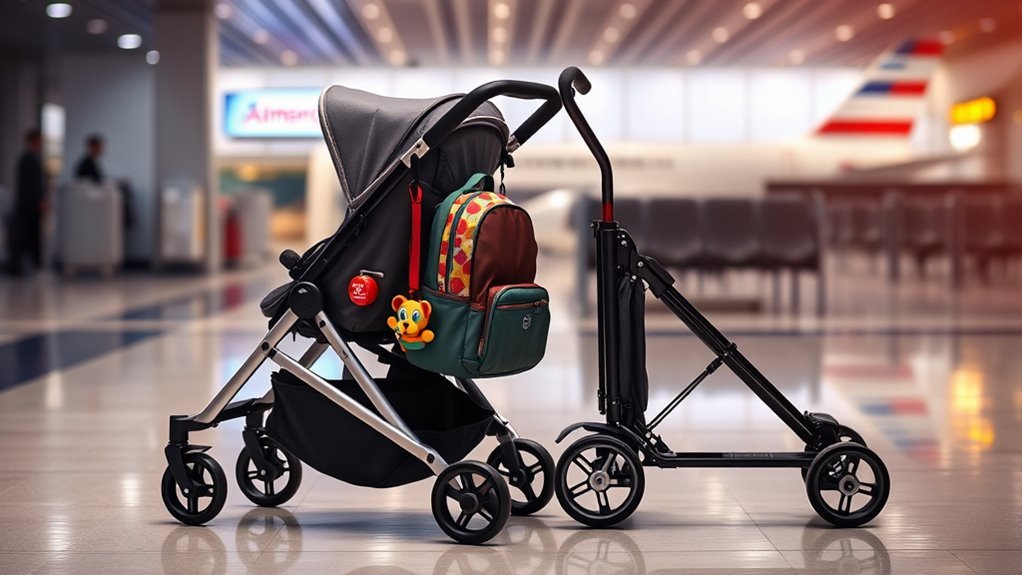
A 4-year-old can travel with a stroller on American Airlines, and bringing one can still be useful for long terminals, connections, or a tired child. The important part is knowing the difference between carrying a compact stroller into the cabin, checking it at the gate, and checking it at the ticket counter. American’s current rules are more flexible than the older 20-pound gate-check rule that many travel guides still repeat.
Quick Answer
Yes. A 4-year-old may travel with a stroller on American Airlines. American currently allows one stroller and one car seat to be checked free when traveling with a child. Most collapsible strollers can be gate-checked, while non-collapsible strollers and certain stroller wagons must be checked at the ticket counter.
Key Takeaways
- A 4-year-old must have a purchased seat on American Airlines.
- American allows one stroller and one car seat to be checked free of charge when traveling with a child.
- The old rule that every stroller over 20 pounds must be checked at the ticket counter is no longer stated on American’s current child-travel page.
- Non-collapsible strollers and stroller wagons without built-in child safety straps must be checked at the ticket counter; other strollers should generally be checked at the gate.
- A fully collapsible stroller under 20 pounds may be carried into the cabin if it fits in an overhead bin and space is available.
- American lists one diaper bag per child as an additional item that does not count toward the normal personal-item or carry-on allowance.
- At TSA, remove the child from the stroller. The stroller is X-rayed when it fits the machine or inspected manually when it does not.
What Can You Bring for a Child on American Airlines?
Children age 2 and older need their own ticket and seat on American Airlines. That means a 4-year-old is a ticketed passenger rather than a lap child. American’s normal cabin allowance generally permits one personal item and one carry-on item, subject to the fare, aircraft, available storage space, and normal size rules.
American also treats several child-related items separately from the normal carry-on allowance. Its carry-on baggage guidance lists one diaper bag per child, child safety seats, strollers, breast pumps, and certain breast-milk coolers as items that do not count as the passenger’s regular personal item or carry-on.
For checked child equipment, American’s traveling with children policy currently allows each ticketed customer to check one stroller and one car seat free of charge when traveling with a child or traveling to adopt.
Note: A 4-year-old does not automatically receive American’s family boarding category simply because the child is young. American currently lists family boarding for families with children under 2. Travelers who genuinely need special assistance or extra boarding help should speak with the gate team.
AA Stroller Rules for a 4-Year-Old
A stroller is optional for a 4-year-old, but American Airlines does not prohibit one simply because the child is older than a toddler. The main questions are whether the stroller collapses, whether you want to use it through the terminal, and whether you want to check it or try to carry a very compact model into the cabin.
The current American Airlines child-travel page says:
| Stroller type or plan | Current American Airlines handling |
| Non-collapsible stroller | Check at the ticket counter. |
| Stroller wagon without built-in child safety straps | Check at the ticket counter. |
| Other collapsible stroller being checked | American says it should generally be checked at the gate before boarding. |
| Fully collapsible stroller under 20 lb that fits overhead | American’s Conditions of Carriage say it may be carried aboard if it fits in an overhead bin; available bin space is not guaranteed. |
AA Stroller Weight Limits
The most important update is that 20 pounds is not currently published as American’s general gate-check cutoff on its traveling-with-children page. Older versions of the policy used that rule, which is why it still appears in many travel articles.
American’s current child-travel guidance focuses instead on the stroller’s design. Non-collapsible strollers and stroller wagons without built-in child safety straps must go to the ticket counter. Other strollers should generally be checked at the gate.
The 20-pound figure still appears in American’s Conditions of Carriage for a different situation: a fully collapsible stroller may be carried into the cabin if it weighs under 20 pounds and fits in an overhead bin.
This distinction matters. A 25-pound collapsible stroller is not automatically disqualified from gate checking merely because it exceeds 20 pounds under the current child-travel wording. However, it would not meet the published under-20-pound cabin-carry-on exception.
Gate Check Or Ticket Counter
For most families with a 4-year-old, gate checking is convenient because the child can use the stroller through check-in, the terminal, and most of the way to boarding.
- Use the ticket counter if the stroller is non-collapsible or is a stroller wagon without built-in child safety straps.
- Use the gate for most other strollers if you want the stroller available while walking through the airport.
- Consider cabin carry-on only for a fully collapsible model under 20 pounds that actually fits the overhead-bin requirement.
If you are traveling with both a stroller and car seat, American’s current policy says both may be checked at the ticket counter, or one may be checked at the gate and the other at the ticket counter.
Pro Tip: Before leaving home, remove loose accessories, empty the stroller basket, label the stroller with your contact information, and practice folding it. At the gate, ask where the stroller will be returned after the flight so you know whether to wait near the aircraft door or follow another local procedure.
When Should You Gate Check a Stroller?
Gate checking makes sense when you expect your 4-year-old to get tired during a long walk, have a tight connection, or need the stroller to carry normal child essentials through the terminal.
For most collapsible strollers, American’s current family-travel guidance allows you to keep the stroller through the airport and check it at the gate before boarding.
At the departure gate, ask an agent for the appropriate stroller tag before boarding begins. Fold the stroller completely and remove loose cup holders, toys, detachable organizers, or other accessories that might be lost during handling.
American also states in its airport guidance that strollers checked at the gate are picked up after the flight at the gate. Procedures can differ at some airports or on partner-operated itineraries, so confirm the return point with the gate agent before handing it over.
Car Seat Rules for American Airlines
A 4-year-old already has a purchased aircraft seat because American requires children age 2 and older to have their own seat. Whether the child should also use a car seat or another approved child restraint depends on the child’s size and the restraint manufacturer’s limits.
The Federal Aviation Administration recommends using an approved child restraint system when appropriate for the child. For a U.S.-standard car seat used aboard an aircraft, look for the label stating that the restraint is certified for use in motor vehicles and aircraft.
American says an acceptable child safety seat must have a solid back and seat, restraint straps that securely hold the child, and the required approval labeling. The restraint must be installed according to its instructions and in the correct direction for the child’s size.
Warning: FAA approval applies to child restraint systems used in the aircraft cabin, not to ordinary strollers. A stroller does not need an “FAA-approved stroller” label.
American does not allow a safety seat in an exit row or in rows immediately in front of or behind certain overwing exits. Window seats are generally preferred so the restraint does not block another passenger’s path.
Safety seats are also prohibited in First or Business on certain American aircraft because of the seat design or angle. This is an aircraft-specific restriction rather than a blanket prohibition on all First and Business cabins, so check the aircraft and seat information before travel.
Booster seats without the required aircraft approval and shoulder-harness arrangement cannot be used as approved restraints during taxi, takeoff, and landing. FAA-approved CARES restraints are another option for children who meet the device’s published size limits.
Lightweight Strollers for AA Travel
A lightweight stroller can still make airport travel easier, but the best choice for a 4-year-old is not determined by stroller weight alone. First confirm that the child remains within the stroller manufacturer’s height and weight limits.
Compact folding is valuable because it makes TSA screening, gate handling, car transfers, and storage easier. If you specifically hope to bring the stroller into the aircraft cabin rather than gate-check it, American’s published carry-on exception requires a fully collapsible stroller under 20 pounds that fits in an overhead bin.
Lightweight Stroller Choices
The models mentioned in the original guide illustrate different compact-stroller formats, but families should verify the exact current model, child capacity, folded dimensions, and availability before travel.
- gb Pockit / Pockit+ family: known for a very compact fold. Exact weight and child limits vary by Pockit version, so check the specific model rather than relying on a generic “Pockit” specification.
- Jeep Scout Double Stroller: Delta Children lists the Scout Double at 18.3 pounds with a maximum recommended child weight of 35 pounds per seat. A 4-year-old who weighs more than that should not ride in it.
- Delta Children City Street Side-by-Side: commonly listed at about 18.3 pounds. As with any older or discontinued model, confirm the product label and current manufacturer instructions before using it for an older preschool child.
Do not choose a stroller only because it is under 20 pounds. Child fit, restraint condition, folding reliability, wheel condition, and manufacturer limits matter more for safe everyday use.
AA Gate Check Rules
American’s current gate-check guidance is based primarily on stroller type rather than a blanket 20-pound maximum. Non-collapsible strollers and stroller wagons without built-in child safety straps must be checked at the ticket counter. Other strollers should generally be checked at the gate.
If you have both a stroller and car seat, American currently allows both to be checked free at the ticket counter, or one to be checked at the gate while the other is checked at the counter.
A protective stroller bag can help keep straps and fabric contained, but it cannot guarantee protection from normal baggage handling. Remove valuables and detachable accessories before checking the stroller.
Travel-Friendly Folding Options
For airport use, look for a stroller that can be folded quickly while you manage your child and carry-on bags. Useful features include:
- A simple one- or two-step fold.
- A secure latch that keeps the stroller closed during handling.
- Few loose or detachable accessories.
- A child weight and height limit that still fits your 4-year-old.
- A folded size that is easy to maneuver through TSA and the boarding area.
A model being marketed as “airplane friendly” does not guarantee that American will allow it in the cabin. Cabin acceptance still depends on American’s rules, the stroller’s actual folded size and weight, and available aircraft storage.
How to Pack a Diaper Bag for AA
American lists one diaper bag per child as an item that does not count toward the normal personal-item or carry-on allowance. For a 4-year-old, that bag may function more like a child essentials bag, especially if the child no longer uses diapers.
Keep the most frequently needed items near the top:
- A change of clothes.
- Wipes and any toileting supplies your child still uses.
- Medications that should remain with you rather than in checked baggage.
- Dry snacks that comply with TSA rules.
- A small comfort item or toy.
- Headphones and a charged entertainment device.
- Travel documents needed for the trip.
- An empty refillable water bottle that can be filled after security.
TSA provides special screening allowances for formula, breast milk, toddler drinks, and baby/toddler food. These items may be carried in quantities greater than 3.4 ounces when they qualify under TSA’s child-feeding rules, but they should be declared and presented for separate screening.
That exception should not be interpreted as permission to take any oversized drink through security simply because you are traveling with a 4-year-old. Ordinary liquids that do not qualify for a TSA exception remain subject to the normal security rules.
TSA Screening for Strollers and Baby Gear
TSA screening is separate from American Airlines’ baggage policy. American determines whether the stroller is carried aboard, gate-checked, or checked at the ticket counter; TSA determines how the stroller and accompanying items are screened at the security checkpoint.
According to FAA guidance featuring TSA representatives, children should be removed from strollers and car seats for screening. Strollers and child safety seats that fit through the X-ray machine are screened there. Oversized equipment receives a visual and physical inspection.
- Before reaching the belt, empty the stroller basket and pockets.
- Remove your child from the stroller.
- Fold or collapse the stroller if possible.
- Place the stroller on the X-ray belt when instructed if it fits.
- If it does not fit, give it to the TSA officer for visual and physical inspection.
- Collect the stroller and belongings after clearing security, then reopen and reload it away from the immediate screening belt when possible.
Children age 12 and under generally receive modified TSA procedures and can leave their shoes on during standard screening. TSA also says children will not be separated from their parent or guardian during the screening process.
American Airlines Boarding With a 4-Year-Old
American’s published boarding process lists family boarding for families with children under 2. A family traveling only with a 4-year-old should therefore expect to board according to the boarding group printed on the boarding pass unless another boarding entitlement applies.
If a traveler has a disability, mobility limitation, or another genuine need for special assistance, American allows customers needing special assistance to request early boarding at the gate.
For a typical family with a 4-year-old, reaching the gate early is still useful even without preboarding. It gives you time to obtain the stroller tag, use the restroom, organize carry-ons, and fold the stroller without rushing.
What If Your Flight Is Operated by Another Airline?
If your ticket has an American Airlines flight number but one or more segments are operated by another carrier, check the operating airline’s stroller and child-equipment policy as well. Partner airlines can have different gate-check, weight, size, and pickup procedures.
This is especially important on international itineraries and codeshare trips. Do not assume that an American Airlines stroller rule automatically applies to every segment merely because the ticket was purchased through American.
Frequently Asked Questions
Can I bring a stroller for free on American Airlines?
Yes. American currently says each ticketed customer may check one stroller and one car seat free of charge when traveling with a child or traveling to adopt. The stroller may need to be checked at the ticket counter or gate depending on its design.
Does a 4-year-old need a separate seat on American Airlines?
Yes. American Airlines requires children age 2 and older to have their own purchased seat. A 4-year-old cannot travel as a lap child.
Do strollers over 20 pounds have to be checked at the ticket counter?
Not under the wording of American’s current child-travel page. It now specifically sends non-collapsible strollers and stroller wagons without built-in child safety straps to the ticket counter and says other strollers should be checked at the gate. The 20-pound figure remains relevant to American’s separate rule allowing a fully collapsible stroller under 20 pounds to be carried aboard if it fits in an overhead bin.
Can I gate-check both a stroller and a car seat on American Airlines?
American’s current published policy says both items may be checked at the ticket counter, or one item may be checked at the gate and the other at the ticket counter.
Can I carry a stroller onto the plane instead of gate-checking it?
American’s Conditions of Carriage say a fully collapsible stroller under 20 pounds may be carried aboard if it fits in an overhead bin. Overhead storage varies by aircraft and available space is not guaranteed, so a compact stroller may still need to be checked.
Can kids stay in a stroller through TSA?
No. Children should be removed from strollers for TSA screening. A stroller that fits the X-ray machine is screened there; oversized equipment receives a visual and physical inspection.
Does a family with a 4-year-old get early boarding on American Airlines?
Not automatically based on the child’s age. American currently lists family boarding for families with children under 2. A family with a 4-year-old normally follows its assigned boarding group unless another boarding benefit or legitimate special-assistance need applies.
Conclusion
A stroller can make an American Airlines trip with a 4-year-old much easier, especially in large airports or during connections. The biggest policy point is to avoid relying on the old assumption that every stroller over 20 pounds must be checked at the ticket counter. Current American guidance focuses on whether the stroller is collapsible, while the 20-pound threshold is relevant to carrying a fully collapsible stroller into the cabin.
Check your stroller’s folding design and child-size limits before departure, arrive at the gate with enough time to obtain any needed tag, remove the child from the stroller at TSA, and confirm where a gate-checked stroller will be returned. These few steps prevent most last-minute surprises.
Sources
- American Airlines — Traveling with children — stroller and car-seat checking rules, child seating requirements, diaper bags, and approved safety seats.
- American Airlines — Conditions of Carriage — cabin carry-on rule for a fully collapsible stroller under 20 pounds.
- American Airlines — Carry-on bags — personal-item, carry-on, diaper-bag, stroller, and child-safety-seat allowances.
- American Airlines — Boarding process — current family boarding category.
- Federal Aviation Administration — Kids’ Corner — approved child restraint systems and aircraft safety guidance.
- FAA — Flying With Kids: Tips From TSA — stroller, car-seat, child, and checkpoint screening procedures.
