
Last updated: September 22, 2026 — 2026 U.S. RAV4 drivetrain availability and specifications rechecked against Toyota.
For the 2026 U.S.-market Toyota RAV4, the choice is front-wheel drive (FWD) or Electronic On-Demand All-Wheel Drive (AWD), not traditional truck-style 4WD with selectable 4H and 4L. The redesigned RAV4 is offered with hybrid or plug-in hybrid powertrains, and AWD availability depends on grade. That distinction matters if you drive in rain, snow, gravel, mud, or genuinely technical off-road terrain.
Scope: This guide focuses on U.S.-market RAV4 models and is based on published specifications rather than a controlled road test. Older model years and other markets may use different drivetrain hardware or terminology.
Quick Answer
The 2026 Toyota RAV4 does not use traditional 4WD like a Tacoma, 4Runner, or Land Cruiser with selectable high- and low-range gearing. U.S. models use FWD or Electronic On-Demand AWD. On AWD versions, a dedicated rear electric motor adds rear-wheel drive force automatically when traction, acceleration, or stability can benefit. It is useful for rain, snow, gravel, and light trails, but it is not a low-range 4WD system for technical off-roading.
Key Takeaways
- The 2026 U.S. RAV4 is offered as a Hybrid Electric Vehicle (HEV) or Plug-in Hybrid Electric Vehicle (PHEV); there is no gas-only 2026 U.S. version.
- LE, SE, and XLE Premium hybrid grades can be configured with FWD or AWD; Woodland, XSE, and Limited hybrids use AWD.
- The 2026 RAV4 PHEV grades use AWD, with a dedicated electric motor driving the rear axle.
- RAV4 AWD works automatically and is suited to wet roads, snow, gravel, and mild dirt-road use; it does not provide a traditional 4L low range.
- Selected 2026 AWD configurations can tow more than others, so always use the rating for the exact grade and powertrain.
Which 2026 Toyota RAV4 Trims Have AWD?
Toyota expanded drivetrain choice for the sixth-generation RAV4. For the first time, selected RAV4 Hybrid grades are available with FWD, while AWD remains available across the lineup. Plug-in hybrid versions use AWD. The U.S. lineup is summarized below.
| 2026 grade | Powertrain | Drivetrain |
| LE | HEV | FWD or AWD |
| SE | HEV or PHEV | HEV: FWD or AWD; PHEV: AWD |
| XLE Premium | HEV | FWD or AWD |
| Woodland | HEV or PHEV | AWD |
| XSE | HEV or PHEV | AWD |
| Limited | HEV | AWD |
| GR SPORT | PHEV | AWD |
Toyota can change regional availability during a model year, so confirm the exact vehicle on the official Toyota RAV4 page or its window sticker before buying.
Comparing AWD and 4WD: Key Differences
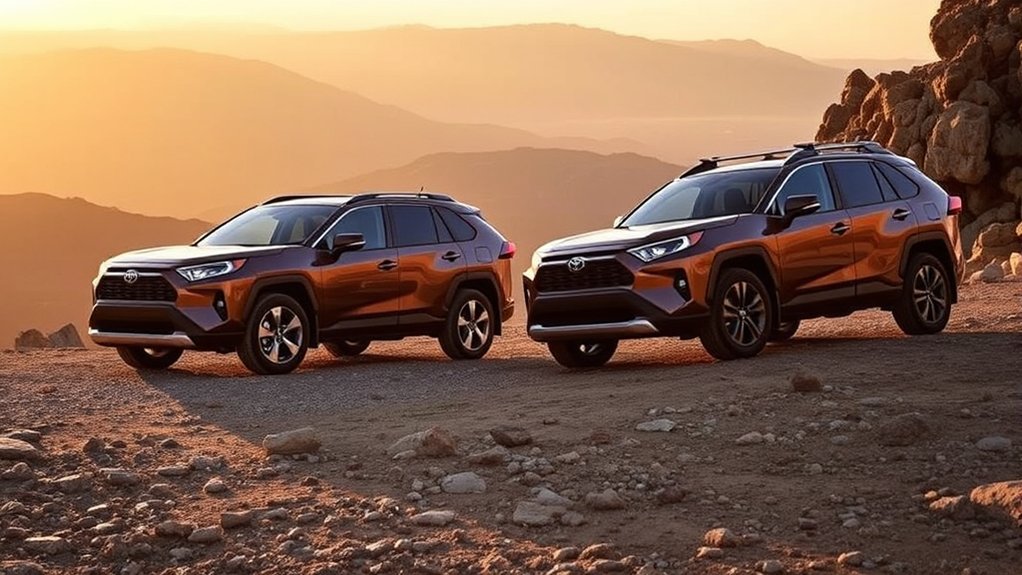
AWD and 4WD can both power more than one axle, but they are built for different priorities. RAV4 AWD automatically adds rear-wheel drive force when useful for traction and stability. Traditional truck-style 4WD is designed for more demanding terrain and may provide driver-selectable high and low ranges.
| System | How it works | Best use |
| Front-Wheel Drive (FWD) | Drives the front wheels only. | Maintained paved roads, mild climates, and drivers prioritizing efficiency and lower drivetrain complexity. |
| 2026 RAV4 Electronic On-Demand AWD | Uses a dedicated electric rear motor to add rear-wheel drive force automatically when needed. | Rain, snow, gravel, hills, launches on slippery surfaces, and mild trails. |
| Traditional 4WD | Typically uses a transfer case and may provide selectable 4H and 4L modes. | Deep mud, rocks, steep technical climbs, deep snow, and rugged off-road use. |
For normal commuting, RAV4 AWD requires little driver involvement because torque distribution is managed automatically. Traditional 4WD gives the driver more mechanical control when low-speed gearing and difficult terrain are the priority.
Does the RAV4 Have 4WD or AWD?
For the current U.S. lineup, the RAV4 has FWD or AWD, not traditional low-range 4WD. AWD-equipped 2026 models use Electronic On-Demand AWD with an electric rear motor. There is no 4L selector or two-speed transfer case like you would expect in a traditional off-road 4WD system.
Terminology can differ outside the United States. Some Toyota distributors and markets may use “4WD” or “4×4” wording for four-wheel-driven RAV4 variants, so use the specification sheet and owner’s manual for the exact market rather than assuming the badge describes the same hardware everywhere.
Note: Trim names, drivetrain availability, controls, and terminology change by model year and market. Before buying a used RAV4, identify the exact year, powertrain, and trim before applying advice written for a newer or older generation.
How Traditional Toyota 4WD Differs From RAV4 AWD
Traditional 4WD systems used on off-road-oriented trucks and SUVs may let the driver select modes such as 2WD, 4H, and 4L. Low range uses additional gear reduction for slow-speed control and torque multiplication. The exact controls vary by vehicle, so the table below describes a typical selectable 4WD layout rather than every Toyota 4WD system.
| Mode | What it does | Typical conditions |
| 2WD | Drives one axle in systems that provide a selectable two-wheel-drive mode. | Dry pavement and normal cruising. |
| 4H | Drives both axles through the high-range gearing. | Loose dirt, snow, slippery rural roads, and off-road surfaces where the vehicle manufacturer permits 4H. |
| 4L | Adds low-range gear reduction for slow-speed torque and control. | Rocks, deep mud, steep climbs, recovery situations, and difficult trails. |
The RAV4 is designed primarily as a compact crossover for commuting, road trips, bad weather, and light adventure. Its AWD system targets those conditions without adding a low-range transfer case.
How Does Toyota’s RAV4 AWD System Work?
The answer depends on model year. The 2026 U.S. RAV4 uses an electrified drivetrain, while many 2019–2025 gas-powered RAV4s used mechanical AWD hardware. If you are buying used, identifying the year and powertrain is essential before comparing AWD behavior or maintenance requirements. For a deeper model-year breakdown, see how the Toyota RAV4 AWD system works.
2026 Electronic On-Demand AWD
On AWD-equipped 2026 RAV4 Hybrid models, Toyota uses a dedicated rear electric motor to power the rear wheels. The rear axle therefore does not need a conventional mechanical driveshaft carrying engine torque from the front of the vehicle. The system can add rear-wheel drive force automatically when acceleration, traction, or stability benefits from it.
This design combines hybrid efficiency with extra traction on wet roads, snow, gravel, and hills. The driver does not switch between 2H, 4H, and 4L because those traditional transfer-case ranges are not part of the system.
2019–2025 Gas Models: Dynamic Torque-Control AWD
Many gas-powered fifth-generation RAV4 models used Dynamic Torque-Control AWD. That system could send engine torque through a mechanical driveline to the rear axle when conditions called for additional traction or stability. Normal operation was automatic rather than requiring the driver to engage traditional four-wheel drive.
This hardware applies to earlier gas RAV4s, not the all-electrified 2026 U.S. lineup. That distinction is important when comparing used RAV4s or reading older owner’s manuals.
2019–2025 Gas Models: Dynamic Torque Vectoring AWD
Selected fifth-generation gas RAV4 trims used Dynamic Torque Vectoring AWD. In addition to varying front-to-rear torque distribution, the system could control torque delivery between the left and right rear wheels. Toyota also paired this design with rear driveline disconnect hardware to reduce unnecessary mechanical drag when AWD assistance was not needed.
Dynamic Torque Vectoring AWD gave selected gas RAV4s additional control on slippery or uneven surfaces, but it still did not provide the low-range gearing of a traditional off-road 4WD system.
RAV4 AWD Performance in Different Conditions
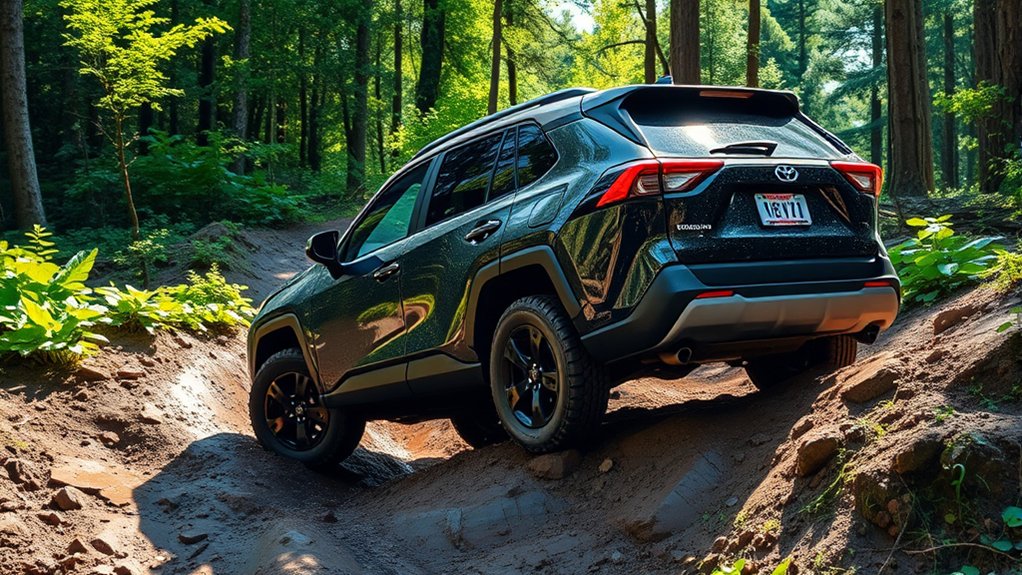
RAV4 AWD is designed primarily for changing road traction and moderate unpaved-road use. Its main advantage is helping the vehicle put power down when the available grip changes; it does not increase the tire’s basic braking grip or turn the RAV4 into a low-range off-road vehicle.
- Rain: AWD can reduce front-wheel spin during acceleration when wet pavement limits traction.
- Snow: AWD can improve launch traction and stability, especially when paired with appropriate winter or all-weather tires.
- Gravel: Rear-wheel assistance can help the RAV4 accelerate and maintain its intended path on loose surfaces.
- Mild trails: Maintained dirt roads, campsite access roads, and moderate ruts are more appropriate than technical rock-crawling routes.
- Steep or rough terrain: The RAV4 remains limited by tire choice, ground clearance, suspension travel, underbody protection, and the absence of low-range gearing.
Warning: AWD does not replace suitable tires, safe speed, proper braking distance, or driver judgment. For towing, off-road driving, deep snow, or difficult terrain, follow the owner’s manual and stay within the vehicle’s load, tire, and trailer ratings.
Do You Need 4WD for City and Suburban Driving?
Traditional low-range 4WD is rarely necessary for normal city and suburban driving. If you stay on maintained pavement, the more relevant RAV4 decision is FWD versus AWD.
FWD is well suited to paved-road driving in milder climates. AWD becomes more useful when your regular routes include snow, frequent heavy rain, steep slippery grades, gravel, or unpaved access roads. For a more detailed cost-and-traction comparison, see the RAV4 AWD vs FWD comparison.
Weather Conditions Assessment
AWD primarily helps the RAV4 put power to the road. It can help during acceleration on wet, snowy, or loose surfaces, but it does not shorten braking distance by itself. Tire compound, tread, road temperature, speed, and following distance remain critical when stopping or turning.
- Choose FWD if most of your driving is on maintained paved roads in a mild climate and you want the simplest drivetrain choice.
- Choose AWD if snow, heavy rain, gravel, steep grades, or unpaved roads are a regular part of your driving.
- Choose a true 4WD vehicle if your routes require low-range gearing for rocks, deep mud, difficult recoveries, or technical off-road climbs.
Driving Terrain Considerations
The RAV4 can travel beyond ordinary pavement, especially with AWD, but terrain difficulty still matters. Ground clearance, tires, approach and departure angles, underbody protection, heat buildup, and available traction all limit how far a crossover should be pushed.
A maintained forest road, gravel driveway, or campsite access road is very different from deep ruts, boulders, significant water crossings, or steep loose climbs. For the latter conditions, a vehicle designed around traditional 4WD, low-range gearing, suitable recovery points, and appropriate tires is the more suitable tool.
Common Myths About Toyota AWD and 4WD
AWD and 4WD terminology is often used loosely in listings and older documentation. Separating the drivetrain hardware from the marketing label prevents several common mistakes.
- Myth: Every RAV4 has 4WD. The 2026 U.S. RAV4 uses FWD or AWD depending on grade; it does not use traditional low-range 4WD.
- Myth: AWD and 4WD are mechanically the same. The 2026 RAV4’s Electronic On-Demand AWD uses a dedicated rear electric motor, while traditional 4WD commonly uses a transfer case and may provide selectable high and low ranges.
- Myth: AWD has to be manually switched on. Normal RAV4 AWD operation is automatic. Drive modes may change how the vehicle responds, but they are not the same as selecting 4H or 4L.
- Myth: AWD means tires matter less. AWD helps distribute driving force, while tire grip remains fundamental for braking and cornering.
- Myth: Every AWD RAV4 has the same towing capacity. Tow ratings vary by grade, powertrain, equipment, payload, and model year.
Which Should You Choose: FWD, AWD, or 4WD?
The right drivetrain depends on the conditions you actually encounter rather than the badge you prefer.
Driving Conditions Consideration
FWD fits maintained-road driving. If you mainly commute on paved roads in a mild climate, it avoids paying for traction capability you may rarely use.
RAV4 AWD fits variable traction. If you regularly encounter snow, heavy rain, gravel, steep wet roads, boat ramps, or unpaved routes, automatic rear-wheel assistance can be useful without requiring traditional 4WD controls.
Traditional 4WD fits technical terrain. If your plans routinely involve rocks, deep mud, steep unmaintained routes, difficult recoveries, or situations where low-range gearing is required, the RAV4 is not designed to replace a dedicated 4WD vehicle.
Performance Needs Assessment
For 2026, drivetrain choice also affects efficiency and capability. Toyota lists FWD on selected HEV grades and AWD on every grade in at least one configuration. AWD adds the rear electric motor and additional traction capability, while FWD eliminates that rear drive hardware.
Compare official fuel-economy figures only between the exact grades you are considering. Wheel size, tires, trim equipment, AWD, and powertrain choice can all change the rating, so a comparison between unrelated trims can give a misleading picture of the drivetrain penalty.
Advantages of Driving a RAV4 With AWD
RAV4 AWD is most valuable when traction changes frequently and you still want the everyday behavior of a compact crossover.
- Better launch traction: Rear-wheel assistance can help the vehicle move away from a stop when available front-tire grip is limited.
- Automatic operation: The system varies rear-wheel assistance without requiring routine manual engagement.
- Useful all-weather capability: AWD is relevant for snow, wet grades, loose gravel, and similar changing surfaces.
- Light-trail usefulness: It can help on maintained forest roads, campsites, and similar low-speed unpaved routes without adding a traditional low-range transfer case.
Pro Tip: If winter traction is the reason you are buying AWD, budget for appropriate tires as well. AWD helps the vehicle accelerate, while the tire-to-road contact patch remains critical when you brake and turn.
RAV4 AWD Towing and Fuel Economy
For the 2026 U.S. lineup, Toyota states that selected AWD RAV4 configurations can tow up to 3,500 pounds. Toyota lists FWD models and the LE AWD at 1,750 pounds. The higher figure therefore does not apply automatically to every AWD RAV4.
Before towing, confirm the rating for the exact grade and powertrain in the owner’s manual and vehicle documentation. Trailer weight must include cargo, and tongue weight contributes to vehicle payload along with passengers and luggage.
Fuel economy also varies by drivetrain and grade. FWD versions of the 2026 LE, SE, and XLE Premium hybrids provide the efficiency-focused option, while AWD configurations add rear-wheel drive capability. Check the official EPA label or FuelEconomy.gov for the exact configuration rather than applying one RAV4 MPG figure to the entire range.
Where to Find Your Ideal Toyota RAV4 Model
For a 2026 RAV4, start by deciding whether FWD is sufficient or whether your weather, terrain, towing needs, and regular routes justify AWD. LE, SE, and XLE Premium hybrids give you a direct FWD-versus-AWD choice, while other grades narrow that decision by making AWD standard.
Then compare trims within the same powertrain. Use the official Toyota build page, window sticker, owner’s manual, and EPA fuel-economy label. Do not rely only on a dealer headline, especially when shopping older RAV4s where “AWD,” “4WD,” and “4×4” may be used inconsistently.
During a test drive, evaluate visibility, tire noise, ride comfort, controls, cargo space, and how the RAV4 responds on the roads you actually use. If towing or unpaved travel matters, confirm the exact tow rating, tires, hitch requirements, ground clearance, and model-specific limitations before buying.
Frequently Asked Questions
Is the 2026 Toyota RAV4 4WD or AWD?
The 2026 U.S.-market RAV4 uses FWD or Electronic On-Demand AWD depending on grade. It does not use a traditional truck-style 4WD system with selectable 4H and 4L ranges.
Which 2026 RAV4 trims have AWD?
AWD is available on the 2026 Hybrid LE, SE, and XLE Premium. Hybrid Woodland, XSE, and Limited use AWD. The 2026 RAV4 Plug-in Hybrid grades also use AWD, including SE, XSE, Woodland, and GR SPORT configurations listed by Toyota.
Does the RAV4 have an AWD Lock or 4WD button?
Some older RAV4 models used an AWD Lock control for temporary low-speed traction assistance. The 2026 RAV4 does not use a traditional 4H/4L selector. Its AWD operates automatically, while available drive modes such as Snow or Trail adjust vehicle control strategies depending on the configuration.
Is RAV4 AWD always on?
The AWD control system is available automatically whenever the vehicle is being driven, but that does not mean the rear motor delivers a fixed amount of torque all the time. The system varies rear-wheel assistance according to acceleration, traction, and vehicle-control needs.
Is RAV4 AWD good enough for snow?
RAV4 AWD can provide useful traction in light to moderate snow, especially with appropriate winter or all-weather tires. AWD helps the vehicle accelerate and distribute drive force, but it does not replace tire grip, reduced speed, longer following distance, or careful braking on ice.
Can I convert my RAV4 AWD to traditional 4WD?
Not in a practical factory-style way. The RAV4 AWD system and a traditional low-range 4WD drivetrain use fundamentally different hardware, controls, and packaging. If low-range four-wheel drive is a requirement, buying a vehicle designed for it is the practical solution.
How much can a 2026 RAV4 AWD tow?
Toyota lists up to 3,500 pounds of towing capacity for selected 2026 AWD configurations, while the LE AWD is listed at 1,750 pounds. Always use the rating for the exact grade, powertrain, hitch setup, and loaded vehicle rather than assuming every AWD RAV4 has the maximum rating.
Conclusion
For the 2026 U.S. Toyota RAV4, “4WD vs AWD” has a straightforward answer: the RAV4 offers FWD or Electronic On-Demand AWD, not a traditional low-range 4WD system. AWD-equipped versions use a dedicated rear electric motor to add traction automatically when conditions call for it.
Choose FWD for primarily maintained-road driving in a mild climate. Choose RAV4 AWD when snow, heavy rain, gravel, hills, or light unpaved travel are regular parts of your driving. If your routes require 4L, technical rock crawling, deep mud, or demanding off-road recovery capability, choose a vehicle designed around traditional 4WD instead.
Sources
- Toyota RAV4 official model page — current U.S. RAV4 lineup and model reference.
- Toyota USA Newsroom: 2026 RAV4 — 2026 drivetrain, powertrain, AWD, towing, and grade information.
- Toyota 2026 RAV4 specifications — current U.S. equipment and mechanical specifications.
- Toyota All-Wheel Drive Vehicles — Toyota AWD and 4WD system context.
- FuelEconomy.gov — official EPA fuel-economy lookup by model year and configuration.

