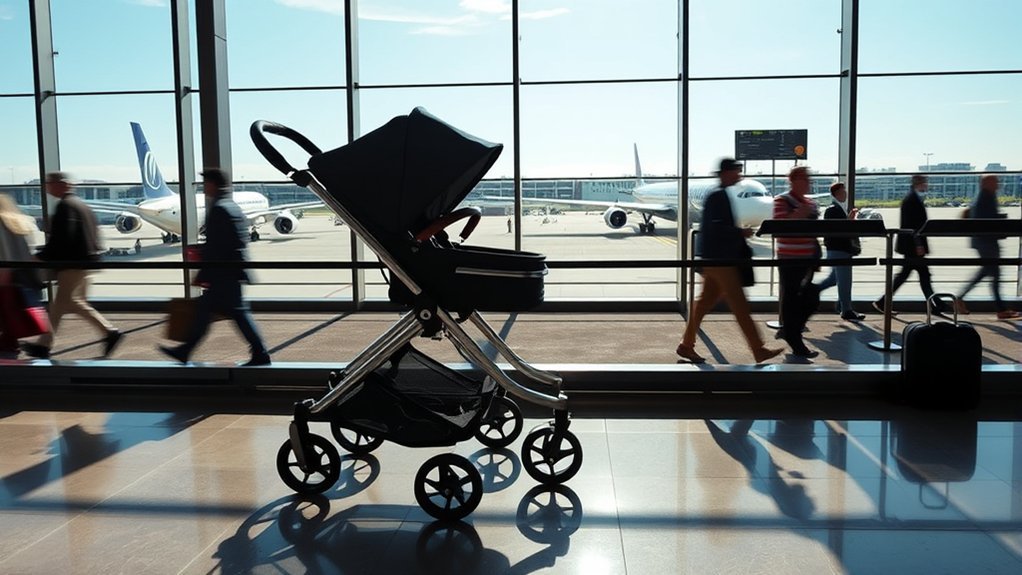
Do You Have to Check a Stroller When Flying?
You usually do not have to check a stroller with your regular luggage when flying. Many major U.S. airlines transport a stroller without a standard checked-bag fee, but whether you can gate-check it, must check it at the ticket counter, or can bring it into the cabin depends on the airline, stroller type, folded size, aircraft, and available storage space.
Last updated: September 22, 2026
Quick Answer
You usually do not have to check your stroller with regular luggage. Gate-checking is available on many airlines and lets you use the stroller through most of the airport, while very compact strollers may sometimes travel in the cabin if they meet the operating airline’s carry-on rules and space is available. Always confirm where a gate-checked stroller will be returned because pickup may be at the jet bridge, aircraft door, oversized-baggage area, or baggage claim.
Key Takeaways
- Many major U.S. airlines transport a stroller for a child without charging a standard checked-bag fee, but the exact allowance and check-in procedure vary.
- Gate-checking is often convenient because you can use the stroller through the terminal until boarding.
- A compact stroller may qualify for cabin storage only if it meets the operating airline’s carry-on rules and space is available.
- Gate-checking does not guarantee jet-bridge pickup; ask the agent where the stroller will be returned.
- A protective travel bag, clear identification, removed accessories, and pre-flight photos can reduce handling problems and simplify a damage claim.
At a Glance
| Best Option for Most Parents | Gate-check the stroller if you want to use it through the terminal, but ask where it will be returned after the flight. |
| Carry-On Stroller Rule | Only very compact folded strollers may qualify, and the operating airline’s cabin-bag rules and available storage space control. |
| Protection Tip | Remove loose accessories, label the stroller, photograph its condition, and use a protective bag if practical. |
| Main Risk | Damage, delayed return, or confusion about where to collect the stroller if the policy and pickup location are not confirmed before boarding. |
Understanding Airline Policies for Strollers
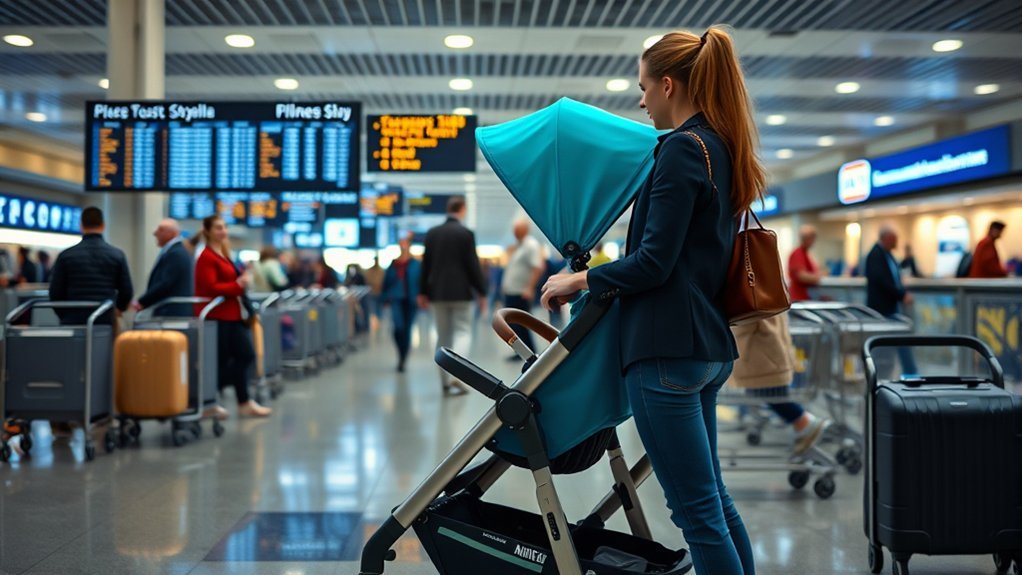
There is no single airline stroller rule that applies to every flight. Start with the official baggage or family-travel page for the airline actually operating your flight. A stroller that can be taken to the gate on one carrier may need to be checked at the ticket counter on another because of its design, size, or the carrier’s handling rules.
You can often gate-check your stroller, which means you keep it through the terminal and hand it to airline staff shortly before boarding. You normally receive a tag, remove loose items, fold the stroller, and leave it at the location identified by the gate staff.
If you want the stroller inside the aircraft cabin, measure it when fully folded and compare those measurements with the operating airline’s current carry-on rules. Do not rely on a generic “airline approved” or “cabin size” description alone. Final acceptance can also depend on the aircraft and available overhead storage.
If your itinerary includes a codeshare or partner airline, check the policy of the operating carrier for each flight segment. Do not assume the airline that sold the ticket uses the same stroller rules as the airline operating the aircraft.
| Airline | Current Published Stroller Guidance |
|---|---|
| American Airlines | American says each ticketed customer traveling with a child or for adoption may check one stroller and one car seat free. Both can be checked at the ticket counter, or one item can be checked at the gate and the other at the counter. Non-collapsible strollers and stroller wagons without built-in child safety straps must be checked at the ticket counter. |
| Delta Air Lines | Delta says strollers and child safety seats do not count as standard baggage and may be checked free at curbside, the ticket counter, or the gate. |
| Southwest Airlines | Southwest says each ticketed customer traveling with children may check one stroller and one car seat or child restraint free. Gate-checked items normally go to baggage claim at the final destination unless you ask the agent for jet-bridge return. |
| Alaska Airlines | Alaska says a child’s stroller and car seat travel free and may be checked with other baggage or at the gate. It also publishes a separate free allowance for child-carrying stroller wagons that collapse below its stated size and weight limits. |
Note: Airline staff have the final operational decision on cabin storage for your flight. Even a stroller that fits published carry-on dimensions may need to be checked if the aircraft or available bin space cannot accommodate it.
Options for Handling Your Stroller at the Airport
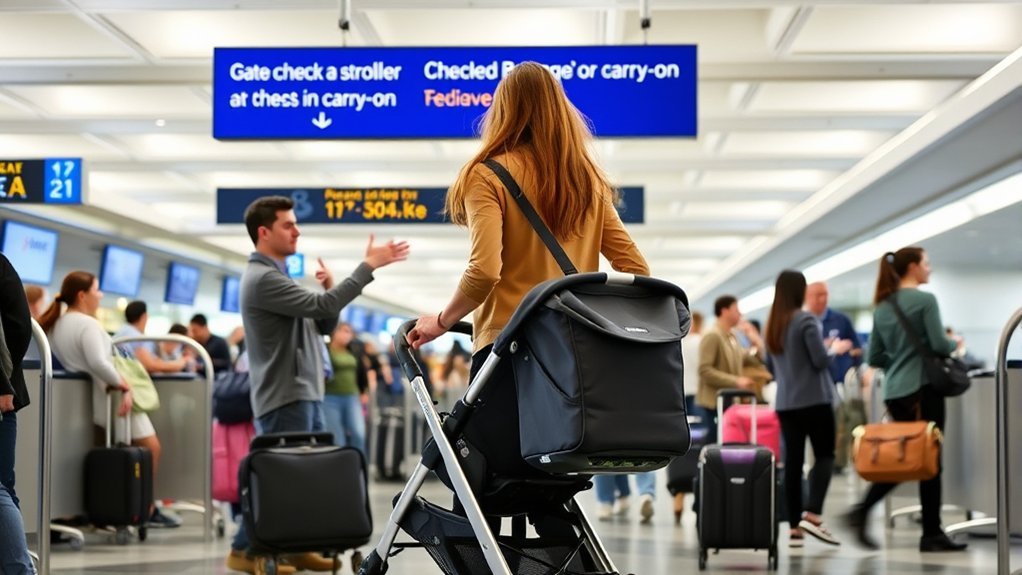
You normally have three practical ways to handle a stroller during air travel:
- Gate Check: Keep your stroller through the terminal, get the required tag, fold it before boarding, and hand it over at the location identified by airline staff. This is useful when your child still needs the stroller in the airport.
- Check at the Ticket Counter: Hand over the stroller with checked baggage before security. This can simplify security and boarding when the stroller is bulky, difficult to fold, or not eligible for gate check.
- Bring It Onboard: A very compact folded stroller may be accepted as cabin baggage if it meets the operating carrier’s rules and there is enough approved storage space.
If you are deciding between the first two options, see our detailed guide to checking a stroller at the airport counter.
A stroller bag, luggage tag, removable-accessory plan, and practice run with the folding mechanism can make any of these options easier.
Benefits of Gate Checking Your Stroller
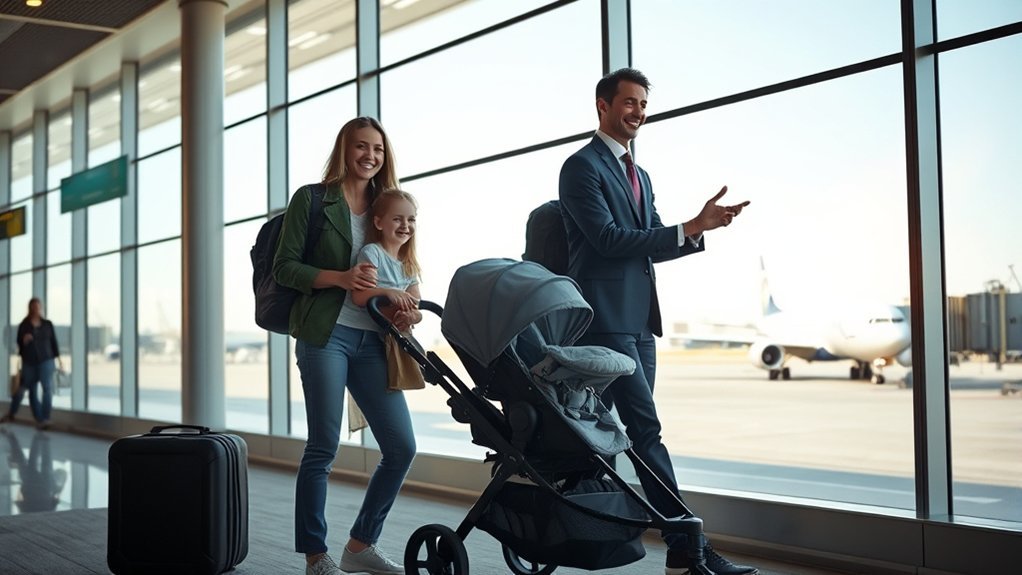
The main advantage of gate-checking is simple: you keep the stroller for most of the airport journey. That can help with long terminals, tired toddlers, naps, and carrying diaper bags or other small items.
Many major U.S. airlines transport child strollers without a standard checked-bag fee, although the exact allowance and gate-check eligibility vary. Confirm the rule for your airline rather than assuming every stroller type receives identical treatment.
Convenience Until Boarding
Gate checking your stroller can improve airport logistics in several ways:
- Terminal Transport: You can keep your child in the stroller while moving through much of the airport.
- Useful During Delays: The stroller remains available for seating or naps until the airline asks you to hand it over.
- Less Carrying: A stroller can reduce the amount of time you need to carry a tired child through long concourses.
For a tight connection, ask where the stroller will be returned before boarding. A gate-check tag does not guarantee that it will be waiting at the jet bridge during your layover.
Free Check-In Option
Many major U.S. carriers publish a free stroller allowance for passengers traveling with children, but their procedures are not identical. Some permit gate or counter check broadly, while others distinguish between stroller types or limit which child item can be handed over at the gate.
Here’s a practical look at the benefits and limitations:
| Benefit | Description | What to Confirm |
|---|---|---|
| Easy Navigation | Use the stroller through the terminal before handing it over. | Whether your stroller type is eligible for gate check. |
| No Standard Bag Fee on Many U.S. Airlines | Strollers are commonly treated as child-travel items rather than normal checked bags. | The carrier’s item-count, stroller-type, and size rules. |
| Flexible Handoff | Some carriers allow stroller check-in at the counter or gate. | Where your airline requires your particular stroller to be checked. |
| Airport Convenience | The stroller can help manage a child while you handle documents and carry-ons. | Where the stroller will be returned after each flight. |
Pro Tip: Take clear photos of the stroller, including its wheels, frame, fabric, and gate-check tag, immediately before handing it over. The photos can document its pre-flight condition if you need to report damage.
Requirements for Bringing Strollers on Board
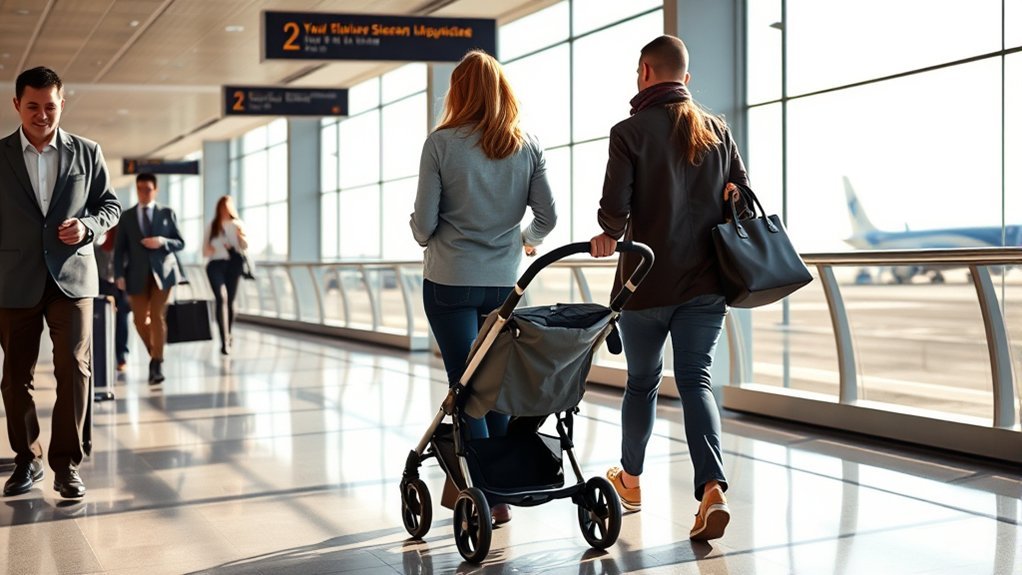
Bringing a stroller into the cabin is different from gate-checking it. The stroller must meet the operating airline’s cabin-baggage rules and fit in an approved storage location. A manufacturer’s “travel stroller” or “cabin-size” description does not override the airline’s requirements.
Most full-size, jogging, double, and travel-system strollers are more likely to require gate check or ticket-counter check than cabin storage. Measure your stroller fully folded, including wheels and handles, before departure.
Airline Size Restrictions
Use this three-step check before planning to bring a stroller onboard:
- Measure the Folded Stroller: Record its full length, width, and height with the wheels and normal folded parts in place.
- Check the Operating Airline: Compare those measurements with the airline’s current cabin-baggage rules and any stroller-specific guidance.
- Plan for Gate Check Anyway: Cabin acceptance may still depend on aircraft storage space, so pack the stroller so it can be checked if required.
If your main concern is folded size, see our separate guide to stroller size limits on airplanes.
Gate-Checking Procedures
When gate-checking, use the stroller through the terminal, then ask the gate staff for the correct tag and confirm the return location. Empty the basket, remove detachable accessories, fold the stroller fully, and leave it only where airline staff instruct.
Many airlines transport strollers without a standard checked-bag fee, but the rules for car seats, double strollers, wagons, and non-collapsible designs may differ.
| Stroller Type | What to Expect |
|---|---|
| Compact | May qualify for cabin storage if it meets the operating airline’s rules; otherwise it can often be gate-checked. |
| Standard | Usually needs to be folded and checked at the gate or ticket counter. |
| Double | Confirm the carrier’s size and gate-check rules because larger folded dimensions can affect handling. |
| Travel System | Confirm how the stroller frame and child restraint are counted and where each item must be checked. |
| Stroller Wagon | Rules vary significantly by carrier; some airlines publish separate wagon restrictions or size limits. |
A gate-checked stroller may be returned at the aircraft door, jet bridge, oversized-baggage area, or regular baggage claim. Confirm the pickup point before boarding, especially on connecting or international itineraries.
For wagon-specific rules, see our guide to gate-checking stroller wagons.
Warning: Remove toys, cup holders, snack trays, rain covers, hooks, organizers, and loose bags before handing over your stroller. Detachable parts can break, fall off, or become caught during handling.
Tips for Packing and Protecting Your Stroller
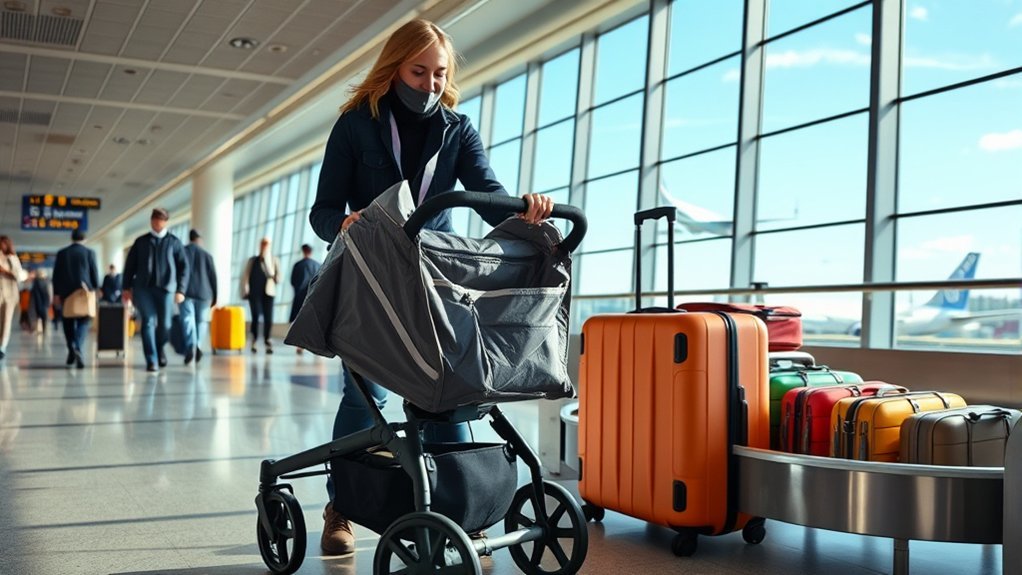
Checked and gate-checked strollers pass through airline handling systems, so prepare the stroller as if it may be lifted, stacked, rolled, or transferred between several teams. Protective packing cannot prevent every type of damage, but it can reduce dirt, scuffs, loose parts, and avoidable handling problems.
Use these packing steps:
- Use a protective travel bag when practical: A basic bag helps with dirt and loose pieces, while a padded bag adds cushioning. Neither guarantees protection against crushing or structural damage.
- Label the stroller and bag: Include current contact information and your destination details.
- Remove detachable parts: Take off cup holders, trays, hooks, organizers, rain covers, and other accessories that can snap off.
- Follow the manufacturer’s fold instructions: Use any transport or frame lock designed to keep the stroller securely folded.
- Photograph its condition: Take pictures immediately before the airline accepts it.
Always empty storage pockets and baskets before handoff. Diapers, wipes, bottles, medicine, toys, blankets, tablets, chargers, passports, boarding documents, and valuables should remain with you.
A stroller bag is not always required. For a more detailed decision, see whether you need a gate-check bag for your stroller.
If your stroller returns damaged, inspect it before leaving the airport and report the problem promptly at the airline’s baggage service desk. The U.S. Department of Transportation advises passengers to file baggage-damage claims with the airline as soon as possible. See the U.S. DOT guidance on lost, delayed, or damaged baggage for general passenger-rights information.
Navigating Airport Security With a Stroller
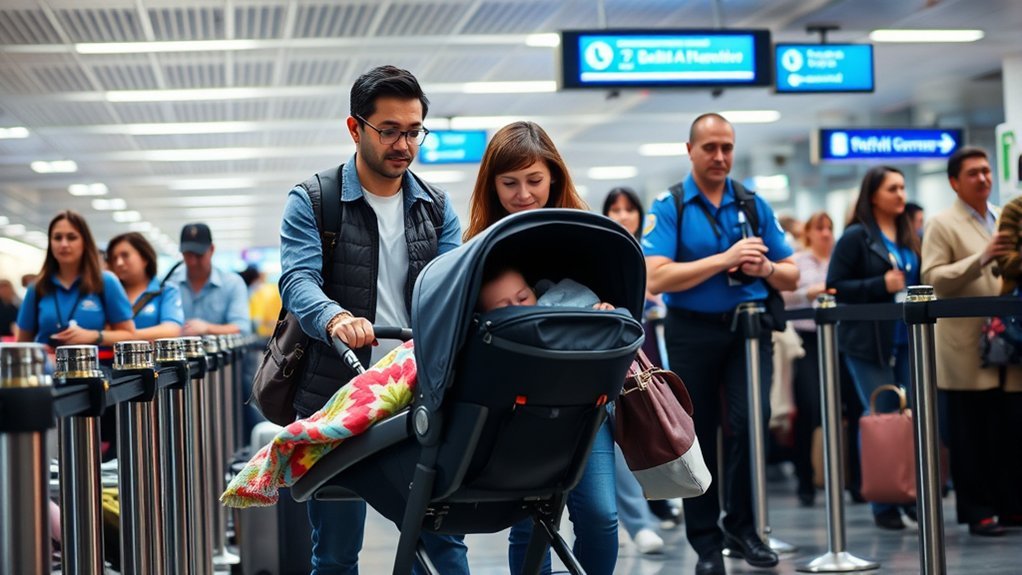
In the United States, strollers are allowed through the security checkpoint but must be screened. Remove your child from the stroller when directed by security staff. A stroller that fits the screening equipment may be sent through X-ray; equipment too large for the machine may require separate physical inspection.
Before reaching the checkpoint, empty the stroller basket and remove loose accessories so the stroller is easier to inspect. Baby food, formula, breast milk, toddler drinks, and related cooling items have separate TSA screening rules, so keep them accessible rather than buried under other belongings.
Security procedures can differ outside the United States and may also vary according to equipment at the departure airport. Follow the instructions given by security staff at the checkpoint.
Choosing the Best Stroller Option for Your Trip
Choose your stroller-handling method based on how much you need the stroller inside the airport, how easily it folds, and what your airline allows.
- Gate-check it if you need the stroller through the terminal, your airline accepts it at the gate, and you are prepared for varying pickup locations.
- Counter-check it if the stroller is bulky, difficult to manage through security, or the airline requires your stroller type to be checked before security.
- Carry it onboard only when the folded stroller meets the operating carrier’s cabin-baggage requirements and the airline accepts it for cabin storage.
A direct flight reduces the number of handoffs, while a connecting itinerary makes the stroller’s return location more important. If you expect to need the stroller during a layover, ask before the first flight whether it will be returned during the connection.
For international trips, bring a backup plan such as a baby carrier when appropriate. Some airports return gate-checked strollers at baggage claim or an oversized-baggage area instead of planeside.
Common Mistakes to Avoid When Flying With a Stroller
Most stroller problems at the airport come from policy assumptions or small preparation mistakes. Avoid these:
- Assuming every airline has the same rule: Check the operating carrier for each flight segment.
- Assuming gate check means jet-bridge return: Ask exactly where the stroller will be returned.
- Leaving belongings in the basket: Loose items can disappear during screening or loading.
- Leaving detachable accessories attached: Remove parts that can snap off or become caught.
- Not practicing the fold: Know how to collapse and lock the stroller before reaching the boarding door.
- Skipping identification: Put contact information on the stroller and any travel bag.
- Relying only on the stroller: Have another way to move your child if the stroller is delayed or sent to baggage claim.
- Leaving before checking for damage: Inspect the frame, wheels, brakes, folding mechanism, and fabric before leaving the airport.
Frequently Asked Questions
Do I have to check a stroller when flying?
No. You usually have several options. Depending on the operating airline and stroller, you may be able to gate-check it, check it at the ticket counter, or bring a very compact folded stroller into the cabin if it meets the airline’s cabin-baggage rules and storage space is available.
Can I use my stroller during layovers?
You can use your stroller during a layover only if the airline returns it to you between flights. Some gate-checked strollers are returned planeside, while others go to baggage claim or another pickup point. Ask the gate agent where it will be returned before your first flight.
Do different airlines have varying stroller policies?
Yes. Airlines differ on stroller allowances, gate-check eligibility, stroller-wagon treatment, cabin storage, and pickup procedures. Check the current policy of the airline operating each flight segment before you travel.
Where do I pick up a gate-checked stroller?
The pickup location varies by airline, airport, aircraft, and flight. A gate-checked stroller may be returned at the aircraft door, jet bridge, oversized-baggage area, or regular baggage claim. Ask the gate agent before boarding so you know where to look after landing.
Can I take a stroller through airport security?
Yes. In the United States, strollers can go through the security checkpoint but must be screened. Remove your child when instructed. A stroller that fits the screening equipment may go through X-ray, while a larger stroller may require separate inspection.
What if my stroller gets damaged during travel?
Inspect the stroller as soon as it is returned. If you find damage, report it to the airline before leaving the airport when possible, visit the baggage service desk, keep the claim tag, and show your pre-flight photos. Ask the airline for its baggage-damage claim procedure.
Are there size restrictions for strollers in overhead compartments?
Yes. A stroller carried in the cabin must meet the operating airline’s applicable cabin-baggage rules and fit in an approved storage location. If it is too large or storage space is unavailable, expect to check or gate-check it.
Can I gate check multiple strollers for siblings?
Possibly, but do not assume a universal one-stroller-per-child gate-check rule. Airline allowances and gate-check procedures differ, so confirm the number and type of child items allowed with your operating carrier before departure.
Is it better to gate-check or counter-check a stroller?
Gate-checking is usually more convenient when you need the stroller inside the airport. Counter-checking can be easier for a bulky stroller or when your airline requires that stroller type to be checked before security. The better option depends on your child, itinerary, stroller, and airline policy.
Do I need a stroller travel bag?
A stroller travel bag is not always required. A basic bag can help with dirt, moisture, scuffs, and loose parts, while a padded bag adds cushioning. No soft travel bag can guarantee protection against crushing or structural damage.
Conclusion
You do not automatically have to check a stroller with regular luggage when flying. Depending on the stroller and airline, you may be able to use it through the airport and gate-check it, check it at the ticket counter, or carry a very compact folded model onboard.
The most important step is to check the current policy of the airline operating your flight. Measure the stroller when folded, remove loose accessories, photograph its condition, label it clearly, and ask where it will be returned before you board. Those few checks prevent most of the confusion parents face when flying with a stroller.