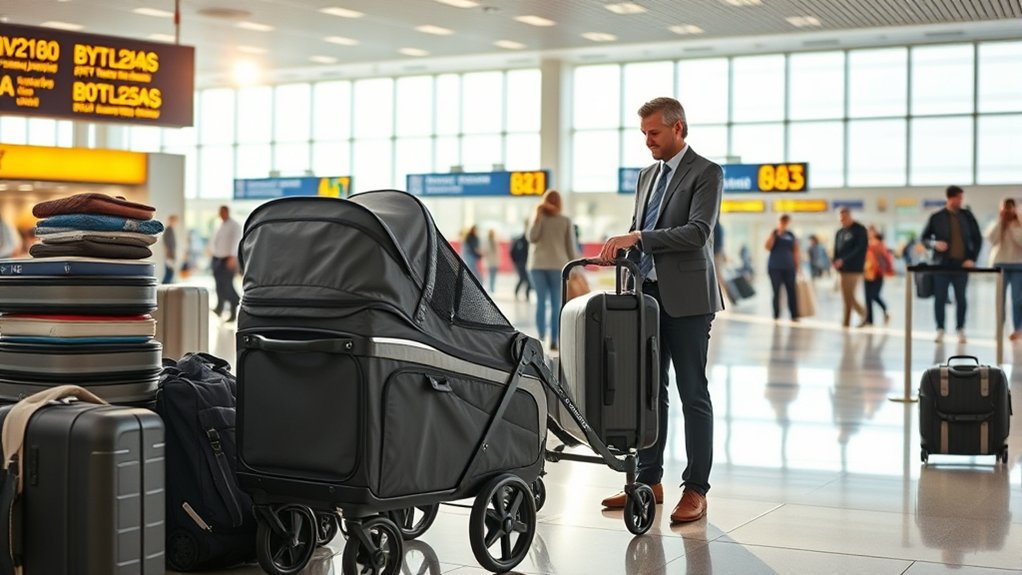
Last updated: September 22, 2026. Airline and TSA policies rechecked against current published guidance.
Yes, some airlines let you gate-check a stroller wagon, but it is not a universal rule. United explicitly allows folding wagons to be used to the departure gate and checked free, while Alaska allows qualifying child-carrying stroller-wagons that are under 90 linear inches and 35 pounds. American applies additional design restrictions, and Delta currently says wagons count toward checked baggage and should be checked before security.
Southwest allows eligible strollers to be checked at the gate but does not specifically define stroller wagons in its published child-item policy. Before you fly, check the policy of the airline actually operating your flight, measure and weigh your wagon when folded, remove loose accessories, and have a counter-check backup plan if the carrier does not explicitly accept your model at the gate.
Quick Answer
You can gate-check some stroller wagons, but the answer depends on the airline and the wagon itself. A folding wagon that is designed to carry children is more likely to qualify than a utility wagon. United explicitly permits folding wagons at the gate, Alaska publishes a 90-linear-inch and 35-pound limit for qualifying stroller-wagons, and other carriers apply different rules. Check the operating airline before every trip.
Key Takeaways
- Do not assume a stroller wagon receives the same treatment as a conventional stroller; airline classifications differ.
- Expect to empty and collapse the wagon for security when possible. Equipment too large for the X-ray machine may receive a visual or physical TSA inspection.
- Measure the wagon when folded and know its weight before leaving home.
- Remove cup holders, snack trays, toys, blankets, bags, and other loose accessories before handing the wagon over.
- Attach the airline’s tag plus your own ID tag with your name and phone number.
- Ask where the wagon will be returned. “Gate check” does not automatically guarantee jet-bridge delivery after landing.
At a Glance
| Best For | Parents traveling with toddlers, siblings, or child gear who need mobility through the terminal |
| Gate-Check Eligibility | Carrier-specific; folding, child-carrying models have the clearest acceptance on airlines that explicitly address stroller wagons |
| What to Measure | Folded length, width, height, and total weight |
| Tools Needed | Airline gate-check tag, personal ID tag, optional protective travel bag, and a secure strap if your wagon needs one to stay folded |
| Cost | Often free when the carrier classifies it as eligible child equipment; normal or oversized-baggage rules can apply when it is classified as a wagon or regular bag |
Which Airlines Let You Gate-Check a Stroller Wagon?
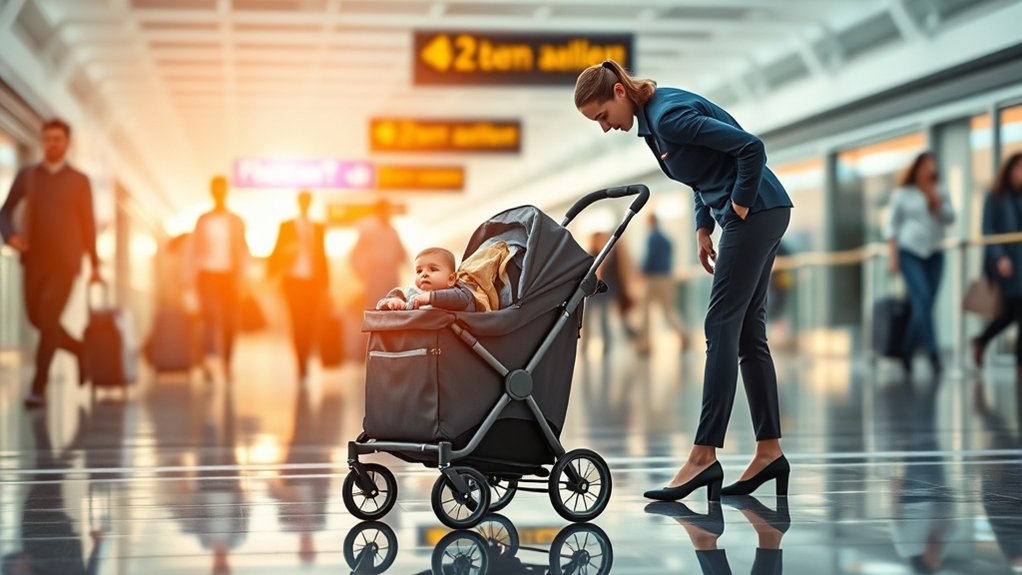
The most important rule is simple: “stroller wagon” does not have one industry-wide definition. Some airlines explicitly accept folding stroller wagons as child equipment, some place limits on them, and others distinguish wagons from strollers. The table below reflects published U.S. airline policies checked on September 22, 2026.
| Airline | Published stroller-wagon rule | What it means for you |
|---|---|---|
| United Airlines | United’s published family-travel policy covers a stroller or folding wagon as free child equipment and allows folding wagons to be used to the departure gate. | A folding wagon has an explicit path to gate check. Large non-collapsible strollers and non-folding wagons should be taken to the check-in counter. |
| Alaska Airlines | Alaska applies its free stroller treatment to stroller-wagons designed to carry children when they collapse to under 90 linear inches and weigh 35 pounds or less. | Measure the folded wagon and weigh it before travel. Larger wagons, utility wagons, or an additional wagon can fall under standard baggage rules. |
| American Airlines | American says non-collapsible strollers and stroller wagons without built-in child safety straps must be checked at the ticket counter. Its published allowance also limits how a stroller and car seat are split between gate and counter check. | Do not assume every folding wagon qualifies. Built-in child restraints and the carrier’s stroller classification matter. |
| Delta Air Lines | Delta allows strollers to be checked free at the curb, counter, or gate, but its current child-baggage page separately says wagons count toward the checked-baggage allowance and should be checked before security. | If your product is described as a stroller wagon, confirm Delta’s treatment before relying on gate check. |
| Southwest Airlines | Southwest permits an eligible stroller and child-restraint system to be checked free and allows stroller check-in at the counter or gate, but its published stroller page does not specifically define stroller wagons. | Confirm how Southwest will classify your particular wagon before travel instead of assuming the stroller rule automatically applies. |
These differences are why a generic “strollers fly free” statement is not enough. A child-carrying stroller wagon with seats and built-in restraints may be treated differently from a folding utility wagon designed mainly for cargo.
If you are on a codeshare or connecting itinerary, check the airline actually operating each flight. Rules and return procedures can differ between carriers even when the entire trip was purchased under one booking.
Policy note: This guide summarizes published airline and TSA rules. It does not assume that every airport, aircraft, or gate operation will handle a stroller wagon identically. Recheck the operating airline before each trip.
How Should You Prepare a Stroller Wagon for Gate Check?

Prepare the wagon before you reach the boarding line. Empty the storage areas, remove detachable accessories, practice the fold, and make sure the folded frame stays closed. Measure it in its fully folded form and record the weight so you can compare it with your airline’s published limits.
Keep passports, medication, electronics, formula, snacks, wipes, keys, wallets, and comfort items in your cabin bags. Anything left in the wagon can become inaccessible once the airline takes it.
Secure Loose Items
Detach cup holders, snack trays, removable canopies, clip-on fans, toys, hooks, organizers, and other pieces that can fall off or snag during baggage handling. Store important removable parts in your carry-on when practical.
If a component must stay attached, make sure it is secured according to the wagon manufacturer’s instructions. Do not use the wagon itself as a checked container for backpacks, shopping bags, blankets, or loose personal belongings.
Add your own identification tag with your name and phone number. If you use a travel bag, put identification on both the wagon and the bag.
Fold and Tag
Use the manufacturer’s normal folding procedure and engage the folding latch or lock if the model has one. Check that fabric, straps, canopies, handles, and wheels are not left in positions where they can drag or snag.
Ask the airline representative for the correct gate-check tag before boarding begins. Attach it to a strong, non-removable part of the frame or to the travel bag and keep the claim stub or receipt if one is provided.
A protective travel bag can reduce dirt and minor scuffs and keep detached parts together, but it does not guarantee against damage or change the airline’s eligibility rules. For more detail, see the site’s guide to stroller gate-check bags.
Pro Tip: Take clear photos of the folded wagon, wheels, frame, fabric, and airline tag before handing it over. The photos can help document its pre-flight condition if you later need to report damage.
How Does Gate Checking a Stroller Wagon Work?
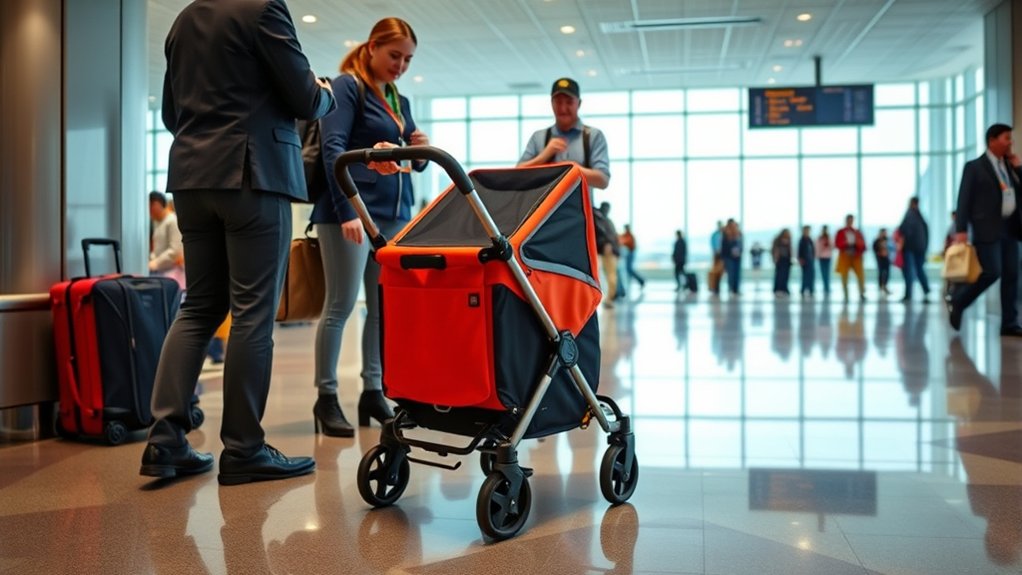
If your airline accepts the wagon at the gate, you normally use it through the terminal, obtain the airline’s tag, remove your belongings, fold it, and leave it at the airline’s designated handoff point near the gate, jet bridge, or aircraft door.
Gate check describes where you hand the item to the airline; it does not guarantee where it will be returned. Return procedures differ by airline and airport. Southwest, for example, says gate-checked strollers normally go to baggage claim unless the passenger asks for jet-bridge delivery. Ask the agent handling your specific flight where to collect the wagon.
Airline Policy Variations
Start with the operating airline’s written rule rather than assuming all carriers treat stroller wagons alike. Check for the terms stroller, stroller wagon, folding wagon, wagon, child equipment, and special baggage.
Pay attention to four decision points: whether the wagon is designed to carry children, whether it has built-in restraints, whether it collapses, and whether its folded size or weight exceeds a published limit. Alaska’s current rule is a useful example: qualifying stroller-wagons must be designed to carry children, collapse to under 90 linear inches, and weigh 35 pounds or less.
If the airline’s policy does not mention stroller wagons clearly, confirm the classification before travel and plan for the possibility of ticket-counter check-in.
Preparation Steps Required
Once you know the wagon is eligible to reach the gate, the physical process is straightforward:
| Step | Action Required | Notes |
|---|---|---|
| 1. Verify policy | Check the operating airline’s current rule | Confirm wagon type, folded size, weight, and any restraint requirement |
| 2. Get the tag | Tell the airline you plan to gate-check the wagon | Do this before boarding is underway |
| 3. Empty and fold | Remove loose items and fully collapse the wagon | Lock the folded frame if your model supports it |
| 4. Attach identification | Secure the airline tag and your own ID tag | Keep the claim stub if one is issued |
| 5. Confirm pickup | Ask where the wagon will be returned | It may be the jet bridge, gate, baggage claim, or oversized-baggage area |
If you need broader guidance on the difference between counter checking and gate checking a conventional stroller, see the airport stroller-checking guide.
Tagging and Identification Process
Use both the airline’s operational tag and your own identification. Place the airline tag where baggage handlers can see it without attaching it to a removable tray, canopy, cup holder, or organizer.
Your personal tag should include enough contact information for the airline to identify you if the operational tag is damaged or separated. Keep a photo of the tag and the wagon on your phone until the item has been returned.
What Happens When You Board With a Stroller Wagon?
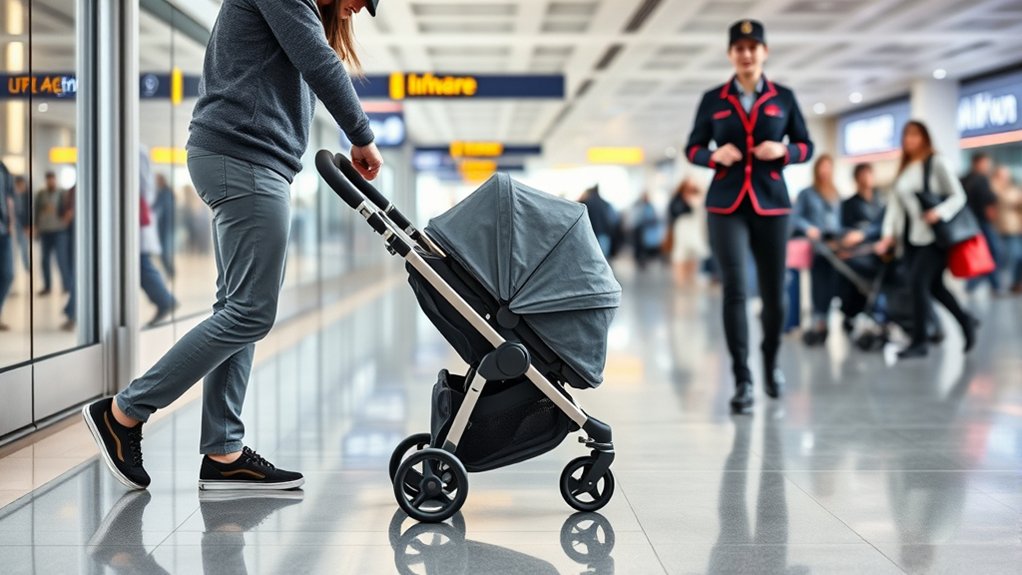
Family or pre-boarding procedures vary by airline, so follow the boarding instructions for your flight. The useful goal is to have the wagon empty, tagged, and ready to fold before your boarding group is called.
| Step | Details |
|---|---|
| 1. Before boarding | Obtain the correct tag and confirm the handoff and pickup locations. |
| 2. Approach the aircraft | Use the wagon only as far as airline staff permit. |
| 3. Remove the child and belongings | Take out children, bags, valuables, food, medication, and loose gear. |
| 4. Fold the wagon | Collapse and secure it using the manufacturer’s normal procedure. |
| 5. Hand it over | Leave it only at the location identified by airline staff. |
| 6. Retrieve and inspect | Collect it from the location specified by the airline and check for damage before leaving the airport area. |
If two adults are traveling together, deciding in advance who manages the children and cabin bags while the other adult folds and hands off the wagon can make boarding easier.
How Does TSA Screen a Stroller Wagon?
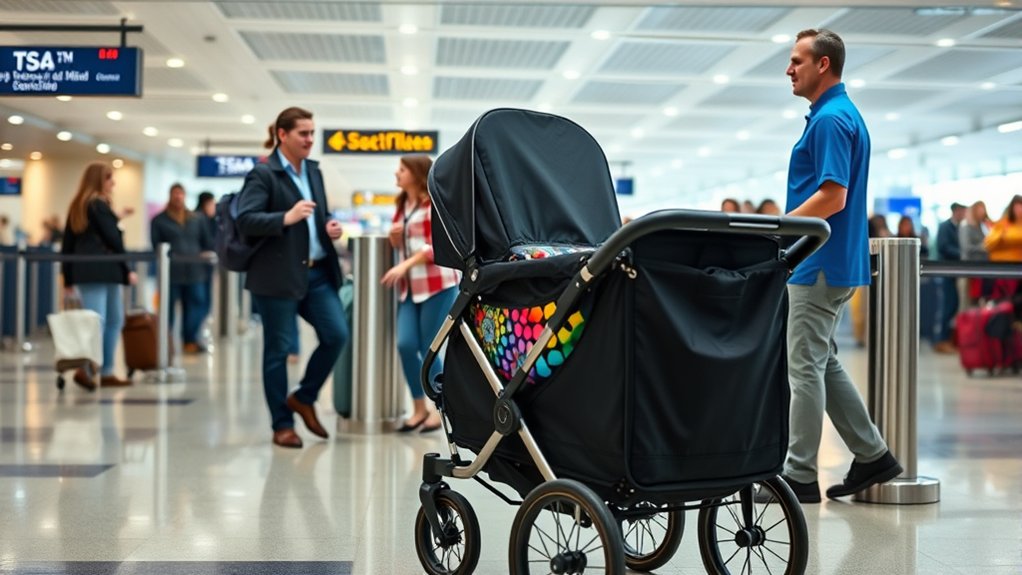
The TSA’s traveling-with-children guidance says strollers and other child-related equipment must be screened. Equipment that fits through the X-ray machine is screened there; equipment that does not fit receives a visual or physical inspection by TSA officers.
Remove the child from the wagon for screening. Empty pockets and storage areas of toys, blankets, electronics, bottles, bags, and other belongings so those items can be screened separately as directed.
Formula, breast milk, toddler drinks, and baby or toddler food can be carried in quantities greater than the normal 3.4-ounce/100-milliliter liquids limit. Tell the TSA officer at the beginning of screening and remove those items from your carry-on for separate screening as instructed.
TSA screening and airline baggage acceptance are separate questions. Passing the wagon through the security checkpoint does not guarantee that the airline will accept it for gate check.
Warning: Never leave medication, passports, boarding passes, keys, wallets, baby formula, electronics, or must-have comfort items inside a stroller wagon when you hand it to the airline. Keep essential items with you in the cabin.
How Can You Make Stroller-Wagon Gate Check Easier?
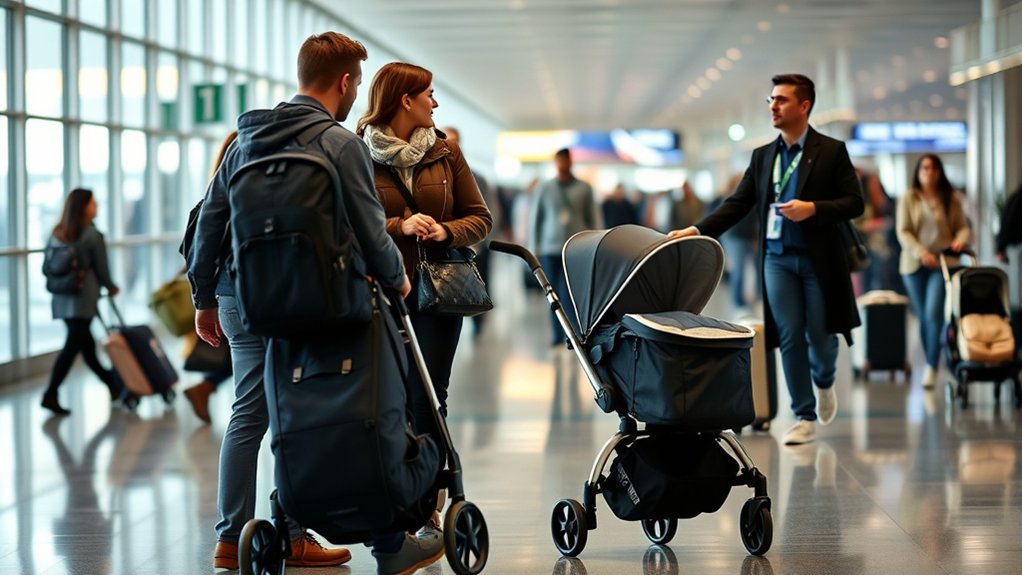
First, verify the policy before the travel day rather than trying to settle the classification at the aircraft door. Save the relevant airline policy page on your phone so you can reference the published wording if necessary.
Second, arrive knowing your wagon’s folded measurements and weight. For an airline using linear dimensions, add the folded length + width + height. This is especially useful with Alaska’s published stroller-wagon threshold.
Third, keep the wagon empty when you hand it over. A stroller wagon may carry a surprising amount of family gear through the terminal, but those items should be moved to your cabin bags before gate check.
Fourth, use both an airline tag and a personal ID tag. A protective bag or bright strap can also make the folded wagon easier to identify, although neither changes the airline’s baggage rules.
Finally, ask about the return location on every segment. This is especially important during a connection because a wagon sent to baggage claim may not be available to use between gates.
What If Your Stroller Wagon Is Missing or Damaged?
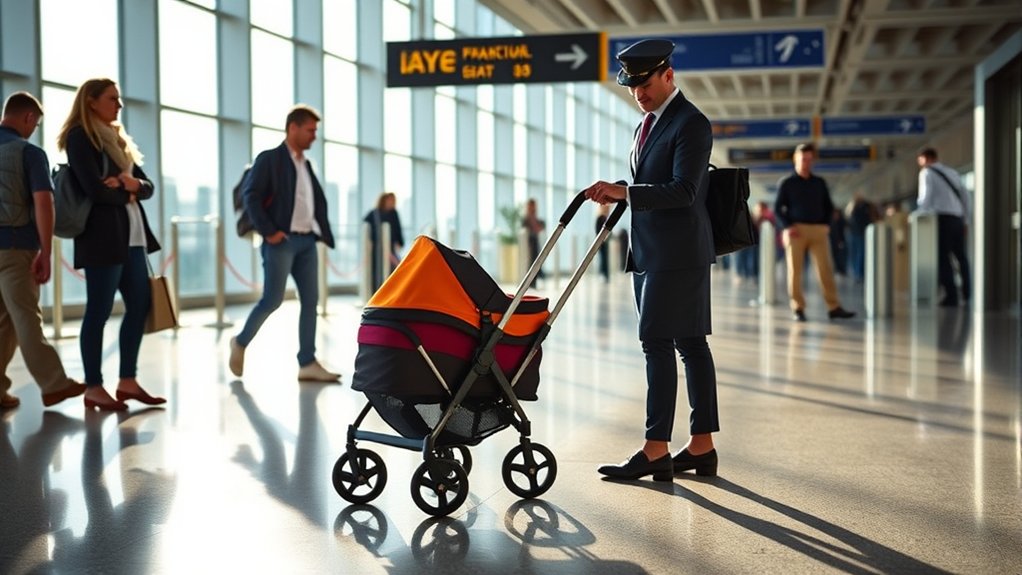
If the wagon is not where you expected it, first ask the airline where gate-checked child equipment from that flight is delivered. Depending on the carrier and airport, the correct location may be the aircraft door, jet bridge, gate area, regular baggage claim, or oversized-baggage area.
Keep the baggage or gate-check receipt until the wagon has been returned. If it is damaged, photograph the affected area, the entire wagon, its tag, and any model-identification label before leaving the airport area when practical.
Report the problem to the airline promptly and follow that carrier’s baggage-claim procedure and reporting deadlines. Coverage and liability terms can vary by airline and itinerary, so use the carrier’s current baggage policy or Contract of Carriage rather than assuming all stroller damage is handled the same way.
Benefits of Using a Stroller Wagon for Air Travel
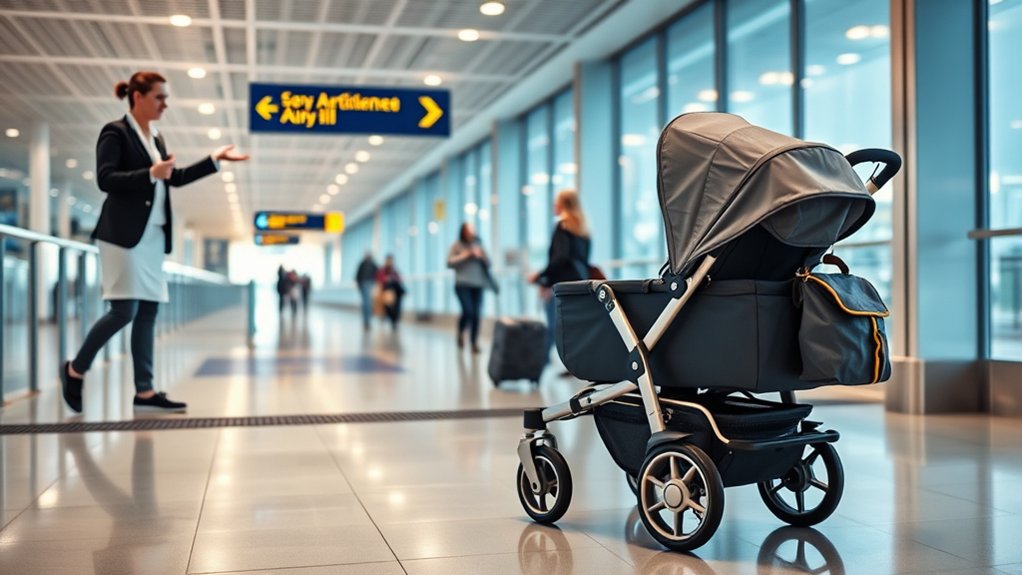
A stroller wagon can be useful during airport travel when you are managing toddlers, siblings, diaper bags, snacks, and long walks between security and the gate. It gives children a defined place to sit and can keep small family items organized while you move through the terminal.
The tradeoff is that stroller wagons are usually bulkier than compact travel strollers. That makes the airline’s definition of a stroller, folding wagon, or ordinary wagon especially important.
| Feature | Travel Benefit | What to Check Before Flying |
|---|---|---|
| Compact Fold | Easier handling and storage | Folded dimensions and locking mechanism |
| Manageable Weight | Easier to lift when required | Airline weight limits |
| Built-in Child Restraints | Supports child-carrying use | Carrier rules that distinguish stroller wagons from utility wagons |
| Built-in Storage | Useful while moving through the terminal | Storage must be emptied before handoff |
| Sturdy Wheels | Easier movement over terminal surfaces and jet bridges | Remove detachable wheel accessories if the manufacturer permits and handling requires it |
If your priority is the smallest possible airport footprint rather than carrying multiple children or lots of gear, a lightweight travel stroller may be simpler to handle.
How Do You Choose a Stroller Wagon for Flying?
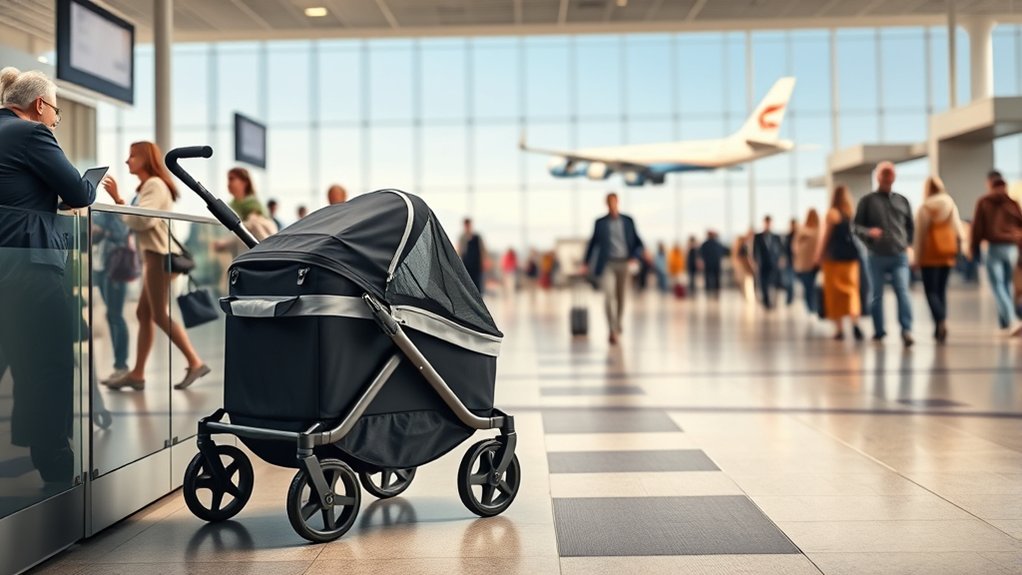
For air travel, prioritize folded size, weight, child-carrying design, restraints, and ease of folding before features such as extra storage or oversized all-terrain wheels.
Consider these travel-specific factors:
- Collapsibility: Select a model that folds completely and stays secured when folded.
- Folded Dimensions: Measure the wagon at its widest, longest, and tallest points after folding. Linear inches are calculated by adding length + width + height.
- Weight: Know the wagon’s empty travel weight. Alaska, for example, currently limits its qualifying stroller-wagon treatment to 35 pounds or less and under 90 linear inches.
- Child-Carrying Design: A purpose-built stroller wagon with seats and child restraints has a clearer child-equipment purpose than a general utility wagon.
- Built-in Restraints: Check this especially carefully when flying American Airlines because its published policy specifically addresses stroller wagons without built-in child safety straps.
- Removable Parts: Fewer loose trays, cup holders, organizers, and detachable accessories mean fewer components to protect before handoff.
- Liftability: Choose a wagon you can briefly lift or reposition when security or airline staff require it.
Frequent flyers should also compare the wagon’s folded dimensions with the trunk, rental-car, shuttle, and hotel storage space they expect to use after landing. Airport acceptance is only one part of travel convenience.
Stroller Wagon Gate-Check Mistakes to Avoid
Most problems are easier to avoid when you separate airline policy, TSA screening, and baggage handling into three different steps.
- Assuming every wagon is a stroller: Utility wagons and child-carrying stroller wagons can receive different treatment.
- Checking only the word “stroller” in the policy: Search the carrier’s page for stroller wagon, folding wagon, wagon, child equipment, and special baggage.
- Ignoring folded size and weight: Measure and weigh the wagon before travel.
- Leaving belongings in the wagon: Move personal items to your cabin bags before handoff.
- Waiting until boarding to request a tag: Get the correct tag before your boarding group is called.
- Using only the airline tag: Add a separate personal ID tag.
- Assuming gate check means jet-bridge return: Confirm the collection point for every flight.
- Keeping fragile accessories attached: Remove detachable trays, fans, cup holders, toys, and organizers when practical.
- Checking the marketing airline but not the operating carrier: Verify every segment of a codeshare or connection.
Related Guides
Frequently Asked Questions
Which U.S. airlines explicitly address stroller wagons?
United explicitly addresses folding wagons, and Alaska explicitly covers qualifying child-carrying stroller-wagons under its published size and weight limits. American specifically addresses stroller wagons without built-in child safety straps. Delta separately says wagons count toward checked baggage, while Southwest’s published stroller policy does not specifically define stroller wagons. Recheck your operating airline before every trip because policies can change.
Can I use my stroller wagon throughout the airport?
Only if the airline allows your wagon to be taken through the terminal and TSA permits it through screening. You should expect to remove the child and have the wagon screened at security. If your airline requires the wagon to be checked at the ticket counter, you will not be able to use it all the way to the gate.
What if my stroller wagon gets damaged during gate check?
Photograph the damage, the entire wagon, and its airline tag, then report the problem to the airline promptly and follow that carrier’s baggage-claim procedure. Keep the claim tag, boarding information, purchase documentation, and model information until the issue is resolved.
Are there weight limits for stroller wagons at the gate?
It depends on the airline. Alaska currently applies a 35-pound maximum and a limit of under 90 linear inches to stroller-wagons that qualify for its child-equipment treatment. Other airlines use different rules or do not publish a specific stroller-wagon weight limit, so check your operating carrier.
Can I bring additional items in my stroller wagon during gate check?
Do not leave personal belongings or loose gear in the wagon when you hand it to the airline. Remove backpacks, toys, blankets, food, bottles, electronics, medication, documents, and detachable accessories, and keep essential items with you in the cabin.
Do I need to collapse my stroller wagon for gate check?
Yes, if the airline accepts your stroller wagon at the gate, you should expect to hand it over fully collapsed and secured. Folding also matters at TSA screening when the equipment can fit through the X-ray machine. Equipment that is too large for the machine may receive a visual or physical inspection instead.
Will my stroller wagon be returned at the jet bridge?
Not necessarily. Gate check describes where the item is handed to the airline, not a guaranteed return location. Depending on the airline, airport, and flight, it may be returned near the aircraft, at the jet bridge, at the gate, at regular baggage claim, or at oversized baggage. Ask the gate agent before boarding.
Is a stroller wagon better than a regular stroller for flying?
A stroller wagon can be useful for multiple children and extra gear, but a compact travel stroller is usually lighter and faces fewer airline-policy questions. For frequent flying, compare folded size, weight, ease of folding, child restraints, and your airline’s rules before deciding which option is more practical.
Conclusion
You can gate-check some stroller wagons, but you should not assume that every airline treats them like ordinary strollers. Check the operating carrier first, then compare your wagon’s design, folded dimensions, weight, and restraints with that airline’s published rule.
Before leaving home, measure and weigh the folded wagon. At the airport, empty it before security and again before handoff, remove loose accessories, secure the fold, use both an airline tag and a personal ID tag, and ask where it will be returned. If the airline does not explicitly recognize your stroller wagon, keep a ticket-counter check-in plan as your backup.
Sources
- TSA — Traveling with Children — child-equipment screening, X-ray procedures, and screening of children.
- TSA — What Can I Bring: Strollers — stroller screening and transportation guidance.
- United Airlines — Traveling with Children — folding-wagon and stroller handling.
- Alaska Airlines — Infants and Children — stroller-wagon design, weight, and linear-dimension limits.
- American Airlines — Traveling with Children — stroller allowances and stroller-wagon restraint requirements.
- Delta Air Lines — Children and Infant Items — free stroller handling and separate wagon baggage guidance.
- Southwest Airlines — Stroller and Child Items Policy — stroller check-in locations, allowance, and return guidance.
- U.S. Department of Transportation — Fly Rights — checked-baggage and passenger guidance.

