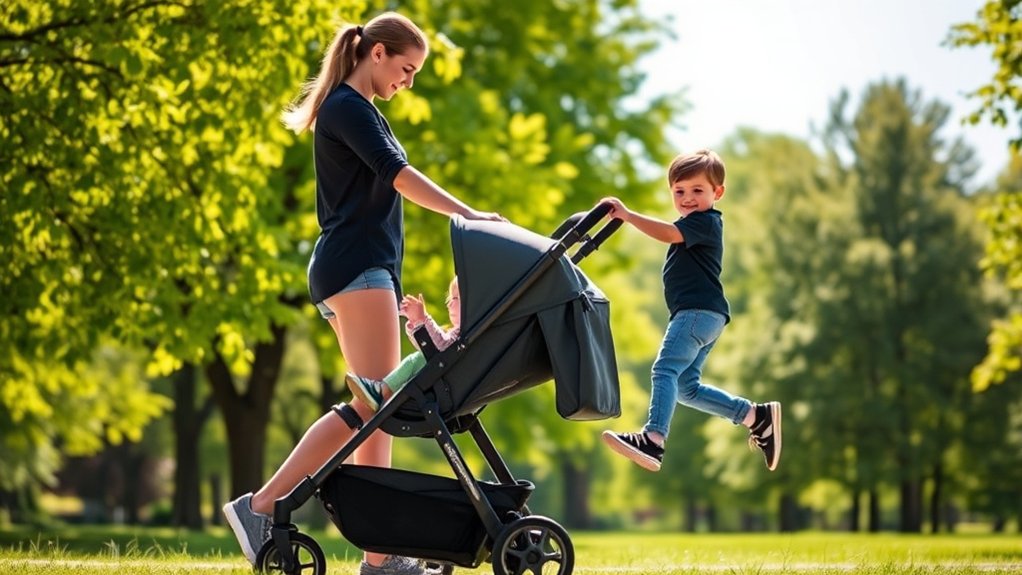
A sit-and-stand stroller helps you move two children with one stroller when one child still needs a seat and the older child wants more freedom. It usually has a front seat for a younger child and a rear bench or standing platform for an older child. This makes it useful for school runs, errands, theme parks, sidewalks, and short family outings where a full double stroller may feel too bulky.
Quick Answer
A sit-and-stand stroller works by giving one child a regular stroller seat while an older child rides on a rear bench or standing platform. It is best for families with a baby or toddler plus an older child who can follow instructions, hold on securely, and stay within the stroller’s weight limits.
Key Takeaways
- A sit-and-stand stroller is designed for two children, usually one seated in front and one older child sitting or standing in the back.
- Always check the exact weight limit, age guidance, and car seat compatibility for the model you choose.
- The rear platform works best for an older child who can balance, hold the handles, and follow safety rules.
- Look for a 5-point harness, reliable rear brake, large canopy, stable frame, and easy one-hand fold.
- A sit-and-stand stroller is flexible, but it may feel longer, heavier, or harder to steer than a single stroller.
At a Glance
| Best For | Families with two children of different ages, especially a younger seated child and an older child who wants to hop on and off. |
| Typical Weight | Many models weigh about 20 to 30 pounds, though larger double models can be heavier. |
| Key Safety Checks | Harness fit, brake lock, platform grip, child weight limits, wheel condition, and car seat compatibility. |
| Main Tradeoff | More flexible than a single stroller, but often longer and less compact than a lightweight everyday stroller. |
Understanding the Sit-and-Stand Stroller Design
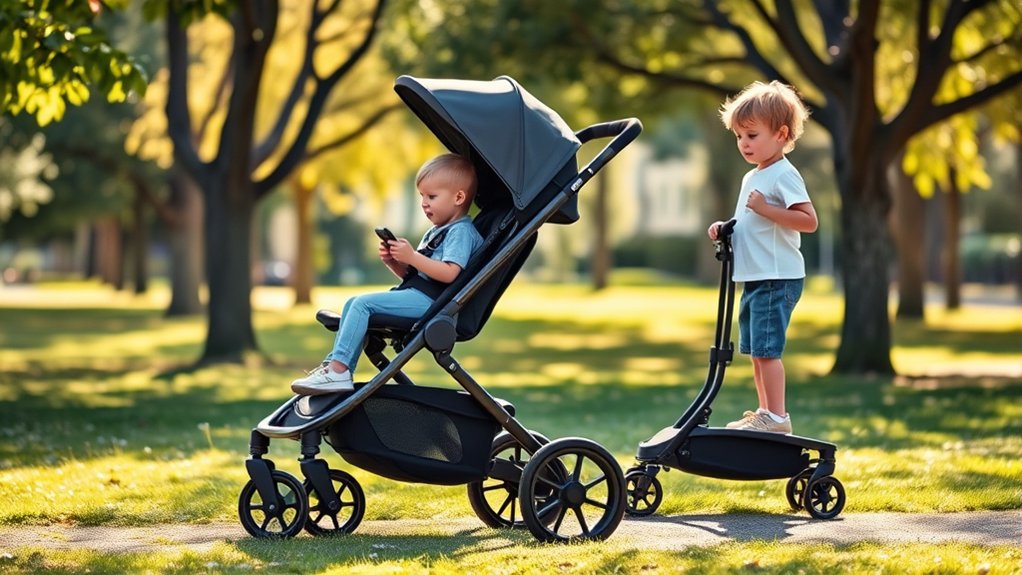
When you explore the Sit-and-Stand stroller design, you’ll find it is built for flexibility, convenience, and families with children at different stages. Instead of using two full stroller seats side by side, it usually uses a stacked tandem layout. One child rides in the main seat while the older child sits on a rear bench or stands on a rear platform.
Some sit-and-stand models support a combined weight of up to 22KG, while many other models use separate limits for the front seat and rear riding area. Because limits vary by model, always check the stroller label and manual before use. This matters because overloading the stroller can affect steering, braking, folding, and stability.
This design gives you flexibility in busy places. The rear seat can often be removed, letting one child sit in the front while the other enjoys the rear platform. Some models weigh around 15KG, which can make them easier to transport than larger double strollers. The stroller’s one-hand folding mechanism also simplifies storage, especially when you are moving between the car, sidewalk, store, or home.
Many sit-and-stand strollers are also compatible with selected Baby Trend car seats or other approved infant car seats, depending on the exact model. This helps the stroller adapt to your children’s developmental stages and supports your family’s dynamic lifestyle.
Note: “Sit N’ Stand” is often used for Baby Trend models, while “sit-and-stand stroller” is the general stroller type. Always compare the exact model name before buying accessories or car seat adapters.
How a Sit-and-Stand Stroller Works
A sit-and-stand stroller works by combining a regular stroller seat with a rear riding option. The younger child usually rides in the front seat with a harness. The older child can either stand on the back platform while holding the handles or sit on a small rear bench when the stroller includes one.
This setup is helpful when your older child is too big for a full stroller seat but still gets tired during longer walks. It also gives you better control in places where holding hands may be difficult, such as parking lots, sidewalks, airports, parks, and crowded events.
- Front seat: Best for a baby or younger toddler who still needs full support and a harness.
- Rear bench: Best for an older child who wants to rest but does not need a full stroller seat.
- Rear standing platform: Best for short rides when the older child can stand steadily and hold on.
- Car seat mode: Best for newborn use only when the stroller is approved for the specific infant car seat.
Key Features and Benefits for Parents
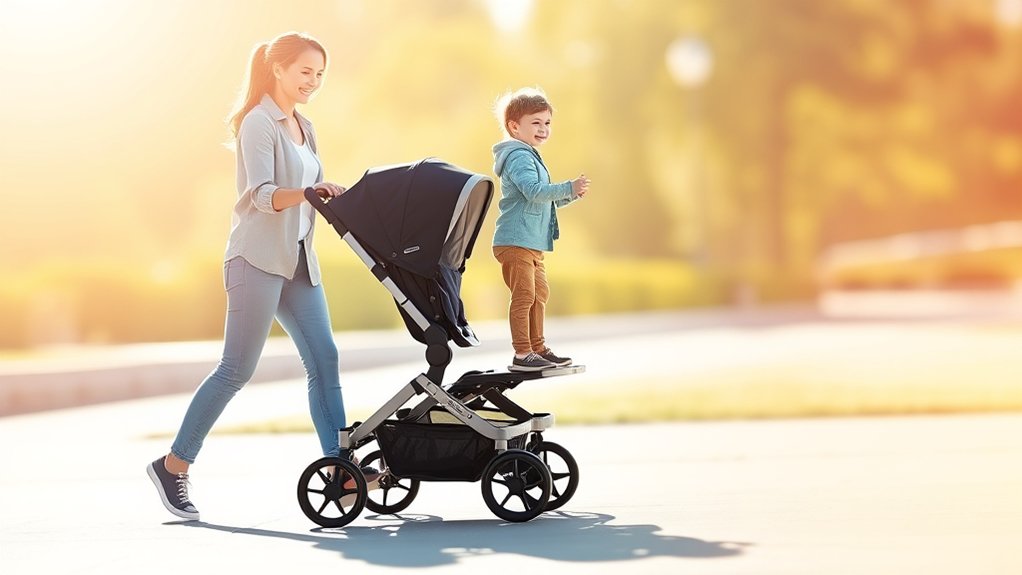
As you navigate the challenges of parenting multiple young children, the Sit N’ Stand Double Stroller can be valuable because it gives you several riding choices in one frame. This stroller’s stacked tandem seats support two children while keeping the stroller narrower than many side-by-side double strollers. That can make it easier to move through doorways, store aisles, sidewalks, and busy family spaces.
You can remove the rear seat on many models, giving one child the option to sit or stand as they grow. This is one of the biggest benefits for parents with an older child who wants independence but still needs a safe place to ride when tired.
| Feature | Benefit | Child Comfort |
|---|---|---|
| Lightweight design | Easy to carry and store | Comfortable seating |
| 5-point harness | Secure travel | Adjustable for growth |
| Large canopy | Sun protection | Shield from elements |
With these features, you get a versatile and efficient solution for daily adventures. A sit-and-stand stroller can also reduce the need to carry an older child when they become tired. That small convenience can make a big difference during errands, family trips, and longer walks.
Safety Considerations for Your Children
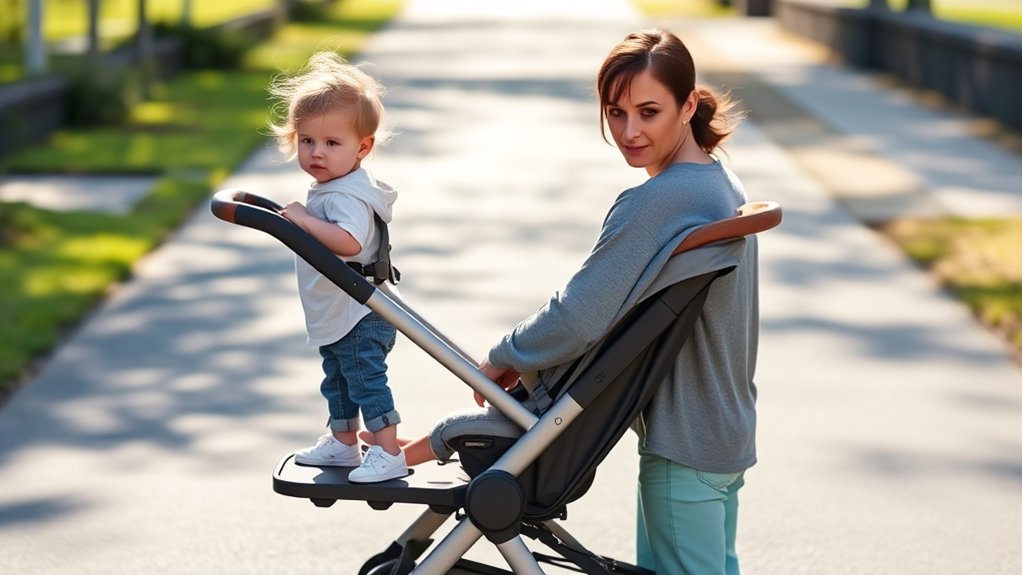
Ensuring your children’s safety in a Sit N’ Stand stroller is essential. The most important safety step is using the stroller only as the manufacturer allows. That means following the listed age range, weight capacity, seating position, car seat compatibility, and folding instructions.
The adjustable 5-point safety harness secures your child in the stroller seat and helps prevent leaning, sliding, or climbing out. The standing child should always hold the rear handles, face forward, and keep both feet on the platform. If your child cannot follow those rules, the rear standing platform may not be the right option yet.
You’ll also appreciate the foot-activated rear brake mechanism, which locks the stroller in place when stationary. Use the brake every time you stop, even on flat ground. Soft padding, a sturdy frame, and an extra-large canopy can improve comfort and help shield your children from sun exposure, but they do not replace close supervision.
Some sit-and-stand strollers are designed for kids aged 2.5 years and older in the rear riding position. Others may have different age guidance, so do not rely on age alone. Your child should be mature enough to stand still, hold on, and avoid jumping off while the stroller is moving.
Warning: Never let a child ride on the rear platform unless the stroller is designed for it. Do not hang heavy bags from the handlebar, because that can make the stroller tip backward.
Using the Stroller: Tips for Parents

Using a Sit N’ Stand stroller can be a game changer for parents with multiple children, especially because it offers various seating configurations to match changing needs. You can switch between having one child seated in the front and the other either sitting in the rear or standing on the platform.
Before each outing, check that the stroller is fully locked open. Make sure the wheels roll smoothly, the brake works, and the rear platform is clear. Adjust the 5-point safety harness so it sits snugly on the seated child. A loose harness can allow too much movement, while a too-tight harness can be uncomfortable.
Teach your older child three simple rules: hold the handles, keep both feet on the platform, and wait until the stroller fully stops before stepping off. These rules are especially important near curbs, slopes, parking lots, and store entrances.
To guarantee a smoother experience, prioritize stroller maintenance by regularly checking the wheels and frame for signs of wear. Remember to engage the foot-activated rear brake when stationary. This lightweight stroller folds effortlessly with one hand, making shifts between car and stroller use easier, especially when compatible with approved Baby Trend car seats.
Pro Tip: Practice folding, unfolding, braking, and switching seat modes at home before your first long outing. It is much easier to learn the stroller before you are managing two tired children in public.
Choosing the Right Sit-and-Stand Stroller for Your Family

How can you find the perfect Sit-and-Stand stroller for your family? Start by considering the weight capacity. Many models support up to 50 lbs in the front seat and another 50 lbs on the rear platform, totaling 100 lbs. Other models use lower or higher limits, so check the exact stroller before buying.
Look for customizable seating configurations that adapt as your children grow. A removable rear seat, standing platform, bench seat, parent tray, child tray, storage basket, and reclining front seat can all affect daily convenience. If you have a newborn, compatibility with infant car seats is essential for transporting your baby safely and smoothly.
Prioritize safety features such as a 5-point harness, foot-activated rear brake, sturdy frame, lockable fold, and large canopy for sun protection. Finally, evaluate portability. Choose a stroller that fits your trunk, storage space, doorway, and daily lifting comfort. A one-hand fold mechanism can be helpful, but only if the stroller still feels stable and manageable.
Sit-and-Stand Stroller vs. Double Stroller
A sit-and-stand stroller is not always better than a traditional double stroller. It depends on your children’s ages, your walking habits, and how much support each child needs. A full double stroller is usually better for twins, two babies, or two toddlers who both need regular naps and full seats. A sit-and-stand stroller is usually better when the older child walks part of the time but still needs a place to ride.
| Option | Best For | Possible Drawback |
|---|---|---|
| Sit-and-stand stroller | Baby or toddler plus an older child who wants to walk sometimes | Rear rider may have less comfort for long naps |
| Side-by-side double stroller | Two children who both need full seats and equal comfort | Wider frame can be harder in tight spaces |
| Tandem double stroller | Two seated children in a narrower front-to-back layout | Longer frame may feel harder to steer or lift |
Common Mistakes to Avoid
A sit-and-stand stroller is simple to use, but a few mistakes can make outings harder or less safe. The biggest mistake is assuming every model works the same way. Some accept infant car seats, some do not. Some include a rear bench, while others only include a standing platform. Some are suitable for older toddlers, while others need a more mature child in the rear position.
- Skipping the manual: The manual tells you the approved seating positions, weight limits, and car seat compatibility.
- Overloading the basket: Too much weight in the wrong place can affect balance and steering.
- Letting the older child jump off: The stroller should stop fully before the rear rider steps down.
- Using the wrong car seat: A car seat should click or strap in only as the stroller maker allows.
- Ignoring terrain: These strollers are usually best on smooth sidewalks, stores, paved paths, and flat surfaces.
Related Guides
Frequently Asked Questions
Can a sit-and-stand stroller accommodate twins or multiple children?
A sit-and-stand stroller typically is not the best choice for newborn twins because it usually has one main stroller seat and one rear riding platform or bench. For twins or two babies, choose a stroller specifically designed for two infant seats or two full stroller seats.
How much does a sit-and-stand stroller typically weigh?
A sit-and-stand stroller typically weighs between 20 and 30 pounds, though some double models can be heavier. When comparing stroller features, check the folded size, frame weight, and how easily you can lift it into your vehicle.
Are sit-and-stand strollers compatible with all car seat brands?
No. Sit-and-stand strollers are not compatible with all car seat brands. Compatibility depends on the stroller model, the infant car seat model, and whether an adapter is required. Always check the stroller maker’s compatibility list before using a car seat with the stroller.
Can the older child ride while the stroller is being pushed uphill?
Yes, the older child can ride while the stroller is being pushed uphill if the stroller is designed for that riding position and the child stays within the weight limit. Use extra caution on slopes because the stroller may feel harder to push, steer, and stop.
What is the maximum weight limit for the older child?
The maximum weight capacity for the older child often ranges from 40 to 50 pounds, depending on the stroller model. Some models allow different limits for the rear bench and standing platform, so check the exact product label and manual before use.
What age is best for the rear standing platform?
The rear standing platform is usually best for an older toddler or preschool-age child who can balance, hold on, and follow instructions. Some models mention children around 2.5 years and older, but readiness depends on both the stroller instructions and your child’s behavior.
Is a sit-and-stand stroller good for travel?
A sit-and-stand stroller can be good for travel when you need flexibility for two children, but it may not be as compact as a lightweight travel stroller. Check the folded size, stroller weight, and airline or venue rules before bringing it on a trip.
Conclusion
To sum up, a sit-and-stand stroller can be a practical choice for busy parents who need one stroller for two children at different stages. It gives your younger child a secure seat while your older child gets the freedom to sit, stand, or walk when appropriate.
The best choice is the stroller that fits your children’s ages, weight limits, car seat needs, trunk space, and daily routine. Check the safety features, test the fold, compare the rear riding setup, and make sure your older child can use the platform safely. With the right model, you can make outings smoother, reduce carrying, and create easier family adventures together.

