Replacing a blown, owner-serviceable fuse in a Toyota RAV4 is usually straightforward: turn the vehicle and electrical accessories off, identify the correct circuit from the fuse-box cover or owner’s manual, remove the suspected fuse, and install an exact match for both physical type and amperage. For a 2026 RAV4, use the 2026 Toyota documentation and the diagrams on your vehicle rather than assuming a 2019–2025 fuse layout applies.
Quick Answer
Turn your RAV4 and all electrical accessories off, identify the affected fuse from the fuse-box cover or owner’s manual, and remove it with a plastic fuse puller. Confirm that it is blown, then replace it with a fuse that matches the exact physical format and amperage specified for that circuit. If the new fuse blows again, stop replacing fuses and have the circuit diagnosed.
Last updated: September 19, 2026.
Verification scope: This guide covers owner-serviceable, low-voltage RAV4 fuses. Fuse-box locations, circuit labels, fuse formats, and amperages vary by model year, powertrain, market, and equipment. For a 2026 RAV4, use Toyota’s 2026 documentation rather than an earlier-generation fuse diagram.
Key Takeaways
- RAV4 fuse locations, labels, and amperages vary by model year, powertrain, market, and equipment.
- Do not assume a 2019–2025 fuse diagram applies to a 2026 RAV4.
- Use the diagram on the fuse-box cover and the owner’s manual for your exact RAV4.
- The replacement must match both the original fuse’s amperage and physical format.
- Turn the vehicle and all accessories off before removing an owner-serviceable fuse.
- Do not install a higher-amperage fuse or bypass a fuse with wire, foil, or another object.
- If a replacement blows again, the circuit may have a short, overload, damaged component, or wiring fault.
At a Glance
| Time Required | About 10 to 20 minutes for an accessible blade fuse |
| Difficulty | Beginner for standard blade fuses; professional service recommended for bolted, high-current, or heat-damaged fuses |
| Tools Needed | Plastic fuse puller, flashlight, exact replacement fuse, owner’s manual, and an optional multimeter |
| Cost | Low for a standard blade fuse; specialty fuses and electrical diagnosis cost more |
Warning: This guide covers owner-replaceable, low-voltage fuses only. Never touch orange high-voltage cables, connectors, service plugs, the traction battery, or inverter components on a RAV4 Hybrid or plug-in hybrid. Do not use a higher-amperage fuse, wire, foil, or another object as a substitute.
How to Change a Fuse in Your Toyota RAV4
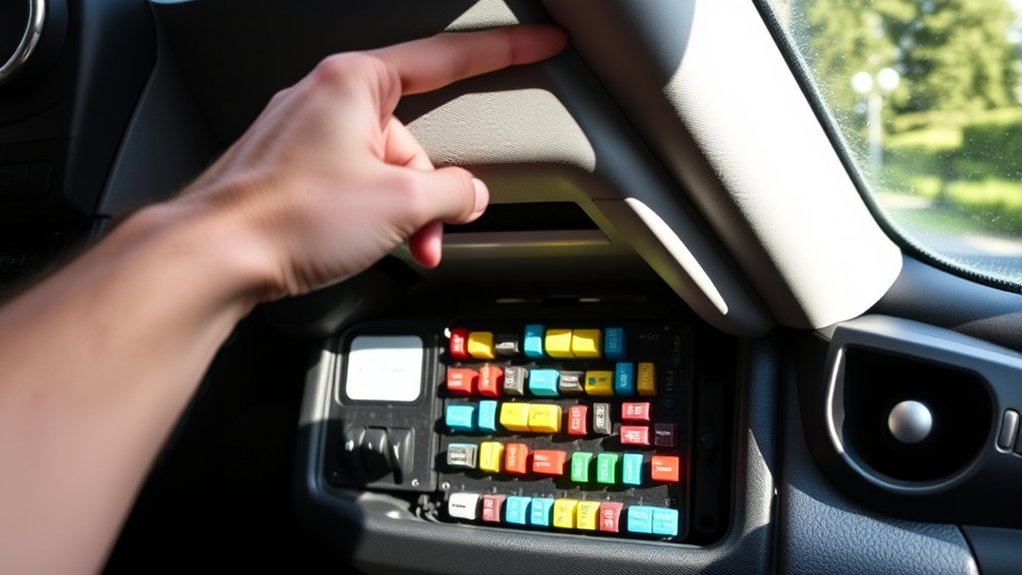
Before opening a fuse box, confirm which electrical feature has stopped working. A single component may depend on more than one fuse, and several components may share one protected circuit.
Use the fuse-box cover diagram and the owner’s manual for your exact year and powertrain. Toyota publishes separate documentation for different RAV4 configurations, so a diagram from another model year may not match your vehicle.
Note: A fuse can protect several systems. The fact that one accessory has failed does not prove that the fuse is the cause. A damaged switch, motor, bulb, relay, connector, ground, or control module can produce similar symptoms.
Check Your RAV4 Model Year Before Using a Fuse Diagram
RAV4 electrical layouts are not universal. Use the table below only as an orientation point, then confirm the actual fuse-box cover and owner’s manual supplied for your vehicle.
| Vehicle | Useful Starting Point | What to Do |
|---|---|---|
| 2025 gasoline RAV4 | Toyota documentation identifies engine-compartment fuse boxes and an instrument-panel fuse box. | Use the 2025 gasoline-model manual and the diagrams on your vehicle. |
| 2025 RAV4 Hybrid | Hybrid documentation can include an additional luggage-compartment fuse or relay location. | Use the Hybrid manual before removing luggage-area trim. |
| 2026 RAV4 | Treat the 2026 model as requiring its own model-year documentation rather than an earlier fuse map. | Use Toyota’s 2026 manual and the fuse-box diagrams on the vehicle before removing a fuse. |
Understanding Your RAV4 Fuse Boxes
RAV4 fuse-box locations depend on the model year, powertrain, trim, installed equipment, production market, and steering configuration. Many RAV4s use an interior fuse panel plus one or more fuse or relay boxes in the engine compartment, while some electrified configurations also use a luggage-area fuse or relay block.
Do not rely on a generic diagram that does not identify the same model year and powertrain as your vehicle.
| Area | What You May Find | How to Verify It |
|---|---|---|
| Lower driver-side instrument panel on many models | Small blade fuses for interior accessories and control circuits | Check the removable panel, fuse-box label, and owner’s manual |
| Engine compartment | Blade fuses, relays, cartridge fuses, and higher-current circuit protection | Release the marked cover tabs and read the diagram inside the lid |
| Luggage area on some electrified models | Low-voltage fuses or relays associated with rear-mounted systems and hybrid components | Consult the Hybrid or plug-in hybrid manual for the exact year |
Step-by-Step Guide to Changing a Fuse
- Park safely. Stop on a level surface, engage the parking brake, shift to Park, and turn the engine or power switch completely off.
- Turn accessories off. Switch off the lights, climate control, audio system, chargers, and any device connected to a power outlet. Keep the smart key away from the controls while you work.
- Identify the correct fuse. Use the diagram on the fuse-box cover and the owner’s manual for your model year. Confirm the circuit name, cavity, fuse type, and amperage.
- Open the correct fuse box. Remove the interior access panel or release the tabs on the engine-compartment cover without forcing them.
- Remove the suspected fuse. Grip it with the supplied plastic fuse puller, if present, and pull it straight out. Avoid twisting the fuse or scraping nearby terminals.
- Inspect or test the fuse. Look for a broken internal link. When the result is unclear, test the removed, de-energized fuse with a multimeter in continuity or resistance mode.
- Compare the replacement. Match the printed amperage, blade arrangement, body size, and exact fuse family. Do not rely on color alone.
- Install the new fuse. Push it straight into the correct cavity until it is fully and evenly seated. It should fit securely without excessive force.
- Reinstall the cover. Confirm that the cover or access panel is aligned and completely latched to help keep out moisture and debris.
- Test the component. Start the vehicle only after the panel is closed, then operate the affected component briefly.
- Stop if it fails again. If the replacement blows immediately or soon afterward, turn the affected system off and arrange an electrical diagnosis.
Pro Tip: Photograph the fuse-box diagram before removing a fuse. The photo helps you confirm the cavity and orientation when visibility is limited.
Where Is the Interior Fuse Box on a Toyota RAV4?

On many RAV4 model years, the owner-accessible interior fuse panel is positioned beneath or beside the driver-side instrument panel near the footwell. The exact position can change with model year, market, and steering configuration, so confirm the location in the manual for your vehicle.
Look for a removable cover or an exposed fuse panel above the lower trim. Use a flashlight because the labels and cavities can be difficult to see from the driver’s seat.
The diagnostic connector may be nearby on some RAV4 models, but it is not part of the fuse box. Avoid pulling on wiring, connectors, or trim pieces that are not identified as fuse-panel access points.
Do not use a generic list of numbered fuses. Read the circuit labels for your vehicle because positions and ratings can change between model years.
Where Is the Engine-Compartment Fuse Box on a Toyota RAV4?
Open the hood and locate the fuse or relay box identified in your owner’s manual. Many RAV4 configurations use one or more covered electrical boxes in the engine compartment, but their exact positions and contents vary.
Release the cover tabs by hand and lift the cover without prying aggressively. The underside often contains a diagram showing the fuse labels and positions.
The engine-compartment box may contain small blade fuses, larger cartridge fuses, relays, and high-current fusible links. Replace only the owner-serviceable fuse type covered by your manual.
The fuse-box diagram for your exact RAV4 is more reliable than a chart copied from another year, trim, or powertrain.
After checking the fuse, reinstall the cover completely. A loose engine-compartment cover can allow water or dirt to reach electrical terminals.
Fuse Considerations for RAV4 Hybrid and Plug-In Hybrid Models
RAV4 Hybrid and plug-in hybrid models contain conventional low-voltage circuits as well as high-voltage systems. An owner may replace an ordinary low-voltage blade fuse when the manual identifies it as serviceable, but high-voltage components require trained service personnel.
Luggage-Compartment Fuse Box Location
Some electrified RAV4 configurations use an additional fuse or relay block behind luggage-area trim or beneath a deck panel. Its presence, side, access method, and protected circuits vary by year and market.
Do not remove luggage trim based only on a generic video or diagram. Use the Hybrid or plug-in hybrid owner’s manual for your exact vehicle before opening the area.
Hybrid Fuse Types
Hybrid-related low-voltage circuits may use blade or cartridge fuses with labels that differ from other RAV4 configurations. Never substitute a fuse because its color or body appears similar.
Automotive blade fuses are available in several physical formats, including standard, mini, low-profile mini, and micro designs. Eaton’s automotive blade-fuse guide shows why both format and rating matter.
Hybrid Safety Considerations
Do not touch orange wiring, high-voltage connectors, the service plug, traction-battery terminals, the inverter, or damaged hybrid-system components. Those parts are outside the scope of routine fuse replacement.
If a hybrid warning appears, the vehicle will not enter READY mode, or a hybrid-system fuse fails repeatedly, have the vehicle inspected by a qualified Toyota or hybrid technician.
Tools You’ll Need for Fuse Replacement
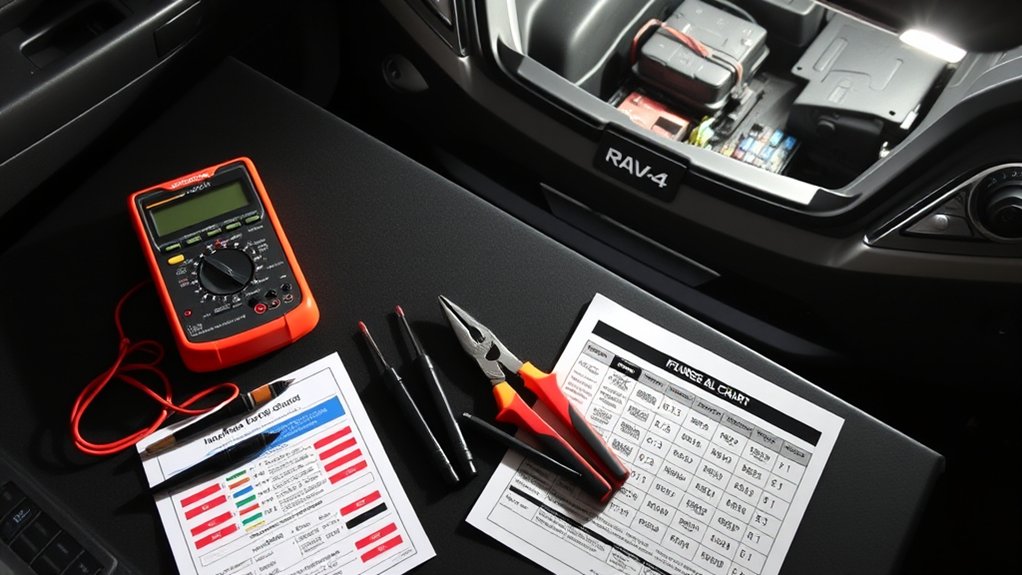
- Plastic fuse puller: Use the puller supplied with the vehicle if one is present.
- Flashlight: Interior panels are often recessed above the footwell.
- Exact replacement fuse: Match the original physical type and amperage.
- Owner’s manual: Use the manual for the correct year, powertrain, and market.
- Digital multimeter: Optional, but useful when the internal element is hard to see.
Avoid using metal pliers around a fuse panel. They can damage the fuse body, spread the terminal, or contact an adjacent conductor. If the supplied puller is missing, obtain a plastic automotive fuse puller.
How Can You Tell If a RAV4 Fuse Is Blown?
Many blade fuses have a translucent body. Hold the removed fuse under good light and inspect the metal link between its two blades.
- Good fuse: The internal link remains continuous from one blade to the other.
- Blown fuse: The link has a visible break or burned gap.
- Uncertain result: The body is cloudy, the element is hidden, or the break is too small to see.
- Heat damage: The body, blades, socket, or surrounding plastic is melted, darkened, distorted, or scorched.
Warning: Do not install another fuse in a melted, loose, scorched, or corroded socket. Heat damage can indicate a poor terminal connection or circuit fault that requires professional repair.
Testing a Fuse With a Multimeter
Remove the fuse and make sure it is isolated from an energized circuit. Set the multimeter to continuity or the lowest resistance range, then place one probe on each blade.
A steady continuity tone or a resistance reading close to zero normally indicates a good fuse. No tone, an OL display, or an infinite resistance reading indicates an open fuse. See Fluke’s fuse-testing instructions for additional meter guidance.
How to Maintain Your RAV4 Fuse Boxes
Fuses do not need to be removed on a fixed three-month schedule. Inspect the relevant fuse when an electrical component stops working, after water reaches the panel, after accessory wiring is installed, or when the owner’s manual directs you to check it.
Keep each fuse-box cover clean, correctly aligned, and fully latched. Do not spray cleaner, lubricant, or water into a fuse panel.
When replacing a fuse, check that its blades are clean and that it sits firmly in the socket. A fuse that feels unusually loose may indicate a damaged terminal.
Record the circuit, amperage, date, and symptom when a fuse is replaced. That information can help a technician diagnose a recurring problem.
What Should You Do If the New RAV4 Fuse Blows Again?
A fuse that blows again is doing its job by opening an overloaded or shorted circuit. Repeatedly installing new fuses does not repair the cause.
- Confirm the rating. Verify that the fuse matches the amperage and physical format shown on the cover or in the manual.
- Disconnect recent accessories. Unplug phone chargers, power inverters, dash cameras, trailer accessories, and other recently added equipment.
- Inspect power outlets. Coins, broken charger tips, and other metal objects can short a 12-volt socket.
- Review recent work. Audio, lighting, trailer, alarm, remote-start, and camera installations can pinch or overload wiring.
- Look for visible damage. Stop if you see exposed wiring, moisture, corrosion, melted plastic, smoke, or scorching.
- Arrange diagnosis. A qualified technician can test current draw, wiring insulation, grounds, relays, motors, and connected modules.
| What Happens | Possible Cause | Next Step |
|---|---|---|
| Replacement blows immediately | Direct short, damaged wiring, failed component, or incorrect fuse | Leave the circuit off and arrange electrical diagnosis |
| Fuse blows only when an accessory is connected | Faulty accessory or excessive current draw | Disconnect the accessory and inspect its plug, cable, and power requirement |
| Fuse fails after rain, washing, or water intrusion | Moisture in a connector, lamp, outlet, harness, or electrical box | Do not keep energizing the circuit until the moisture source is found |
| Fuse remains good but the component is still dead | Second fuse, relay, switch, motor, bulb, ground, connector, wiring, or module fault | Check the complete circuit information rather than replacing a good fuse |
| Several systems fail at once | Main power, ground, junction-block, battery, or fusible-link problem | Seek qualified electrical diagnosis instead of removing random fuses |
Note: Never “solve” a recurring failure by installing a higher-amperage fuse. The wiring may overheat before the oversized fuse opens.
When You Should Not Replace the Fuse Yourself
Seek professional service when any of the following applies:
- The fuse is bolted in place or forms part of a fusible-link assembly.
- The owner’s manual directs you to a Toyota dealer for that fuse type.
- The fuse box, socket, or wiring is melted, scorched, loose, or corroded.
- The same fuse blows again after an exact replacement is installed.
- The failed circuit controls airbags, steering, braking, the hybrid system, or another safety-critical function.
- You smell burning insulation, see smoke, or find an unusually hot fuse panel.
- The vehicle has flood, collision, rodent, or major wiring damage.
Frequently Asked Questions
Can I use any fuse that fits the socket?
No. Match the amperage, body size, blade arrangement, voltage class, and fuse family specified for the circuit. A fuse that physically fits may still have the wrong rating or design.
What happens if I install a higher-amperage fuse?
The wiring and connected equipment may carry more current than they were designed to handle. This can damage the harness, melt insulation, overheat connectors, or increase fire risk.
How often should I inspect my RAV4’s fuses?
You do not need to remove them on a routine three-month schedule. Check the relevant fuse when a protected component fails, after electrical work or water intrusion, or when the owner’s manual recommends an inspection.
Are RAV4 fuse locations the same for every model year?
No. Fuse boxes, labels, ratings, and protected circuits can differ by generation, model year, market, trim, powertrain, and installed equipment. Use the documentation for your exact vehicle.
Can I use a 2019–2025 fuse diagram for a 2026 RAV4?
Do not assume it applies. Use the 2026 RAV4 owner’s documentation and the fuse-box diagrams on the vehicle. Fuse locations, labels, and protected circuits can change between generations and model years.
Where is the fuse puller in a Toyota RAV4?
If your RAV4 includes a factory fuse puller, check the engine-compartment fuse box or its cover first. Storage location can vary by model year and configuration, so confirm it in your owner’s manual. If no puller is supplied, use a plastic automotive fuse puller rather than metal pliers.
Do I need to disconnect the 12-volt battery first?
For a standard owner-replaceable blade fuse, the normal preparation is usually to turn the vehicle and all electrical accessories completely off. Follow your exact owner’s manual. Battery disconnection may be required for certain bolted or high-current repairs and can erase settings or stored information.
Can a fuse look good but still be blown?
Yes. A very small break can be difficult to see, and some cartridge fuses hide the element. Test the removed fuse with a multimeter when the visual result is unclear.
Why did the replacement fuse blow immediately?
An immediate failure can indicate a short circuit, overloaded accessory, damaged motor, pinched wire, contaminated power outlet, faulty component, or incorrect fuse. Stop using the circuit and have the cause diagnosed.
What if the fuse is good but the electrical feature still does not work?
Check the complete circuit information for your RAV4. The component may use another fuse, or the fault may be in a relay, switch, bulb, motor, ground, connector, wiring harness, or control module.
Where can I buy the correct replacement fuse?
Toyota dealers and established automotive-parts retailers carry replacement fuses. Take the original fuse or its exact specifications with you, and confirm compatibility with your model year before installation.
Conclusion
Changing an owner-replaceable fuse in a Toyota RAV4 is manageable when you use the correct model-year information and follow a careful sequence. Turn the vehicle off, identify the correct circuit, remove the fuse with a plastic puller, confirm that it is blown, and install an exact match for both physical type and amperage.
Do not treat a repeatedly blown fuse as a supply problem. It can point to an overload, short circuit, damaged accessory, component failure, or wiring fault. Stop if you find heat damage, smoke, a loose socket, or a fuse that fails again, and have the electrical system inspected. Owners of a 2026 RAV4 should use the 2026 manual and vehicle-specific diagrams instead of relying on a 2019–2025 fuse map.
Sources
- Toyota 2024 RAV4 Hybrid Owner’s Manual — model-specific maintenance, fuse, and hybrid-system guidance.
- Toyota 2021 RAV4 Owner’s Manual — checking and replacing fuses for the applicable model year.
- Toyota 2020 RAV4 Engine-Compartment Guide — identifies engine-compartment fuse-box information.
- Toyota 2025 RAV4 Hybrid Fuse Parts Information — confirms model-specific instrument-panel, under-hood, and luggage-compartment fuse applications.
- Eaton Bussmann Automotive Blade Fuses — blade-fuse sizes, formats, and amperage ranges.
- Fluke Fuse Testing Guide — continuity and resistance testing with a digital multimeter.
