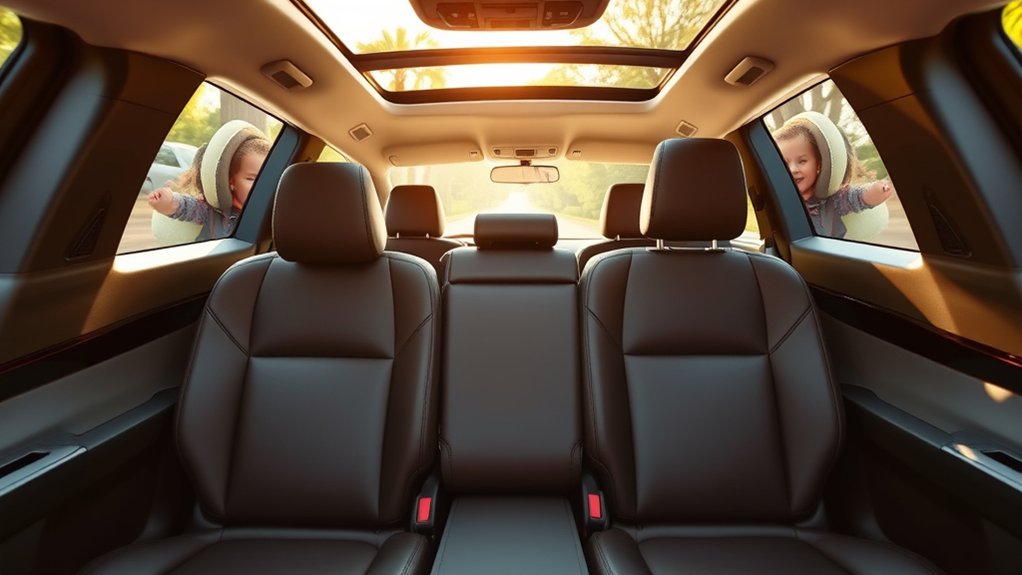
The Toyota RAV4 is a two-row compact SUV with seating for up to five people: two in front and three across the rear bench. That answer is consistent across recent U.S. model years, but interior measurements, cargo figures, upholstery, and child-seat hardware details can vary by year, trim, market, and installed options.
Quick Answer
A Toyota RAV4 seats five passengers. It has two front seats and a three-person rear bench. For child restraints, the rear outboard positions provide the simplest LATCH installation. Three child seats may fit in some combinations, but it is not guaranteed and must be confirmed with the vehicle and child-seat manuals.
Key Takeaways
- Recent Toyota RAV4 models seat up to five people and do not offer a third row.
- The rear bench has a 60/40 split-folding design, so you can carry passengers and longer cargo at the same time.
- For the 2024 U.S. RAV4, published cargo capacity is 37.6 cubic feet behind the rear seats and up to 69.8 cubic feet with the rear seatbacks folded.
- The 2024 RAV4 has two complete outboard LATCH positions; the center position requires careful review of approved anchor or seat-belt use.
- Check specifications for your exact model year because the RAV4 entered a new generation for 2026.
How Many Passengers Can I Fit in a Toyota RAV4?
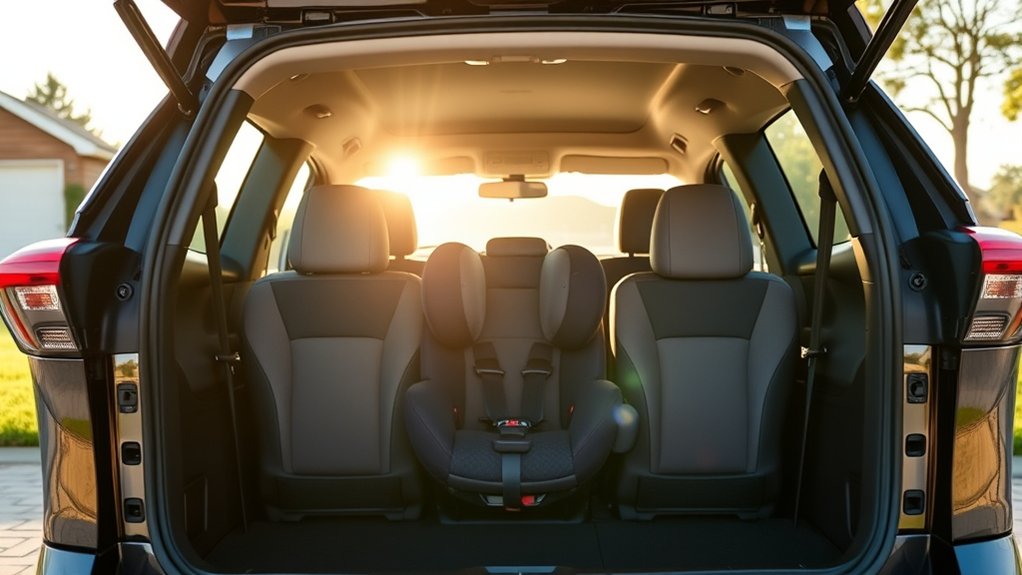
You can fit five occupants in a Toyota RAV4 when every seating position has an appropriate restraint. The layout includes a driver and front passenger seat plus a rear bench designed for three people.
The RAV4 is not a three-row SUV. If you regularly need room for six or more passengers, you will need a larger model with a third row rather than a different RAV4 trim.
The RAV4’s official seating capacity is five, but real-world comfort depends on passenger size, child restraints, and how much cargo you carry.
Three adults can use the rear bench for shorter trips, although two adults will usually have more shoulder and hip room. Before a long drive, test the seating position with the actual passengers or child restraints you plan to carry.
Maximizing Comfort: Passenger Space in the RAV4
Passenger comfort depends on more than the five-seat rating. Seat position, roof options, child-seat placement, and the amount of luggage in the cabin can all affect how spacious the RAV4 feels.
Ample Headroom and Legroom
For the 2024 U.S. RAV4, Toyota lists about 41.0 inches of front legroom and 37.8 inches of rear legroom. Those figures give most adults useful knee room, but headroom varies by trim and roof equipment.
A moonroof can reduce front headroom, so do not treat one headroom number as universal across every RAV4. Taller drivers and passengers should sit in the exact trim before buying.
Adjustable Seating Configurations
The seating capacity stays at five, but the cabin can be adjusted for passengers or cargo. The rear seatbacks use a 60/40 split, allowing one section to fold while the other remains available for a passenger.
The rear seatbacks also recline on many fifth-generation RAV4 configurations. Availability and adjustment range can differ by model year and market, so check the feature list for your vehicle.
Comfort Features Overview
Depending on trim, the RAV4 may offer power-adjustable front seats, heated front seats, ventilated front seats, SofTex-trimmed upholstery, dual-zone climate control, and rear air vents. These features are not standard on every model.
U.S. RAV4 listings commonly use SofTex synthetic upholstery rather than genuine leather. Confirm the material and comfort package on the window sticker or official build sheet instead of relying on a general description.
Why You’ll Love the 60/40 Split-Folding Rear Seat
The split rear seat is useful when you need to carry a long item without giving up the entire second row. You can fold the smaller or larger section, depending on how many passengers and how much cargo you have.
Enhanced Cargo Flexibility
For the 2024 U.S. RAV4, Toyota publishes 37.6 cubic feet of cargo space behind the rear seat and up to 69.8 cubic feet with the rear seatbacks folded. The maximum figure applies when the rear seatbacks are folded, not when only one section is down.
| Configuration | Usable Seating | Cargo Guidance |
|---|---|---|
| Rear seatbacks upright | Up to 5 people | Up to 37.6 cu. ft. on the 2024 U.S. model |
| One rear section folded | Usually 3 or 4 people, depending on the folded side | More room for long items; Toyota does not publish a separate universal volume for this mixed layout |
| Both rear sections folded | 2 people | Up to 69.8 cu. ft. on the 2024 U.S. model |
Easy Access for Passengers
The RAV4’s four side doors provide direct access to both rows. A reasonably tall roofline can make it easier to guide a child restraint through a rear door, but a bulky rear-facing seat may still limit front-seat travel.
Do not fold or recline a seatback while a passenger or installed child restraint occupies that seating position. Keep the cargo area clear of loose objects that could move forward during sudden braking.
Versatile Seating Arrangements
The 60/40 layout supports several practical combinations: five passengers with the rear seats upright, four passengers with the narrow section folded, or three passengers with the wider section folded. With both rear sections down, the RAV4 becomes a two-person vehicle with maximum cargo room.
The exact load floor shape and cargo capacity vary by generation and powertrain. Toyota lists up to 37.8 cubic feet behind the rear seats for the redesigned 2026 RAV4, so 2024 measurements should not be copied to every model year.
Understanding Car Seat Compatibility in the RAV4
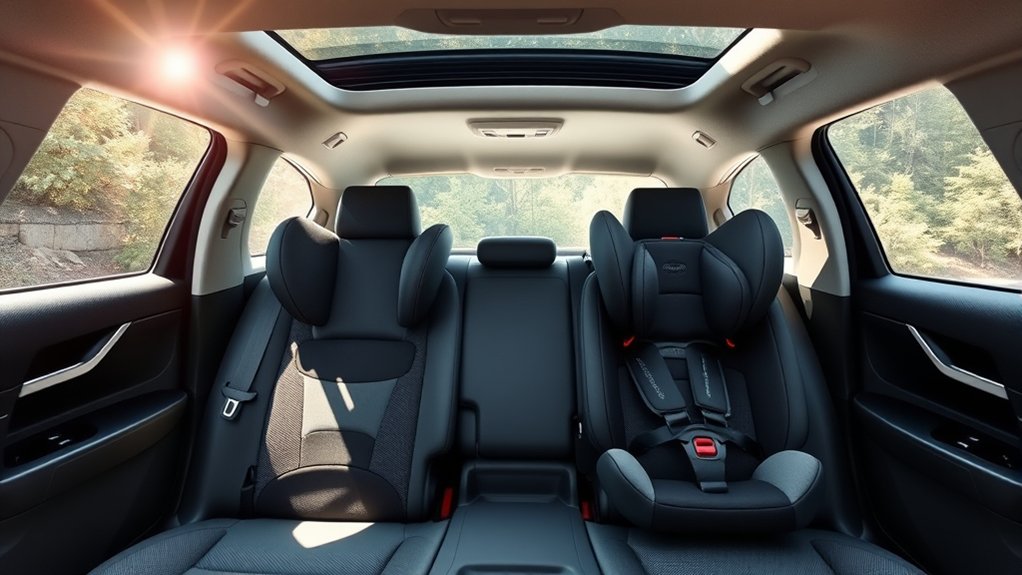
The RAV4 can work well for families, but five seating positions do not guarantee that three child restraints will fit side by side. Child-seat width, belt-path design, buckle location, front-seat position, and the child’s required restraint type all matter.
In U.S. terminology, the lower-anchor system is called LATCH; many other markets use the term ISOFIX. The IIHS evaluation of the 2024 RAV4 identifies two complete rear outboard LATCH positions. The center has a tether anchor and may allow borrowed lower anchors, but using borrowed anchors makes those anchors unavailable to the adjacent seats.
Warning: Never assume you can use lower anchors for three seats at once. Use only the seating positions and anchor combinations approved by both the RAV4 owner’s manual and each child-restraint manufacturer.
A three-across setup may require one or more child restraints to be installed with the vehicle seat belt. It may also be impossible with a particular combination of seats, even if each seat fits separately.
Evaluating Car Seat Fit in the RAV4
Evaluate fit with the exact RAV4 and the exact child restraints you plan to use. Model year, trim, front-seat position, and child-seat shell width can change the result.
- Check approved positions: Read the child-restraint section of the vehicle manual before choosing LATCH or seat-belt installation.
- Test front-seat clearance: A rear-facing restraint must not press against the front seat unless both manufacturers explicitly allow contact.
- Confirm independent tightness: Each installed restraint should remain secure when the neighboring restraint is removed.
- Check buckle access: A booster rider must be able to buckle without routing the belt incorrectly or unbuckling an adjacent restraint.
- Inspect head-restraint compatibility: Remove or adjust a vehicle head restraint only when the vehicle and child-seat instructions permit it.
The 2024 RAV4 earned a Good+ child-seat-anchor usability rating from IIHS, but that rating does not certify every possible three-across combination.
Tips for Installing Car Seats in the Toyota RAV4
Start with the NHTSA car-seat guidance, the RAV4 owner’s manual, and the child-seat manual. NHTSA recommends choosing a restraint that fits your child, fits your vehicle, and can be used correctly every trip.
- Choose LATCH or the seat belt: Do not use both unless the child-seat manufacturer specifically permits it.
- Use the tether for forward-facing seats: Attach the top tether as directed because it limits forward movement in a crash.
- Follow anchor weight limits: Switch to a seat-belt installation when required by the vehicle or restraint instructions.
- Check movement at the belt path: The installed restraint should not move more than one inch side to side or front to back at the belt path.
- Get an expert check: A certified Child Passenger Safety Technician can help verify a difficult installation.
Pro Tip: Before buying three new restraints, test the full three-across combination in your RAV4. A narrow seat can help, but buckle access and approved anchor use matter as much as shell width.
Additional Cargo Space and Versatility for Families
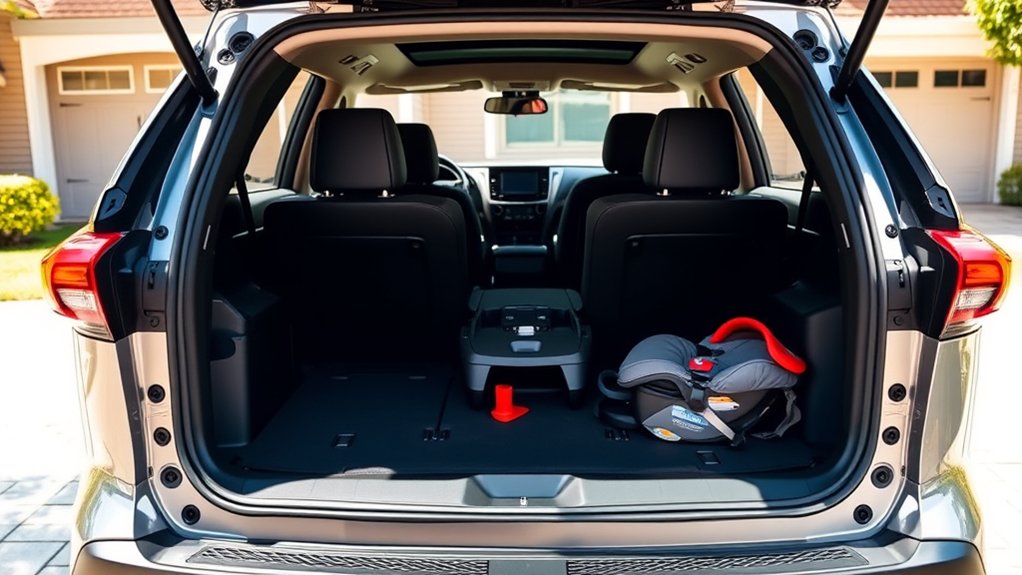
The RAV4’s cargo area is one reason it works well for many small families. The space behind the rear bench can hold a stroller, groceries, school bags, or travel gear without folding the second row.
- 2024 cargo volume: 37.6 cubic feet behind the rear seats and up to 69.8 cubic feet with the rear seatbacks folded.
- Split-folding flexibility: One rear section can stay upright for a passenger while the other carries longer items.
- Child-seat tradeoff: Folding a section is not available when a child restraint is installed on that section.
- Safer loading: Keep heavy items low and secured so they cannot become projectiles.
- Model-year check: Cargo dimensions and floor design can differ between the 2019-2025 generation and the redesigned 2026 RAV4.
Do not use the cargo floor as a changing surface unless the vehicle is parked safely, the liftgate area is secure, and the child is continuously supported. A dedicated changing mat on a stable surface is safer and more hygienic.
Related Guides
Frequently Asked Questions
Is the RAV4 available in different seating configurations?
The RAV4 remains a two-row, five-passenger SUV across recent trims. The 60/40 rear seat changes the passenger-and-cargo layout, but it does not add a third row or increase the official seating capacity.
What is the maximum cargo capacity of a 2024 RAV4?
Toyota lists up to 69.8 cubic feet with both rear seatback sections folded. With the rear seats upright, the 2024 U.S. model provides 37.6 cubic feet behind the second row.
Which optional seating features are available?
Features vary by year and trim. Depending on the configuration, you may find power-adjustable front seats, heated or ventilated front seats, SofTex-trimmed upholstery, driver-seat memory, and reclining rear seatbacks.
Can I fit a booster seat in a Toyota RAV4?
Usually, yes. The booster must sit flat, the lap-and-shoulder belt must route correctly, and the child must be able to buckle without disturbing an adjacent restraint. Check the booster and vehicle instructions.
How does the RAV4 compare with similar SUVs for seating capacity?
Its five-seat layout is typical for a compact SUV. The RAV4 offers useful rear and cargo space, but families needing six or more seats should compare larger three-row SUVs rather than expecting a RAV4 trim with extra seating.
Can three child seats fit across the RAV4’s rear bench?
Sometimes, but not with every combination. The 2024 RAV4 has two complete outboard LATCH positions, and a three-across setup may require approved seat-belt installations. Test the exact restraints and follow both manuals.
Conclusion
The Toyota RAV4 seats up to five people and offers a practical balance of passenger and cargo room. Its 60/40 rear bench adds flexibility, but it does not create extra seats. Families planning multiple child restraints should treat three-across fit as a compatibility question, not a guaranteed feature. Verify your model year, trim, manuals, and actual seats before relying on a specific layout.
Sources
- Toyota USA Newsroom: 2024 Toyota RAV4 — official model information and product-specification download.
- Toyota: 2026 RAV4 — current-generation model and cargo-capacity information.
- IIHS: 2024 Toyota RAV4 ratings — child-seat anchor positions and usability rating.
- NHTSA: Car Seats and Booster Seats — restraint selection, installation, and inspection guidance.
- Toyota Owners: Manuals and Warranties — model-year-specific child-restraint and seating instructions.

