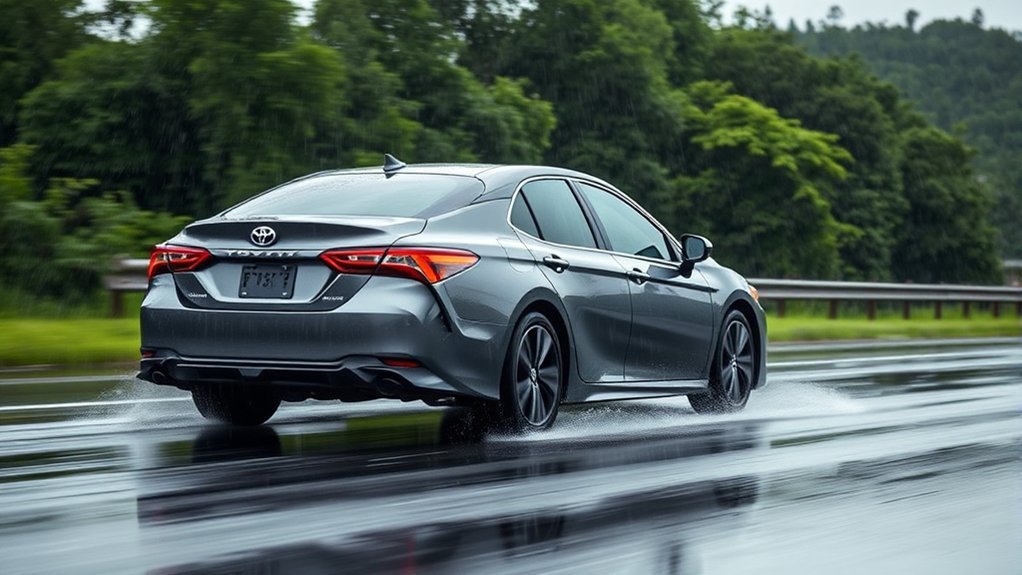
Hydroplaning can make your Toyota Camry feel light, unresponsive, or as though it is drifting across the road. You can lower the risk by maintaining the tires, slowing down before standing water, increasing following distance, and avoiding sudden steering, braking, or acceleration. If traction drops, calm and gentle inputs give the tires the best chance to reconnect with the pavement.
Quick Answer
To reduce hydroplaning risk in a Toyota Camry, check cold tire pressure and tread monthly, replace damaged or worn tires, slow down before standing water, leave extra following distance, and avoid cruise control in heavy rain. If traction drops, ease off the accelerator, hold the wheel steady, avoid hard braking, and make only small steering corrections.
Key Takeaways
- Hydroplaning risk rises with speed, standing water, worn or damaged tread, incorrect tire pressure, and abrupt control inputs.
- Use the cold pressure shown on your Camry’s driver-door placard or in its owner’s manual, not the maximum pressure printed on the tire sidewall.
- Slow down before puddles, avoid cruise control in heavy rain, use smooth steering, and increase following distance.
- A TPMS warning is not a substitute for checking tire pressure with an accurate gauge every month.
- If traction disappears, ease off the accelerator and avoid sudden braking or steering until the tires reconnect with the road.
- Never drive through a flooded road, even when the water looks shallow.
At a Glance
| Time Required | About 5 minutes for a pre-drive tire and visibility check |
| Difficulty | Easy maintenance checks; calm driving judgment required |
| Tools Needed | Accurate tire-pressure gauge and a tread-depth gauge, penny, or quarter |
| Cost | No cost for safer driving habits; tire service or replacement costs vary |
Hydroplaning Risks: What You Need to Know

Hydroplaning happens when a tire cannot move water away quickly enough and begins riding on a layer of water instead of gripping the pavement. Steering and braking response can weaken until the tire slows and reconnects with the road.
No single speed guarantees that hydroplaning will or will not happen. Water depth, rainfall intensity, road drainage, tire tread, tire pressure, vehicle speed, and steering or braking inputs all affect the risk. AAA notes that even new tires can lose some road contact at speeds as low as 35 mph when enough water is present.
Even new tires may lose some contact with the road at about 35 mph in sufficient water, so treat 35 mph as a warning example, not a universal hydroplaning threshold.
The common claim that the first 10 minutes of every rainstorm always create the highest hydroplaning risk is too exact. Roads can be especially slick when rain begins after a dry period, but standing water, rainfall intensity, speed, tread condition, and drainage are more useful signs that you need to slow down.
Main Hydroplaning Risk Factors
- Too much speed for the conditions: Faster-moving tires must displace more water in less time.
- Standing water: Puddles, wheel-track ruts, low spots, and poorly drained lanes can overwhelm the tread.
- Worn, aged, or damaged tires: Shallow or uneven tread, cracks, bulges, and other damage reduce predictable wet-road performance.
- Incorrect tire pressure: Pressure that differs from Toyota’s specification can reduce predictable tire performance and handling on a wet road.
- Abrupt inputs: Hard braking, sharp steering, or sudden acceleration can use up the limited grip available on a wet road.
- Poor visibility: Heavy spray, worn wipers, fogged glass, and dim or inoperative lights make it harder to detect pooled water and react early.
How Speed, Water, and Tread Work Together
Hydroplaning is not caused by one factor alone. A shallow puddle may be manageable at a lower speed with healthy tread, while deeper water, worn tread, or a poorly drained curve can create a loss of grip at a much lower speed than expected. The safest response is to reduce speed before entering visible water rather than trying to judge a precise threshold.
Tire Maintenance Tips to Prevent Hydroplaning
Your tires are the only parts of the Camry that touch the road, so routine checks are your first line of defense. The National Highway Traffic Safety Administration recommends checking tire pressure and tread at least monthly. Check pressure when the tires are cold, then inflate them to the value on the driver-side door placard or in the owner’s manual.
| Maintenance Check | What to Do |
|---|---|
| Cold tire pressure | Check all tires monthly and use the Camry’s door-jamb pressure, not the maximum number on the tire sidewall. Recheck after major temperature changes. |
| Tread depth | NHTSA says tires should be replaced at 2/32 inch. For better wet-road margin, use the quarter test as an early signal to start planning replacement near 4/32 inch. |
| Damage and uneven wear | Look for cuts, bulges, cracks, exposed cords, flat spots, or one-sided wear. Have damage or unusual wear inspected promptly. |
| Tire age | Check the DOT Tire Identification Number for the week and year of manufacture. Follow Toyota’s and the tire maker’s replacement guidance because some manufacturers recommend replacement based on age even when tread remains. |
| Rotation | Follow the interval and pattern in your model-year owner’s manual. NHTSA gives 5,000 to 8,000 miles only as a general interval when the manufacturer recommends rotation. |
| Balance and alignment | Have the wheels checked if you notice vibration, pulling, steering changes, or uneven wear. New tires should be balanced when installed, but balancing is not automatically required at every rotation. |
Pro Tip: Measure tread in several grooves across each tire. One good reading can hide shoulder wear, alignment problems, or uneven wear elsewhere on the tread.
How to Use a Penny or Quarter for a Quick Tread Check
Insert a penny into several tread grooves with Lincoln’s head upside down. If the top of his head remains visible, the tread is at or below about 2/32 inch and the tire should be replaced. For an earlier wet-weather warning, insert a quarter with Washington’s head upside down. If the tread does not reach the top of his head, begin planning for replacement rather than waiting for minimum tread.
Do Not Rely on the TPMS Light Alone
A Tire Pressure Monitoring System warns when a tire is significantly underinflated, but it does not replace a monthly gauge check. A tire can be below the recommended pressure before the warning light appears, and the system does not measure tread depth, cracking, bulges, or uneven wear.
Camry tire sizes and recommended pressures vary by model year, trim, wheel package, and load. Use Toyota’s manual lookup for your exact vehicle rather than relying on a generic PSI number.
Effective Driving Techniques to Avoid Hydroplaning
Good wet-weather driving starts before your Camry reaches standing water. Slow down gradually while the tires still have solid grip. Then keep your steering, braking, and acceleration smooth.
- Reduce speed early. Do not wait until the tires enter a puddle to lift off the accelerator.
- Leave extra following distance. Wet pavement can increase the distance needed to slow or stop.
- Avoid cruise control in heavy rain or pooled water. Keeping direct control of the accelerator makes it easier to reduce speed smoothly.
- Use low-beam headlights when visibility drops. Confirm that your wipers, lights, defogger, and washer system work before severe weather.
- Avoid puddles when you can do so safely. Never make a sudden lane change to miss water.
- Choose the clearest visible lane path. Avoid deep wheel ruts, low spots, and areas where water visibly collects.
- Separate major control inputs. Finish most of your braking before a turn, steer smoothly through it, and accelerate gently afterward.
- Keep stability and traction systems enabled. They can help manage available grip, but they cannot create tire contact while a tire is riding on water.
Five-Minute Pre-Drive Rain Check
- Check that the windshield, mirrors, headlights, taillights, brake lights, and turn signals are clean and working.
- Make sure the wipers clear the glass without streaking and the washer reservoir is filled.
- Confirm that no tire looks low, damaged, or unusually worn; use a gauge if the monthly pressure check is due.
- Clear interior fog before moving and know how to operate the defogger without looking away from the road.
- Delay the trip or choose a safer route when severe rain, flooding, or poor drainage is expected.
What Camry Safety Systems Can and Cannot Do
Anti-lock brakes, traction control, and vehicle stability control can help when the tires still have usable contact with the road. They cannot force tread through a layer of water. Front-wheel drive, all-wheel drive, hybrid power, and newer driver-assistance features do not remove the need for sound tires, lower speed, extra space, and smooth control.
Note: Wet-weather laws differ by jurisdiction. Follow local rules for headlights, hazard lights, speed, and stopping, and use your Camry owner’s manual for model-specific controls and warning lights.
How Rainy Weather Increases Hydroplaning Risk
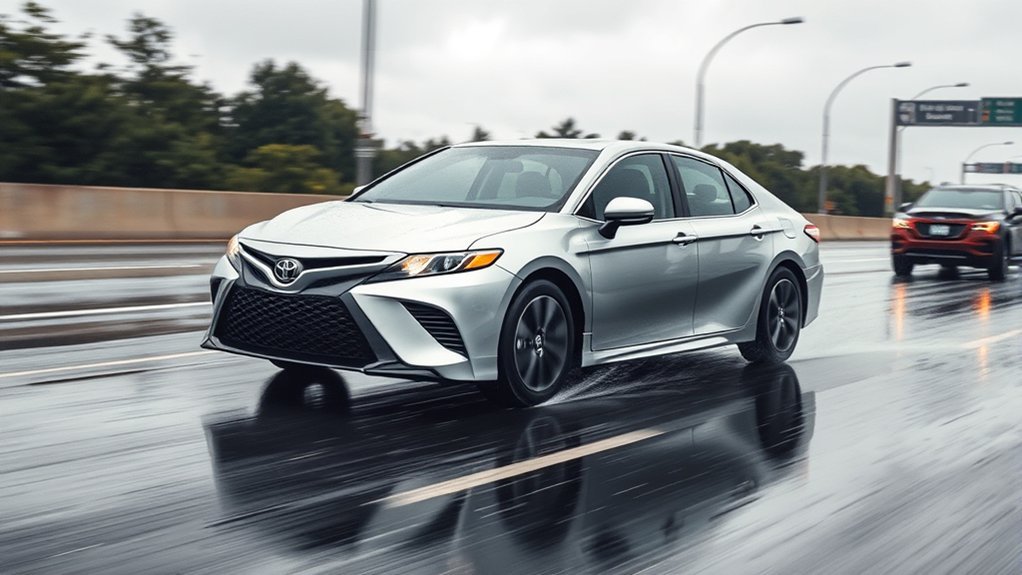
Rain reduces visibility and can lower pavement friction even before full hydroplaning occurs. The Federal Highway Administration reports that more than 77% of weather-related crashes occur during rain or mist, based on 2019 to 2023 averages.
Hydroplaning risk becomes more serious where water collects. Watch for shiny patches, spray from vehicles ahead, water flowing across the lane, deep wheel tracks, low areas, bridge approaches, and the outside of curves. At night, standing water can be difficult to distinguish from ordinary wet pavement, so reduce speed further when visibility is limited.
If rain becomes too heavy to see lane markings or nearby traffic clearly, leave the roadway at a safe location. Choose a parking area or other location well away from moving traffic and low-lying flood zones, then wait for conditions to improve.
Warning: Do not treat floodwater like an ordinary puddle. The National Weather Service warns that 12 inches of rushing water can carry away most cars. Never drive around a flood barrier or enter a road covered by moving water.
What to Do When Hydroplaning Occurs
You may be hydroplaning if the steering suddenly feels light, the Camry drifts without responding normally, the engine speed changes unexpectedly, or the tires feel disconnected from the road. The goal is to reduce demand on the tires until they regain contact.
- Stay calm and look where you want to go. Avoid staring at a barrier, ditch, or nearby vehicle.
- Ease off the accelerator. Lift smoothly instead of making an abrupt pedal change.
- Hold the steering wheel steady. Keep the front wheels aimed along your intended path and make only small corrections.
- Avoid hard braking. Braking may have little effect while the tires are riding on water and can upset the car as traction changes.
- Wait for grip to return. You may feel the steering become heavier and the vehicle begin responding normally again.
- Slow down and reassess. Once traction returns, brake smoothly if needed, increase following distance, and pull over safely if visibility or road conditions remain poor.
Coast, keep the wheel steady, look toward your intended path, and avoid sudden inputs until the tires regain contact with the road.
Do not rely on a generic instruction to pump the brakes while hydroplaning. Brake behavior depends on whether the tires have regained grip and on the braking system fitted to your model year. Avoid hard braking during the loss of traction. After grip returns, brake smoothly as needed and follow the ABS guidance in your Toyota owner’s manual. AAA’s wet-weather guidance likewise advises drivers not to slam on the brakes and to keep looking and steering toward the intended path.
After the Car Regains Traction
- Reduce speed and create more space around the car.
- Check whether rain intensity, visibility, or standing water makes it safer to exit the road.
- Pay attention to vibration, pulling, warning lights, or steering changes.
- After a hard impact with a deep puddle or hidden pothole, inspect the tires and wheels when it is safe to stop.
If your Camry hydroplanes repeatedly at modest speeds, have the tires, pressure, tread wear, alignment, wheels, and suspension inspected. Repeated loss of traction can point to worn tires, uneven wear, incorrect pressure, damage, or a road condition that requires a much lower speed.
Frequently Asked Questions
How do you prevent hydroplaning in rainy weather?
Slow down before standing water, keep your tires properly inflated, monitor tread and damage, avoid cruise control in heavy rain, leave extra following distance, and use smooth steering, braking, and acceleration. Keep your lights and wipers working, and never drive through a flooded road.
At what speed can a Toyota Camry hydroplane?
There is no guaranteed threshold. AAA notes that even new tires can lose some road contact at about 35 mph in enough water, but worn tread, deeper water, poor drainage, or abrupt inputs can create problems at lower speeds. Adjust speed to the actual conditions.
What are the 3 C’s of driving?
The phrase is not a universal or official hydroplaning standard. As a simple memory aid, use calm, coast, and correct gently: stay calm, ease off the accelerator, and make small steering corrections until the tires regain grip.
What two things should you avoid when your car first hydroplanes?
Avoid hard braking and abrupt steering. Both can destabilize the car as traction changes. Ease off the accelerator, keep the wheel steady, look toward your intended path, and wait for the tires to reconnect with the road.
Should you brake while hydroplaning?
Avoid hard braking while the tires have lost contact. Ease off the accelerator and keep the wheel steady. When you feel normal steering response return, slow with smooth braking if needed. Follow the ABS instructions in the owner’s manual for your model year.
What is one good tip for driving in wet weather?
Reduce speed before you reach standing water. Early, smooth slowing is safer than braking or steering sharply after the tires enter a puddle. Pair that habit with extra following distance and working headlights and wipers.
Can all-wheel drive or traction control prevent hydroplaning?
No. These systems can help manage available traction, but they cannot force a tire through a layer of water when the tread has lost contact with the pavement. Tire condition, speed, water depth, and smooth driver inputs still matter.
Does the TPMS light tell you whether the tires are safe in rain?
Not by itself. TPMS warns about significant underinflation, but it does not confirm correct cold pressure, adequate tread, even wear, or freedom from damage. Check pressure with a gauge and inspect the tread and sidewalls every month.
Conclusion
Preventing hydroplaning in your Toyota Camry comes down to tire care, lower speed, extra space, clear visibility, and smooth control. Check pressure and tread monthly, pay attention to tire age and damage, slow down before water collects, and avoid cruise control in heavy rain. If the car begins to hydroplane, ease off the accelerator, keep the wheel steady, avoid hard braking, and let the tires regain grip before making larger corrections.
Sources
- National Highway Traffic Safety Administration: Tire Safety — tire pressure, tread, TPMS, rotation, damage, aging, balance, and alignment guidance.
- AAA: Wet Weather Driving Tips — speed, cruise control, following distance, tread checks, visibility, and skid-response guidance.
- Federal Highway Administration: Road Weather Impacts — weather-related crash and roadway-impact data.
- National Weather Service: Turn Around Don’t Drown — floodwater and flooded-road safety guidance.
- Toyota Owners: Manuals and Warranties — model-year-specific Camry operating, warning-light, braking-system, and tire information.
