
Last updated: September 22, 2026. This revision rechecked Toyota’s 2026 Camry AWD information, the 2020–2024 Dynamic Torque Control system, current NHTSA winter-driving guidance, and the availability of the Subaru Legacy and Nissan Altima AWD.
The Toyota Camry AWD is good for light-to-moderate snow, slush, wet roads, slippery starts, and maintained winter routes when it has suitable tires. AWD mainly helps the car accelerate and maintain momentum by adding rear-wheel drive assistance. It does not shorten icy-road stopping distance, prevent hydroplaning, or add SUV-like ground clearance. The 2020–2024 gasoline AWD and 2025–2026 hybrid AWD systems also work differently, so model-year-specific guidance matters.
This guide focuses on Camry AWD performance on slippery roads. For a deeper look at drivetrain hardware, see Toyota Camry All-Wheel Drive Explained. For step-by-step winter technique, see How to Drive a Toyota Camry Safely in Snow & Ice.
Quick Answer
Toyota Camry AWD performs best as a traction aid on plowed snow, slush, wet hills, and slippery starts. It can add rear-wheel assistance when front-wheel traction is limited, but it does not create extra braking grip on ice, prevent hydroplaning, or overcome deep snow. Four suitable tires, lower speed, and extra stopping room remain more important than AWD alone.
Key Takeaways
- The 2020–2024 Camry AWD and 2025–2026 Camry AWD use different drivetrain designs.
- AWD mainly improves acceleration and momentum when the front tires have limited traction.
- Winter tires affect acceleration, steering, and braking, so AWD cannot replace them.
- The Camry remains a relatively low sedan, making deep or packed snow a ground-clearance concern.
- Check the owner’s manual for your exact model year, trim, and tire size before using chains or other traction devices.
How Does the Toyota Camry AWD System Work on Slippery Roads?
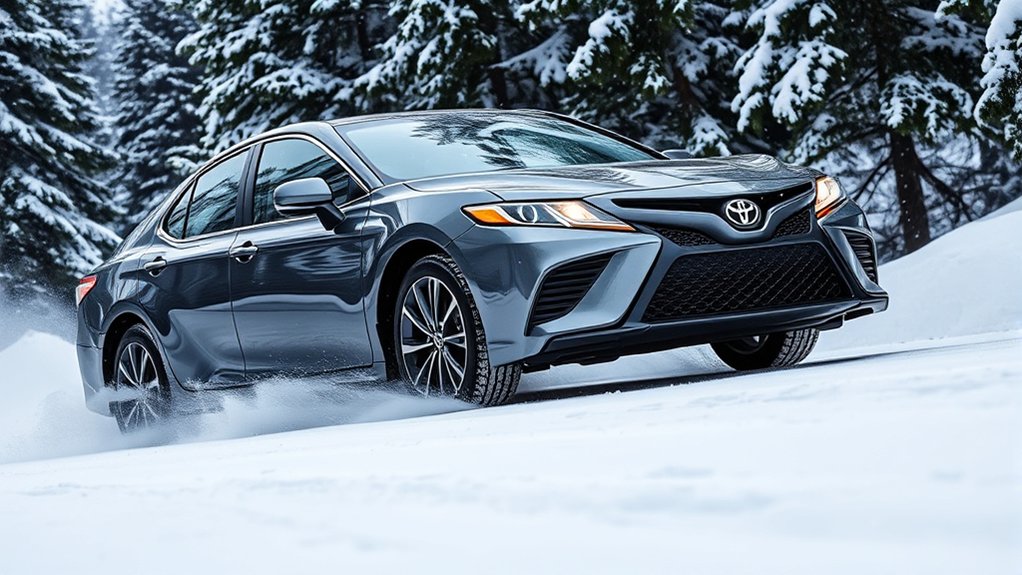
Toyota has used more than one AWD design in recent U.S.-market Camrys. That distinction matters because a description, specification, warning, or traction-device rule for an earlier gasoline-powered Camry AWD may not apply to the current hybrid model.
Camry AWD Differences by Model Year
| Model Years | AWD Design | What You Should Know |
|---|---|---|
| 2020–2024 | Dynamic Torque Control AWD with a mechanical driveshaft and rear differential | Toyota says this system can direct up to 50% of engine torque to the rear wheels during acceleration from a stop or when the front wheels slip. It can disconnect the rear driveline when AWD is not needed. |
| 2025–2026 | Hybrid Electronic On-Demand AWD with a dedicated rear electric motor | The 2025–2026 AWD Camry is hybrid-only and produces 232 net combined horsepower. Toyota says the rear motor is controlled automatically to support start-off acceleration, handling, stability, and traction when grip is limited. |
Toyota identifies the current Camry drivetrain as available Electronic On-Demand All-Wheel Drive. Toyota’s next-generation Camry announcement and 2026 Camry update explain that the system uses a dedicated rear electric motor and automatically supplies rear-wheel power when needed. You normally do not need to switch AWD on before entering rain or snow.
Rear-wheel assistance varies with acceleration, available grip, handling demand, and other system inputs. “Automatic AWD” therefore does not mean that every wheel receives the same amount of drive force at every moment.
Note: Do not apply a torque-split figure, warning procedure, towing method, or traction-device rule from one Camry generation to every AWD Camry. Check the specifications and owner’s manual for your exact model year.
AWD can help your Camry get moving, but the tires still provide every bit of grip used for accelerating, steering, and stopping.
Camry AWD vs. Winter Tires: Which Matters More?
AWD and winter tires solve different problems. AWD can distribute driving force between the front and rear wheels, which is especially useful when pulling away from a stop or climbing. Tires determine how much grip the vehicle has for acceleration, turning, and braking.
NHTSA notes that winter tires are more effective than all-season tires in deep snow. That matters because AWD can only distribute drive force through the grip the tires can generate; it cannot compensate for a tire that is poorly suited to the surface.
| Vehicle Setup | Main Benefit | Important Limitation |
|---|---|---|
| AWD with ordinary all-season tires | Can improve starts and hill climbing when more than one axle has usable traction | Tire compound and tread may still provide limited braking and cornering grip in severe cold, snow, or ice |
| Front-wheel drive with four winter tires | Improves the tire grip available for accelerating, steering, and braking | May not launch as easily as AWD when the front tires alone cannot maintain momentum |
| AWD with four winter tires | Combines additional propulsion options with cold-weather tire grip | Still cannot defeat glare ice, excessive speed, poor visibility, or insufficient ground clearance |
Install the same suitable tire category on all four wheels. Mixing tire types, substantially different tread depths, or incompatible sizes can create unpredictable handling and may interfere with the way an AWD vehicle responds.
How Does the Camry AWD Perform on Snow, Ice, and Wet Roads?
Snow and Slush Performance
The Camry AWD’s clearest advantage appears when you start from a stop, climb a slippery incline, or encounter different traction levels under the front and rear tires. Rear-wheel assistance can reduce unnecessary front-wheel spin and help the vehicle build momentum more smoothly.
On packed snow, loose snow over a plowed road, slush, or a wet incline, that assistance usually makes an AWD Camry easier to launch than an otherwise similar front-wheel-drive Camry using comparable tires. Traction-control and stability systems can also reduce power or apply individual brakes when wheel slip is detected.
Those systems work best when you apply the accelerator progressively. A hard throttle input can overwhelm the tires before the AWD and traction-control systems have an opportunity to manage available grip smoothly.
Ice and Freezing Rain
Ice remains much more difficult than ordinary snow. Even an AWD vehicle can slide when its tires cannot generate enough friction. Accelerating successfully may create a false sense of security because the same surface can require far more distance for braking and provide very little cornering grip.
Warning: AWD does not guarantee shorter stopping distances on snow or ice. Slow down before turns and stops, increase your following distance, and avoid abrupt steering, throttle, or braking inputs.
Freezing rain and polished intersections can be especially deceptive because the road may look merely wet. Reduce speed before reaching the slippery area rather than relying on braking after the tires have already lost grip.
NHTSA reports that in 2023 there were 320 fatal crashes and an estimated 22,293 injury crashes when snow or sleet conditions were present. Its winter-driving guidance emphasizes lower speeds and longer following distances because control and stopping are harder on slick surfaces.
Wet Roads and Hydroplaning
On wet pavement, AWD can support stable acceleration when one axle begins to lose traction. It cannot prevent hydroplaning. Hydroplaning occurs when a tire cannot maintain adequate contact with the road through standing water, and sending power to additional wheels does not restore that lost contact.
Maintain sufficient tread, avoid standing water when possible, and reduce speed in heavy rain. If the steering suddenly feels light, ease off the accelerator smoothly and avoid abrupt steering or braking until the tires regain contact.
Deep Snow and Ground Clearance
Deep snow introduces a different limitation. The Camry is a sedan rather than a high-clearance SUV. If snow reaches the underside, packs beneath the chassis, or accumulates in front of the bumper, the car can become stuck even while the drivetrain is capable of powering all four wheels.
Avoid entering unplowed areas when you cannot judge snow depth. Four-wheel propulsion cannot help once packed snow lifts part of the vehicle’s weight away from the tires or physically blocks forward movement.
Does the Camry AWD Have a Snow Mode?
The 2025–2026 U.S.-market Camry does not list a dedicated selectable Snow mode. Toyota lists NORMAL, ECO, and SPORT drive modes, while Electronic On-Demand AWD manages rear-wheel assistance automatically. That means you should not look for a Snow button before entering slippery conditions; instead, focus on suitable tires, smooth inputs, lower speed, and the exact warnings in your owner’s manual.
Older Camry controls vary by model year. For a fuller breakdown of the current controls, see Toyota Camry Drive Modes Explained.
Top Winter-Ready Features of the Toyota Camry AWD
The Camry AWD combines its drivetrain with several systems and available comfort features that can support winter driving. Equipment varies by year and trim, so confirm the exact configuration before purchasing or relying on a particular feature.
- Automatic AWD response: The driver generally does not need to predict when rear-wheel assistance should engage.
- Traction control: The vehicle can respond when one or more driven wheels begin spinning.
- Vehicle stability control: The system can help correct certain understeer or oversteer situations, although it cannot overcome insufficient tire grip.
- Anti-lock braking: ABS helps prevent wheel lock during hard braking, allowing the driver to retain some steering ability.
- Hybrid AWD availability: The current Camry combines available AWD with an efficient hybrid powertrain.
- Cold-weather comfort features: Depending on trim and options, heated seats, a heated steering wheel, and other convenience features can make winter travel more comfortable.
These systems support the driver rather than replace careful judgment. You still need clear windows and lights, suitable tires, a safe speed, smooth control inputs, and enough room to stop.
Insights From Real-World Testing

Published snow-course testing of the 2020 mechanical AWD Camry gives useful context, but it should not be treated as a laboratory ranking. MotorTrend reported that the AWD Camry accelerated effectively on a snow course where a front-drive car would be more likely to spin. The Car Connection described the rear wheels helping the car recover forward drive on snow and ice, while Jalopnik found that the stock all-season tires still limited grip on a slippery incline and in corners.
Those reports apply to the 2020–2024 mechanical AWD generation, not the 2025–2026 hybrid system. They also were short media-drive evaluations rather than standardized instrumented comparisons. Tire model, tread depth, pressure, temperature, snow consistency, vehicle load, test speed, electronic settings, and driver input can all change the result. A fair comparison requires matched tires, controlled conditions, and repeated measurements.
Testing transparency: This guide summarizes Toyota documentation, NHTSA guidance, and published third-party snow-course reporting. It does not claim first-hand instrumented testing of the 2025–2026 hybrid Camry AWD.
Traction Performance Tests
A useful traction test should answer a specific question. For example, it might measure how quickly the system responds when the front tires begin to slip or whether the vehicle can move when one axle has less grip than the other.
When interpreting a Camry AWD test, look for these details:
- Exact model year: A 2024 AWD Camry does not use the same system as a 2026 AWD Camry.
- Tire information: The test should identify tire model, category, size, tread depth, pressure, and approximate wear.
- Surface conditions: Loose snow, packed snow, polished ice, wet pavement, standing water, and artificial rollers test different abilities.
- Electronic settings: Traction-control settings and warning conditions can influence wheel spin and power delivery.
- Repeatability: A single successful attempt does not prove consistent performance.
- Relevant outcome: A launch test does not reveal braking distance, cornering grip, hydroplaning resistance, or deep-snow clearance.
A roller demonstration may show that the system can redirect or add drive force, but it does not measure emergency braking, lateral grip, ride height, or performance in deep snow.
Slippery Surface Capability
On a slippery surface, the Camry AWD is designed to add traction support without requiring constant driver intervention. You may feel little or no obvious transition as the system responds.
That smooth operation is useful during normal winter driving because sudden power delivery could upset the vehicle. Apply the accelerator progressively. Pressing harder after the tires begin spinning usually creates more heat, wheelspin, and packed snow rather than useful forward movement.
If the vehicle becomes stuck, stop before digging deep ruts or packing snow beneath the chassis. Clear snow from around the tires and underbody, straighten the wheels when possible, and use only traction aids permitted by the owner’s manual.
Warning: Do not continue spinning the tires at high speed when the car is not moving. Prolonged wheelspin can dig the vehicle deeper, overheat components, damage a tire, or cause the car to surge unexpectedly when traction returns.
Real-World Driving Scenarios
The Camry AWD can provide different levels of benefit depending on the road and the maneuver:
- Snow-covered intersection: AWD can help the vehicle pull away with less front-wheel spin.
- Slippery hill: Rear-wheel assistance can help maintain momentum when the front tires have limited grip.
- Wet highway: AWD can support acceleration stability, but hydroplaning remains possible if speed is too high or tread is inadequate.
- Icy curve: AWD offers limited protection once the tires lose lateral grip. Enter the curve slowly and avoid sudden corrections.
- Deep unplowed snow: Ground clearance can become the limiting factor before drivetrain traction does.
- Downhill braking: AWD does not remove the need for early, gentle braking and a much larger safety margin.
- Mixed pavement and snow: Automatic rear-wheel assistance can help the vehicle respond when grip changes from one part of the road to another.
How Does the Camry AWD Compare to Competitors in Slippery Conditions?
The Camry AWD, Subaru Legacy, and Nissan Altima AWD use different approaches, but manufacturer descriptions alone cannot identify a universal winner on snow or ice. Tires, ground clearance, maintenance, driver input, and test conditions can have a larger effect than small differences between competent AWD systems.
Subaru Legacy Performance Comparison
The 2025 Subaru Legacy came with standard Symmetrical All-Wheel Drive. Subaru has discontinued the Legacy after the 2025 model year, so it is now mainly a used-car comparison, although remaining dealer inventory may still exist in some areas.
That makes the Legacy most relevant when comparing used cars. A used Legacy with worn all-season tires may perform worse in snow than a Camry fitted with four quality winter tires. The reverse can also be true.
Compare the condition of the actual vehicles rather than relying only on drivetrain branding. Check tire age and tread, maintenance history, alignment, warning lights, accident history, open recalls, and whether all four tires match.
Nissan Altima AWD Assessment
The 2026 Nissan Altima remains available with Intelligent All-Wheel Drive. Nissan says the system monitors grip and responds when road conditions become challenging.
The current Camry combines available AWD with a hybrid powertrain and dedicated rear electric motor, while the Altima uses Nissan’s on-demand AWD approach. Neither manufacturer publishes directly comparable winter-test data sufficient to justify a universal ranking across every slippery-road situation.
| Vehicle | Verified AWD Description | Shopping Context |
|---|---|---|
| 2025–2026 Toyota Camry | Available Electronic On-Demand AWD with a hybrid powertrain and dedicated rear electric motor | A current choice for shoppers who want a hybrid midsize sedan with available foul-weather traction. |
| 2025 Subaru Legacy | Standard Symmetrical All-Wheel Drive | The final model year; availability is primarily used vehicles and remaining inventory. |
| 2026 Nissan Altima | Available Intelligent All-Wheel Drive that monitors grip and responds to changing conditions | A current non-hybrid AWD sedan alternative for shoppers comparing features, price, and local availability. |
For winter use, compare the complete package: tires, ground clearance, fuel economy, local service access, purchase price, seating comfort, safety equipment, maintenance history, and the condition of the specific car.
Buying a Used Camry AWD for Winter
No Camry AWD model year should be rejected solely because of its age. The condition and history of the individual vehicle matter more than a broad model-year label.
- Confirm the exact drivetrain: Verify the model year and that the vehicle is genuinely an AWD configuration rather than assuming every trim has AWD.
- Inspect all four tires: Look for matching size and type, similar tread depth, uneven wear, cracks, bulges, and old date codes.
- Review maintenance records: Check whether routine service, tire rotations, repairs, and warning-light concerns were documented.
- Check for warning lights: An AWD, ABS, stability-control, hybrid-system, or tire-pressure warning deserves diagnosis rather than dismissal.
- Road-test the vehicle: Listen for unusual bearing, driveline, suspension, or tire noise and confirm that the car tracks and brakes normally.
- Check open recalls: Use the official NHTSA recall lookup with the vehicle identification number.
- Review accident and ownership history: Previous collision repairs, flood exposure, or neglected alignment can affect tire wear and winter handling.
- Obtain a pre-purchase inspection: Have a qualified technician inspect the tires, brakes, suspension, underbody, electronics, and AWD-related systems before purchase.
Note: Mismatched or heavily worn tires can be a warning sign of poor maintenance even when the AWD system appears to operate normally during a short test drive.
Maximizing Your Camry AWD’s Performance in Slippery Conditions
You can improve your Camry’s winter performance more through preparation and driving technique than by attempting to force the AWD system to engage.
- Use suitable tires: Select a tire category appropriate for your climate and install the same suitable type on all four wheels.
- Check cold tire pressure: Use the recommended pressure on the driver-side door label or in the manual. The number molded into the tire sidewall is a maximum tire rating, not the normal vehicle setting.
- Inspect tread and damage: Check for cuts, cracks, bulges, embedded objects, uneven wear, and inadequate tread before winter trips.
- Accelerate gently: Apply power progressively so the tires can maintain grip.
- Brake early: Begin slowing well before intersections, curves, bridge decks, and downhill sections.
- Increase following distance: Leave enough room to stop without relying on sudden braking.
- Look farther ahead: Watch for shaded areas, bridges, standing water, polished snow, snowplows, and changing traffic flow.
- Clear the entire vehicle: Remove snow and ice from the windshield, windows, lights, mirrors, roof, hood, cameras, radar areas, and other sensors.
- Know the clearance limit: Avoid driving into snow that may pack beneath the car or obstruct the bumper and cooling openings.
- Check the manual before using chains: Tire size, clearance, axle placement, and approved traction devices can vary by year and trim.
- Carry practical winter supplies: Bring a brush, scraper, gloves, flashlight, charging cable, warm clothing, and other emergency items appropriate for the trip.
Pro Tip: Check tire pressure when the tires are cold and before a major winter trip. Cold weather lowers inflation pressure, and an underinflated tire can respond poorly even when the AWD system works correctly.
NHTSA’s winter-driving guidance recommends slowing down and allowing additional stopping room on slick or snow-covered roads. Those habits remain necessary in every AWD vehicle.
What to Do When an AWD or Traction Warning Appears
If an AWD, traction-control, stability-control, ABS, or related warning remains illuminated, do not assume that every assistance system is fully available. Reduce speed, avoid hard acceleration and demanding slippery conditions, and follow the warning instructions in the exact owner’s manual.
A flashing light may indicate active wheel-slip management, while a warning that stays on can indicate a fault, temporary system limitation, overheating condition, sensor problem, or another issue requiring attention. Meanings vary by model year, so do not rely on a generic explanation from another Camry.
Warning: If a warning is accompanied by unusual handling, braking changes, a burning smell, severe vibration, or instructions to stop, move to a safe location and follow the owner’s manual. Arrange qualified service before relying on the vehicle in severe weather.
Should You Trust the Camry AWD for Winter Driving?
The Toyota Camry AWD is a sensible winter sedan when your routes are normally plowed and the car is equipped with tires suited to local conditions. Its automatic AWD operation can make starts and hills easier than they would be in a comparable front-wheel-drive Camry with similar tires.
You should not treat it like a high-clearance four-wheel-drive vehicle. Deep snow, glare ice, steep unplowed roads, poor tires, excessive speed, limited visibility, and standing water can exceed the Camry’s capabilities.
| Situation | How Camry AWD Helps | Remaining Limitation |
|---|---|---|
| Starting on snow | Adds rear-wheel assistance when more traction is useful | Worn or unsuitable tires can still spin and provide poor steering or braking grip |
| Climbing a slippery hill | Can help maintain forward momentum | Ice, steep grades, stopped traffic, and unsuitable tires may prevent progress |
| Braking on ice | ABS and stability systems can assist vehicle control within available grip | AWD does not create extra braking grip or eliminate long stopping distances |
| Deep snow | Four-wheel propulsion can help while the tires remain firmly in contact with the road | Sedan ground clearance can allow snow to lift, pack beneath, or stop the vehicle |
| Standing water | Can support controlled acceleration while the tires maintain road contact | AWD cannot prevent hydroplaning when the tires lose contact with the pavement |
Trust the system as an additional traction tool, not as permission to maintain dry-road speeds. With four appropriate tires, proper maintenance, clear visibility, and conservative driving, the Camry AWD can handle many ordinary winter commutes effectively.
Related Guides
Frequently Asked Questions
How does a Toyota Camry AWD work?
The system monitors driving conditions and automatically provides rear-wheel assistance when useful. The exact design depends on the model year. The 2020–2024 AWD Camry uses the prior mechanical arrangement, while the 2025–2026 hybrid Camry uses Electronic On-Demand AWD with a dedicated rear electric motor.
Is Toyota Camry AWD good in snow?
Yes. It can provide helpful traction for starting, climbing, and maintaining momentum on snowy roads. Results depend on tire type, tire condition, snow depth, temperature, speed, and driver input. It is best suited to maintained or plowed roads rather than deep, unplowed snow.
Is the Toyota Camry AWD always on?
The system operates automatically, but that does not mean the rear wheels receive the same assistance at every moment. The vehicle adjusts AWD operation according to acceleration, available traction, handling needs, system conditions, and other inputs.
Which Toyota Camry AWD model years should you approach carefully?
No Camry AWD model year should be rejected solely because of age. Evaluate the exact vehicle’s recall status, warning lights, service records, accident history, AWD operation, alignment, brakes, and tire condition. A pre-purchase inspection is especially useful when tires are mismatched or maintenance history is uncertain.
Does a Camry AWD still need winter tires?
Winter tires are strongly worth considering when you regularly drive in freezing temperatures, deep snow, or ice. AWD helps distribute driving force, while winter tires improve the grip available for acceleration, steering, and braking.
Can you put snow chains on a Toyota Camry AWD?
Chain and traction-device compatibility depends on the model year, trim, tire size, and available wheel-well clearance. Check the instructions for your exact vehicle through Toyota’s manuals and warranties portal before buying or installing any device.
Does Camry AWD help the car stop on ice?
AWD does not directly shorten an icy-road stopping distance. The tires, road surface, speed, brakes, ABS, and available traction determine how the car slows. AWD may help the vehicle accelerate, which is why drivers must avoid mistaking an easy launch for safe braking grip.
Which matters more in winter: AWD or winter tires?
Suitable tires usually have the broader safety effect because they influence acceleration, steering, and braking. AWD mainly adds propulsion options. For frequent severe winter driving, combining AWD with four appropriate winter tires provides the most complete setup, but safe speed and adequate following distance remain essential.
Can a Toyota Camry AWD still hydroplane?
Yes. AWD cannot prevent hydroplaning when water separates one or more tires from the road. Adequate tread, correct pressure, reduced speed, and avoiding deep standing water are more important than drivetrain type for reducing hydroplaning risk.
Does the 2025 or 2026 Toyota Camry AWD have Snow mode?
The 2025–2026 U.S.-market Camry does not list a dedicated selectable Snow mode. Toyota lists NORMAL, ECO, and SPORT drive modes, while Electronic On-Demand AWD manages rear-wheel assistance automatically when conditions call for it.
Can a Toyota Camry AWD handle deep snow?
Only to a point. AWD can help while all four tires have usable contact, but the Camry is a low sedan. Deep or packed snow can build beneath the car or in front of the bumper and stop forward progress even when the drivetrain is still sending power to the wheels.
Conclusion
The Toyota Camry AWD can be a dependable option for wet roads, packed snow, slush, and ordinary winter commuting. Its main drivetrain benefit is improved acceleration and momentum when traction under the front tires is limited. The 2020–2024 and 2025–2026 AWD Camrys use different systems, so model-specific information matters.
AWD does not overcome ice, hydroplaning, poor tires, excessive speed, limited visibility, persistent warning conditions, or snow that exceeds the car’s ground clearance. Equip the car properly, maintain all four tires, follow the exact owner’s manual, and leave extra room for every turn and stop.
Sources
- Toyota: Camry, Toyota: Next-Generation Camry Announcement, and Toyota: 2026 Camry Update — current hybrid powertrain, 232-hp AWD output, Electronic On-Demand AWD availability, rear electric motor, and automatic torque distribution.
- Toyota: 2020 Camry AWD Launch — Dynamic Torque Control AWD design, up-to-50% rear torque delivery, and rear-driveline disconnect operation.
- Toyota Manuals and Warranties — model-specific operating instructions, warnings, tire guidance, and approved traction-device information.
- NHTSA Winter Weather Driving Tips — winter crash data, speed, following distance, tire-pressure, vehicle preparation, and emergency guidance.
- NHTSA TireWise — tire selection, winter-tire capability, pressure, tread, maintenance, and safety information.
- MotorTrend: 2020 Camry AWD First Drive, The Car Connection: 2020 Camry AWD First Drive, and Jalopnik: 2020 Camry AWD First Drive — published observations from snow- and ice-course driving of the mechanical AWD generation.
- Subaru: 2025 Legacy — standard Symmetrical AWD and discontinued/final-model-year status.
- Nissan: 2026 Altima — current Intelligent All-Wheel Drive availability and manufacturer system description.
