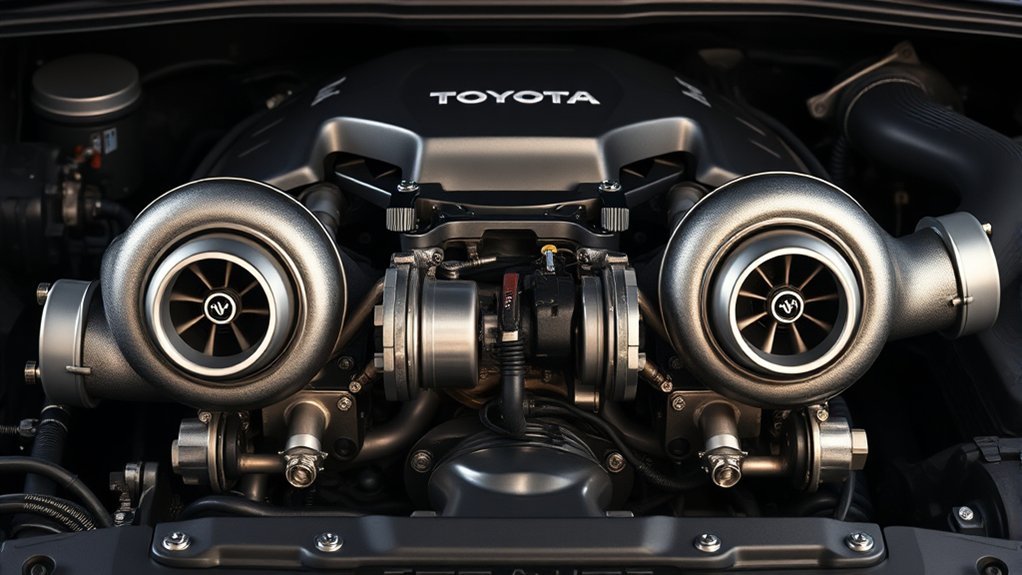
The Toyota Tundra i-FORCE twin-turbo system uses exhaust energy to spin two turbochargers that compress the V6 engine’s intake air. The denser air lets the engine add fuel and make more torque when the driver asks for power. Toyota’s standard i-FORCE is a gasoline twin-turbo V6, while i-FORCE MAX adds an electric motor generator and hybrid battery for higher combined output and stronger low-speed response.
Last updated: September 11, 2026. This guide focuses on how the Tundra’s twin-turbo boost system works. For the powertrain-name distinction, see what i-FORCE means on a Toyota Tundra; for hybrid-only details, see the i-FORCE MAX system explainer.
Quick Answer
Exhaust gas spins each turbocharger’s turbine, which turns a compressor that pressurizes the Tundra’s intake air. A water-cooled intercooler then lowers the air temperature before it enters the engine. The standard i-FORCE is gasoline-only, while i-FORCE MAX adds an electric motor for stronger combined output and quicker low-speed response.
Key Takeaways
- The Tundra uses two turbochargers, electric wastegate actuators, and a water-cooled intercooler.
- i-FORCE is the gasoline twin-turbo V6; i-FORCE MAX adds a motor generator and hybrid battery.
- Toyota rates i-FORCE at up to 389 horsepower and 479 lb-ft of torque, while i-FORCE MAX produces 437 net combined horsepower and 583 lb-ft.
- Fuel economy and towing capacity vary by trim, drivetrain, cab, bed, equipment, and load.
- Correct oil, filter, cooling-system, and intake maintenance are especially important in a turbocharged engine.
How Does the Toyota Tundra i-FORCE Twin-Turbo Work?
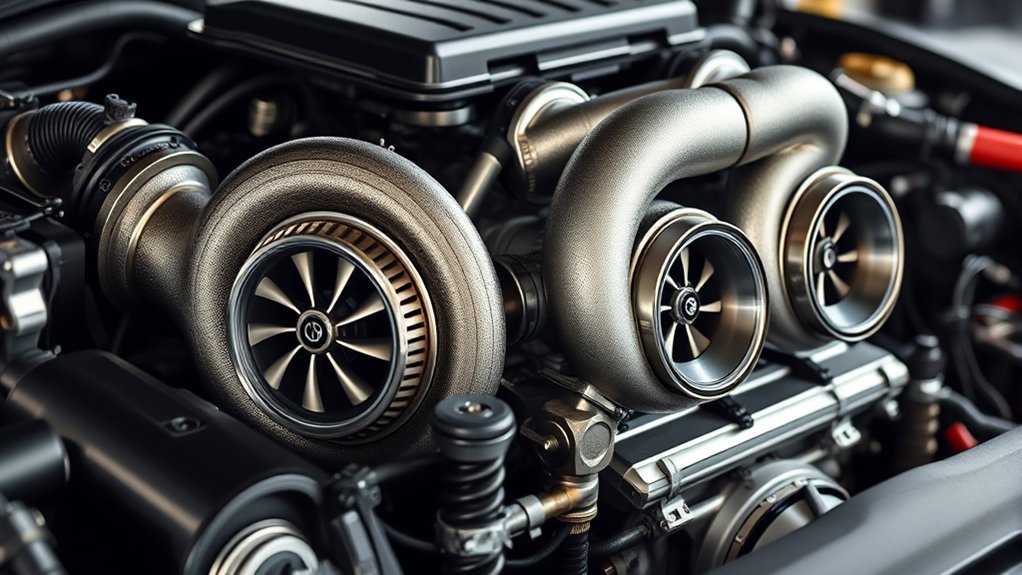
A turbocharger is a forced-induction device that uses part of the energy in an engine’s exhaust stream to increase the mass of air entering the cylinders. More oxygen allows the engine-management system to add more fuel when extra power is needed. The result is greater power and torque than the same engine displacement could normally produce without boost.
The basic process described by Garrett Motion’s turbocharger engineering guide works in the following sequence:
- Exhaust leaves the cylinders. Hot exhaust gas flows from the engine into the turbocharger’s turbine housing.
- The turbine spins. Exhaust pressure and heat energy rotate the turbine wheel.
- A shaft transfers the motion. The turbine wheel is connected to a compressor wheel on the intake side of the turbocharger.
- The compressor pressurizes fresh air. As the compressor turns, it draws in outside air and raises its pressure and temperature.
- The intercooler cools the compressed air. Cooling increases air density and helps control combustion temperature and knock.
- The engine burns the denser charge. The engine computer meters fuel, ignition timing, throttle position, and boost to deliver the requested torque.
- The wastegate regulates boost. When the target pressure is reached, the wastegate redirects some exhaust flow around the turbine so the turbo does not continue building uncontrolled boost.
What Makes the Tundra’s Twin-Turbo System Different?
The Tundra uses two turbochargers rather than one large unit. Toyota also equips the engine with electric wastegate valve actuators and a water-cooled intercooler. The two-turbo layout supports strong airflow while helping the engine respond over a broad operating range. The intercooler removes heat created during compression before the air reaches the intake manifold.
Toyota’s engineering description of the current-generation engine identifies a 3.4-liter, 3,445 cc aluminum V6 with dual overhead camshafts, dual variable valve timing, and added cooling around high-temperature areas. These details matter because a turbocharged towing engine must control cylinder pressure and heat while producing substantial torque at low engine speed. See Toyota’s technical introduction to the Tundra powertrain for the underlying engine design.
Note: A turbocharger does not create literally “free” power. It recovers part of the exhaust stream’s energy, but the system still produces backpressure, intake heat, cooling demand, and mechanical losses.
What Does Turbocharging Do for the Toyota Tundra?
Turbocharging lets the Tundra’s V6 produce the low-rpm torque expected from a full-size pickup without relying on a larger naturally aspirated engine. The key benefits are strong acceleration, useful torque under load, and better power retention at elevation than a comparable naturally aspirated engine.
The turbochargers are only one part of the result. Direct and port fuel injection, variable valve timing, intercooling, engine calibration, the 10-speed automatic transmission, and—in i-FORCE MAX models—the electric motor all affect how the truck responds.
What Changes in Real Driving?
The turbo system does not operate at one fixed boost level. Engine load and the driver’s torque request determine how much airflow and turbine energy the control system needs. This makes the same hardware behave differently during light cruising, acceleration, towing, and high-elevation driving.
| Driving Condition | What the Turbo System Does | What It Means for the Driver |
|---|---|---|
| Light cruise | Lower engine load means less exhaust energy and less need for boost. | The engine can operate without demanding maximum turbo airflow. |
| Acceleration or climbing | Exhaust energy rises, the turbine and compressor speed increase, and wastegate control manages boost toward the requested torque. | More pressurized air is available as the engine asks for more power. |
| Towing under load | The engine and transmission can sustain higher airflow and lower gears as needed, while the cooling systems manage added heat. | Strong low-rpm torque helps the truck accelerate and hold speed, but fuel use and heat load rise. |
| Higher elevation | The compressors can offset part of the lower ambient air density by increasing intake pressure within system limits. | Power loss can be smaller than with a comparable naturally aspirated engine, but it is not eliminated. |
| Powertrain | Main Components | Toyota Output Rating | Key Difference |
|---|---|---|---|
| i-FORCE | Gasoline twin-turbo V6 and 10-speed automatic transmission | Up to 389 hp and 479 lb-ft of torque; output can vary by configuration | No hybrid traction motor or high-voltage battery |
| i-FORCE MAX | Twin-turbo V6, motor generator, clutch, hybrid battery, and 10-speed automatic transmission | 437 net combined hp and 583 lb-ft of torque | Electric assistance strengthens low-speed response and contributes to the combined output |
These ratings are published on Toyota’s 2026 Tundra specifications page. The 437-horsepower number belongs to the complete i-FORCE MAX hybrid system; it should not be described as output from the turbochargers or gasoline engine alone.
Output note: Toyota rates the i-FORCE MAX system at 437 net combined horsepower and 583 lb-ft of torque, with peak torque listed at 2,400 rpm. Those are combined-system figures, not gasoline-engine-only output.
How Does Turbocharging Help the Toyota Tundra Tow?
Turbocharging helps a tow vehicle by increasing the amount of air the engine can process when the driver asks for more torque. That is especially useful when accelerating with a trailer, climbing a grade, merging into traffic, or holding speed against a headwind.
The Tundra’s broad torque delivery works with its 10-speed automatic transmission and TOW/HAUL modes. The transmission can select lower ratios sooner, hold a gear longer, and provide engine braking on descents. On i-FORCE MAX models, the motor generator can also contribute torque through the transmission during demanding operation.
Turbocharging also reduces—but does not eliminate—the power loss associated with higher elevation. A naturally aspirated engine can only draw in the mass of air available at local atmospheric pressure. A turbocharger can compensate by increasing intake pressure, although turbo speed, cooling capacity, fuel quality, temperature, and engine-control limits still apply.
Toyota advertises a 12,000-pound maximum towing capacity for the 2026 Tundra lineup. That figure does not apply to every truck, and the configuration with the greatest combined horsepower is not automatically the configuration with the greatest tow rating.
Warning: Never select a trailer by using the advertised lineup maximum alone. Confirm the specific truck’s towing capacity, payload, gross combined weight rating, axle ratings, receiver rating, tire limits, and allowable tongue weight. Passengers, cargo, accessories, and trailer tongue weight all consume available payload.
How Does i-FORCE MAX Add Hybrid Power?
The i-FORCE MAX hybrid powertrain uses the same basic twin-turbo V6 architecture as i-FORCE but adds a motor generator between the engine and 10-speed automatic transmission. Its purpose is not simply to alternate between gasoline and electric driving. The components can work together to add torque, start the engine, support low-speed movement, recover energy during deceleration, and improve response.
Hybrid Powertrain Configuration
Toyota places the motor generator and a clutch inside the transmission bell housing. This inline arrangement sends the motor’s output through the truck’s conventional transmission and driveline. Toyota’s 2026 Tundra powertrain overview confirms that the motor assists through the transmission while the hybrid components handle engine start-up, electric assist, limited EV operation, and energy regeneration.
The system uses a sealed 288-volt nickel-metal hydride battery located beneath the rear passenger seat. Toyota lists a 1.87-kWh capacity in the Tundra electronic brochure. It is a conventional self-charging hybrid rather than a plug-in hybrid, so owners do not connect it to an external charger.
Enhanced Towing Capacity
The hybrid motor’s immediate torque can make initial acceleration feel smoother when the truck is loaded or pulling a trailer. It also helps fill the response gap while exhaust flow and turbo speed increase. That does not mean the motor can override the truck’s mechanical limits or that every i-FORCE MAX configuration has the highest available tow rating.
Towing capacity remains a complete-vehicle calculation. Cooling, wheelbase, suspension, axle ratio, cab, bed, drivetrain, curb weight, tires, hitch equipment, and installed options all influence the final rating.
Efficient Fuel Economy
The hybrid system can shut off or assist the gasoline engine in selected low-speed situations and can recover some energy during deceleration. However, the Tundra is still a large full-size pickup, and its fuel economy changes substantially with speed, temperature, tires, terrain, payload, and trailer load.
For the 2026 lineup, Toyota lists i-FORCE MAX city/highway estimates ranging from 18/20 mpg to 20/24 mpg, depending on trim and drivetrain. A Limited i-FORCE MAX is listed at 20/24, while the off-road-oriented TRD Pro is listed at 18/20. These are EPA estimates, not guaranteed real-world results.
Performance Dynamics: Turbocharged vs. Naturally Aspirated Engines
A naturally aspirated engine draws air into its cylinders using atmospheric pressure and the low pressure created as the pistons move downward. A turbocharged engine adds a compressor, allowing a smaller displacement to process more air under load.
| Characteristic | Turbocharged Engine | Naturally Aspirated Engine |
|---|---|---|
| Power density | Can produce more power from a smaller displacement when boost is available | Usually needs more displacement or engine speed for similar output |
| Throttle response | May have a short delay while airflow and turbo speed rise; hybrid assist can reduce the sensation | Often responds more directly because no boost must build |
| Elevation | Can compensate for some reduction in air density by increasing intake pressure | Typically loses more output as atmospheric pressure falls |
| Heat and complexity | Adds turbochargers, wastegates, charge plumbing, intercooling, oil supply, and greater heat-management demands | Uses fewer forced-induction components but can still be mechanically sophisticated |
| Fuel use under heavy load | Can rise quickly because producing boost and power requires additional fuel | Also rises under load, but there is no boosted operating region |
Neither design is automatically superior in every situation. Turbocharging favors high power density and elevation performance, while a naturally aspirated engine may offer simpler response and fewer forced-induction components.
Does Turbocharging Improve Toyota Tundra Fuel Economy?
Turbocharging can support better rated fuel economy when it allows an automaker to replace a larger engine with a smaller one that uses less fuel during light-load operation. The benefit is not created merely by compressing more air. It comes from the complete engine design, transmission calibration, aerodynamics, vehicle weight, gearing, and how often the driver requests boost.
During gentle cruising, the smaller engine may operate with relatively low airflow and fuel demand. During acceleration or towing, the turbochargers supply more air and the engine adds more fuel to create power. A heavily loaded turbocharged truck can therefore consume much more fuel than its window-sticker estimate.
The i-FORCE MAX hybrid system adds another efficiency tool by recovering some deceleration energy and assisting the gasoline engine. Its greatest value is the combination of strong low-rpm output and modest improvement in selected EPA test configurations—not a guarantee of low fuel use in every driving condition.
Pro Tip: Smooth acceleration, correct tire pressure, moderate highway speed, proper trailer setup, and avoiding unnecessary cargo usually have a greater effect on real-world truck fuel economy than trying to keep the turbochargers from operating.
How Do You Maintain the Toyota Tundra Twin-Turbo System?
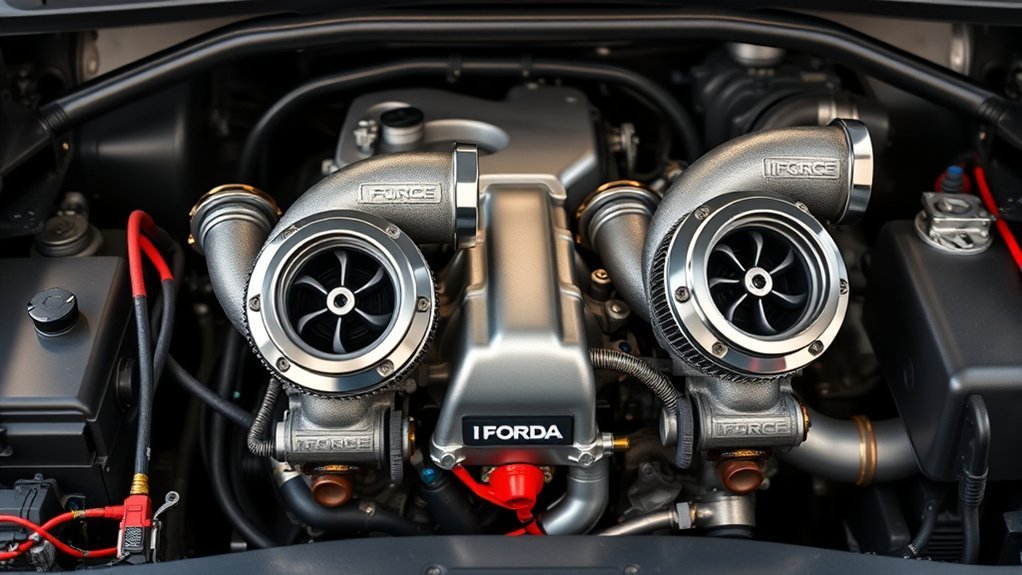
The Tundra’s turbocharging system is designed to operate automatically. The driver does not manually select boost pressure or open the wastegates. Engine-control software adjusts throttle position, fuel delivery, ignition timing, cooling strategies, and wastegate operation according to load and operating conditions.
Turbocharger Functionality Explained
When the driver requests more torque, the throttle opens and exhaust energy increases. The turbocharger turbines accelerate, the compressors move more air, and boost rises toward the engine computer’s target. Electric wastegate actuators regulate how much exhaust reaches the turbines. The water-cooled intercooler then reduces the temperature of the compressed intake charge before combustion.
When less power is needed, the engine reduces fuel and airflow, turbo speed falls, and the wastegates help control turbine energy. This continuous regulation is why boost can change without a separate driver command.
Performance Benefits Observed
- Strong low-rpm torque: useful when accelerating, towing, or climbing.
- High power density: substantial output from a 3.4-liter-class V6.
- Better elevation compensation: the compressors can offset part of the reduction in atmospheric air density.
- Broad transmission flexibility: the 10-speed automatic can keep the engine in an effective torque range.
- Hybrid response: i-FORCE MAX motor assistance can make initial acceleration feel more immediate while boost builds.
Common Maintenance Considerations
Turbocharger bearings and moving parts depend on clean engine oil, while the intercooler and engine rely on properly maintained cooling systems. Owners should follow the schedule for their exact model year, engine, market, and operating conditions rather than using a generic turbo-maintenance interval.
- Check the engine-oil level regularly. Toyota’s 2026 maintenance guide recommends checking it about once a month.
- Replace the oil and filter on schedule. The guide calls for replacement after 10,000 miles or 12 months under its normal schedule. It shortens the interval to 5,000 miles or six months when the truck is driven mainly on dirt or dusty roads or repeatedly makes trips shorter than five miles below freezing.
- Use the specified oil and fluids. Consult the owner’s manual for the correct viscosity, grade, capacity, and coolant specifications.
- Inspect the engine air filter. A damaged or heavily restricted filter can reduce airflow and allow contamination into the intake system.
- Maintain the cooling system. Inspect the engine and intercooler coolant reservoirs, hoses, radiator, condenser, and intercooler for leakage, damage, or blockage.
- Do not ignore warning signs. Sudden power loss, an oil-pressure warning, overheating, heavy smoke, persistent abnormal whistling, rattling, or visible oil and coolant leakage warrant prompt inspection.
- Avoid unsupported modifications. Intake, exhaust, boost-control, and software changes can alter air-fuel control, cylinder pressure, emissions compliance, and warranty coverage.
Toyota’s current schedules and service notes are available in the official 2026 Tundra Warranty & Maintenance Guide and 2026 Tundra Hybrid Warranty & Maintenance Guide.
Warning: Stop driving as soon as it is safe if the truck displays a low-oil-pressure warning, overheats, produces heavy smoke, or suddenly loses substantial power. Continuing under load can turn a correctable oil, cooling, intake, or boost-control problem into major engine or turbocharger damage.
Frequently Asked Questions
How does Toyota i-FORCE work?
The standard i-FORCE powertrain uses a gasoline twin-turbo V6 and a 10-speed automatic transmission. Exhaust gas spins two turbine wheels, which drive compressors that pressurize the intake air. The standard i-FORCE does not include the high-voltage hybrid motor or battery found in i-FORCE MAX.
How does a turbocharger work step by step?
Exhaust enters the turbine housing and spins the turbine wheel. A shaft turns the compressor wheel on the intake side. The compressor pressurizes fresh air, the intercooler removes heat, and the engine meters fuel for the denser air charge. A wastegate bypasses some exhaust when the target boost pressure is reached.
What does “i-FORCE” mean on a Toyota Tundra?
i-FORCE is Toyota’s branding for the Tundra’s gasoline twin-turbo V6 powertrain. i-FORCE MAX is the separate hybrid version that combines the twin-turbo engine with an electric motor generator and high-voltage battery.
What Toyota Tundra year should you stay away from?
There is no single model year that every buyer should automatically reject. Check the specific VIN, service history, corrosion condition, accident history, and completed repairs. Toyota’s November 2025 engine-debris recall covered certain conventional-gas 2022–2024 Tundras, and a May 2026 recall expanded the issue to additional 2024 non-hybrid Tundras. The campaigns do not include every truck from those model years. Use Toyota’s official VIN recall lookup; for a step-by-step check, see how to check a Tundra recall by VIN.
Does the Tundra i-FORCE MAX need to be plugged in?
No. i-FORCE MAX is a conventional hybrid, not a plug-in hybrid. Its battery is charged by the gasoline engine and regenerative braking, so there is no external charging port.
Does the Toyota Tundra have turbo lag?
Some delay is possible because turbo speed and exhaust flow must increase before full boost is available. The twin-turbo sizing, 10-speed transmission, electronic wastegate control, and low-rpm torque help limit the sensation. In i-FORCE MAX models, electric-motor assistance can make the initial response feel quicker.
Conclusion
The Toyota Tundra’s i-FORCE engine uses two exhaust-driven turbochargers, electronic boost control, and a water-cooled intercooler to produce strong torque from a 3.4-liter-class V6. The i-FORCE MAX version adds a motor generator and hybrid battery, raising combined output and improving low-speed response.
The technology supports towing and acceleration, but it does not eliminate configuration limits, heat, fuel use under load, or maintenance requirements. Verify the rating for the individual truck, follow Toyota’s oil and cooling-system schedule, and check the VIN for open recalls before buying or towing—especially when evaluating a used 2022–2024 non-hybrid Tundra.
Sources
- Garrett Motion — What Is a Turbo and How Does It Work? — turbine, compressor, charge-air cooling, and turbocharger operating principles.
- Toyota — 2026 Tundra Specifications — current horsepower, torque, towing, payload, and trim-level fuel-economy figures.
- Toyota USA Newsroom — 2026 Toyota Tundra — i-FORCE and i-FORCE MAX construction and combined output.
- Toyota Tundra Electronic Brochure — hybrid motor and nickel-metal hydride battery specifications.
- Toyota 2026 Tundra Maintenance Guide and Tundra Hybrid Maintenance Guide — oil, filter, cooling-system, and inspection schedules.
- NHTSA Recall 25V767 — certain 2022–2024 V35A-powered Tundras and related vehicles affected by possible engine machining debris.
- NHTSA Recall 26V320 and Toyota’s May 2026 recall notice — additional certain 2024 non-hybrid Tundras affected by the engine-debris issue.
- Toyota Recall Lookup — current VIN-specific recall status.