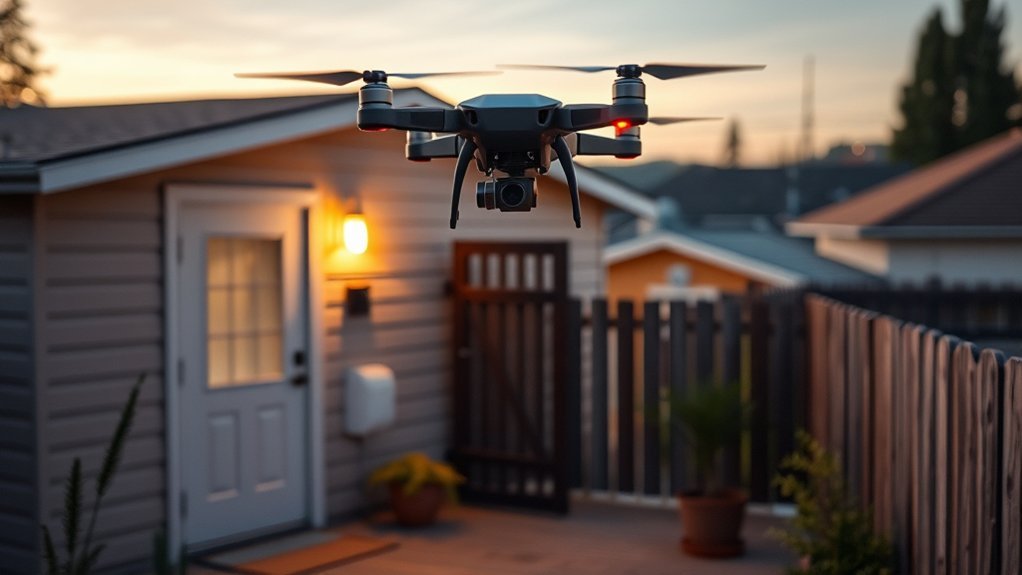
A low-cost security surveillance drone can add flexible aerial coverage to a home, farm, yard, jobsite, or small commercial property, but it should not be treated as a flying replacement for fixed cameras or guards. Buyers should focus on usable camera detail, real flight time, wind resistance, obstacle sensing, battery support, data storage, and lawful operating limits. In the United States, a security flight is generally non-recreational, so FAA rules can matter even when nobody is paying the pilot.
Quick Answer
For a low-cost security drone, prioritize a stabilized 4K camera, dependable GPS, obstacle sensing, spare batteries, strong return-to-home behavior, and enough wind resistance for the property. Treat long advertised transmission ranges cautiously: U.S. Part 107 operations normally require visual line of sight, and thermal or fully autonomous security systems can cost far more than consumer drones.
Key Takeaways
- Buy for the actual patrol area, lighting, wind, and identification distance rather than choosing from headline specifications alone.
- A stabilized 4K camera is useful for cropping and reviewing details, but there is no universal 1080p or 4K legal standard for surveillance evidence.
- Advertised radio range does not override FAA visual-line-of-sight or airspace rules.
- Thermal cameras, automated docks, and enterprise analytics usually move a system well beyond ordinary consumer-drone pricing.
- For U.S. security use, check Part 107, registration, Remote ID, airspace, night-flight, privacy, and local takeoff or landing rules before deployment.
What to Expect From a Budget Security Drone
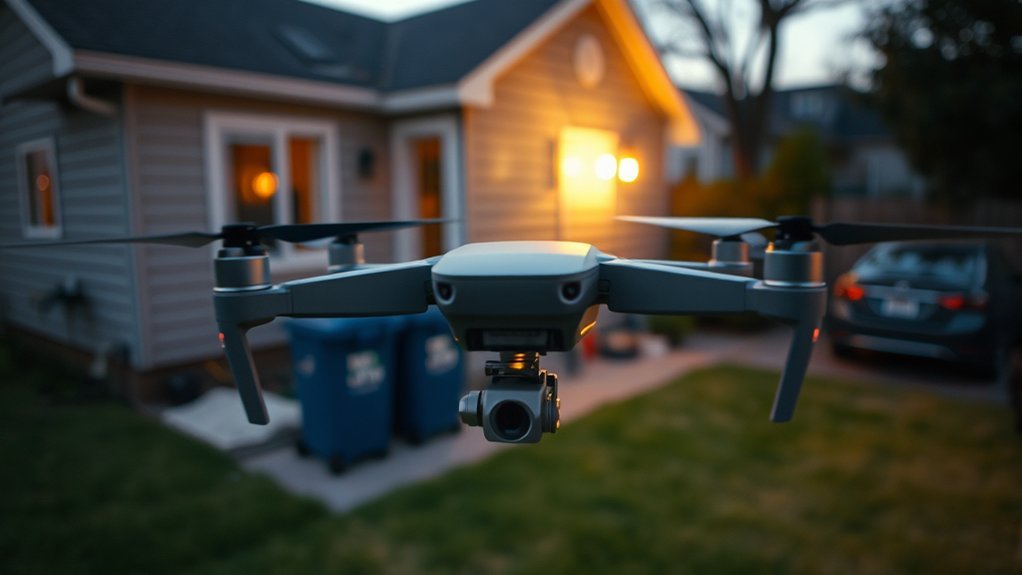
A budget security drone is usually a consumer or prosumer camera drone adapted for occasional observation rather than a purpose-built autonomous security system. If the target budget is roughly $200 to $1,500, concentrate on dependable flight controls, GPS positioning, stabilized video, obstacle sensing, return-to-home behavior, spare-battery availability, and clear manufacturer support.
Modern inexpensive drones are not limited to 720p or 1080p. Many current models record 4K video and advertise flight times beyond 30 minutes under controlled test conditions. Those headline numbers should be treated as laboratory maximums rather than guaranteed patrol performance.
A useful security drone is the one that produces clear footage and returns safely under the conditions where it will actually be flown—not the model with the longest specification sheet.
True thermal imaging, automated charging docks, advanced object detection, fleet management, and persistent remote operations belong to a different class. For example, a U.S. Department of Homeland Security market survey lists the professional Parrot ANAFI USA GOV, which combines visible-light and thermal cameras, at an MSRP far above typical consumer-drone budgets. Buyers should therefore separate a low-cost camera drone used for security checks from an enterprise security-drone system.
Set a Realistic Security Drone Budget
Start with the full cost of operating the drone, not just the aircraft price. A low purchase price loses its advantage if the system needs expensive batteries, proprietary storage, frequent propeller replacement, paid cloud services, or an early upgrade because the camera cannot capture useful detail.
A practical budget should include:
- Aircraft and controller: the base drone, compatible controller, and required mobile device if one is not included.
- Extra batteries: security checks are much easier when one battery can charge while another is in use.
- Charging equipment: a multi-battery hub or additional charger can reduce turnaround time.
- Memory and storage: microSD cards, local backup storage, or any cloud subscription used for recorded video.
- Replacement parts: spare propellers, guards where appropriate, landing gear, and carrying protection.
- Lighting: compliant anti-collision lighting may be needed for Part 107 night operations.
- Training and regulatory costs: registration and pilot-certification requirements can apply to non-recreational operations.
- Software: advanced mapping, fleet management, automated alerts, or cloud archiving may require subscriptions.
Pro Tip: Price a second battery, charger, memory card, replacement propellers, and protective case at the same time as the drone. That gives a more realistic first-year cost than comparing aircraft prices alone.
Choose the Right Drone for Your Property
The property should determine the drone. A compact suburban yard, a wooded rural property, a construction site, and a large farm create very different camera, range, wind, and obstacle-avoidance requirements.
Define the mission before comparing models:
- Gate or driveway checks: prioritize quick setup, optical clarity, stable hovering, and easy return-to-home.
- Roof or building perimeter observation: prioritize obstacle sensing, precise low-speed control, and a stabilized camera.
- Rural boundary checks: prioritize battery reserve, wind handling, controller reliability, and legal line-of-sight planning.
- Night security checks: determine whether a good low-light visible camera is enough or whether genuine thermal sensing is justified.
- Scheduled commercial patrols: investigate enterprise platforms, automated docks, operations software, and the regulatory authority required for the intended mission.
Do not assume a long-range radio system makes a drone suitable for an entire property. Trees, buildings, terrain, interference, and the requirement to maintain legal visual contact can reduce the area that can actually be covered on one flight.
Compare Camera Quality on Cheap Security Drones
Camera quality should be judged by the detail visible at the actual monitoring distance. Resolution is important, but it is only one part of image quality. Lens quality, sensor size, bitrate, compression, shutter speed, lighting, gimbal stabilization, digital zoom, and subject distance can matter just as much.
- 4K recording: useful when footage may need cropping after a flight, but 4K alone does not guarantee readable faces or license plates.
- Mechanical gimbal: usually produces steadier footage than electronic stabilization alone.
- Low-light performance: evaluate sample clips rather than relying only on a large megapixel number.
- Optical zoom: can preserve more usable detail than heavy digital zoom when observation from a distance is necessary.
- Original-file retention: keep original recordings when footage may later need to document an incident.
There is no universal rule stating that 1080p or 4K is the minimum resolution for legally usable evidence. If footage may be used in an insurance claim, workplace investigation, police report, or court proceeding, preserve the original file and its metadata and follow any evidence-handling requirements that apply in the relevant jurisdiction.
Note: Before buying, download original sample footage when the manufacturer provides it. Online videos are often recompressed, so they may not show the camera’s real recording quality.
Compare Flight Time, Range, and Stability
Flight time, radio range, and wind stability are related but should be evaluated separately. Manufacturer specifications normally come from controlled conditions, while a security flight may involve wind, hovering, repeated acceleration, obstacle avoidance, cold temperatures, and a safety reserve for the return trip.
Flight Time Tradeoffs
Current compact drones can advertise 30 minutes or more of maximum flight time, but a security operator should never plan to use the entire battery. Real usable time is reduced by wind, temperature, battery age, hovering, camera activity, rapid maneuvering, and the need to land with a safe reserve.
A better comparison is the time available between takeoff and the point when the aircraft must start returning. If a drone advertises a long laboratory endurance but regularly reaches the return threshold halfway through the intended route, its headline number has little practical value.
Extra batteries help with repeated patrols, but they do not create continuous coverage by themselves. Battery cooling and charging time, operator workload, and legal operating limits still matter.
Range And Signal Reliability
Do not treat the manufacturer’s maximum transmission distance as the distance you are allowed to patrol. Some modern drones advertise radio links measured in kilometers, but U.S. Part 107 operations ordinarily require the remote pilot or visual observer to maintain visual line of sight unless the operation has the appropriate additional authorization or waiver.
| Factor | What to Check | Main Risk |
|---|---|---|
| Flight time | Real patrol time with a return reserve | Landing short or creating coverage gaps |
| Radio link | Performance around buildings, trees, and interference | Video breakup or command-link loss |
| Operating distance | Visual line of sight and applicable airspace limits | Flying beyond legal or safe limits |
Test what happens when the signal becomes weak. A dependable drone should have clearly documented lost-link and return-to-home behavior, but automatic return is a backup feature, not permission to fly where the aircraft cannot lawfully be monitored.
Stability In Wind
Wind resistance is model-specific. Published wind ratings should be treated as operating limits, not target conditions. A lightweight drone may hold position acceptably while facing the wind but use far more battery returning against it.
- Check the manufacturer’s maximum wind-resistance specification.
- Leave a generous safety margin below that maximum.
- Consider gusts, not only average wind speed.
- Test return-to-home accuracy from the intended launch area.
- Avoid assuming a heavier drone is automatically safer; weight, propulsion, positioning, and control software all matter.
For reference, current manufacturer specifications show how much ratings vary: DJI lists a maximum wind resistance of 10.7 m/s for the Mini 4 Pro, while Skydio lists 12.8 m/s maximum gust handling for the much larger X10 enterprise platform. Those specifications are not interchangeable with a universal “safe wind speed.”
Look for Night Vision, Thermal, and Motion Alerts
Low-light capability, thermal imaging, and motion analytics solve different problems. A buyer should first identify what must be detected after dark and then select the sensor rather than assuming “night vision” and “thermal” mean the same thing.
Night Vision And Thermal
A good visible-light camera may produce useful footage around illuminated buildings, parking lots, or yards. Thermal imaging detects heat differences and can reveal a person, animal, vehicle, or warm equipment in darkness, but thermal footage does not necessarily provide the facial or color detail needed for identification.
- Low-light visible camera: useful where ambient lighting already exists.
- Spotlight: can improve visible-color footage but may draw attention and consume power.
- Thermal imager: useful for detecting heat signatures in darkness and some visually confusing backgrounds.
- Dual visible/thermal payload: gives the operator detection plus conventional visual context, but usually costs substantially more.
Professional systems such as the Parrot ANAFI USA family and Skydio X10 demonstrate what integrated thermal capability looks like, but they should not be confused with ordinary low-cost camera drones. The U.S. Department of Homeland Security Blue UAS market survey provides examples of professional platforms and their sensor packages.
Warning: A thermal camera does not make a drone invisible, all-weather, or automatically legal to fly at night. U.S. Part 107 night operations have separate pilot and anti-collision-light requirements.
Motion Alert Accuracy
Motion alerts are more common in purpose-built security systems and docked enterprise platforms than in basic consumer drones. Before paying for AI detection, confirm exactly where the analysis runs, what it can classify, whether it requires a cloud subscription, and how the system handles false alerts.
A useful alert system should let the operator review the underlying video rather than rely on a notification alone. Rain, moving trees, shadows, wildlife, headlights, and reflective surfaces can all produce unwanted events in poorly tuned systems.
Ask the vendor to demonstrate detection under the conditions that matter for the property: darkness, backlighting, rain, moving vehicles, animals, and partial obstruction.
Is an Autonomous Security Drone Worth It?
An autonomous security drone can be worthwhile when a property needs repeatable routes, rapid launch, remote inspection, automated charging, or integration with alarms and fixed cameras. The value comes from reducing repetitive manual tasks, not from removing all human or regulatory responsibility.
- Scheduled missions can make repeated inspections more consistent.
- Automated docks can recharge the aircraft and protect it between missions.
- AI-assisted detection can help operators review large amounts of video.
- Integration with fixed cameras can provide context before a drone is launched.
- Centralized logs can make maintenance, incident review, and fleet management easier.
However, automation does not automatically authorize beyond-visual-line-of-sight operations. Under the current Part 107 framework, operations that exceed ordinary visual-line-of-sight requirements may require specific FAA authority or a waiver. Buyers considering an automated perimeter system should resolve that regulatory question before purchasing hardware.
Check Data Security, Storage, and Privacy
A surveillance drone is also a data-collection device. Camera specifications receive most of the attention, but storage and access controls can be equally important when footage contains people, vehicles, building entrances, security procedures, or private property.
Before buying, determine:
- Whether recordings stay on the aircraft, controller, removable card, cloud service, or several locations.
- Whether uploads can be disabled when local storage is preferred.
- Whether stored and transmitted data are encrypted.
- Whether the system supports separate user accounts and access permissions.
- How long cloud footage is retained and how it can be deleted.
- Whether firmware and mobile apps continue receiving security updates.
- Whether flight logs or video are automatically shared with third parties.
The U.S. Commerce Department’s NTIA UAS privacy best practices encourage operators to be transparent about data collection when practical, minimize unnecessary collection, protect stored personal information, and avoid keeping sensitive data longer than necessary.
Know the Drone Laws Before You Buy
For U.S. buyers, the purpose of the flight determines which operating rules apply. The FAA states that flights conducted purely for fun can qualify for the recreational exception, while almost all other small-drone operations fall under 14 CFR Part 107. A drone used as part of a business or organized security function is therefore generally a non-recreational operation even when nobody pays the pilot for that individual flight.
The FAA Part 107 overview explains the core operating requirements. Important points for security use include:
- Remote pilot certification: Part 107 operations must be conducted under the responsibility of a properly certificated remote pilot.
- Registration: Part 107 drones must be registered. The FAA’s drone registration guidance explains current registration rules.
- Remote ID: drones that are required to be registered or are registered generally must comply with Remote ID requirements, subject to applicable exceptions.
- Visual line of sight: ordinary Part 107 flights require the aircraft to remain within visual line of sight unless the operation has the appropriate additional authority.
- Altitude: the normal limit is 400 feet above ground level, with specific provisions for operations near structures and possible waivers for qualifying operations.
- Controlled airspace: authorization may be required before flying in controlled airspace.
- Night operations: Part 107 pilots must meet the applicable training requirements and use anti-collision lighting visible for at least three statute miles.
- Flights over people or moving vehicles: these are governed by specific FAA eligibility categories and operating conditions rather than a simple blanket permission.
Before each location is used, check current airspace information. The FAA’s B4UFLY service information lists approved providers that show airspace restrictions, airports, Temporary Flight Restrictions, and other important flight information.
Warning: FAA compliance addresses aviation rules, not every privacy or property-law issue. State and local laws may separately restrict surveillance, harassment, recording, takeoff, landing, or data collection. This article provides general information, not legal advice.
Test the Drone Before Relying on It for Security
A security drone should be tested on the actual property before it becomes part of an incident-response plan. A specification sheet cannot show how the aircraft will behave around a particular building, tree line, hill, Wi-Fi environment, or lighting condition.
Run controlled tests for:
- Daytime image detail: verify whether people, vehicles, gates, and access points are recognizable at the planned distance.
- Night footage: test every area that may need monitoring after dark.
- Real battery endurance: record the usable patrol time while keeping a safe return reserve.
- Wind: confirm stable hovering and a comfortable return margin in ordinary local conditions.
- Signal strength: identify locations where buildings, vegetation, terrain, or interference weaken the link.
- Return-to-home: verify home-point accuracy, return altitude, and obstacle clearance.
- Obstacle sensing: learn which directions are protected and under what lighting conditions sensing works.
- Storage: confirm that recordings are actually saved where expected and can be retrieved without relying on an expired cloud plan.
- Alerts: if motion or object detection is included, measure false positives before depending on notifications.
Avoid Common Cheap Security Drone Mistakes
The most common buying mistake is treating one impressive specification as proof that the drone will work as a security system. A better purchase decision balances imaging, endurance, reliability, regulation, and the way footage will actually be reviewed.
- Do not buy on resolution alone. A poor lens, tiny distant subject, low bitrate, or heavy motion blur can defeat a 4K label.
- Do not plan around the maximum battery figure. Leave enough reserve to return and land safely.
- Do not confuse radio range with lawful patrol range. Visual-line-of-sight and airspace rules still apply.
- Do not assume thermal is cheap. Genuine thermal payloads can move a system into professional pricing.
- Do not assume obstacle avoidance sees everything. Thin branches, wires, reflective surfaces, darkness, and sensor blind spots can remain hazards.
- Do not ignore data security. Surveillance video can expose more about a property than the buyer intends.
- Do not depend on autonomy before checking the rules. Automated routes and docking do not remove FAA operating requirements.
- Do not skip spare-battery and maintenance planning. A grounded drone provides no security coverage.
Frequently Asked Questions
What is the best drone for security surveillance?
There is no single best model for every property. For occasional daytime checks, a stable GPS camera drone with 4K recording, obstacle sensing, dependable return-to-home, and readily available batteries may be enough. Night, thermal, automated docking, or large-site requirements can justify a professional security platform instead.
What do I need to know before I buy a drone?
Check camera quality, real flight time, battery cost, wind rating, obstacle sensing, storage, software support, return-to-home behavior, and manufacturer parts availability. Also determine which FAA operating rules apply, whether the drone needs registration and Remote ID, and whether local privacy or takeoff rules affect the intended location.
Is it illegal for my neighbor to fly a drone over my property?
There is no single nationwide answer based only on crossing a property boundary. The FAA regulates navigable airspace and flight safety, while state and local laws may address privacy, voyeurism, harassment, nuisance, recording, trespass-related claims, and takeoff or landing from property. Persistent low-altitude surveillance can raise different issues from an ordinary transit flight, so the facts and jurisdiction matter.
What drone should a beginner buy?
A beginner should favor predictable controls, GPS positioning, automatic return-to-home, a stabilized camera, obstacle sensing, clear documentation, replacement-part availability, and a well-supported flight app. Start with supervised practice in an open legal flying area before using the aircraft around buildings or as part of a security routine.
Do I need a Part 107 certificate to use a drone for security?
In the United States, flights conducted for a business or another non-recreational purpose generally fall under Part 107 rather than the recreational exception. The FAA says the purpose of the flight matters; simply flying without payment does not automatically make the operation recreational.
Can an autonomous drone patrol my property by itself?
Automation can schedule routes, launch from a dock, return for charging, and generate alerts, but software does not cancel aviation rules. Under ordinary Part 107 operations, visual-line-of-sight requirements still apply unless the operator has the appropriate additional FAA authority for a different type of operation.
Conclusion
A low-cost security surveillance drone can be valuable when it is treated as a mobile observation tool rather than a guaranteed autonomous security system. The strongest purchase combines clear stabilized footage, realistic battery reserves, reliable GPS and return-to-home behavior, manageable wind performance, secure data handling, and an operating plan that fits the property.
Do not pay extra for a huge advertised transmission range that cannot be used safely or legally, and do not assume a 4K label guarantees identification-quality footage. Test the drone at the intended distance, in the expected lighting and wind, and verify the relevant FAA, state, and local rules before relying on it for security.
Sources
- Federal Aviation Administration — Small Unmanned Aircraft Systems Regulations (Part 107) — visual line of sight, altitude, operating limits, and general Part 107 requirements.
- Federal Aviation Administration — How to Register Your Drone — registration and Remote ID applicability.
- Federal Aviation Administration — B4UFLY — current airspace-awareness resources and approved providers.
- National Telecommunications and Information Administration — UAS Privacy, Transparency, and Accountability — privacy and responsible data-handling best practices.
- U.S. Department of Homeland Security — Blue UAS Market Survey — professional drone capabilities, thermal payload examples, and enterprise pricing context.