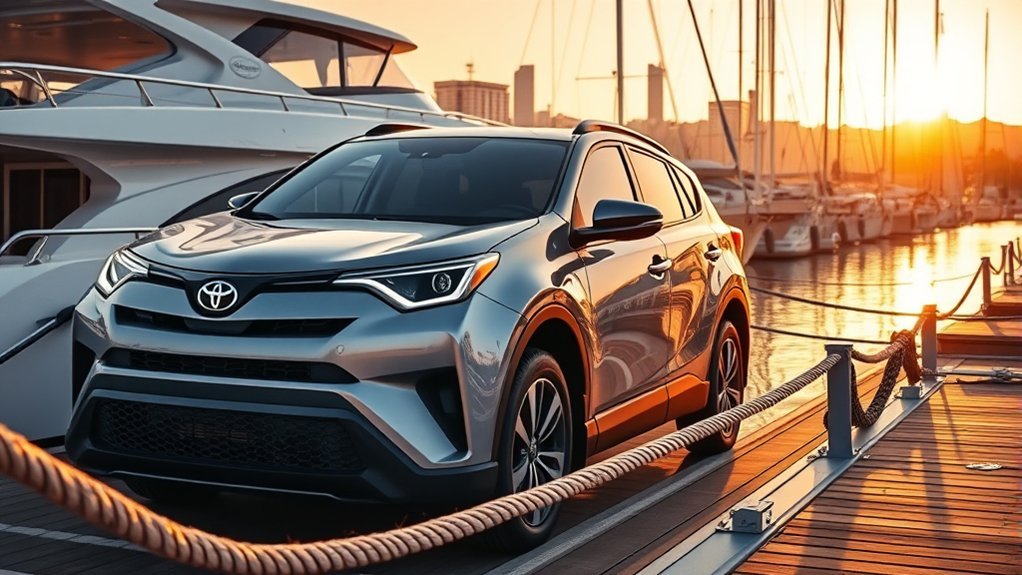
A 2026 Toyota RAV4 can tow many small boats, but not every RAV4 is rated for 3,500 pounds. For U.S.-market models, Toyota lists a 1,750-lb rating for all front-wheel-drive configurations and the LE AWD, while specified AWD Hybrid and Plug-in Hybrid grades can tow up to 3,500 lbs. The right answer therefore depends on your exact trim, drivetrain, fully loaded boat-trailer weight, hitch equipment, tongue load, vehicle payload, and trailer brake setup.
Quick Answer
Yes, a properly equipped 2026 Toyota RAV4 can tow a small boat. Specific AWD Hybrid and Plug-in Hybrid grades are rated up to 3,500 lbs, while all FWD models and the LE AWD are limited to 1,750 lbs. Always compare the boat’s fully loaded trailer weight with your exact vehicle and towing-equipment ratings.
Key Takeaways
- The 2026 RAV4 has an up-to-3,500-lb tow rating; 3,500 lbs does not apply to every trim.
- All FWD configurations and the LE AWD are rated at 1,750 lbs according to Toyota’s 2026 model information.
- Calculate the weight of the boat, trailer, motor, fuel, batteries and all gear as actually towed.
- Do not exceed the lowest rating for the vehicle, hitch receiver, ball mount, hitch ball, trailer, axles or tires.
- Toyota’s four-pin towing harness powers trailer lighting; a trailer with service brakes may require additional brake-compatible wiring or equipment.
- AWD can help on a slippery launch ramp, but it does not override the published towing limit.
Warning: Never assume every 2026 RAV4 can tow 3,500 lbs. Confirm the rating for the exact trim and drivetrain and stay within all vehicle, hitch, trailer, axle and tire limits. Trailer-brake and towing-equipment laws also vary by state or province.
Can a Toyota RAV4 Tow Your Boat?
Whether a Toyota RAV4 can tow your boat depends first on the vehicle’s exact published tow rating and then on the actual loaded trailer weight. Toyota currently advertises the 2026 RAV4 with towing capacity of up to 3,500 lbs, but that number varies by configuration.
A boat’s advertised dry weight is not enough for this calculation. Count the trailer itself, outboard motor if it is not included in the boat’s listed weight, fuel, batteries, trolling motor, anchors, electronics, coolers, safety equipment, fishing gear, spare tire and anything else carried on the trailer.
AWD can also be useful during launch and retrieval because a wet, algae-covered, sandy or gravel ramp may provide much less traction than dry pavement. However, AWD is a traction aid; it does not increase a RAV4 beyond the towing rating Toyota assigns to that configuration.
For the 2026 RAV4, the important phrase is “up to 3,500 lbs.” Your exact trim and drivetrain determine whether the limit is 1,750 or 3,500 lbs.
[Amazon Products Picked for You]

SECURE TRAILERS, RVS AND TOWING EQUIPMENT: This Master Lock trailer coupler lock helps deter theft by blocking unauthorized coupling, making it a dependable trailer hitch lock for parked trailers, RVs, campers, boat trailers, and utility trailers.

[SECURE BOAT TRAILER LOADING] Heavy-duty 3/16 in. proof coil steel chain with 3/8 in. zinc-plated S-Hook + wire latch keeps your boat safely attached to the bow stand. Ideal boat trailer replacement part for towing peace of mind.

Robust Tightener: 0.28" powder coated with DEEAGLE hitch tightener plate to achieve better shock absorption and anti-cuts. Rubber-coated U-bolts for tougher bumps and poor weather. The hitch anti rattle 2 inch is built to last and rust-free
What Is the RAV4’s 3,500-Lb Tow Rating?
Toyota’s 3,500-lb maximum refers to the allowable gross trailer weight for configurations that qualify for that rating. Gross trailer weight means the trailer plus everything loaded in or on it. It is different from gross combination weight, which considers the tow vehicle and trailer together.
Toyota’s 2026 launch information identifies the following towing limits for U.S.-market configurations. Because equipment and specifications can change, confirm the final figure in the documentation for the exact vehicle before towing.
| 2026 RAV4 Configuration | Published Maximum |
| Hybrid LE — FWD or AWD | 1,750 lbs |
| Hybrid SE — FWD | 1,750 lbs |
| Hybrid SE — AWD | Up to 3,500 lbs |
| Hybrid XLE Premium — FWD | 1,750 lbs |
| Hybrid XLE Premium — AWD | Up to 3,500 lbs |
| Hybrid Woodland — AWD | Up to 3,500 lbs |
| Hybrid XSE / Limited — AWD | Up to 3,500 lbs |
| Plug-in Hybrid SE / XSE / Woodland — AWD | Up to 3,500 lbs |
| Plug-in Hybrid GR SPORT | Do not assume 3,500 lbs; verify the current vehicle documentation before towing |
The source for these configuration differences is Toyota’s 2026 RAV4 model announcement. Toyota’s consumer specification page also describes the model’s maximum as “up to 3,500 lbs.”
The tow rating is not permission to ignore other limits. Passengers, cargo, accessories and tongue load all affect how heavily the RAV4 itself is loaded. Check the vehicle’s certification and tire-loading labels and the towing section of the owner’s documentation so the vehicle does not exceed its GVWR or axle ratings.
Note: A fixed “stay 10% or 20% below the tow rating” rule is not an official Toyota requirement. Keeping useful reserve below a maximum can make real-world towing less demanding, but the mandatory limits are the published ratings for the vehicle and every towing component.
How Much Do Your Boat and Trailer Weigh?
Start with the boat and trailer as one complete towing system. The relevant trailer figure is not simply the hull’s dry weight. You need the weight of the combination as it will actually travel down the road.
The loaded total should include the trailer, boat, engine, fuel, batteries, water carried aboard, electronics, anchors, coolers, fishing or watersports equipment, safety equipment and other cargo. The trailer must also remain within its own GVWR and axle and tire ratings.
[Amazon Products Picked for You]
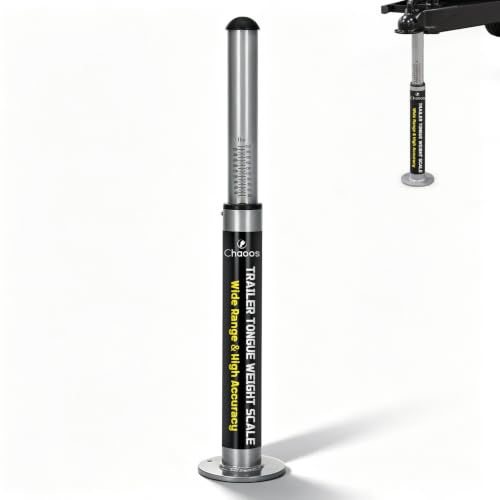
【Wide Range & High Accuracy】The Chaoos trailer tongue weight scale measures up to 2100 lbs with an accuracy within ±20 lbs, helping ensure proper tongue weight for safer towing and reduced trailer sway.

【Professional-Grade Accuracy & Durability】Engineered for professionals and meticulous owners, this scale combines an industrial Q235 steel structure with a military-grade spring mechanism for lab-like precision up to 1800 lbs. Its finish undergoes a rigorous 300-hour salt spray test, offering exceptional corrosion and abrasion resistance for use in marinas, construction sites, farms, or frequent highway travel.

100 PACK IN 2 SIZES: 50 Packs of 100 ml Weighing Boats & 50 Pack of 7 ml Weighing Boats are in this set, which allows you to use them in different ways in your lab
Boat and Trailer Weight
Avoid relying on broad “typical boat weight” ranges when deciding whether your RAV4 is suitable. Two boats of similar length can have very different weights because of hull construction, engines, batteries, fuel capacity and accessories.
Use the manufacturer’s documented weights only as a starting point. Then add equipment that is not included in those specifications and, preferably, verify the combination on a scale.
For example, imagine a boat that weighs 1,150 lbs in its ready-to-run condition, a 650-lb trailer and 250 lbs of additional fuel and gear. The loaded trailer would be about 2,050 lbs. That would already exceed a 1,750-lb RAV4 configuration even though the boat itself weighs much less than 1,750 lbs.
Loaded Towing Total
Use this checklist when estimating gross trailer weight:
- Boat or personal watercraft in its road-ready condition
- Trailer
- Outboard or other propulsion equipment not included in the boat weight
- Fuel
- Starting and trolling-motor batteries
- Anchors, lines and safety gear
- Electronics and mounted accessories
- Coolers, fishing tackle or watersports equipment
- Spare trailer tire and carrier
- Any water, ballast or other cargo transported on the trailer
Compare the result with the RAV4’s applicable towing rating. Then separately confirm that the tongue load and everything carried inside the vehicle keep the RAV4 below its GVWR, axle limits and available carrying capacity.
Warning: Tongue weight is carried by the tow vehicle. A trailer can be below the RAV4’s maximum trailer rating and still overload the vehicle, rear axle, hitch or ball mount.
Verify Scale Numbers
A public vehicle scale removes much of the uncertainty from towing calculations. Load the boat exactly as you expect to tow it, including normal fuel, batteries and gear.
- Measure the fully loaded trailer weight using a suitable scale procedure.
- Measure or otherwise verify tongue load with equipment rated for the expected weight.
- Confirm the trailer remains below its GVWR and axle and tire limits.
- Load the RAV4 with the normal passengers and cargo and make sure vehicle and axle limits are not exceeded.
- Use the lowest applicable rating among the vehicle, receiver, ball mount, hitch ball and trailer components.
Pro Tip: Weigh the setup after you have added the real boating gear. A scale measurement taken with an empty fuel tank, no batteries and no equipment does not represent the load you will tow to the ramp.
What Hitch and Wiring Does a RAV4 Need?
A towing-capable RAV4 needs a receiver, ball mount, hitch ball and electrical connection that are compatible with both the vehicle and trailer. Never assume that installing a higher-rated aftermarket hitch increases the RAV4’s factory towing capacity.
Toyota lists a tow hitch receiver and towing wire harness among current RAV4 accessories. The Woodland is different because Toyota says that grade includes a 2-inch rear tow hitch receiver with wiring harness as standard equipment.
[Amazon Products Picked for You]

Hitch Wire for RAV4: - This flat 4 pin custom RAV4 vehicle side trailer wiring harness kit compatible with 2019-2024 Toyota RAV4, 2021-2024 Toyota RAV4 Prime and Mitsubishi Outlander PHEV 2023 2024 (You will need to run the hot lead up to your vehicle battery, 12V is required for proper operate)

Avalon Trailer Wiring Harness: This custom 4 way trailer wire for Toyota Avalon fits for 2013-2018 Toyota RAV4/2013-2017 Toyota Avalon; Note: You will need to run the hot lead up to your car battery, it does need 12v to operate

FITMENT: This 4-way flat Toyota RAV4 tow hitch wire harness is designed 2006 - 2012 Toyota RAV4. OEM-compatible connectors to plug into the taillight assembly. You will need to run the hot lead up to your vehicle battery, 12v is required for proper operate.
Hitch Class and Rating
Toyota’s current 2-inch RAV4 ball mount is identified as Class III and carries a 3,500-lb load rating with a 350-lb tongue-weight rating.
That does not mean every RAV4 can tow 3,500 lbs. If the vehicle is a 1,750-lb configuration, 1,750 lbs remains the vehicle limit even when the hitch hardware itself is rated higher.
Before connecting a trailer, verify:
- The receiver is approved for the vehicle and properly installed.
- The ball mount is rated for at least the actual trailer and tongue load.
- The hitch ball has the correct diameter for the trailer coupler and sufficient rating.
- The coupler closes and locks completely around the ball.
- Safety chains are properly connected and have enough clearance for turns without dragging.
- No towing component has a lower rating than the load you intend to tow.
Do not automatically apply a generic 10–15% tongue-weight rule without checking the equipment. For example, Toyota lists a 350-lb tongue rating for its current 3,500-lb RAV4 ball mount. The trailer should be balanced according to the applicable Toyota and trailer-manufacturer instructions while remaining below every tongue-load limit.
Trailer Wiring Harness
Toyota’s towing wire harness provides a four-pin connection for trailer brake lights, turn signals and taillights.
The word “brake” here refers to the trailer’s brake lamps. A four-pin lighting connector does not by itself provide an electric trailer-brake control circuit.
Note: If your boat trailer has surge brakes, electric brakes, electric-over-hydraulic brakes, a reverse-lockout circuit or another brake system, use the electrical equipment specified by that trailer and brake-system manufacturer. Brake requirements vary by jurisdiction and trailer weight.
After installation, test the running lights, turn signals and brake lights every time you connect the trailer. Inspect connectors for water, corrosion or damage, especially because boat trailers regularly operate around wet launch ramps.
Should You Test a RAV4 Before Towing?
Yes, but separate the vehicle test drive from the loaded-trailer shakedown. Before buying, test-drive the RAV4 normally to evaluate visibility, braking feel, seating position, mirrors and low-speed control. Do not assume a dealer will permit a prospective buyer to attach and launch a personal boat trailer.
After the correct towing hardware is installed and the trailer’s weight has been verified, perform the first towing test in a safe, low-traffic area before heading onto a highway or backing down a boat ramp.
- Confirm the coupler is locked and the safety chains are connected.
- Test all trailer lights.
- Check trailer tires, wheel condition and visible bearing or hub problems.
- Confirm the jack and any stabilizers are fully raised.
- Check that cargo cannot move during braking or cornering.
- Accelerate gently and confirm that the combination tracks normally.
- Make several controlled stops at low speed to assess braking.
- Practice wide turns and reversing before entering a busy ramp.
- Stop after a short distance and recheck the hitch, coupler, chains and load.
If the trailer sways, the steering becomes unusually light, the rear of the RAV4 sags excessively or braking feels inadequate, stop and correct the loading or equipment problem rather than continuing.
Launching and Retrieving on a Slippery Ramp
AWD can improve the available traction when pulling a boat up a wet or loose ramp, but tires and surface conditions still matter. Approach slowly, keep unnecessary people clear of the vehicle and trailer, and avoid sudden throttle inputs that can break traction.
Before backing down, confirm the launch area is deep and wide enough for the trailer and that you know where the ramp ends. During retrieval, load the boat correctly on the trailer before attempting the climb.
Pro Tip: If boat-ramp traction is a major reason for choosing a RAV4, prioritize an AWD configuration that also carries the tow rating your loaded trailer requires. AWD alone does not turn a 1,750-lb-rated LE AWD into a 3,500-lb tow vehicle.
How Does the RAV4 Compare to Other Hybrid SUVs?
The most useful comparison for a boat owner is the manufacturer’s published towing capacity rather than subjective claims about which SUV is “better.” For 2026, several popular compact hybrids differ substantially.
| 2026 Hybrid SUV | Published Towing Figure | Important Detail |
| Toyota RAV4 Hybrid | 1,750 or up to 3,500 lbs | Depends on drivetrain and grade |
| Honda CR-V Hybrid | 1,000 lbs | Honda lists 1,000 lbs for 2026 hybrid grades |
| Hyundai Tucson Hybrid | 2,000 lbs with trailer brakes; 1,650 lbs without | Hyundai publishes separate braked and unbraked figures |
| Mazda CX-50 Hybrid | 1,500 lbs | Same stated maximum across current hybrid trims |
| Subaru Forester Hybrid | 1,500 lbs | Subaru’s 2026 Forester specifications list 1,500 lbs for non-Wilderness models |
| Ford Escape Hybrid | 1,500 lbs when properly equipped | Ford specifies the required towing package for its hybrid rating |
These numbers do not make one SUV automatically better for every buyer. Cabin space, fuel economy, purchase price, ramp conditions and the actual boat-trailer weight may matter just as much. But for someone towing a trailer above 2,000 lbs, the difference between a 1,000-, 1,500-, 2,000- and 3,500-lb published rating is significant.
Frequently Asked Questions
Which RAV4 should you stay away from for boat towing?
There is no single 2026 RAV4 trim everyone should avoid. For towing specifically, avoid a 1,750-lb configuration if your fully loaded boat trailer exceeds 1,750 lbs. Toyota lists all FWD configurations and the LE AWD at that lower rating, while selected AWD grades reach 3,500 lbs.
What is the most common problem with the 2026 RAV4?
The 2026 RAV4 is a newly redesigned generation, so there is not enough long-term ownership history to responsibly name one failure as its definitive “most common problem.” Buyers should check current recalls and service information rather than applying problems from older RAV4 generations to the 2026 model.
What should you know before buying a RAV4 for towing?
Know the exact loaded trailer weight first. Then choose a RAV4 configuration with enough published towing capacity, check vehicle payload and axle limits, confirm the hitch and ball ratings, determine whether the trailer needs service brakes, and verify that the required wiring is available.
Which years of the Toyota RAV4 are best for towing?
There is no universal “best year” because RAV4 towing ratings vary by generation, drivetrain, trim and equipment. When shopping used, verify the official towing specifications for the exact model year and configuration instead of assuming one year’s rating applies to another.
Can a 2026 RAV4 tow a 3,000-lb boat and trailer?
A 3,000-lb fully loaded trailer is within the headline towing rating only for a 2026 RAV4 configuration rated to 3,500 lbs. It is too heavy for a 1,750-lb configuration. Vehicle payload, tongue load, hitch ratings, trailer brakes and all other limits must still be satisfied.
Is AWD required to get the 3,500-lb rating?
For the 2026 RAV4 Hybrid, Toyota assigns the 3,500-lb maximum to specified AWD grades. All FWD configurations and the LE AWD are rated at 1,750 lbs. The applicable Plug-in Hybrid grades use AWD and are rated up to 3,500 lbs.
Conclusion
A properly equipped 2026 Toyota RAV4 can be a practical tow vehicle for many small boats, but the important number is the rating of the exact RAV4 you own or plan to buy. All FWD configurations and the LE AWD are rated at 1,750 lbs, while specified AWD Hybrid and Plug-in Hybrid grades can tow up to 3,500 lbs.
Before towing, calculate or weigh the complete boat-and-trailer load, confirm vehicle payload and axle limits, use towing hardware rated for the job, match the electrical connection to the trailer’s lighting and brake system, and perform a controlled shakedown before highway driving or entering a launch ramp. Those checks matter more than the headline maximum alone.
Sources
- Toyota — 2026 RAV4 — current model specifications, including the up-to-3,500-lb towing figure.
- Toyota USA Newsroom — 2026 RAV4 Model Information — trim, drivetrain, towing-capacity and Woodland hitch details.
- Toyota — 2026 RAV4 Accessories — tow hitch receiver, towing wire harness and related towing equipment.
- Toyota Genuine Parts — 2-Inch Tow Hitch Ball Mount — Class III, 3,500-lb load and 350-lb tongue ratings.
- Honda — 2026 CR-V Specifications — 2026 CR-V Hybrid towing figures used in the comparison.
- Hyundai — 2026 Tucson Hybrid Specifications — braked and unbraked towing figures used in the comparison.
