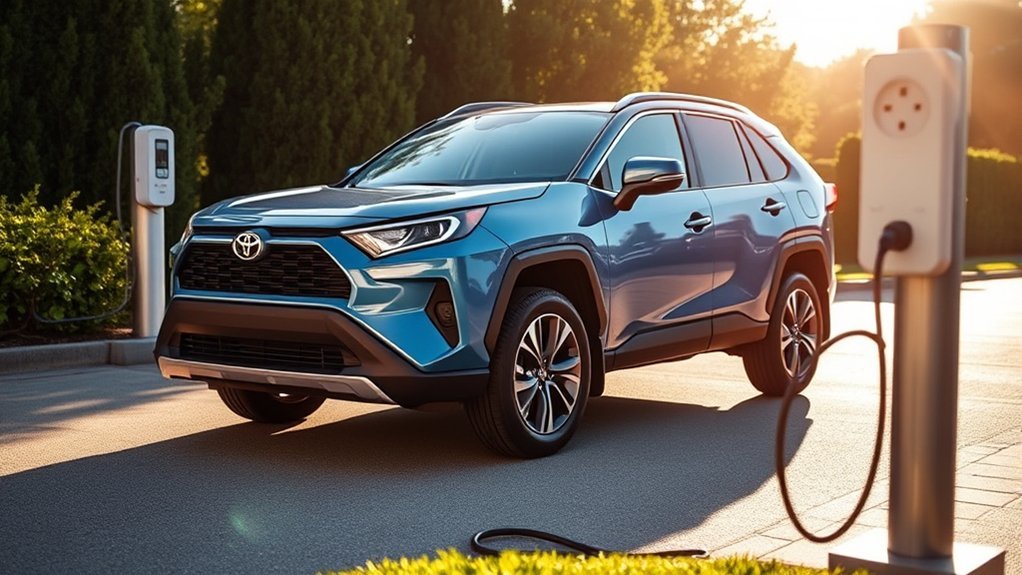
A standard Toyota RAV4 Hybrid does not need to be plugged in. It is a conventional hybrid electric vehicle, or HEV, that charges its traction battery automatically while you drive. The gasoline engine and regenerative braking supply electricity to the hybrid system. The RAV4 Plug-in Hybrid, or PHEV, is different because it has a larger battery, a charging port, and a useful electric-only driving range.
Last updated: September 19, 2026. U.S.-market specifications and programs are referenced unless otherwise noted.
Quick Answer
No. A standard Toyota RAV4 Hybrid is a conventional hybrid, so you never plug its traction battery into a wall charger. Its gasoline engine and regenerative braking replenish the battery automatically. The RAV4 Plug-in Hybrid, formerly called RAV4 Prime in the United States, has a larger battery and should be plugged in regularly to maximize electric-only driving.
Key Takeaways
- The standard RAV4 Hybrid has no external traction-battery charging requirement and manages its battery automatically.
- Regenerative braking recovers some energy during slowing and stores it in the traction battery.
- The RAV4 Plug-in Hybrid has a charging port and can cover many short trips on electricity.
- Toyota renamed the RAV4 Prime as the RAV4 Plug-in Hybrid for model year 2025.
- The practical choice depends on your charging access, daily mileage, fuel and electricity costs, and purchase budget.
How Does the RAV4 Hybrid Work Without Being Plugged In?

The standard RAV4 Hybrid combines a gasoline engine, electric motors, a traction battery, and an electronically controlled transmission. The system automatically chooses when to use the engine, the electric motors, or both.
You do not control the charging process or connect the vehicle to an outlet. According to Toyota’s explanation of hybrid and plug-in-hybrid systems, a conventional hybrid replenishes its battery through the gasoline engine and regenerative braking.
For a deeper explanation of the power flow, see how the Toyota RAV4 Hybrid engine works.
How the Hybrid Battery Recharges
- The engine supplies energy: When needed, the gasoline engine can propel the vehicle and help generate electricity for the hybrid system.
- Regenerative braking captures energy: During slowing and braking, the electric motors can work as generators and recover some of the vehicle’s motion.
- The battery stores recovered electricity: The system saves that energy in the traction battery for later motor assistance.
- Computer controls manage the process: The vehicle automatically keeps the battery within its intended operating range.
Note: “Self-charging hybrid” does not mean the vehicle creates free energy. Its electricity ultimately comes from gasoline and energy recovered while the vehicle slows down.
The redesigned 2026 Toyota RAV4 is sold with hybrid or plug-in-hybrid power rather than a gasoline-only powertrain. Toyota lists 226 net combined horsepower for front-wheel-drive hybrid versions and 236 horsepower for all-wheel-drive versions.
Fuel-economy ratings vary by grade, drivetrain, equipment, weather, and driving conditions. Toyota lists ratings as high as 47 city, 40 highway, and 43 combined MPG for certain 2026 RAV4 configurations.
Warning: Do not attempt to open, repair, or disconnect the traction battery or orange high-voltage wiring. Use a qualified Toyota or hybrid-vehicle technician for high-voltage service.
What Is the Difference Between the RAV4 Hybrid and RAV4 Plug-in Hybrid?
The most important difference is how the battery receives energy. The standard RAV4 Hybrid relies on its engine and regenerative braking. The RAV4 Plug-in Hybrid can also accept electricity from an external charging source.
The standard RAV4 Hybrid never needs an outlet. The RAV4 Plug-in Hybrid uses external charging to provide a much longer electric-only driving range.
Note: Toyota used the name RAV4 Prime for U.S. model years 2021 through 2024. Starting with model year 2025, Toyota renamed it the RAV4 Plug-in Hybrid.
| Feature | 2026 RAV4 Hybrid | 2026 RAV4 Plug-in Hybrid |
| External charging | Not required and no traction-battery charging port | Supported through its charging port |
| Battery charging sources | Gasoline engine and regenerative braking | External electricity, gasoline engine, and regenerative braking |
| Electric-only operation | Brief low-speed operation under suitable conditions | Up to an EPA-estimated 54 miles on the SE when fully charged |
| Net combined output | 226 horsepower with FWD or 236 horsepower with AWD | 324 horsepower |
| Drivetrain availability | FWD or AWD, depending on grade | AWD standard |
| Starting MSRP listed by Toyota | $31,900 | $41,500 |
The prices above are Toyota’s listed U.S. starting MSRPs verified September 19, 2026. They exclude destination charges, taxes, registration, dealer fees, accessories, and optional equipment.
How Does the 2026 RAV4 Plug-in Hybrid Charge?
Charging hardware varies by 2026 Plug-in Hybrid grade. Toyota says the XSE and Woodland use an 11-kW onboard AC charger and a CCS1 charging port with DC fast-charging capability. Under ideal conditions, Toyota estimates a 10% to 80% DC fast charge at approximately 30 minutes. The SE and GR SPORT use a 7-kW onboard charger with a J1772 port for Level 1 and Level 2 charging; Toyota estimates roughly four hours for a 10% to 80% Level 2 charge under ideal conditions.
All 2026 RAV4 Plug-in Hybrid grades include a dual-voltage charging cable that supports 120-volt or 240-volt home charging. Check your exact grade and owner’s manual before choosing charging equipment. For a dedicated walkthrough, see how to charge a Toyota RAV4 Plug-in Hybrid.
What Happens When the Plug-in Hybrid Runs Out of EV Range?
The vehicle does not stop when its displayed electric range reaches zero. It transitions to hybrid operation and continues using gasoline, the electric motors, and regenerative braking. You can keep driving as long as the vehicle has fuel and is otherwise operating normally.
You can also drive a RAV4 Plug-in Hybrid without charging it regularly. However, doing so reduces the main benefit of buying the plug-in version because more trips will rely on gasoline.
Pro Tip: Compare your normal daily mileage with the plug-in model’s rated electric range. A plug-in hybrid provides the greatest benefit when you can charge at home or work and complete many routine trips on electricity.
How Do Fuel Economy and Ownership Costs Compare?
The standard hybrid generally costs less to buy and requires no home-charging setup. The plug-in model costs more but can reduce gasoline use when you charge it regularly and drive many short or medium-length trips.
Understand MPG and MPGe
- MPG measures how far a vehicle travels using one gallon of gasoline.
- MPGe converts electrical energy into a gallon-equivalent measurement so shoppers can compare energy efficiency.
- A plug-in hybrid’s MPGe rating is not the same as claiming that the vehicle literally travels that many miles on one gallon of gasoline.
A personal calculation such as “468.3 MPG” can occur when a driver uses very little gasoline while charging frequently. However, it is not a standardized fuel-economy rating and should not be compared directly with an official MPG figure.
What Determines Your Actual Savings?
- Your daily driving distance
- How often you charge the plug-in model
- Your local electricity rate
- Current gasoline prices
- City versus highway driving
- Weather and cabin-heating or air-conditioning use
- The purchase price, financing terms, insurance, and available incentives
The RAV4 Hybrid often makes more financial sense when you cannot charge at home, take frequent long trips, or want a lower purchase price. The RAV4 Plug-in Hybrid may suit you better when you have dependable charging and can cover much of your weekly driving within its electric range.
Are Federal Tax Credits Available?
For a current U.S. purchase, do not assume that either version includes a federal clean-vehicle purchase credit. The Internal Revenue Service states that the New Clean Vehicle Credit is unavailable for vehicles acquired after September 30, 2025.
State, local, electric-utility, employer, or charging-equipment programs may have different rules. Check the current program requirements before treating an incentive as part of your purchase budget. For more detail, see the current RAV4 federal tax-credit guide.
Performance and Efficiency Metrics for Current RAV4 Models

The 2026 RAV4 Plug-in Hybrid is the more powerful version. Toyota lists 324 net combined horsepower and a manufacturer-estimated 0–60 mph time of 5.4 seconds.
The standard 2026 RAV4 Hybrid produces 226 net combined horsepower with front-wheel drive or 236 horsepower with all-wheel drive. It prioritizes everyday fuel economy and simple ownership rather than extended electric driving.
The 2026 RAV4 Plug-in Hybrid provides an EPA-estimated electric range of up to 54 miles on the SE grade. Range can decrease with high speeds, cold or hot weather, steep terrain, heavy loads, climate-control use, and driving style.
The two powertrains therefore solve different problems. The standard hybrid removes the need to plan external charging, while the plug-in model combines stronger acceleration with the ability to complete many trips using stored grid electricity before relying on gasoline.
What Should Owners Expect in Daily Use?
Your experience will depend more on your routine than on a single published efficiency figure.
- Standard-hybrid convenience: You fuel it like a conventional vehicle and never schedule traction-battery charging.
- Automatic engine operation: The gasoline engine may start and stop frequently as the system responds to speed, battery charge, temperature, and power demand.
- Limited EV operation: The standard hybrid may move on battery power at low speeds under suitable conditions, but it is not designed to function as a gasoline-free vehicle.
- Plug-in savings depend on charging: The plug-in version uses less gasoline when you recharge it consistently.
- Comfort depends on grade: Seat materials, wheel sizes, audio systems, climate features, and suspension tuning vary by trim. The plug-in powertrain alone does not guarantee better comfort.
Which RAV4 Version Is Better for You?
The practical dividing line is charging access. If dependable charging is unavailable, the standard Hybrid avoids paying for plug-in capability you may rarely use. If much of your daily travel fits inside the PHEV’s electric range and you can recharge regularly, the plug-in can replace many gasoline miles with electricity.
Choose the Standard RAV4 Hybrid If:
- You do not have dependable home or workplace charging.
- You rent, park on the street, or frequently change parking locations.
- You want the lower starting price.
- You regularly take long highway trips.
- You want hybrid fuel economy without changing your fueling routine.
Choose the RAV4 Plug-in Hybrid If:
- You can charge at home or work.
- Your normal daily mileage fits within its electric range.
- You want stronger acceleration.
- You want to reduce gasoline use without depending entirely on public charging.
- You accept the higher purchase price in exchange for plug-in capability.
Frequently Asked Questions
Does the standard RAV4 Hybrid have a charging port?
No. The standard RAV4 Hybrid does not have a traction-battery charging port because its hybrid system manages charging through engine-generated electricity and regenerative braking. A RAV4 Plug-in Hybrid has an external charging port.
Can I recharge the RAV4 Hybrid battery using a standard outlet?
No. The standard RAV4 Hybrid does not have a traction-battery charging port. Its gasoline engine and regenerative braking maintain the battery automatically. A RAV4 Plug-in Hybrid can be connected to compatible charging equipment, including Level 1 charging from a suitable household outlet.
How long does the RAV4 Hybrid battery last before replacement?
Toyota does not publish a fixed replacement age because battery condition depends on mileage, temperature, use, maintenance, and other factors. For model year 2020 and newer Toyota hybrids, the hybrid battery is covered by a 10-year or 150,000-mile limited warranty, whichever comes first. Warranty coverage is not a prediction of battery failure.
Is the RAV4 Hybrid eligible for tax credits or incentives?
Do not assume a current federal clean-vehicle purchase credit is available. The IRS states that the New Clean Vehicle Credit is unavailable for vehicles acquired after September 30, 2025. State, local, utility, employer, and charging-equipment incentives may vary, so verify the current rules before purchasing.
What maintenance does the RAV4 Hybrid require compared with a conventional vehicle?
It still needs scheduled services such as engine-oil changes, tire rotations, fluid inspections, filters, and brake inspections. Regenerative braking may reduce use of the friction brakes in some driving, but it does not eliminate brake maintenance. Follow the schedule for your exact model year and operating conditions.
Can the standard RAV4 Hybrid run solely on electric power?
It can sometimes move on electric power alone for brief periods at low speeds when battery charge, temperature, and power demand allow it. However, it has no meaningful rated electric-only range and is not designed to operate without gasoline in the tank.
What happens when the RAV4 Plug-in Hybrid uses its electric charge?
It automatically continues in hybrid operation. The gasoline engine and electric motors work together, so you do not need to stop and recharge before continuing your journey.
Can I drive a RAV4 Plug-in Hybrid without ever charging it?
Yes, it can operate as a hybrid while gasoline is available. However, failing to plug it in means you will receive less benefit from its larger battery and electric-only capability.
How can I tell whether a RAV4 is the plug-in version?
Look for a charging door and a Plug-in Hybrid or PHEV badge. U.S. models from 2021 through 2024 may carry the RAV4 Prime name. Confirm the model year, VIN, window sticker, or owner’s manual before buying charging equipment or replacement parts.
Conclusion
The standard Toyota RAV4 Hybrid does not need to be plugged in. It automatically maintains its traction battery through the gasoline engine and regenerative braking, making it the simpler choice when you lack regular charging access.
The RAV4 Plug-in Hybrid adds a charging port, a larger battery, stronger performance, and a useful electric-only range. It provides the most value when you can charge regularly and complete many daily trips on electricity. Compare your driving routine, charging access, purchase budget, and local energy costs before choosing between them.
Sources
- Toyota: Differences Between Hybrid and Plug-in Hybrid Vehicles — explains battery size, regenerative braking, and external charging differences.
- Toyota: 2026 RAV4 — current hybrid specifications, fuel-economy ratings, capacity, and pricing.
- Toyota: 2026 RAV4 Plug-in Hybrid — current electric range, horsepower, acceleration, drivetrain, and pricing.
- Toyota USA Newsroom: 2026 RAV4 — confirms current Plug-in Hybrid charging hardware, connector differences, and charging estimates by grade.
- Toyota USA Newsroom: RAV4 Plug-in Hybrid Naming Change — confirms the change from RAV4 Prime for model year 2025.
- Toyota Electrified-Vehicle Warranty — confirms Toyota’s hybrid-battery warranty coverage.
- Internal Revenue Service: New Clean Vehicle Credit — confirms the September 30, 2025 acquisition cutoff.
