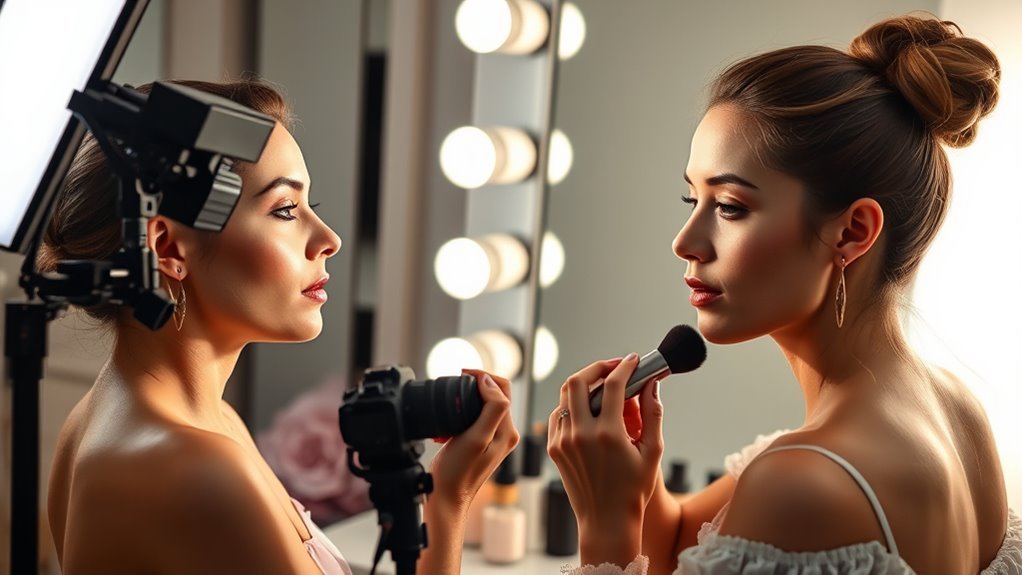
For makeup videos, both LED lights and softboxes can produce excellent results, but they solve different problems. A compact LED panel gives fast brightness and color-temperature control, while a softbox creates a larger diffused source that can soften shadows and specular highlights. The best choice depends on available space, color accuracy, camera settings, and how much control you want over the shape of the light.
Quick Answer
For close-up makeup videos, a softbox is usually the easiest way to get broad, flattering light, while a diffused LED panel is better when space, portability, and fast brightness or color-temperature adjustments matter most. For maximum flexibility, use a soft key light and a weaker LED or reflector as fill.
Key Takeaways
- A softbox is a light modifier; an LED panel is a light fixture. Some LED fixtures can also be used with softboxes.
- Larger, well-diffused sources placed relatively close to the face generally create softer shadow transitions.
- For makeup color accuracy, compare CRI/TLCI, output, dimming range, and color-temperature control rather than wattage alone.
- Small rooms usually favor slim LED panels, clamp-mounted lights, or compact softboxes.
- Match the camera’s white balance to the lighting and avoid mixing different color temperatures when accurate foundation and lipstick shades matter.
LED vs Softbox for Makeup Videos?
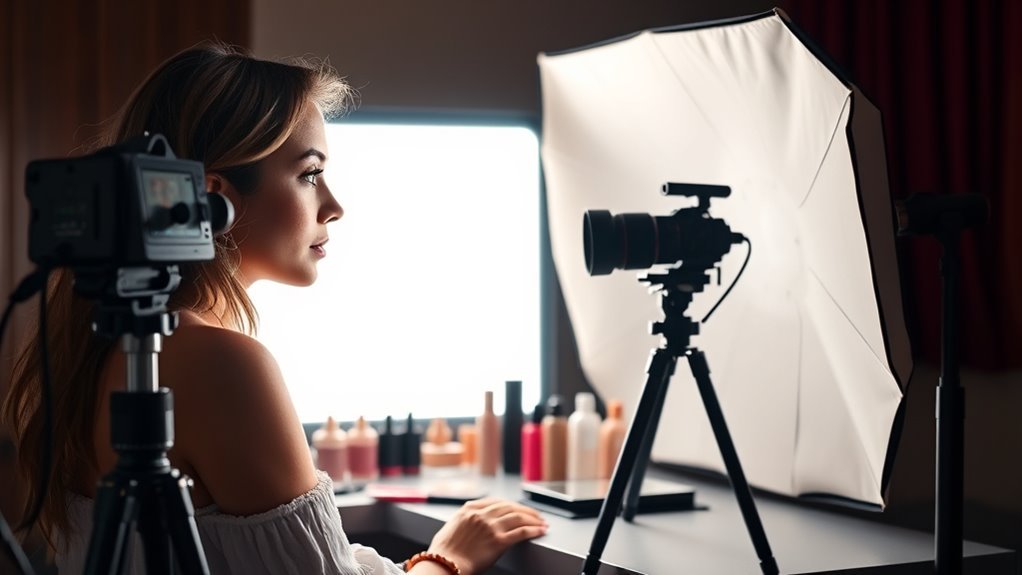
The most important distinction is that an LED panel is a light source, while a softbox is normally a modifier that spreads and diffuses light from a compatible lamp or LED fixture. That means the comparison is not always strictly LED versus softbox: many studio LED fixtures can be placed inside or behind a softbox.
LED panels are useful because many current models are slim, dimmable, energy-efficient, and adjustable from warm to cool white. Those features make them easy to use in bedrooms, home studios, and other tight filming spaces. A well-diffused LED panel can also produce soft light without a separate softbox.
Softboxes are designed to turn a smaller source into a broader illuminated surface. Aputure, for example, specifies multiple diffusion fabrics for its softbox systems so creators can alter the density and softness of the source. Larger diffused surfaces can produce gentler transitions between highlights and shadows when positioned appropriately.
| Factor | LED Panel | Softbox Setup |
|---|---|---|
| Space needed | Usually low | Usually moderate to high |
| Softness | Varies with panel size and diffusion | Often very soft when the modifier is large and close |
| Adjustment speed | Excellent on dimmable, bi-color models | Depends on the light mounted behind the softbox |
| Travel | Usually easier | Bulkier unless designed to collapse quickly |
| Best fit | Small rooms, fast setups, mobile filming | Beauty close-ups, tutorials, controlled studio setups |
Which Light Looks Most Flattering?
For makeup videos, the most flattering source is usually the one that appears large relative to the face and provides enough diffusion to prevent hard-edged shadows. That is why a large softbox is popular for beauty tutorials. It can wrap light across the cheeks, forehead, and jaw while reducing distracting contrast.
A diffused LED panel can produce a similar effect when its illuminated surface is large enough and it is positioned at a useful distance. The label “LED” by itself does not mean the light will be harsh; panel dimensions, optical design, diffusion, and placement matter more.
For beauty video, think about the apparent size and diffusion of the source—not simply whether the fixture is called an LED panel or a softbox.
Softbox Flattering Diffusion
A softbox placed slightly above eye level and roughly 30 to 45 degrees to one side of the camera is a useful starting point. This creates enough directional light to reveal cheekbone and contour work while maintaining soft transitions across the skin.
Moving a reasonably large softbox closer to the subject generally makes it appear larger from the subject’s perspective, which can soften shadow edges. Moving it farther away makes the apparent source smaller and can increase contrast.
Close placement also means the light may not need to run at maximum output. Lowering intensity can improve comfort, reduce unwanted shine, and make exposure easier to control.
For tutorials, this broad wash helps foundation, blush, contour, highlighter, and eye makeup remain visible without relying on harsh frontal light.
LED Panel Softness
LED panels are particularly useful when the setup must stay compact. Many current creator-focused panels include adjustable intensity and color temperature, and some use built-in diffusion or edge-lighting to broaden the source.
For close beauty shots, choose a panel with a reasonably large illuminated surface or add diffusion if the manufacturer supports it. A tiny undiffused source close to the optical axis can create harder shadows and bright specular highlights, while a larger diffused panel can look much gentler.
LED panels also make quick exposure changes convenient. Instead of moving a stand every time the framing changes, the creator can often dim the fixture while watching the camera preview or histogram.
What Makes Makeup Colors Look Accurate on Camera?
Softness is only part of good beauty lighting. Foundation, blush, eyeshadow, and lipstick also need accurate color rendering.
When comparing continuous lights, look for a published Color Rendering Index (CRI) or, when available, TLCI data. CRI describes how accurately a source renders colors compared with a reference source. For video work, a CRI above 90 is a sensible baseline, while fixtures in the mid-90s or higher are commonly chosen when accurate skin and product color is important.
Color temperature is a separate specification. A light may be adjustable from warm to cool while still differing in its ability to reproduce color accurately. For that reason, do not judge a makeup light by Kelvin range alone.
Pro Tip: Before filming a product demonstration, hold a neutral gray or white reference in the same light as your face and set a custom white balance if your camera supports it. This reduces unwanted warm, cool, green, or magenta shifts.
What Works Best in Small Makeup Spaces?
In a small makeup space, LED panels usually have the advantage in space efficiency. A slim panel can sit beside a monitor, clamp to a desk, or fit close to a wall while still allowing brightness adjustments.
A softbox needs more physical depth, but compact sizes such as approximately 50 × 70 cm can still work in bedrooms and home studios. That size should be treated as a practical compact option rather than a universal optimum.
One effective small-room arrangement is a single diffused key light slightly above eye level and 30 to 45 degrees off the camera axis. Place a white reflector, foam board, or weaker fill light on the opposite side if the shadows are deeper than desired.
This arrangement needs less floor space than two equally powerful softboxes and usually preserves more shape in the face.
Warning: Secure light stands on a stable surface, keep cables away from walkways, and stay within the stand and fixture manufacturer’s load limits. Large modifiers can make a stand easier to tip, especially near doors, fans, or open windows.
How Do You Fix Glare, Shadows, and Flat Skin?
Glare, deep shadows, and a flat-looking face usually require different adjustments rather than simply adding more brightness.
For glare on glasses, move the key light higher or farther to the side and slightly change its angle until the reflection no longer travels directly into the camera. Small position changes can make a large difference.
For strong facial shadows, start with a soft key light around 45 degrees from the camera and add a weaker fill source or reflector from the opposite side. The goal is to reduce unwanted shadow density without removing every shadow and making the face look flat.
If the face already looks flat, reduce the fill intensity or move it farther away. A little controlled contrast helps the cheekbones, nose, eyes, and contour remain visible.
For shiny skin or reflective highlighter, first reduce light intensity or change the angle. Increasing diffusion can also soften specular highlights. Powder or makeup adjustments may help, but lighting should be corrected before assuming the cosmetic product is the problem.
- Raise or move the key light to redirect reflections.
- Use a softer or larger source when shadow edges look too hard.
- Use a weaker fill instead of matching both lights at equal power.
- Keep the main lights at compatible color temperatures.
- Check exposure on the actual camera rather than judging brightness by eye alone.
How Should You Set White Balance?
White balance determines how the camera interprets the color of the light. If it is wrong, foundation can appear too orange or too blue, and neutral products may gain an unwanted color cast.
When possible, set all artificial lights to the same or closely matched color temperature. Then set the camera’s white balance to that lighting or use a custom white-balance reading under the actual setup.
Mixed lighting is a common source of problems. For example, a daylight window combined with a warm household lamp can illuminate opposite sides of the face with different colors. Either block the unwanted source, replace it with a matched fixture, or deliberately balance the scene before recording.
Note: Color temperature and CRI are not the same measurement. Kelvin describes whether the light appears warmer or cooler, while CRI relates to how faithfully colors are rendered.
What Size and Output Should You Choose?
A 50 × 70 cm softbox can be a practical starting size for a compact home studio because it gives more illuminated surface area than a small bare bulb while remaining easier to place than very large portrait modifiers. Larger modifiers can become even softer when used at an appropriate distance, but they also require more room and stronger support.
For an LED light, do not choose solely by electrical wattage. Two fixtures consuming the same number of watts can deliver different usable output because LED efficiency, optics, diffusion, and beam spread vary.
Instead, compare:
- Measured output: lumens are useful for total output, while lux at a stated distance is more helpful for estimating how much light reaches the subject.
- CRI/TLCI: look for strong color-rendering performance for skin and cosmetics.
- Dimming range: smooth low-level control is useful when the light is close to the face.
- Color-temperature range: bi-color models make it easier to match daylight or other fixtures.
- Modifier size: larger diffused surfaces generally make softer transitions.
- Fan noise: important when the microphone is close to the light.
- Mount stability: especially important with large softboxes.
As a real-world example of why wattage alone is insufficient, creator-focused LED panels can range from compact low-power lights to substantially larger fixtures while producing very different lumen outputs. The camera exposure and the measured light reaching the face are ultimately more useful than an arbitrary wattage target.
Best Softbox and LED Kit Features for Makeup Videos
Instead of treating one product as universally best, compare kits by the features that directly affect makeup video quality.
A SOU FOTO 50 × 70 cm softbox setup, for example, represents the common compact rectangular format discussed earlier. That type of modifier can be appropriate when the goal is broad diffusion in a home studio, but the bulbs or LED fixtures used with it still determine output, color accuracy, flicker behavior, and color temperature.
For an LED panel, prioritize a high published CRI, enough measured output for the planned camera distance, smooth dimming, and a useful color-temperature range. A built-in diffuser or an appropriately sized external modifier can make the source more flattering for close-up work.
For a simple makeup-video setup:
- Use one large diffused source as the key light.
- Position it slightly above eye level and about 30 to 45 degrees from the camera.
- Add a reflector or weaker fill on the opposite side if necessary.
- Keep the key and fill at compatible color temperatures.
- Set white balance before judging whether makeup shades look correct.
Creators who need maximum flexibility can combine both approaches: use a softbox as the main beauty light and a compact LED as fill, background light, or a controllable accent.
Lighting Checklist Before You Record
- Check the eyes: make sure the source is not uncomfortably bright and avoid staring directly into an intense fixture.
- Check the skin: reduce clipped highlights on the forehead, nose, cheeks, and glossy products.
- Check the shadows: keep enough depth for facial shape while lifting shadows that hide makeup detail.
- Check color: confirm white balance and inspect foundation, blush, and lipstick against their real appearance.
- Check flicker: record a short clip and review it, especially when using inexpensive dimmable lights.
- Check the background: make sure the face is not so bright that the rest of the frame looks unnaturally dark.
- Check stability: tighten stands, clamps, tilt mechanisms, and modifier mounts before recording.
Frequently Asked Questions
What is the best option: softbox or LED panel?
Choose a softbox when broad, diffused beauty light is the priority and there is enough room for the modifier. Choose a diffused LED panel when compact size, portability, dimming, and quick color-temperature adjustments matter more. The strongest setup may combine a soft key light with a smaller LED fill.
What is the best lighting for recording makeup videos?
A useful starting point is one large, diffused key light slightly above eye level and 30 to 45 degrees from the camera, plus a weaker reflector or fill on the opposite side when needed. Use a high-CRI source, keep color temperatures consistent, and set the camera’s white balance under the actual recording light.
What is better, a softbox or a ring light?
A softbox usually offers more control over direction and can produce natural-looking facial dimension when placed off-axis. A ring light is compact and convenient for frontal illumination, but placing the source directly around the lens can flatten facial contours and create circular reflections in the eyes or glasses. Neither is automatically better for every setup.
Can using a ring light harm your eyes?
Bright or poorly positioned lights can cause glare and visual discomfort, especially during long recording sessions. That does not mean every ring light causes permanent eye damage. Photobiological risk depends on the fixture’s output and spectrum, viewing distance, exposure time, and safety classification. Avoid staring directly into an intense source, use only as much brightness as needed, take breaks if discomfort occurs, and follow the manufacturer’s safety instructions.
Is CRI or color temperature more important for makeup videos?
Both matter for different reasons. CRI helps describe how faithfully the light renders colors, while color temperature describes whether the light appears warmer or cooler. For makeup recording, use a high-CRI source and set the camera’s white balance to match the actual light.
Do you need two lights for a makeup tutorial?
No. One large diffused key light can produce an excellent result. If the unlit side of the face becomes too dark, add a white reflector or a weaker fill light. Starting with one controlled key source is often easier than balancing two equally bright lights.
Conclusion
For makeup videos, a softbox is a strong choice when the priority is broad, forgiving light for close-up skin and product detail. A diffused LED panel is often more convenient in tight spaces and gives fast control over brightness and color temperature. Neither format is automatically superior: source size, diffusion, placement, color rendering, white balance, and exposure determine the final image. Start with one soft key light, add fill only when needed, and judge the setup by how accurately and clearly the makeup appears on the camera.
Sources
- Aputure — LS 60 Softbox — diffusion density, soft-light modification, and light-control information.
- Elgato — What Is CRI? — color-rendering guidance for skin, products, streaming, and video.
- Adobe — Portrait Lighting — soft light, directional lighting, and portrait-light positioning.
- Sony — White Balance Help Guide — matching white balance to the shooting environment and light source.
- IEC 62471-7:2023 — photobiological safety framework for visible-light sources and luminaires.
- American Optometric Association — Computer Vision Syndrome — glare, poor lighting, and visual-discomfort considerations.