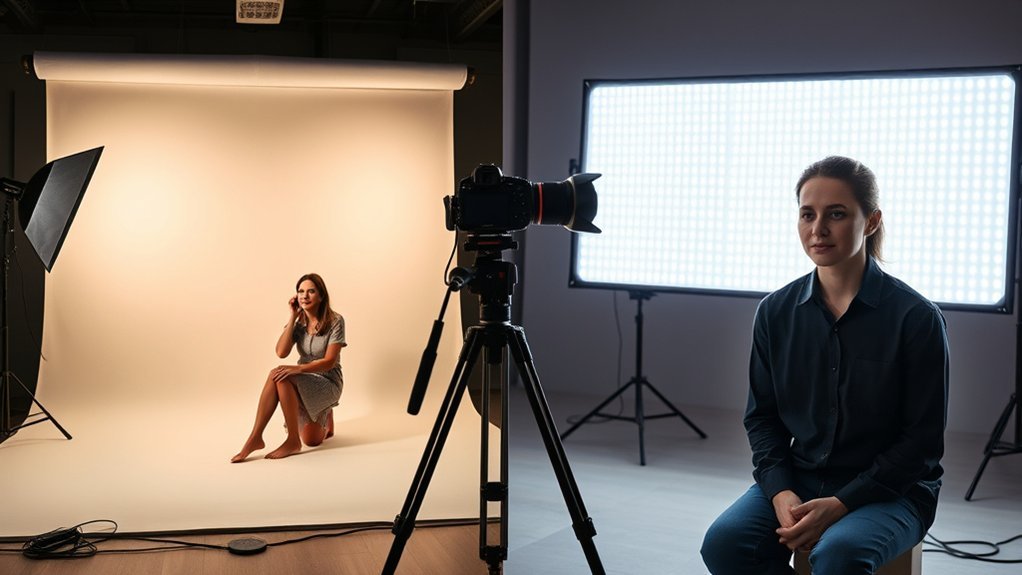
Choosing between an entry softbox setup and a compact LED panel for video is not quite an apples-to-apples comparison. A softbox is a light modifier that enlarges and diffuses another light source, while an LED panel is a lighting fixture. For interviews and tutorials, a large diffused source placed fairly close to the subject usually creates softer shadows and smoother skin. A compact LED panel can be faster to position, easier to carry, and more convenient when battery power or quick color-temperature changes matter. If “Playa LED” refers to a particular product, compare that model’s actual output, color, power, and flicker specifications rather than relying on the name alone.
Quick Answer
For most talking-head videos, interviews, and tutorials, a large softbox produces the most flattering key light. A compact LED panel is usually better when space, fast setup, battery operation, or portability matters more. The best choice depends on source size, diffusion, output, color accuracy, flicker performance, and how much control you need.
Key Takeaways
- A softbox is a modifier, not a competing light technology; it can be used with LED fixtures.
- A larger apparent light source generally produces softer shadow edges than a smaller source at the same position.
- Compact LED panels are useful for travel, small rooms, fast setup, fill light, backgrounds, and battery-powered shooting.
- Do not judge a video light by CRI alone; also consider TLCI or other color metrics, flicker performance, tint consistency, and real output.
- A diffused LED panel can be soft, and some LED panels accept additional softboxes or diffusion.
Softbox vs LED Panel: Which Is Better for Video?
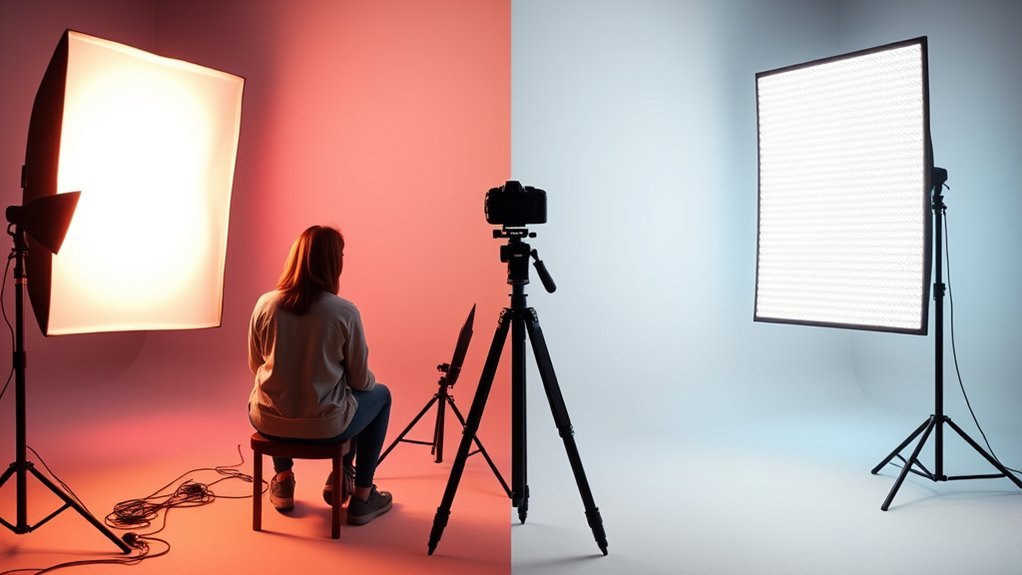
For most face-to-camera work, a softbox-modified key light is the easier route to broad, flattering illumination. The diffuser becomes a much larger apparent source than a small bare lamp, so shadow edges become gentler and skin texture is less emphasized.
A compact LED panel can still produce attractive light, especially if it has a large diffused front surface or is placed close to the subject. Panels also make brightness and color-temperature adjustments fast, and many portable models can run from rechargeable or removable batteries.
The important distinction is that softbox and LED are not mutually exclusive. Professional LED systems can use softboxes, and manufacturers such as ARRI make softbox accessories specifically for LED panels. The useful comparison is therefore between a large diffused source and a smaller or more direct source, plus the practical differences in size, output, control, and portability.
| Feature | Point-Source LED + Softbox | Compact LED Panel |
| Typical light quality | Broad and soft when the modifier is large relative to the subject | Ranges from hard to soft depending on panel size, diffusion, optics, and distance |
| Setup speed | Usually slower because the modifier must be opened and mounted | Usually fast; mount, aim, and adjust |
| Space required | More room for the modifier and stand | Often easier in small rooms or tight locations |
| Portability | Depends on fixture, softbox size, stand, and power system | Excellent with small battery-powered panels |
| Best fit | Interviews, tutorials, portraits, beauty, controlled studio work | Travel, run-and-gun video, fill light, backgrounds, cramped rooms |
[Amazon Products Picked for You]

【MULTIPLE COLOR TEMPERATURE & ADJUSTABLE BRIGHTNESS】There are 3 Color temperatures (2800K, 4800K & 6500K) which offer different lighting atmosphere; This Studio Light is equipped with 356 Led beads which offers a stable and ample output of 15W. Features a high CRI of 97+ for precise color rendering. Adjust the brightness in a range of 10 to 100% with button up and down on remote to meet different photography circumstances, offering extra lighting for your works.

【Powerful & Versatile Light】 With 240 white and 240 yellow LEDs, each light will offer bright, continuous, and bi-color illumination for portraits, product photos, YouTube vlogs, video gaming, and online meetings. The ultra-high CRI 96+ ensures natural and vivid color reproduction for all your creation

KIT INCLUDES: (2)Softbox, (2)Carrying Bag; It is perfect for portrait and product photographers, video bloggers, outdoor events, fashion display, product display etc; Note: The LED Light is not included
What Light Quality Do You Need?
Light quality depends heavily on the apparent size of the source relative to the subject. A large source close to a face produces broad transitions between light and shadow. A smaller or more distant source creates sharper shadow edges.
This is why a softbox often looks flattering on skin, but the box itself is not magical. Its main job is to enlarge and diffuse the illuminated surface. A sufficiently large diffused LED panel can create a similar effect.
Soft Vs Hard Light
A soft light produces gradual shadow transitions, making it useful for interviews, tutorials, portraits, and beauty work. It can reduce the visual emphasis on pores, wrinkles, and small skin texture without eliminating facial shape.
A harder light has more defined shadow edges and can emphasize texture, contrast, and shape. That can be useful for dramatic scenes, product textures, backgrounds, or intentional separation.
A bare compact panel may appear harder than a large softbox because its emitting area is smaller, but this is not true of every LED panel. Large soft panels are specifically designed to produce broad illumination.
The softer-looking source is usually the one that appears larger from the subject’s position—not simply the one labeled “softbox” or “LED.”
Color Accuracy Needs
Color quality matters whenever the camera must reproduce skin, clothing, artwork, food, or products consistently. CRI is a familiar color-rendering metric, but it should not be treated as the only measure of video-light quality.
The European Broadcasting Union developed TLCI specifically to assess how lighting behaves through a television-camera system. A high TLCI value is useful when comparing video fixtures, while CRI remains another useful reference point. Neither number replaces a real camera test when color is critical.
- CRI: a general indication of color fidelity compared with a reference source.
- TLCI: designed around television-camera color reproduction.
- CCT: describes whether white light is warmer or cooler; it does not by itself prove good color rendition.
- Tint control: green-magenta adjustment can help match multiple fixtures or difficult ambient lighting.
Bi-color fixtures may cover ranges such as roughly tungsten to daylight, but there is no universal 3000–6500K requirement. Check the actual range of the light you are considering.
Shadow Control Style
Soft light is forgiving, but it can spill onto walls and backgrounds. A softbox with a fabric grid can reduce that spill and keep the source directional. LED panels can use barn doors, grids, flags, or dedicated softboxes where the manufacturer supports them.
For a simple talking-head setup, place the key light roughly 30–45 degrees to one side of the camera and slightly above eye level, then adjust the distance until the face has the balance of softness and contrast you want. Moving a light closer generally makes it appear larger relative to the subject and can increase softness while also raising exposure.
Brightness, Output, and Distance
Do not compare lights by wattage alone. Power consumption tells you how much electrical power a fixture uses, not exactly how much useful light reaches the subject. When possible, compare lux measurements at the same distance and color-temperature setting.
Diffusion also costs some output. A softbox’s inner baffle and front diffusion make the source larger and smoother, but some light is absorbed or redirected. That means a softbox setup may need a stronger fixture when the light must be placed farther away or compete with daylight.
Flicker and High-Frame-Rate Video
A light can look steady to your eyes yet create bands or brightness changes on camera. This becomes especially important with fast shutter speeds or high-frame-rate recording. If you shoot slow motion, check whether the manufacturer publishes flicker-free performance for the frame rates and shutter settings you use.
Pro Tip: Before an important shoot, record a short test at your actual frame rate, shutter speed, dimming level, and color-temperature setting. Review the footage for flicker, color shifts, banding, fan noise, and unwanted reflections.
When Is an LED Panel Better for Video?
An LED panel is especially useful when the production needs a compact fixture that can be moved and adjusted quickly. Continuous light lets you see exposure, direction, reflections, and shadow placement before recording.
- Compact panels fit into small rooms and crowded sets.
- Many models offer onboard dimming and adjustable color temperature.
- Battery-capable panels reduce dependence on wall outlets.
- RGB models can add colored background or accent light.
- Flat panels are easy to use as fill lights, hair lights, practical accents, or small key lights.
An LED panel can also be the better choice for documentary work, travel, livestreaming, product shots, or run-and-gun filming where setup time matters more than achieving the largest possible soft source.
Check cooling as well. A passively cooled panel can be useful when microphones are close to the light, while fan-cooled high-output fixtures should be tested for audible noise in quiet rooms.
[Amazon Products Picked for You]
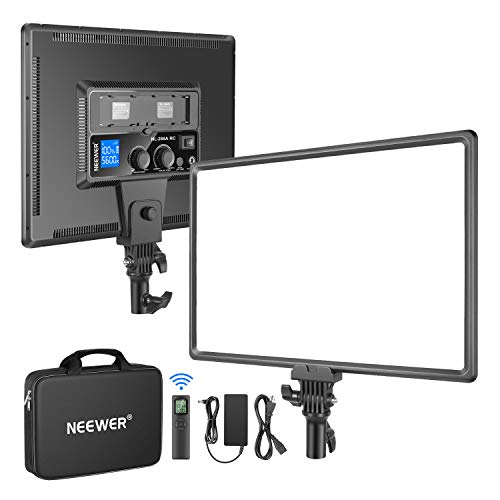
Wide Application: The 14.8"×10.5" large, 1"/25mm thick LED video light panel provides continuous, non flickering soft light for video and photo photography. NL288 portable lighting kit offers key light for portraits, studio photoshoots, YouTube/TikTok/podcast videography, filming, social media live streaming, online conferences, video calls, Zoom calls, etc. It is a suitable lighting equipment for various professions such as content creators, influencers, makeup artists, live streamers

10000LM Super Brightness: Light up your workspace like never before! Our LED solar work light delivers 10000LM of ultra-bright lighting, powered by 144 high-efficiency LED beads and a high-transparency glass panel for optimal brightness. Whether you're working in a dim garage, on a nighttime job site, or during a power outage, this rechargeable work light cuts through darkness with ease

【12W 600LUX/0.5M Soft and Even Lighting】 RALENO panel light features edge-lit technology and 4-layer diffusers that create soft, uniform lighting without glare, making it ideal for video conferences, photography, and live streaming. Delivers 600LUX at 0.5 meter, perfect for crisp, well-lit photos and videos, yet gentle on skin tones—no harsh Tip: To maintain good lighting, please use a 5V/3A adapter
When Is a Softbox Better for Video?
A softbox is most useful when the goal is to turn a compatible fixture into a larger, more controlled source. For interviews, educational videos, demonstrations, beauty content, and portrait-style filming, this often creates an immediately polished look.
Large softboxes are particularly effective when faces are the visual priority. They can smooth shadow transitions while retaining enough direction to shape the face. Rectangular, square, octagonal, and lantern-style modifiers each spread light differently, so the best shape depends on the scene rather than a universal rule.
A softbox does not create or power the light; it modifies the fixture behind it. The fixture determines output, color controls, flicker behavior, battery compatibility, and electrical requirements.
If you need tighter control, add a grid to the softbox. This helps keep broad diffused light from washing over the background or nearby walls.
Can You Use a Softbox With an LED Light?
Yes. This is one of the most useful corrections to the common “softbox versus LED” comparison. Many point-source LED fixtures use Bowens or proprietary mounts designed for softboxes, domes, lanterns, reflectors, and other modifiers. Some LED panels also have dedicated softboxes that enlarge their emitting area and control spill.
This hybrid approach gives you LED advantages such as dimming, tunable color, efficient power use, and repeatable settings while still providing a broad diffused source for faces.
How Space, Power, and Portability Affect Your Setup
Room size often determines what is practical. A deep softbox and full-size stand may occupy too much floor area in a bedroom, office, or narrow studio. A slim LED panel can sit closer to a wall or desk and leave more room for the camera and subject.
Power should be evaluated at the fixture level, not the softbox level. A softbox needs no electricity. The LED, fluorescent, tungsten, or other lamp behind it determines whether the setup uses AC, an internal battery, V-mount batteries, NP-F-style batteries, or another power system.
- Small room: compact panel or small softbox.
- Controlled interview: larger softbox for the key light.
- Travel: rechargeable compact LED panel.
- Outdoor daylight: prioritize sufficient output and stable stands.
- Quiet recording: consider passive cooling or verify fan noise.
- Frequent scene changes: onboard dimming, bi-color control, app control, or presets can save time.
Warning: Large softboxes can catch air like sails, and even small lights can become hazardous on tall stands. Use stable stands, appropriate counterweight or sandbags, keep cables out of walkways, and follow the fixture manufacturer’s ventilation and mounting instructions.
Best Softbox and LED Panel Picks by Budget
The original budget examples illustrate several different lighting formats, but they should not be treated as direct equivalents or permanently priced recommendations. Lighting prices and availability change, and some of the named Nanlite products are now legacy models.
The Best Studio Softbox Lighting Kit 2×25W with Stands represents the low-cost multi-lamp softbox category. With generic kits like this, do not judge the system only by bulb wattage. Verify the included lamp type, replacement-bulb availability, color consistency, flicker performance, stand stability, socket rating, and whether output is sufficient at your working distance.
The Godox LR150 LED Ring Light is not a conventional LED panel. It is a ring light designed for uses such as video, livestreaming, makeup, and portraits. Godox specifies 3000–6000K color adjustment, 1–100% brightness control, approximately 38W power, and CRI and TLCI values above 90 for the original LR150. It can be useful for frontal beauty or livestream lighting, but it produces a different catchlight and facial shape than a side-positioned softbox.
The SANDMARC Prolight Series is closer to the compact-panel category. The line focuses on portable LED lighting for mobile creators, including bi-color and RGB options. Its small form makes it more useful for travel, fill light, accents, and mobile shooting than for creating the very broad source of a large studio softbox.
The Nanlite Compac 24B Colour Adjustable LED Soft Panel is a legacy bi-color soft LED panel with a 3200–5600K range and published CRI 95/TLCI 93 specifications. It demonstrates an important point: an LED panel can itself be designed as a soft source. It should now be viewed primarily as an older or used-market example rather than a current mainstream recommendation.
The Nanlite LumiPad 25 and Nanlite LumiPad 25 Triple Kit are also older soft-panel examples. The LumiPad 25 offered 3200–5600K adjustment, CRI 95/TLCI 93, AC operation, and optional battery capability. The previously quoted $799.95 figure should not be treated as a current market price because availability has changed.
Instead of buying by an old price ladder, compare current lights using the same checklist:
- Lux output measured at a stated distance
- Size of the emitting surface or compatible softbox
- CRI, TLCI, and any published advanced color metrics
- CCT range and green-magenta adjustment if needed
- Flicker performance for your frame rates
- AC and battery options
- Fan noise or passive cooling
- Mounting system and modifier compatibility
- Included grid, barn doors, stand, case, and power accessories
- Total packed size and weight
Note: Two lights with the same wattage or CRI rating can perform very differently on camera. Whenever possible, compare output at the same distance, look at TLCI or other color data, and test the fixture at the dimming levels and frame rates you actually use.
[Amazon Products Picked for You]

【Illuminate Your Creativity】 Torjim softbox lighting kit is made of high-quality PET fabric and a foldable nylon cover, which has high reflectivity, softer and even light, and a wider range of illumination. The inner baffle of silver particles built into the lampshade makes the light cast evenly, which maximizes the soft light ability and eliminates shadows.

The kit included: 2pcs 20" x 28"/50cm x 70cm Softbox +2pcs 85W 2700-6400K 100V-240V LED Light Bulb + 2pcs 79"/200cm Aluminum Alloy Light Stand + 2pcs Remote Control + 1pcs Oxford Cloth Carrying Bag.

【100W Power: Adjustable Brightness and Color】Designed for home studio creators, the Torjim photography lighting kit includes a 100W video light with stepless dimming and adjustable 3000-6500K color temperature. Match warm or cool light to your scene and adjust brightness for makeup tutorials, product videos and live streams
Frequently Asked Questions
Which Is Better, LED Panel Lights or Softbox Lights?
Neither is automatically better. A large softbox is usually easier for flattering interviews and talking-head video, while a compact LED panel is often easier for travel, small rooms, fast setup, fill light, and battery-powered work. Large diffused LED panels can also produce very soft light.
What Is the Best Softbox for Video Recording?
Choose a softbox that is compatible with your fixture, large enough to create the softness you want, and practical for your room. A grid is useful when you need to limit spill. Large octagonal and rectangular softboxes work well for interviews, while smaller modifiers are easier in compact spaces.
What Is the Best Lighting Setup for Video Recording?
There is no single best setup. A strong starting point for a talking-head video is one large soft key light placed slightly above eye level and 30–45 degrees off camera. Add a reflector or dim fill light if shadows are too deep, then use a separate background or hair light only when the scene needs it. Three-point lighting is useful, but it is not mandatory.
Are Softboxes Good for Filmmaking?
Yes. Softboxes are widely useful for interviews, close-ups, beauty work, narrative scenes, product demonstrations, and any shot that benefits from broad controlled diffusion. Their main tradeoffs are physical size, setup time, light loss through diffusion, and greater susceptibility to wind outdoors.
Can You Put a Softbox on an LED Panel?
Yes, if the panel manufacturer provides a compatible softbox or mounting system. Dedicated panel softboxes increase the apparent emitting area and can soften the light further. Do not attach an unsupported modifier that blocks ventilation or exceeds the fixture’s mounting limits.
Is CRI 95 Enough for Video?
CRI 95 is a useful positive sign, but it should not be the only specification you check. For video, TLCI and other color data can reveal additional information about how a fixture reproduces colors on camera. Also test tint consistency, dimming behavior, flicker, and skin tones with your actual camera.
Conclusion
A softbox is usually the stronger choice when your priority is a large, flattering key light for interviews, tutorials, portraits, or controlled studio work. A compact LED panel is often more convenient when you need fast setup, small size, battery operation, fill light, or frequent location changes.
The most important point is that you do not always have to choose one or the other. A softbox can modify an LED fixture, and some LED panels are already designed as broad soft sources. Compare the apparent source size, output, diffusion, color performance, flicker, power options, noise, mounting system, and portability of the actual equipment rather than relying only on the product category.
Sources
- ARRI Lighting Handbook — guidance on hard versus soft light, diffusion, source size, and lighting control.
- Aputure Modifiers & Accessories documentation — confirms softboxes are lighting modifiers used with LED fixtures.
- European Broadcasting Union Tech 3355 and R 137 — technical guidance on TLCI and evaluating lighting for television-camera systems.
- Illuminating Engineering Society — definition and technical context for the Color Rendering Index.
- Godox LR150 documentation — official classification, color-temperature range, output controls, CRI/TLCI, and power specifications.
- SANDMARC Prolight documentation — current information on its portable LED-panel range and battery-operated creator lighting.
