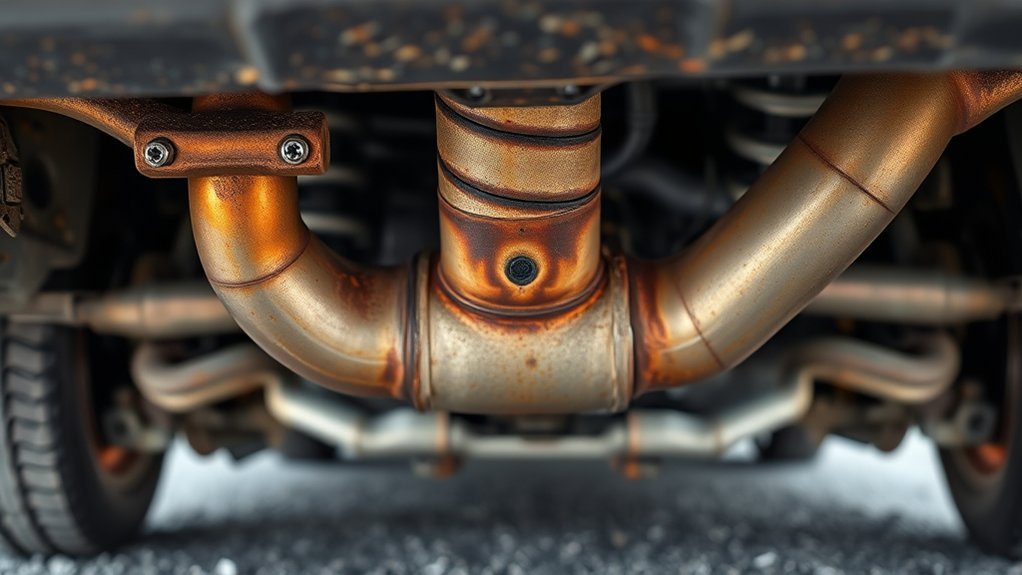
Rust on a Toyota Camry exhaust system does not always mean the entire system needs replacement. A light surface film may be cosmetic, while flaking metal, holes, split seams, black soot, loose pipes, or fumes inside the cabin can indicate a serious leak. The safest response depends on where the damage is and whether exhaust can enter the passenger compartment.
Last updated: September 19, 2026. Editorial basis: Toyota service and warranty information, CDC carbon-monoxide guidance, EPA emissions guidance, NHTSA recall resources, and current repair-cost references. This guide does not claim a hands-on inspection of a specific Camry.
Quick Answer
Toyota Camry exhaust rust is usually less concerning when it is only a thin surface film on solid metal. Inspect the car promptly if you hear hissing, tapping, rattling, or a deeper exhaust sound, see flaking rust or soot, or notice fumes in the cabin. Holes, thinning metal, broken hangers, failed seams, and leaks near the engine or passenger compartment require professional diagnosis and repair.
Key Takeaways
- Light orange or brown surface oxidation is different from deep scaling, holes, cracked seams, or metal that crumbles when inspected.
- Exhaust odor inside the cabin, headache, dizziness, weakness, or confusion requires immediate attention because carbon monoxide may be present.
- A check-engine light does not prove the exhaust is rusted or that an oxygen sensor has failed. Record the diagnostic codes and inspect the system before replacing parts.
- Welding is suitable only when enough strong base metal remains around the damaged area. Severely thinned or perforated sections usually need replacement.
- Repair cost depends on the Camry’s model year, engine, emissions certification, leak location, corrosion level, and whether a catalytic converter is involved.
At a Glance
| Time Required | A brief owner-level visual and sound check; a lift inspection, scan-data diagnosis, or controlled leak test takes longer. |
| Difficulty | Easy for basic screening; moderate to advanced for diagnosis and repair. Welding, catalyst work, and under-vehicle repairs are best left to a qualified technician. |
| Tools Needed | Flashlight, gloves, phone for recording sounds, and an optional OBD-II scanner. A shop may use a vehicle lift, smoke or low-pressure leak tester, scan tool, and exhaust-gas analyzer. |
| Cost | Varies widely. A gasket, clamp, or hanger is usually far less involved than replacing a corroded pipe, manifold, muffler, oxygen sensor, or catalytic converter. |
Warning: Stop the vehicle and move into fresh air if you smell exhaust inside the cabin or develop headache, dizziness, weakness, nausea, chest pain, or confusion. Carbon monoxide has no color or odor, and the CDC warns that even a small exhaust leak can allow it to build up inside a vehicle. Do not crawl under a Camry supported only by its factory jack.
Where Is the Rust or Leak? Why Location Matters
The same size leak can have different consequences depending on where it occurs. Use location as a triage tool, not as a substitute for a full inspection.
| Leak or Rust Location | Why It Matters | Best Next Step |
| Manifold, front pipe, or engine-bay area | Hot exhaust is close to wiring, sensors, the firewall, and the cabin air-intake area. Ticking during a cold start can be a clue. | Treat as high priority, especially if fumes, soot, or a check-engine light are present. |
| Near an air-fuel/oxygen sensor or catalytic-converter connection | Outside air entering through a leak can affect exhaust-sensor data and complicate catalyst diagnosis. | Test for leaks before replacing a sensor or converter. |
| Center pipe, flex section, flange, or resonator | Cracks, failed gaskets, corrosion, or movement can create hissing, chuffing, vibration, or a louder exhaust note. | Inspect the full circumference of the pipe and nearby hangers on a lift. |
| Rear muffler or tailpipe | Rear failures often create rumbling, rattling, split seams, or a loose component, but cabin-fume risk still must not be dismissed. | Repair perforation or failed supports before the component separates or begins dragging. |
How Your Toyota Camry’s Exhaust System Works
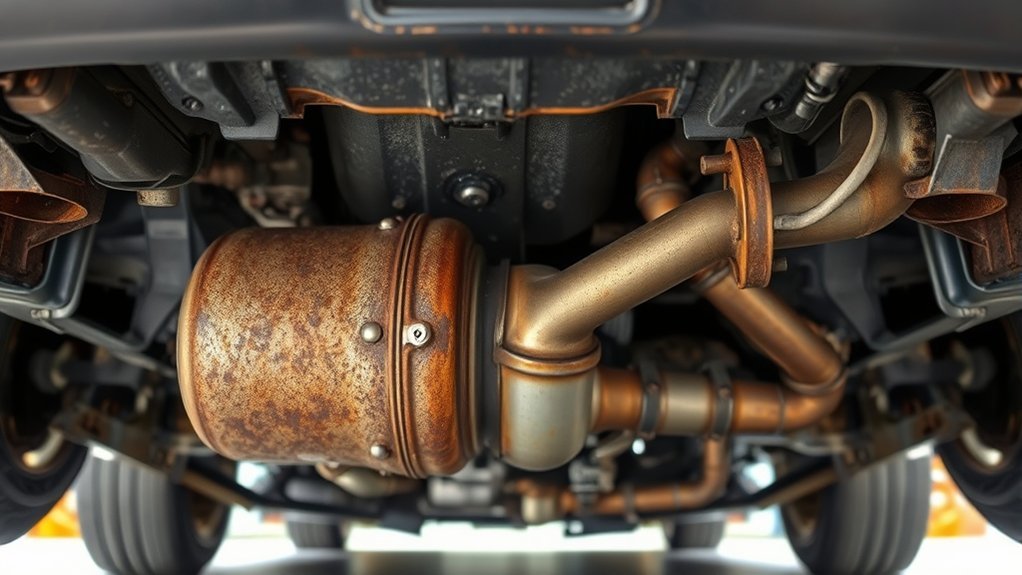
Your Camry’s exact exhaust layout depends on its model year, engine, drivetrain, emissions certification, and whether it is a hybrid. In general, exhaust gas leaves the engine through the exhaust manifold and flows through one or more catalytic converters, connecting pipes, a resonator or muffler, and the tailpipe.
The catalytic converter uses heat and catalyst materials to reduce regulated pollutants before the gases leave the vehicle. This does not make exhaust safe to breathe. The EPA identifies transportation exhaust as a source of nitrogen oxides, volatile organic compounds, particulate matter, carbon monoxide, and toxic pollutants.
Air-fuel ratio and oxygen sensors provide information used by the engine and emissions-control systems. Depending on the Camry, sensors may be positioned before and after a catalytic converter. A leak ahead of a sensor can admit outside air and affect the readings, while a downstream muffler leak may create substantial noise without changing fuel control.
Toyota Tech Tip T-TT-0686-22 gives a Camry-specific example of why leak testing matters. For certain 2018–2022 Camrys in the bulletin’s 2GR-FKS/FXS applicability group, Toyota says a leaking exhaust system can contribute to O2/A/F-sensor and catalyst-efficiency DTCs including P013A00, P013C00, P042000, and P043000. The bulletin directs technicians to check areas including welds, pipe alignment, and gaskets before continuing diagnosis. See the Toyota Tech Tip PDF hosted by NHTSA.
Heat shields reduce heat transfer to the floor and nearby components. Rubber isolators, brackets, and hangers support the exhaust while allowing controlled movement as the engine and exhaust system heat, cool, and flex.
Is Toyota Camry Exhaust Rust Normal or Serious?
Do not judge an exhaust pipe by color alone. Exhaust components can discolor or develop a thin layer of oxidation without leaking. The condition of the metal, seams, flanges, hangers, and welded joints matters more than a light brown surface.
| What You See | Likely Meaning | Recommended Action |
| Thin, even orange or brown film with solid metal and no noise | Possible cosmetic surface oxidation | Monitor during routine service and after winter driving. |
| Thick flakes, deep pitting, swollen seams, or layers falling away | Advanced corrosion and possible loss of wall thickness | Arrange a lift inspection before the metal perforates or separates. |
| Black soot around a joint, crack, or pinhole | Likely exhaust-gas escape | Have the joint, gasket, flange, weld, or pipe tested and repaired. |
| Visible hole, split seam, hanging pipe, or broken bracket | Active failure or immediate risk of separation | Limit driving and arrange repair promptly. Tow the car if a component may drag or fall. |
What Are the Symptoms of a Toyota Camry Exhaust Leak?
An exhaust leak can sound different depending on its location, size, and engine speed. None of the symptoms below confirms the failed part by itself, but each can guide the inspection.
| Symptom | Possible Cause | Urgency |
| Sharp tapping or puffing, often louder during a cold start | Manifold crack, manifold gasket, flange leak, or an upstream joint | High, especially if fumes are present near the cabin air intake. |
| Hissing that increases with acceleration | Crack, pinhole, leaking gasket, or damaged flex section | Inspect soon; urgent if the leak is forward of the passenger compartment. |
| Deep rumble or sudden increase in exhaust volume | Muffler, resonator, pipe, flange, or detached connection | Prompt inspection required. |
| Metallic rattle at idle or over bumps | Loose heat shield, broken hanger, internal muffler damage, or loose catalyst material | Inspect before the part shifts, contacts the body, or separates. |
| Exhaust odor or irritation inside the cabin | Exhaust leak, damaged body seal, open trunk path, or another route allowing fumes to enter | Immediate. Stop driving and move into fresh air. |
| Check-engine light | Possible sensor, fuel-control, misfire, catalyst-efficiency, or leak-related fault. Toyota has documented exhaust leaks as a possible contributor to specific O2/A/F and catalyst-efficiency DTCs on certain Camrys. | Scan the codes promptly. Do not replace a sensor or converter based on the code name alone. |
| Reduced power or fuel economy | Possible upstream leak, sensor error, restricted converter, misfire, or unrelated engine problem | Requires diagnosis because the symptom is not specific to exhaust rust. |
If the check-engine light is flashing rather than steady, use the dedicated Toyota Camry flashing check-engine light guide because an active misfire can create a separate risk to the catalytic converter.
A small exhaust leak is not only a noise problem. If gases find a path into the cabin, carbon monoxide can create a serious health emergency.
Can You Drive a Camry With an Exhaust Leak?
A light surface film with no hole, soot, noise, loose part, warning light, or cabin odor may be safe to monitor until the next service. An active leak should not be ignored, even when the car still drives normally.
Stop driving and arrange towing or urgent inspection when:
- You smell exhaust inside the cabin or develop possible carbon-monoxide symptoms.
- A pipe, muffler, heat shield, or hanger is loose enough to drag or fall.
- The leak is near the engine, firewall, passenger floor, fuel lines, brake lines, wiring, or other heat-sensitive parts.
- The check-engine light is flashing, the engine is misfiring, or power loss is severe.
- The exhaust has become suddenly much louder after a road impact or suspected catalytic-converter theft.
Opening a window is not a repair and does not guarantee that fumes will stay out of the cabin.
How to Check Your Camry for an Exhaust Leak Safely
- Park outdoors on level ground. Do not run the engine in an attached garage, even with the garage door open.
- Begin with the exhaust cold. Look from the sides and rear for hanging components, broken rubber isolators, impact damage, deep rust, or a tailpipe touching the body. Do not crawl underneath an unsupported vehicle.
- Listen during a cold start. A manifold or flange leak may be most noticeable before heat expands the parts. Record the sound so a technician can hear when it occurs.
- Look for soot and movement. Black deposits around a seam or flange can indicate escaping gas. Excess movement may point to a failed hanger or bracket.
- Scan the check-engine light. Save the exact codes and freeze-frame data before clearing anything. A code identifies the system that detected a problem, not necessarily the part that must be replaced.
- Request a professional lift inspection. A technician can inspect the full circumference of the pipes, check flanges and shields, test sensor data, and use a controlled low-pressure or smoke test when appropriate.
Pro Tip: Ask the shop to show you the exact leak, thinning, broken hanger, or failed joint before authorizing a full assembly. Many exhaust systems can be repaired by replacing the failed section rather than every component.
How Do You Fix Rust and Exhaust Leaks on a Camry?
The correct repair depends on the strength of the surrounding metal and the position of the leak.
Gaskets, Clamps, and Hangers
A leaking flange gasket, loose connection, damaged clamp, or failed rubber isolator may be repairable without replacing a long pipe assembly. The technician should also check why the joint loosened or the hanger failed. Misalignment or engine movement can place extra stress on a new part.
Welding an Exhaust Leak
Welding can be appropriate when the hole is localized and the surrounding metal is thick, clean, and structurally sound. It is a poor choice when corrosion extends well beyond the visible opening or the pipe has become thin and porous. Welding weak metal may only move the failure to the edge of the repair.
Replacing a Pipe, Muffler, or Resonator
Replacement is normally more dependable when seams have split, large areas are heavily scaled, multiple holes are present, or an internal muffler component is loose. Exact parts must be matched to the Camry’s year, engine, emissions specification, and exhaust configuration.
Manifold, Catalytic Converter, and Sensor Repairs
Leaks near the manifold or catalytic converter require careful diagnosis because they are close to sensors, wiring, the engine, and the passenger compartment. A catalyst-efficiency code does not automatically prove the converter has failed. Misfires, fuel-control faults, oil or coolant consumption, exhaust leaks, wiring problems, and sensor faults should be addressed before an expensive converter is condemned.
For converter-specific diagnosis, P0420/P0430 context, and replacement considerations, see the separate Toyota Camry catalytic converter guide.
Replacement converters and related parts must meet applicable emissions requirements. The EPA states that the Clean Air Act prohibits tampering with emissions controls and installing devices intended to defeat them. Do not remove a converter, install an oxygen-sensor spacer to hide a fault, or substitute an empty pipe.
Temporary Exhaust Patches
An exhaust-rated tape, bandage, sleeve, or repair cement may temporarily reduce a small leak on a suitable downstream section when its instructions specifically allow that use. The metal still needs professional evaluation, and the patch should not be treated as a permanent repair.
Do not use household aluminum foil, general-purpose epoxy, combustible material, or an unapproved product. Do not apply a patch to a catalytic converter, oxygen sensor, flexible joint, manifold, severely thinned pipe, or any area where failure could direct hot gas toward the cabin, wiring, fuel system, or brake components.
Why Does a Toyota Camry Exhaust Rust?
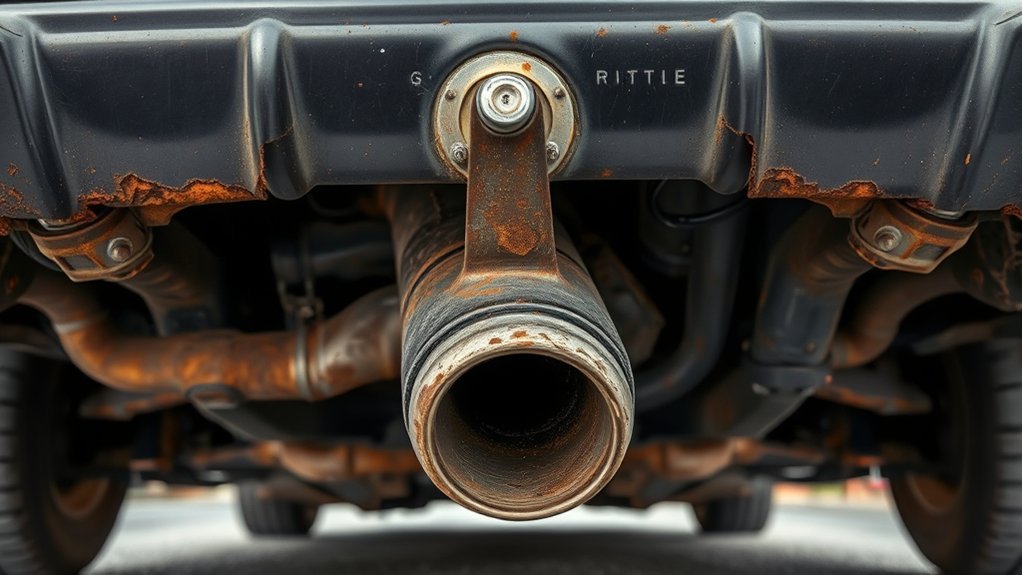
Camry exhaust corrosion normally develops through a combination of moisture, contaminants, heat cycles, age, and physical damage.
- Internal condensation: Gasoline combustion produces water vapor. During cold starts and cool-down, moisture can condense inside cooler exhaust components. Repeated short trips may not keep the system hot long enough to evaporate all accumulated moisture.
- Road salt and deicing chemicals: Chloride residue holds moisture against exposed metal and speeds corrosion, especially around seams, flanges, welds, and brackets.
- Rain, standing water, and humid storage: Persistent external moisture can accelerate oxidation where protective surfaces have deteriorated.
- Heating and cooling cycles: Repeated expansion and contraction can stress welded seams, gaskets, flanges, and already weakened areas.
- Road impacts: Curbs, debris, deep potholes, and improper lifting can dent pipes, crack welds, damage shields, or knock the system out of alignment.
- Failed hangers or excessive movement: A broken isolator can allow the exhaust to strike the body or place excess load on joints and flex sections.
- Engine or fuel-control faults: Misfires and improper fueling can overheat or contaminate emissions components. These issues may damage the exhaust system even when rust is not the original cause.
How Can You Slow Toyota Camry Exhaust Corrosion?
- Wash away winter residue: Use an underbody wash after salt exposure and after the winter season. Allow hot exhaust components to cool before directing water at them.
- Reduce repeated very short trips when practical: A fully warmed drive gives accumulated exhaust moisture more opportunity to leave as vapor. Do not idle the vehicle in a garage as a substitute.
- Inspect after an impact: Have the underside checked after hitting road debris, a curb, or a deep pothole.
- Respond to new noises: A small loose shield or hanger is usually easier to correct before it damages another component.
- Repair engine faults: Diagnose misfires, oil burning, coolant loss, rich operation, and warning lights before they damage a catalytic converter.
- Use coatings carefully: Do not spray ordinary undercoating, oil, or rust inhibitor onto catalytic converters, oxygen sensors, wiring connectors, heat shields, or hot exhaust surfaces. Use only a product specifically rated for the component and temperature.
- Request routine inspection: The CDC recommends having a mechanic check a car or truck exhaust system regularly because even a small leak can permit carbon-monoxide buildup.
Note: Water dripping briefly from the tailpipe during a cold start can be normal condensation. Persistent coolant loss, sweet-smelling white vapor after warm-up, overheating, or heavy smoke requires engine diagnosis and should not be dismissed as ordinary exhaust moisture. For that symptom, see the Toyota Camry white-smoke guide.
How Much Does Toyota Camry Exhaust Repair Cost?
A single national price cannot accurately cover every Camry. The largest cost factors are the failed component, model year, engine, emissions certification, corrosion severity, parts source, local labor rate, and whether seized fasteners increase labor time.
For a current benchmark, when checked on September 19, 2026, RepairPal listed a Toyota Camry muffler replacement at $587–$623 and an exhaust-pipe replacement at $862–$912. These are national estimate ranges rather than quotes for your vehicle; taxes, fees, location, model year, related repairs, and catalytic-converter work can change the total.
| Repair Type | Typical Cost Level | Important Variables |
| Hanger, clamp, gasket, or minor shield repair | Lower | Access, broken bolts, alignment, and whether another failed support caused the problem |
| Localized weld or short pipe section | Lower to moderate | Amount of sound metal, pipe shape, leak location, and fabrication time |
| Muffler, resonator, or larger pipe assembly | Moderate | OEM versus aftermarket part, integrated flanges, shipping size, and surrounding corrosion |
| Manifold, catalytic converter, sensor, or combined assembly | Higher | Engine type, emissions certification, converter design, state requirements, sensor condition, and labor access |
Ask for an itemized estimate showing the exact leaking component, part number, emissions certification, labor time, and any related gaskets, sensors, or hardware. A quote for a complete exhaust system should explain why individual section replacement is not practical.
Does Toyota Warranty Cover Camry Exhaust Rust?
Use your model year and VIN before ordering parts or approving a major repair. Toyota’s manuals and warranties portal provides vehicle-specific documents. Toyota’s general U.S. warranty information states that emissions coverage varies under federal and California regulations and directs owners to the applicable Warranty and Maintenance Guide.
Toyota’s general U.S. rust-through coverage applies to corrosion perforation of body sheet metal or body panels, so do not assume a rusted exhaust pipe is covered. Exhaust and emissions-component coverage depends on the vehicle, component, age, mileage, emissions certification, and applicable warranty rules.
You can also enter the VIN at the NHTSA recall lookup. A general article cannot determine whether a particular Camry has an open recall or service campaign. If you are preparing for an emissions inspection rather than diagnosing rust, see the Toyota Camry emissions-readiness guide.
Frequently Asked Questions
Is surface rust on a Toyota Camry exhaust normal?
Light surface oxidation can occur without causing a leak. Deep flakes, thinning metal, cracked seams, soot deposits, holes, broken hangers, or loose pipes require a professional inspection.
Can I drive with a rusty or leaking Camry exhaust?
A thin surface film on solid metal with no leak, noise, soot, loose part, warning light, or cabin odor may only need monitoring. Stop driving and arrange urgent inspection if exhaust enters the cabin, a component may fall or drag, the leak is near the engine or passenger compartment, or the engine is misfiring severely.
Can an exhaust leak cause P0420 or P0430?
Yes, an exhaust leak can affect sensor readings and contribute to catalyst-efficiency diagnosis in some cases. Toyota Tech Tip T-TT-0686-22 specifically lists P042000 and P043000 among DTCs that can be associated with exhaust leaks on certain 2018–2022 Camrys in its applicable engine group. Test for leaks before replacing a catalytic converter solely because of a code.
How much does Toyota Camry exhaust repair cost?
Cost depends on the failed section. When checked on September 19, 2026, RepairPal listed Camry muffler replacement at $587–$623 and exhaust-pipe replacement at $862–$912. These are national estimate ranges rather than quotes; model year, location, taxes, fees, seized hardware, related repairs, and catalytic-converter work can change the total substantially.
Can an exhaust leak turn on the check-engine light?
Yes, particularly when a leak is near an upstream air-fuel ratio or oxygen sensor and changes the exhaust reading. However, a check-engine light can have many other causes. Save the codes and diagnostic data, then test the exhaust and related systems before replacing a sensor or converter.
Can I patch a rusted exhaust pipe instead of replacing it?
A small localized hole may accept a welded repair or a temporary exhaust-rated patch when the surrounding metal remains strong. A patch is not dependable on deeply scaled, thin, cracked, or widely perforated metal. Never use household foil, general epoxy, or a patch that interferes with a catalytic converter or sensor.
Conclusion
Light surface rust on a Toyota Camry exhaust may only need monitoring, but flaking metal, soot, holes, split seams, loose supports, loud exhaust noise, or cabin fumes require prompt attention. Treat exhaust odor inside the vehicle as a safety issue, not a comfort problem. A proper diagnosis should locate the leak, check related sensors and engine faults, and determine whether a gasket, hanger, weld, pipe section, muffler, manifold, or emissions component actually needs replacement. If there is an active leak, save any diagnostic codes and arrange an inspection that identifies the exact failed section before authorizing major parts.
Sources
- Centers for Disease Control and Prevention: Carbon Monoxide Poisoning Basics — supports cabin-fume risks, symptoms, garage precautions, and exhaust-system inspection guidance.
- U.S. Environmental Protection Agency: Transportation Air Pollution — supports information about vehicle pollutants and emissions-reduction systems.
- Toyota Tech Tip T-TT-0686-22: O2 and/or A/F Sensor DTCs Related to Exhaust Leaks — supports Camry-specific guidance on exhaust leaks, diagnostic trouble codes, welds, pipe alignment, and gaskets.
- U.S. Environmental Protection Agency: Aftermarket Defeat Devices and Tampering — supports the prohibition on defeating catalysts and other required emissions controls.
- Toyota Manuals and Warranties — provides model-year-specific owner manuals, warranty guides, rust-through information, and emissions-coverage information.
- National Highway Traffic Safety Administration Recall Lookup — provides VIN-based recall information.
- RepairPal: Toyota Camry Exhaust Muffler Replacement Cost — provides a current national muffler-replacement estimate range.
- RepairPal: Toyota Camry Exhaust Pipe Replacement Cost — provides a current national exhaust-pipe replacement estimate range.
