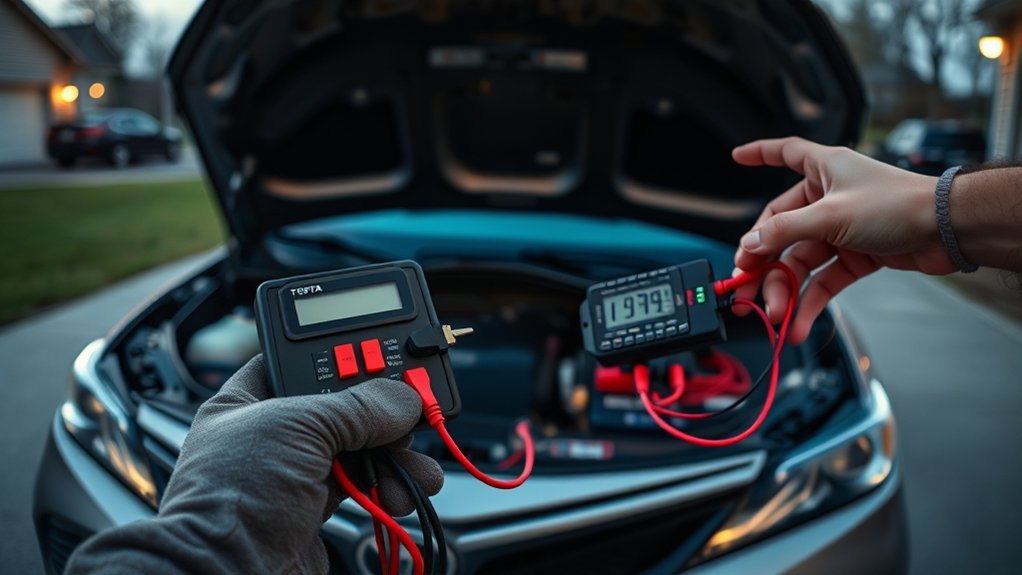
If your Toyota Camry will not crank, the engine does not rotate when you turn the key or press the start button. Start with the 12-volt battery, terminal connections, and ground cables before replacing the starter. Then check whether the car recognizes Park or Neutral, the brake pedal, the key, and the starter-control circuit.
The correct test path depends on the model year and powertrain. A gasoline Camry may use a conventional starter motor, while a Camry Hybrid uses a different starting system and is better diagnosed as a no-READY condition. Use the Toyota owner’s manual for your exact year before jump-starting the vehicle, locating fuses, or interpreting warning messages.
Quick Answer
A Toyota Camry that will not crank usually has a weak 12-volt battery, loose or corroded battery cables, a poor ground, a Park/Neutral recognition problem, a failed relay, or a starter-circuit fault. Confirm the engine truly does not rotate, test the battery under load, and inspect the full starter circuit before replacing parts.
Key Takeaways
- No crank means the engine does not turn. Fuel-pump and injector checks come later only if the engine cranks normally.
- Bright dashboard lights do not prove the battery can supply enough current to operate the starter.
- A single click can come from a weak battery, excessive cable resistance, a relay or solenoid fault, a bad starter, or a mechanically locked engine.
- Trying to start in Neutral can reveal a range-switch or shifter-position issue, but it is not a complete diagnosis.
- Hybrid Camrys require a model-specific no-READY diagnosis and should not be treated as if they all have a conventional starter motor.
At a Glance
| Time Required | 15 to 60 minutes for basic checks; longer for circuit testing or starter access |
| Difficulty | Beginner for visual checks; intermediate to advanced for loaded voltage and control-circuit tests |
| Tools Needed | Safety glasses, gloves, digital multimeter, battery tester or jump pack, terminal brush, and model-specific wiring information |
| Cost | Often $0 for inspection; battery, cable, relay, diagnostic, and starter costs vary by model year and repair location |
Warning: Keep the transmission in Park, apply the parking brake, and keep hands, tools, clothing, and test leads away from belts and fans. Do not bridge starter terminals or bypass the starter solenoid with a jumper wire unless you are trained and following the exact Toyota service procedure. A short circuit can cause burns, vehicle movement, wiring damage, or fire.
Confirm What “No Crank” Means Before Testing
Listen and watch closely during one start attempt. This first observation prevents you from testing the wrong system.
| What Happens | Condition | Where to Focus |
|---|---|---|
| The engine does not rotate | No crank | 12-volt battery, cables, grounds, start authorization, relay, wiring, and starter circuit |
| The engine rotates at normal speed but never runs | Crank-no-start | Fuel delivery, ignition, engine-speed signal, compression, and immobilizer diagnosis |
| A hybrid does not show READY | No-READY condition | 12-volt auxiliary battery, brake input, key recognition, warning messages, hybrid controls, and trouble codes |
Note: The Camry spans many generations. Fuse names, relay locations, starter designs, key systems, and test specifications vary. Toyota’s Technical Information System is the source for model-specific repair manuals and wiring diagrams.
Common Causes of No Crank in Your Toyota Camry
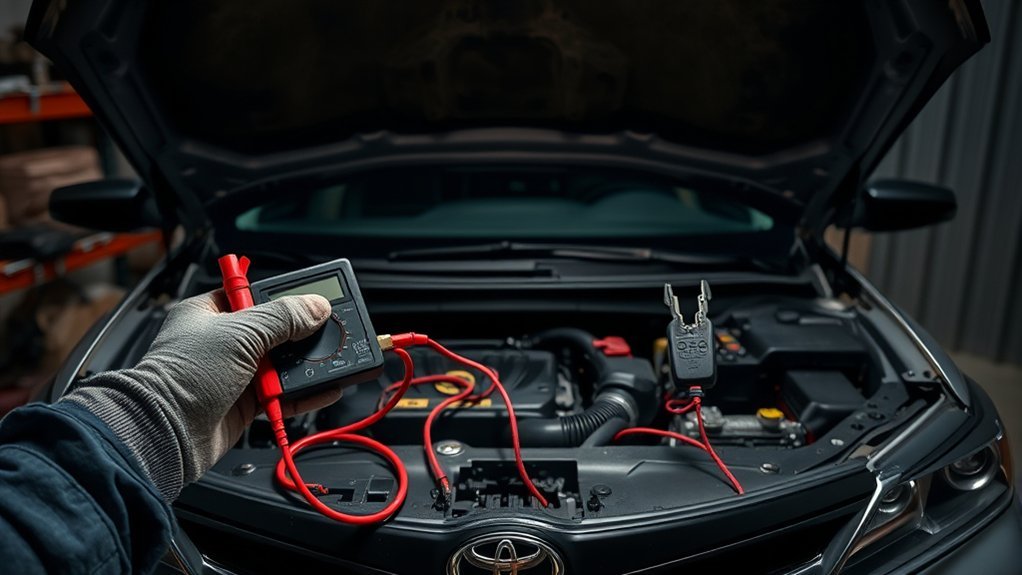
A no-crank Camry usually fails in one of three areas: power delivery, start authorization, or the starter load itself. Check the simple items first because a corroded terminal can imitate a failed starter.
- Weak or discharged 12-volt battery: The lights and radio may still work even when the battery cannot provide starter current.
- Loose or corroded battery terminals: Resistance at either terminal can block high current while allowing low-current accessories to operate.
- Damaged positive cable or poor engine ground: Corrosion can hide inside a cable or under insulation.
- Park/Neutral recognition problem: The transmission range switch, shifter adjustment, or related wiring may prevent the start request.
- Brake-pedal or key-recognition issue: Push-button models may not authorize a start if the brake input or smart key is not recognized.
- Blown fuse, failed starter relay, or control-circuit fault: Exact names and locations depend on the Camry’s year and engine.
- Failed starter motor or solenoid: Internal wear can cause a click, intermittent operation, or silence.
- Mechanical engine or accessory lock-up: A seized engine or accessory can prevent rotation and may be mistaken for a bad starter.
Troubleshooting Starter Motor Problems
Do not condemn the starter from sound alone. Diagnose the battery and high-current cables under load, then verify that the starter receives the correct control signal.
Common Symptoms Explained
| Symptom | Possible Causes | Next Check |
|---|---|---|
| Rapid clicking | Low battery voltage or severe cable resistance | Battery load test and terminal inspection |
| One solid click | Weak battery, cable voltage drop, solenoid or starter fault, or locked engine | Loaded voltage, voltage-drop tests, and mechanical rotation check by a technician |
| No click, lights stay bright | Start-authorization, fuse, relay, switch, key, brake-input, or wiring problem | Try Neutral, inspect messages, check fuses, and scan for codes |
| Lights go very dim | Weak battery, poor connection, excessive starter draw, or mechanical lock-up | Stop repeated attempts and test the battery and starter circuit |
| Starts in Neutral but not Park | Range-switch, shifter, adjustment, or wiring issue | Professional range-data and circuit diagnosis |
Testing Starter Connections
- Check the battery at the posts, not only the cable clamps. A rested, fully charged lead-acid battery is often near 12.6 volts, but resting voltage alone does not prove battery health. Use a proper battery conductance or load test.
- Watch voltage during a start request. A large collapse points toward a discharged or failed battery, excessive starter current, or major resistance. Use the exact Toyota and tester specifications instead of a universal cutoff.
- Inspect and clean both battery terminals. Remove corrosion safely, tighten the clamps, and replace damaged terminals rather than forcing them tighter.
- Inspect the positive cable and grounds. Check the battery-to-body, battery-to-engine, and engine-to-body paths where fitted.
- Perform loaded voltage-drop tests. Measure the positive and ground sides while the circuit is commanded on. Fluke notes that voltage-drop testing can reveal restrictions that a visual inspection misses and provides general limits when a service manual does not list a value.
- Verify the starter control signal. A technician should confirm whether the solenoid command reaches the starter during a valid start request. No command points upstream; correct command with proper power and ground points toward the starter or a mechanical problem.
For a clear explanation of loaded circuit testing, see Fluke’s guide to automotive voltage-drop diagnosis.
Pro Tip: If a jump pack makes the Camry crank normally, do not assume the starter is fixed. Test the battery, charging system, terminals, and cables so the no-crank condition does not return.
Replacement Options Available
Replace the starter only after confirming that the battery passes its test, cable voltage drop is acceptable, the engine can rotate, and the starter receives the proper power, ground, and control input. Choose a Toyota Genuine, reputable new, or high-quality remanufactured unit that matches the VIN, engine, model year, and drivetrain.
A relay or fuse should also be replaced only after the reason for failure is understood. A repeatedly blown fuse can indicate a short circuit or overloaded component. After any repair, perform several hot and cold starts, clear and recheck diagnostic trouble codes when appropriate, and confirm that cable connections remain cool and secure.
Next Steps After Starter Troubles: Ignition and Start-Authorization Checks
If battery and high-current tests are good but the starter never receives a command, move upstream through the control circuit. The exact path can include the ignition switch or start button, brake-pedal switch, transmission range input, immobilizer, body control module, engine control module, fuses, and relays.
Ignition Switch Inspection
- Key-start models: Check whether the instrument panel behaves normally in ACC, ON, and START. An intermittent switch, worn key cylinder linkage, fuse, or wiring fault can interrupt the start request.
- Push-button models: Press the brake firmly and watch for messages such as “Key Not Detected” or instructions to touch the key fob to the start button. A weak fob battery can affect recognition, but it does not prove the vehicle’s 12-volt battery is healthy.
- Automatic transmission: Hold the brake, move the selector fully into Park, and try once. Then try Neutral. If it starts only in one position, stop treating it as a starter-only problem.
- Security indicator: Abnormal immobilizer behavior or a security message calls for key and module diagnosis, not repeated starter replacement.
- Scan data: A capable scan tool can show brake-switch status, gear position, key authorization, start request, module communication, and related trouble codes.
Fuel System Evaluation Comes After the Engine Cranks
Do not test the fuel pump, injectors, or fuel pressure to solve a true no-crank condition. Those systems affect whether a rotating engine starts and runs. Move to fuel and ignition checks only after the engine turns at a normal speed or if the original symptom was described incorrectly.
Diagnosing Battery Issues in Your Toyota Camry
The battery is the first checkpoint, but a single voltage reading is only part of the diagnosis.
- Let surface charge settle when possible. Measure directly across the battery posts with the vehicle off. Temperature, battery type, recent charging, and vehicle loads affect the reading.
- Do not label every reading below 12.6 volts as a failed battery. A reading near 12.6 volts often indicates a well-charged conventional lead-acid battery at rest. A lower value may mean partial discharge, recent load, cold temperature, or deterioration.
- Use a battery tester. A conductance or load test evaluates the battery’s ability to deliver current. This is more useful than deciding from dashboard brightness.
- Inspect for physical damage. Do not jump-start a leaking, swollen, cracked, or frozen battery. Follow the exact jump-start sequence and connection points in the model-year owner’s manual.
- Check the charging system after the engine starts. A healthy battery can discharge again if the charging system, belt drive, DC-DC converter on a hybrid, or related wiring is faulty.
- Investigate repeated discharge. If the battery repeatedly goes dead, test for excessive key-off draw after modules have had time to sleep. This is an advanced test because disconnecting the battery can wake modules or erase learned settings.
Importance of Ground Connections and Wiring Integrity
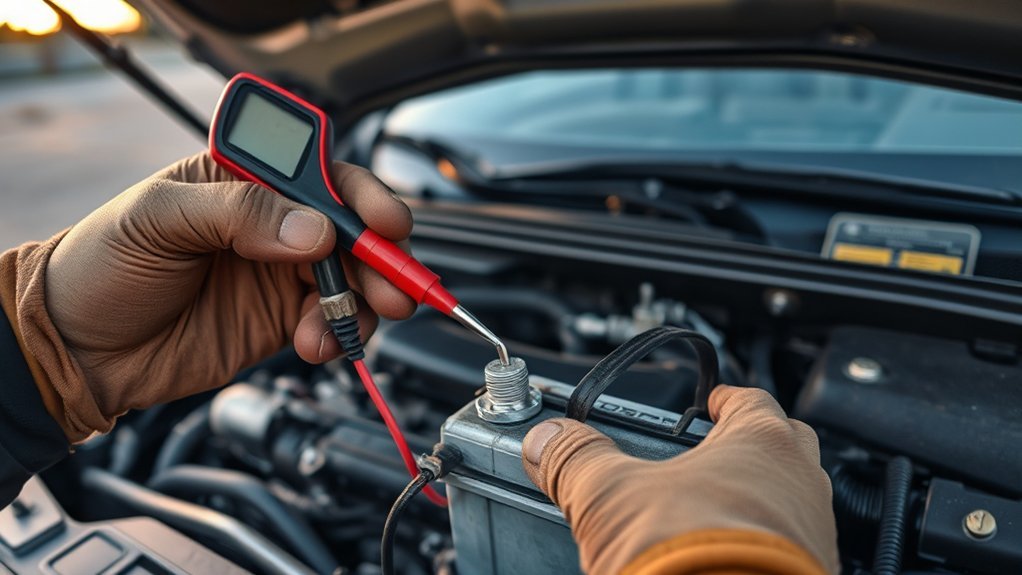
The starter is a high-current load. Even a small amount of resistance in a terminal, cable, splice, or ground can reduce starter performance. Corrosion may be hidden inside a crimp or under insulation, so a connection can look clean and still fail under load.
A voltage-drop test measures loss while current is flowing. Test the positive path from the battery positive post toward the starter and the ground path from the starter housing or engine block back to the battery negative post. Compare results with Toyota’s model-specific specifications. When no factory value is available, Fluke lists general maximum drops of 0.20 volt across a wire or cable and 0.10 volt at a ground, but the Toyota service information takes priority.
A clean-looking cable is not proof of a good circuit. Test voltage loss while the starter circuit is under load.
Repair damaged wiring with the correct gauge, terminal type, routing, insulation, and corrosion protection. Do not add a random ground wire as a substitute for finding a loose, broken, or overheated factory connection.
Fuel System’s Role in a Crank-No-Start Condition
If the Camry cranks at normal speed but does not run, the diagnostic path changes. At that point, confirm warning messages and immobilizer status, scan for codes, and check whether the engine control module sees engine speed during cranking.
- Fuel level and fuel quality: Confirm there is usable fuel in the tank. A failed gauge or contaminated fuel can mislead the diagnosis.
- Fuel-pump command and pressure: Pump sound alone does not prove correct pressure or volume. Use the model-specific procedure and proper gauge or scan data.
- Injector operation: Check power, control, and pulse with approved tools. Do not probe connectors in a way that can damage control modules.
- Ignition and engine-speed signals: A failed crankshaft or camshaft signal, ignition fault, or power-supply problem can cause a crank-no-start condition.
- Mechanical condition: Incorrect valve timing or low compression can prevent starting even when fuel and spark are present.
This section does not apply until the engine rotates. Keeping the two symptoms separate prevents unnecessary fuel-pump, injector, and starter replacement.
When to Call a Mechanic for Help
Stop basic troubleshooting and arrange professional service when any of the following applies:
- The battery is swollen, leaking, cracked, frozen, overheating, or producing a strong sulfur odor.
- Cables become hot, smoke appears, a fuse repeatedly blows, or you see melted insulation.
- The engine will not rotate and a mechanical lock-up is possible.
- The Camry starts only when the shifter is moved or held in a certain position.
- The security light or key warning behaves abnormally.
- A hybrid shows warning messages, will not enter READY, or has high-voltage system faults.
- You cannot safely access the starter or perform loaded electrical tests.
- The problem is intermittent and basic checks do not reveal it.
A technician can use Toyota wiring diagrams, bidirectional scan data, current-draw testing, and voltage-drop measurements to isolate the fault. Before paying for repairs, also check the VIN for open safety recalls or manufacturer communications through the NHTSA recall lookup and Toyota’s recall system.
Preventive Maintenance Tips for Reliable Starting
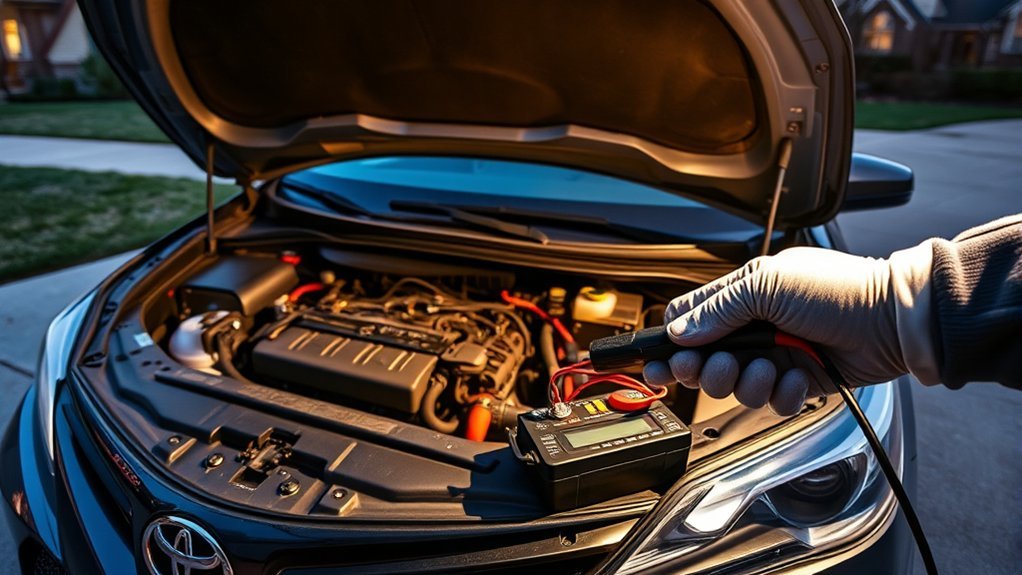
- Inspect the battery and hold-down: Keep the case secure and the top clean and dry.
- Keep terminals clean and tight: Address corrosion before it spreads into the cable.
- Test an aging battery before extreme weather: Heat accelerates battery aging, while cold weather exposes reduced cranking capacity.
- Watch for slower or inconsistent starts: Early symptoms are easier to diagnose than a complete no-crank failure.
- Repair oil or coolant leaks: Fluids can damage wiring, connectors, and starter components.
- Avoid repeated long start attempts: Repeated cranking can overheat cables and starter components.
- Use the correct replacement battery: Match the required size, terminal layout, technology, and rating for the exact Camry.
- Check recalls by VIN: Model-year-specific campaigns cannot be identified accurately from a generic Camry article.
Frequently Asked Questions
Why is my Toyota Camry not cranking?
Common causes include a discharged 12-volt battery, loose or corroded terminals, a poor engine ground, a Park/Neutral recognition fault, a brake or key-authorization problem, a fuse or relay fault, damaged wiring, or a failed starter circuit. Hybrid models require a no-READY diagnosis rather than an automatic assumption that the conventional starter has failed.
What can cause a no-crank, no-start condition?
A no-crank, no-start condition means the engine never rotates. Focus on battery power, cable resistance, grounds, start authorization, fuses, relays, control wiring, the starter circuit, and possible mechanical lock-up. Fuel pressure and injector checks do not explain why the engine fails to rotate.
Why does my Toyota have power but will not start?
The lights, radio, and dashboard need much less current than a conventional starter. A weak battery or resistant cable can power accessories but fail during a start request. If the engine cranks normally, then check fuel, ignition, engine-speed signals, immobilizer status, and mechanical condition.
Why will my Camry not turn over even though the lights are on?
Dashboard lights do not confirm that the battery, terminals, cables, and grounds can carry starter current. Test the battery under load, inspect both battery posts and cable ends, and perform voltage-drop tests before replacing the starter.
What does one click when starting a Camry mean?
One click means a relay or solenoid may be operating, but it does not identify the failed part. The cause can be a weak battery, voltage loss in the cables or grounds, a failed solenoid or starter, or an engine that cannot rotate. Loaded electrical tests are needed.
Why does my Camry start in Neutral but not Park?
That pattern points toward a transmission range-switch, shifter-position, adjustment, connector, or wiring problem. It does not prove the switch itself is bad. Have the selected gear and start-permission data checked before replacing parts.
Conclusion
A Toyota Camry no-crank problem should be diagnosed in order. First confirm that the engine truly does not rotate. Then test the 12-volt battery under load, inspect both terminals and grounds, try Park and Neutral, review key or brake warnings, and verify the fuse, relay, control signal, and starter circuit. Move to fuel and ignition checks only after the engine cranks. Model-year service information matters, especially for hybrid Camrys and push-button start systems.
Sources
- Toyota Manuals and Warranties — model-year owner’s manuals, vehicle procedures, and safety guidance
- Toyota Technical Information System — factory repair manuals, wiring diagrams, service bulletins, and diagnostic information
- Fluke: Diagnosing Voltage Drops — loaded circuit testing, ground diagnosis, and general voltage-drop limits
- National Highway Traffic Safety Administration Recall Lookup — VIN-based safety recall and manufacturer communication checks
