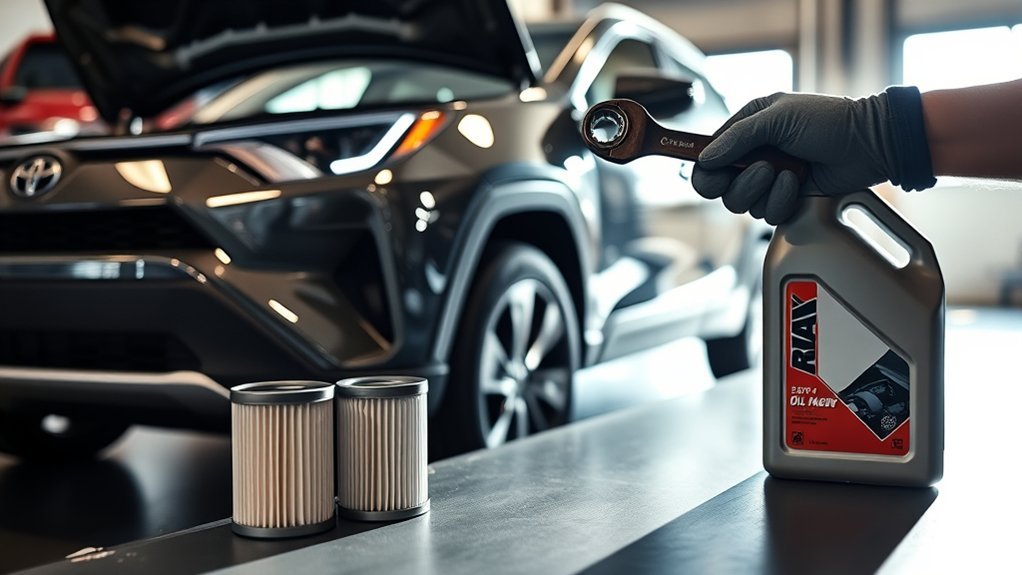
Your Toyota RAV4’s oil-change interval depends on the model year, powertrain, market, and how the vehicle is used. For a 2025 U.S.-market RAV4 under normal driving conditions, Toyota schedules engine oil and filter replacement at 10,000 miles or 12 months. The vehicle still receives scheduled maintenance every 5,000 miles or 6 months, and certain special operating conditions shorten the oil-change interval to 5,000 miles or 6 months.
Quick Answer
For a 2025 U.S. Toyota RAV4, change the engine oil and filter every 10,000 miles or 12 months under normal conditions. Use 5,000 miles or 6 months when Toyota’s listed special operating conditions apply. Older RAV4s and other markets can have different requirements, so your exact owner’s manual takes priority.
Key Takeaways
Key Takeaways
- For a 2025 U.S. RAV4 under normal conditions, Toyota schedules engine oil and filter replacement every 10,000 miles or 12 months.
- Toyota still schedules other maintenance at 5,000 miles or 6 months, so a 5,000-mile service reminder does not always mean the oil is due.
- Oil and filter replacement drops to 5,000 miles or 6 months when the applicable Toyota special operating conditions are met.
- For the referenced 2025 U.S. RAV4, use the oil viscosity and certification specified in the owner’s manual; SAE 0W-16 is the listed viscosity for the applicable gasoline/hybrid powertrain.
- Do not use dark oil color alone to decide when to change oil. Low oil level, leaks, contamination, abnormal oil consumption, or a low-oil-pressure warning require closer attention.
Understanding Toyota RAV4 Oil Change Intervals

The most important distinction is between a scheduled maintenance visit and an engine oil change. Toyota commonly schedules RAV4 maintenance at 5,000-mile or six-month increments, but that does not mean oil and filter replacement is required at every one of those visits.
For the 2025 U.S. RAV4 under normal operating conditions, Toyota’s maintenance guide schedules the engine oil and oil filter for replacement at 10,000 miles or 12 months. The 5,000-mile service includes other maintenance items such as tire rotation and inspections.
If the vehicle is primarily operated under one of Toyota’s applicable special operating conditions, engine oil and filter replacement is moved up to 5,000 miles or 6 months. These conditions include regular driving on dirt or dusty roads, towing or carrying heavy loads where specified, extensive idling or low-speed operation for long distances, and repeated short trips of less than five miles in temperatures below freezing.
Note: RAV4 requirements vary by model year, engine, hybrid system, and country. Use the maintenance guide for your exact vehicle rather than applying a 2025 specification to every RAV4 generation.
For a 2025 U.S. RAV4, think “5,000 miles for scheduled maintenance, 10,000 miles for normal-use oil and filter replacement”—unless Toyota’s special operating conditions apply.
Signs That Indicate Your RAV4 Needs Oil or Engine Attention
Your maintenance schedule should normally determine when the oil and filter are replaced, but several signs deserve attention between scheduled services.
- Maintenance reminder: A maintenance message can indicate that scheduled service is approaching. Check the vehicle’s maintenance guide to see what work is actually due at that mileage.
- Low-oil-pressure warning: This is different from a routine maintenance reminder. If the vehicle reports low engine-oil pressure, stop safely and follow the owner’s manual rather than continuing to drive until the next oil change.
- Low oil level: Check the dipstick on level ground according to the owner’s manual. A repeatedly low level can indicate oil consumption or a leak that should be investigated.
- Milky or contaminated oil: Oil with an unusual milky appearance or obvious contamination deserves diagnosis. Dark oil alone is not proof that the oil has failed.
- Oil leaks or burning smell: Fresh oil spots under the vehicle or a persistent burning-oil odor can indicate a leak.
- Blue or unusual exhaust smoke: This can indicate oil consumption or another mechanical problem. An oil change alone may not fix the cause.
- New knocking or abnormal engine noise: Do not assume an oil change will solve it. Check the oil level and arrange diagnosis if the noise continues.
Warning: A low-oil-pressure warning is not a routine “oil change due” light. Continuing to run an engine with inadequate oil pressure can cause severe damage. Stop safely and follow the owner’s manual.
Driving Conditions and Oil Change Frequency
Driving conditions matter because Toyota shortens the oil-and-filter interval for certain types of repeated or primary use. For a 2025 U.S. RAV4, use the following as a practical guide:
| Driving Condition | 2025 U.S. Oil + Filter Interval |
|---|---|
| Normal operation | 10,000 miles or 12 months |
| Primarily driving on dirt or dusty roads | 5,000 miles or 6 months |
| Towing, car-top carrier use, or heavy vehicle loading where covered by the Toyota schedule | 5,000 miles or 6 months |
| Extensive idling or low-speed driving for long distances | 5,000 miles or 6 months |
| Repeated trips under 5 miles when temperatures are below 32°F (0°C) | 5,000 miles or 6 months |
Do not automatically classify every occasional short trip, towing trip, or unpaved-road drive as severe service. Check the wording in the maintenance guide for your exact model and determine whether your normal use fits the listed condition.
Recommended Oil Types for Optimal Performance

The correct engine oil is determined by the model year, engine, market, viscosity, and oil specification in the owner’s manual. Do not select oil only because the bottle says “synthetic.”
Synthetic Oil Benefits
A quality oil that meets Toyota’s required viscosity and specification is designed to provide lubrication, resist deposits, and protect the engine across its intended operating-temperature range. Modern low-viscosity oils used in late-model RAV4s are formulated for the engine’s lubrication system and fuel-efficiency requirements.
The oil-change interval should still come from Toyota’s maintenance schedule. Using a premium synthetic oil does not automatically justify extending the interval beyond Toyota’s specified mileage or time limit.
Recommended Oil Types
For the referenced 2025 U.S. RAV4, SAE 0W-16 is the applicable listed viscosity for the gasoline/hybrid powertrain. Use an oil that also meets the certification/specification stated in the owner’s manual.
If the manual permits 0W-20 as a temporary substitute when 0W-16 is unavailable, follow Toyota’s instruction to return to the specified viscosity at the next oil change. Do not treat that substitution as a permanent recommendation for every RAV4.
- 2025 U.S. RAV4: Follow the manual’s 0W-16 viscosity and required certification.
- Older RAV4 models: Oil grades can differ, so verify the exact model-year manual instead of applying the 2025 specification.
- Other countries/markets: Specifications and maintenance schedules can differ from U.S. documentation.
Pro Tip: Before buying oil or a filter, confirm the model year, engine/powertrain, required viscosity, oil certification, filter part number, and refill capacity. This prevents a specification for one RAV4 generation from being applied to another.
Oil Change Frequency
| Use | 2025 U.S. Interval | Important Detail |
|---|---|---|
| Normal operation | 10,000 miles / 12 months | Engine oil and filter replacement |
| Applicable special operating conditions | 5,000 miles / 6 months | Use the exact conditions listed in the Toyota maintenance guide |
Whichever limit comes first—mileage or time—should be used. A low-mileage vehicle can still reach its time-based service interval.
The Importance of Correct Oil for Engine Health
Oil protects moving engine components, carries heat away from lubricated surfaces, suspends contaminants, and helps prevent deposits. The most useful choice is therefore not simply “synthetic versus conventional,” but an oil that matches Toyota’s required viscosity and performance specification.
Benefits of Modern Synthetic Oil
Modern synthetic formulations can provide strong low-temperature flow, oxidation resistance, deposit control, and stable lubrication over a broad temperature range. Those characteristics are useful in modern engines with tight tolerances and low-viscosity oil requirements.
- Cold-start flow: Correct low-viscosity oil circulates quickly during startup.
- Deposit control: Quality oil helps control sludge and deposits when changed on schedule.
- Temperature stability: Modern formulations resist breakdown across the operating range for which they are designed.
- Engine protection: Correct viscosity and specification help maintain the intended oil film between moving components.
These benefits are not a reason to ignore Toyota’s mileage and time limits. Follow the scheduled interval even when using a high-quality synthetic product.
Engine Protection and Performance
Using an oil that is too thick, too thin, incorrectly specified, or left in service beyond the required interval can compromise lubrication and deposit control. Conversely, changing oil far more often than Toyota requires under normal conditions is not automatically better.
The practical approach is simple: use the exact oil specification in the owner’s manual, maintain the correct oil level, replace the filter at the scheduled oil service, and shorten the interval only when your operating conditions call for it.
Your RAV4’s Maintenance Schedule: What You Need to Know
A 5,000-mile maintenance schedule and a 10,000-mile oil-change schedule can exist at the same time. That distinction is one of the most commonly misunderstood parts of late-model Toyota maintenance.
| 2025 U.S. Milestone | Typical Normal-Use Work |
|---|---|
| 5,000 miles / 6 months | Scheduled inspections and services such as tire rotation; oil replacement is added when applicable special operating conditions require it. |
| 10,000 miles / 12 months | Engine oil and oil filter replacement plus the applicable scheduled maintenance items. |
Continue following the full maintenance guide for brake inspections, tire service, fluid checks, filters, and other items. Oil changes are only one part of maintaining a RAV4.
What Happens If You Miss an Oil Change?
Oil gradually accumulates contaminants and loses some of its ability to perform its intended jobs. Going substantially beyond the required interval can contribute to deposit formation, accelerated wear, increased oil consumption, and—in severe cases—engine damage.
One late oil change does not automatically mean an engine will fail, but repeated neglect increases risk. If the oil is extremely low, the engine has a low-oil-pressure warning, or you hear abnormal mechanical noise, do not simply add “get an oil change” to a future to-do list; investigate the cause promptly.
Warranty coverage also deserves accurate wording. Missing required maintenance does not automatically erase the entire vehicle warranty. However, if a manufacturer can connect a failure to improper or neglected maintenance, coverage for the related repair can be affected. Keep receipts and maintenance records whether a dealer, independent shop, or you perform the work yourself.
How to Change Oil in Your RAV4
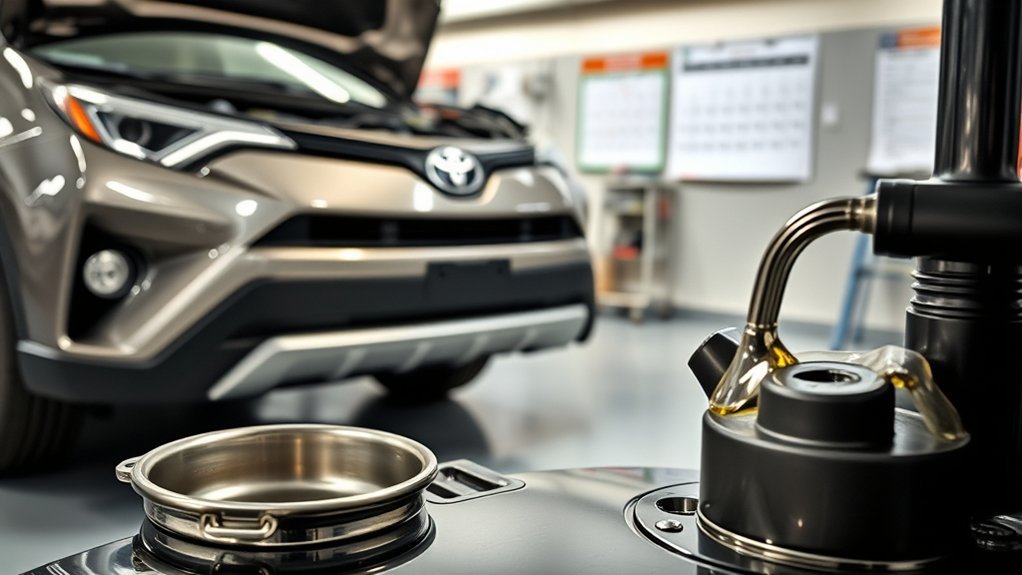
A DIY oil change is manageable for an experienced home mechanic, but the exact oil, filter, refill quantity, drain-plug gasket requirement, lifting points, and torque specifications must come from the documentation for your RAV4.
At a Glance
| Time Required | About 45–60 minutes for a careful DIY service |
| Difficulty | Moderate; requires safe vehicle support and basic mechanical experience |
| Tools Needed | Drain pan, correct socket, torque wrench, oil-filter tool if needed, funnel, wheel chocks, approved ramps or jack stands, gloves, and eye protection |
| Cost | Varies by oil, filter, drain-plug gasket, model year, and local parts pricing |
Warning: Never work under a vehicle supported only by a jack. Park on a stable, level surface, set the parking brake, chock the wheels, and use correctly rated ramps or jack stands at approved support points. Engine components and used oil can be hot enough to burn you.
Required Tools and Materials
- Correct engine oil for your exact RAV4 model year and powertrain
- Compatible replacement oil filter
- New drain-plug gasket/washer if required by the service procedure
- Drain pan with enough capacity for the entire oil fill
- Correct socket and ratchet for the drain plug
- Torque wrench for final drain-plug tightening
- Oil-filter wrench or suitable filter tool if needed
- Funnel
- Wheel chocks and correctly rated ramps or jack stands if the vehicle must be raised
- Safety glasses and oil-resistant gloves
- Rags or absorbent material for spills
- Sealable container for transporting used oil to a recycling location
For a 2025 U.S. RAV4, reference information indicates approximately 4.5 U.S. quarts with the filter changed, but do not blindly pour in a published quantity. Capacity can vary by model/year, and the final oil level should be confirmed according to the owner’s manual and dipstick procedure.
Step-by-Step Process
- Verify the specifications first. Confirm the oil viscosity and specification, filter, refill capacity, drain-plug procedure, approved lifting/support points, and torque specification for your exact RAV4.
- Warm the engine briefly. Slightly warm oil drains more readily, but do not work with an engine or oil hot enough to burn you. Shut the engine off before beginning.
- Secure the vehicle. Park on a level, solid surface, set the parking brake, and chock the wheels. If extra clearance is required, use properly rated ramps or jack stands at the approved points. Never rely on a hydraulic jack alone.
- Position the drain pan. Place it beneath the drain plug with enough room to catch the stream as the oil first exits.
- Drain the old oil. Carefully remove the drain plug and allow the oil to drain fully. Inspect the plug and replace its gasket/washer when required.
- Reinstall the drain plug correctly. Thread it by hand first to avoid cross-threading, then tighten it to the specification for your exact model. Do not guess at the torque.
- Replace the oil filter. Remove the old filter and install the new one according to the filter/Toyota procedure. Make sure the old sealing gasket is not stuck to the engine before installing the replacement.
- Add fresh oil gradually. Pour in slightly less than the full reference capacity at first. Reinstall the filler cap.
- Run and inspect. Start the engine briefly, confirm that the oil-pressure warning goes out normally, and inspect the drain plug and filter area for leaks. Shut the engine off.
- Recheck the level. Wait as directed in the owner’s manual, keep the vehicle level, and verify the dipstick reading. Add small amounts if necessary. Do not overfill.
- Reset the maintenance/oil reminder if appropriate. Use the procedure for your model year and only reset it after the applicable maintenance has actually been completed.
- Recycle the used oil and filter. Transfer used oil to a leak-proof container and take it, along with the used filter where accepted, to an approved used-oil collection or recycling location. Never pour used oil onto the ground, into a drain, or into household trash where prohibited.
Pro Tip: Record the date, mileage, oil specification, filter used, and receipt after every DIY oil change. That makes the next service easier to track and provides useful maintenance documentation.
How to Schedule Maintenance at South Bay Toyota
If you prefer professional service, South Bay Toyota is located in Gardena, California, serving drivers throughout the surrounding South Bay area, including Torrance and Carson.
You can use the dealership’s online service scheduler to choose an available appointment. Before booking, enter or provide the correct vehicle information so the service department can identify the maintenance due for your RAV4’s model year, mileage, and powertrain.
Ask the service advisor whether your driving pattern qualifies for Toyota’s special operating-condition schedule if you regularly tow, carry heavy loads, drive on dirt/dusty roads, idle for extended periods, or make repeated very short trips in freezing weather.
Service promotions and coupons change over time, so check the dealership’s current offers rather than relying on an older advertised discount.
RAV4 Oil Change Checklist Before Your Next Service
Before scheduling or performing an oil change, verify these details:
- Exact model year and powertrain: Do not assume every RAV4 uses the same oil.
- Normal or special-use schedule: For a 2025 U.S. RAV4, normal oil/filter service is 10,000 miles or 12 months; applicable special-use operation can reduce it to 5,000 miles or 6 months.
- Correct viscosity/specification: For the referenced 2025 U.S. application, use the specified SAE 0W-16 oil and required certification.
- Correct filter: Replace the engine oil filter when the scheduled oil service calls for oil-and-filter replacement.
- Oil level between services: Check it periodically and before long trips, particularly if the vehicle has shown consumption or leakage.
- Maintenance records: Keep invoices or DIY receipts and note the service date and mileage.
Note: Toyota’s maintenance guide for your exact VIN/model year is the controlling reference. A generic internet interval should never override vehicle-specific Toyota documentation.
Frequently Asked Questions
Can I use different oil brands for my RAV4?
Yes. The brand name is less important than using oil with the viscosity and performance certification required by your exact owner’s manual. Do not mix specifications simply because two oils are both marketed as synthetic.
How do I check my RAV4’s oil level?
Park on level ground and follow the waiting procedure in your owner’s manual. Remove the dipstick, wipe it clean, fully reinsert it, then remove it again and read the level between the marks. Do not overfill. If the level repeatedly drops, look for leakage or abnormal oil consumption rather than simply topping it off indefinitely.
Is it necessary to change the oil filter every time?
Follow Toyota’s maintenance schedule. On the referenced 2025 U.S. RAV4 schedule, the engine oil and oil filter are replaced together at the applicable oil-service interval.
What are the risks of skipping oil changes?
Repeatedly exceeding the required mileage or time interval can allow contaminants and deposits to accumulate and can increase engine wear. Severe neglect can contribute to expensive engine damage. Missed maintenance can also affect a warranty claim if the related failure is shown to have resulted from improper maintenance.
Can I perform an oil change myself?
Yes, if you have the correct specifications, tools, safe lifting/support equipment, and mechanical experience. Never work beneath a vehicle supported only by a jack, avoid contact with hot oil, torque fasteners to the correct specification, check carefully for leaks, and recycle the used oil and filter.
Does a 5,000-mile maintenance reminder mean my RAV4 needs an oil change?
Not necessarily. A 2025 U.S. RAV4 has scheduled maintenance at 5,000-mile or six-month intervals, while normal-use engine oil and filter replacement is scheduled at 10,000 miles or 12 months. Oil replacement is performed sooner when Toyota’s applicable special operating conditions require it.
Can I use 0W-20 instead of 0W-16 in a 2025 RAV4?
Use 0W-16 when that is the specified viscosity for your vehicle. If your exact owner’s manual allows 0W-20 temporarily when 0W-16 is unavailable, follow Toyota’s substitution instructions and return to the specified viscosity at the next oil change. Do not treat 0W-20 as a universal RAV4 recommendation.
Sources
- Toyota 2025 RAV4 Warranty & Maintenance Guide — normal maintenance intervals and special operating conditions.
- Toyota Owner’s Manuals & Warranty Guides — vehicle-specific owner and maintenance documentation.
- Toyota Maintenance Schedule — Toyota’s vehicle maintenance scheduling resource.
- Federal Trade Commission — Auto Warranties and Service Contracts — warranty and maintenance-record guidance.
- U.S. Environmental Protection Agency — Managing, Reusing, and Recycling Used Oil — safe handling and recycling of used motor oil.
Conclusion
The correct Toyota RAV4 oil-change interval is not a universal 5,000-mile rule. For a 2025 U.S. RAV4 under normal operating conditions, Toyota schedules engine oil and filter replacement every 10,000 miles or 12 months, while applicable special operating conditions can shorten that interval to 5,000 miles or 6 months. Use the exact oil specification in your model-year owner’s manual, maintain the proper oil level, address warning signs promptly, and keep a record of every service. That approach protects the engine without changing the oil earlier—or later—than Toyota requires.
