The Toyota RAV4 Pre-Collision System (PCS) is a forward-collision warning and automatic-emergency-braking system that uses a windshield-mounted camera and front radar. On U.S.-market RAV4s, the safety suite evolved from TSS-P in 2017–2018 to TSS 2.0 in 2019–2022, TSS 2.5 in 2023–2025 gas and hybrid models, TSS 2.5+ in 2023–2025 Prime/Plug-in Hybrid models, and TSS 4.0 for 2026. Depending on model year, PCS can detect vehicles, pedestrians, bicyclists, and—on 2026 TSS 4.0 models—motorcyclists. It can warn, add brake support, or brake automatically, but it cannot guarantee a stop. This guide explains the year-by-year differences, settings, limits, sensor care, calibration, and what to do when PCS is unavailable or reports a malfunction.
Last updated: September 19, 2026
Quick Answer
The Toyota RAV4 Pre-Collision System uses a forward camera and radar to assess certain frontal collision risks. Depending on model year, it can provide a forward-collision warning, add brake support, and apply automatic emergency braking. Newer generations expand the stated detection targets from vehicles and pedestrians to bicyclists and, on 2026 TSS 4.0 models, motorcyclists. Detection and braking are not guaranteed, so the driver must remain ready to brake or steer.
Key Takeaways
- PCS is a driver-assistance feature, not an autonomous-driving or guaranteed collision-prevention system.
- Typical responses include a forward-collision warning, brake assistance, and automatic braking under qualifying conditions.
- Detectable road users vary by model year. Newer systems can recognize more target types than early RAV4 systems.
- Rain, snow, fog, darkness, curves, glare, dirt, sensor damage, and unusual target movement can reduce performance.
- Sensor areas must be kept clean, and some windshield, grille, bumper, camera, or radar repairs require calibration.
Warning: Never drive toward a vehicle, person, bicycle, object, or test target to see whether PCS will stop the RAV4. Toyota warns that the system may not detect a hazard or operate in every situation. The driver remains responsible for braking, steering, maintaining a safe following distance, and watching the road.
How this guide was verified: Model-year and operating claims were cross-checked against Toyota owner literature and Toyota U.S. model-year materials. Safety terminology and independent effectiveness data were checked against NHTSA and IIHS. This guide does not claim hands-on or instrumented testing of a RAV4.
How the Toyota RAV4 Pre-Collision System Works
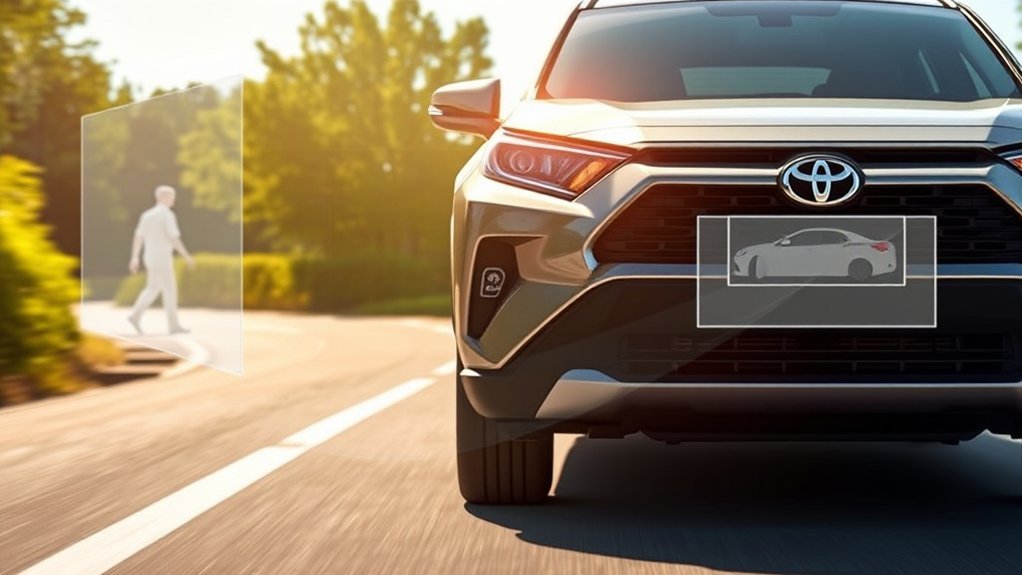
The Toyota RAV4 Pre-Collision System, commonly abbreviated as PCS, is part of the vehicle’s Toyota Safety Sense package. Relevant RAV4 generations use a forward-facing camera near the top of the windshield and a radar sensor near the front grille or bumper area.
While PCS is enabled and its operating conditions are met, the system analyzes information from those sensors. It estimates whether the RAV4 may be approaching a detectable vehicle or road user too quickly. The response depends on the system version, driving conditions, closing speed, target position, driver input, and other factors.
Typical Pre-Collision Response
- Forward-collision warning: A buzzer, message, or warning graphic may tell you to brake or take evasive action.
- Pre-collision brake assist: On systems equipped with this function, PCS may increase braking support when you press the brake pedal but the system determines that stronger braking is needed.
- Pre-collision braking: If the collision risk becomes very high, the system may apply the brakes automatically to help avoid the impact or reduce the collision speed.
This is a simplified sequence rather than a promise that all three actions will occur. The system may warn without braking, may brake with little advance warning, or may not detect the situation at all.
The operation described above is consistent with Toyota’s 2024 RAV4 Quick Reference Guide and with the general automatic-emergency-braking explanation published by the National Highway Traffic Safety Administration.
RAV4 Pre-Collision System by Model Year
The name “Pre-Collision System” spans several Toyota Safety Sense generations. For U.S.-market RAV4s, the major suite changes are 2017–2018 TSS-P, 2019–2022 TSS 2.0, 2023–2025 TSS 2.5 for gas and hybrid models, 2023–2025 TSS 2.5+ for Prime/Plug-in Hybrid models, and 2026 TSS 4.0. Do not assume that a feature described for a new RAV4 exists on an older one.
| RAV4 Version | Safety Suite | Important PCS Notes |
|---|---|---|
| 2017–2018 U.S. RAV4 | Toyota Safety Sense P (TSS-P) | TSS-P was standard on all U.S. grades. PCS with Pedestrian Detection used camera and radar inputs and was designed to detect preceding vehicles and pedestrians under specified conditions. |
| 2019–2022 RAV4 | Toyota Safety Sense 2.0 | The redesigned 2019 RAV4 introduced TSS 2.0. PCS added daytime bicyclist detection and improved low-light pedestrian recognition compared with the previous suite. Toyota continued TSS 2.0 on 2020–2022 RAV4 models. |
| 2023–2025 gas and hybrid RAV4 | Toyota Safety Sense 2.5 | Toyota lists vehicle, pedestrian, and bicyclist detection under specified conditions. TSS 2.5 also adds specified intersection support for an oncoming vehicle or pedestrian while turning. |
| 2023–2025 RAV4 Prime / Plug-in Hybrid | Toyota Safety Sense 2.5+ | Toyota documentation labels the 2023–2025 plug-in model’s suite TSS 2.5+. Toyota lists vehicle, pedestrian, and bicyclist detection, plus specified intersection support. |
| 2026 RAV4 Hybrid and Plug-in Hybrid | Toyota Safety Sense 4.0 | Toyota states that PCS is designed to help detect vehicles, pedestrians, bicyclists, and motorcyclists. TSS 4.0 feature settings are handled through the Audio Multimedia display. |
Note: This comparison refers primarily to U.S.-market RAV4 models. Equipment, system names, detectable targets, speed ranges, and standard-versus-optional status may differ in other countries.
Essential Features of the Toyota RAV4 Pre-Collision System
The RAV4 Pre-Collision System combines several functions intended to support an attentive driver. Not every intervention is available in every situation or on every model year.
Collision Detection Capabilities
The front camera helps evaluate visible characteristics such as a target’s position, profile, and movement. Radar contributes distance and relative-speed information. The system combines this data to estimate collision risk.
Depending on the RAV4’s model year, PCS may be designed to recognize some combination of:
- Preceding passenger vehicles and trucks
- Pedestrians
- Bicyclists
- Motorcyclists on newer systems
- Oncoming vehicles or pedestrians in specified turning scenarios
PCS is not designed to identify every object in the road. Small, low, narrow, partly hidden, unusually shaped, suddenly moving, or poorly illuminated targets can be difficult to recognize.
Automatic Braking Assistance
If PCS determines that a frontal collision risk is very high, it may prepare the brake system, supplement the driver’s braking, or apply automatic braking. The goal is to reduce impact speed and, in some circumstances, help avoid a collision.
Automatic braking does not guarantee that the RAV4 will stop before reaching the target. Available tire grip, vehicle speed, road slope, reaction timing, target movement, brake condition, and weather all influence the result.
Warning Timing Adjustment
Many RAV4 versions let the driver select an earlier or later pre-collision warning. Toyota commonly labels the available choices Far, Middle, and Near, with Middle as the default on relevant models.
Changing the warning timing generally changes when the alert appears. It does not necessarily make automatic braking stronger or alter every braking threshold.
How Does the Pedestrian Detection Feature Work?
Pedestrian Detection uses the RAV4’s forward camera and radar information to look for a person in or approaching the projected path of the vehicle. When the system determines that a collision may occur, it can warn the driver and may provide braking support.
Detection Technology Used
- Forward camera: Helps assess visual features such as the person’s profile, position, movement, and apparent size.
- Front radar: Helps estimate distance and relative motion.
- Control software: Evaluates the sensor data and determines whether warning or braking support is appropriate.
The technology does not recognize every person in every position. Detection may be reduced when a pedestrian is partly hidden, crouching, carrying a large item, moving suddenly, wearing clothing that blends into the background, or standing outside the system’s effective field of view.
Warning System Activation
If PCS determines that the risk is high enough, a warning message or graphic may appear in the driver display and a buzzer may sound. The driver should immediately look ahead, brake as needed, and steer only when there is a safe escape path.
Do not wait for a warning before reacting. A warning can be delayed or absent when sensor recognition is reduced or the situation develops too quickly.
Automatic Braking Mechanism
When the calculated risk becomes extremely high, PCS may apply braking automatically. Its purpose is to lower the RAV4’s speed before impact and, in favorable circumstances, help avoid the collision.
Pedestrian-detecting AEB has demonstrated real-world benefits across the wider vehicle fleet. However, independent research has also found weaker performance in challenging conditions such as unlit darkness and higher-speed roads. Those industry findings reinforce Toyota’s warning that PCS is a backup aid rather than a replacement for driver attention.
What Can the Pre-Collision System Recognize?
It is more accurate to describe PCS targets as detectable road users or target objects rather than general obstacles. The listed targets depend on the Toyota Safety Sense generation.
For example, Toyota states that the 2025 RAV4’s TSS 2.5 system is designed to detect vehicles, pedestrians, and bicyclists under certain conditions. Toyota states that the 2026 RAV4’s TSS 4.0 system can also help detect motorcyclists.
The system may have difficulty with:
- A target that suddenly enters or leaves the vehicle’s path
- A vehicle with a very small, low, narrow, or unusually high profile
- A pedestrian or cyclist who is partly blocked by another object
- A target positioned near the edge of the camera or radar field
- A target encountered immediately after a sharp curve
- A stationary object or structure that is not classified as a supported target
Key Limitations of the RAV4 Pre-Collision System
PCS effectiveness depends on road, weather, vehicle, target, sensor, and driver conditions. Toyota’s manuals provide long lists of circumstances that can reduce or suspend operation.
Weather and Visibility Limitations
- Heavy rain, snow, fog, mist, smoke, or a sandstorm
- Water, snow, dust, or road spray thrown in front of the RAV4
- Strong sunlight, headlight glare, or reflected light entering the camera
- Sudden changes between bright and dark areas
- Night driving with weak, dirty, damaged, or misaligned headlights
- Water droplets, snow, ice, dirt, insects, or mud on a sensor area
Road and Traffic Limitations
- Sharp curves or the period immediately after a curve
- Steep grades, uneven roads, rutted roads, or snow-covered surfaces
- Metal structures, tunnels, guardrails, large trucks, or other surfaces that strongly reflect radar energy
- A vehicle cutting in at close range
- Targets moving unpredictably or crossing at an unusual angle
- Insufficient tire grip on wet, icy, gravel, or otherwise slippery roads
Vehicle and Sensor Limitations
- A dirty, fogged, cracked, damaged, or replaced windshield near the camera
- A damaged, obstructed, painted, modified, or misaligned radar area
- Stickers, accessories, grille badges, license-plate covers, tint, or equipment blocking a sensor
- Incorrect tire sizes, very low tire pressure, heavily worn tires, or an unstable vehicle condition
- Changes to vehicle height, suspension, front bodywork, or sensor alignment
Pro Tip: Before a winter trip, clear snow and ice from the windshield area in front of the camera and from the radar or radar-cover area at the front of the RAV4. Do not scrape, strike, paint, polish aggressively, or attach accessories to a sensor cover.
Activating and Using the Pre-Collision System
PCS is normally enabled when a relevant RAV4 is started, but the exact behavior and menus vary. Check the owner’s manual for the specific model year before changing settings.
Settings on Many 2017–2025 RAV4 Models
- Park the vehicle in a safe place.
- Use the steering-wheel controls to open the settings menu in the multi-information display.
- Find the PCS or driver-assistance setting.
- Select the warning-sensitivity or warning-timing setting when available.
- Choose the desired timing and exit the menu.
On relevant 2024 RAV4 displays, Toyota instructs the driver to select PCS in the multi-information display and choose Far, Middle, or Near. The same menu can be used to turn PCS off. The icon and button sequence can differ between the 7-inch and 12.3-inch driver displays.
Settings on the 2026 RAV4
Toyota Safety Sense 4.0 moves its feature settings to the Audio Multimedia display. Toyota’s TSS 4.0 guide instructs the driver to select Settings on the lower-left of the display, choose Driver support, and then select the feature to adjust. Available preferences can vary by feature, grade, and software configuration, so follow the on-screen description and the owner or multimedia manual for the vehicle.
Note: Turning PCS off removes a layer of collision-mitigation support. Only disable it when the owner’s manual directs you to do so or when a qualified technician requires it for service, testing, transport, or repair procedures.
Sensor Care, Maintenance, and Calibration
PCS does not have a routine fluid or filter replacement interval, but that does not make it maintenance-free. Sensor visibility and alignment are essential.
Routine Sensor Care
- Keep the exterior windshield clean in front of the camera.
- Remove condensation, snow, and ice with the vehicle’s defogger and normal cleaning methods.
- Keep the front radar area and radar cover free of mud, insects, snow, ice, and road film.
- Replace ineffective wiper blades that leave the camera area obscured.
- Do not attach stickers, tint, cameras, electronic devices, badges, tape, or accessories where they can obstruct the sensors.
When Calibration May Be Needed
Camera or radar calibration may be required after certain repairs, including:
- Windshield replacement
- Front camera removal, replacement, or movement
- Radar sensor removal or replacement
- Front bumper, grille, or radar-cover replacement
- A collision or hard impact near a sensor
- Repairs that change ride height, wheel alignment, or sensor position
Calibration requires the correct equipment, targets, measurements, and service information. Do not attempt to aim or reposition the camera or radar by hand.
Troubleshooting RAV4 Pre-Collision System Warnings
Start with the exact dashboard wording. A temporary-unavailable message, a PCS OFF indicator, and a malfunction message do not mean the same thing.
| Message or State | What It Can Mean | First Action |
|---|---|---|
| PCS temporarily unavailable | A camera or radar area may be blocked, visibility may be poor, or sensor temperature may be outside its operating range. | Park safely, read the full message, clear approved sensor areas as directed in the manual, and allow temporary weather or temperature conditions to improve. |
| PCS OFF | PCS has been disabled through a setting or is unavailable because of a vehicle or system condition. | When parked, check the full warning message and the PCS setting for the exact model year. Do not change driver-assistance settings while distracted or moving. |
| Pre-Collision System Malfunction / Visit Your Dealer | The system has detected a condition that may require diagnosis, repair, or calibration rather than simple sensor cleaning. | Follow the displayed instructions and arrange inspection by Toyota or an ADAS-qualified repair facility if the warning remains. |
PCS Temporarily Unavailable
A temporary warning can appear when a sensor is blocked, overheated, too cold, exposed to poor visibility, or unable to interpret the surroundings.
- Park safely and read the complete warning message.
- Inspect the windshield in front of the camera for fog, dirt, snow, ice, stickers, or damage.
- Inspect the front radar or radar-cover area for dirt, snow, ice, mud, insects, or an accessory that blocks it.
- Clean only with methods approved in the owner’s manual.
- Allow extreme weather or temperature conditions to improve.
- Restart the vehicle after the obstruction or temporary condition has been resolved.
If the warning remains in normal conditions, arrange an inspection with a Toyota dealer or a repair facility qualified to diagnose and calibrate advanced driver-assistance systems.
PCS OFF Indicator
The PCS OFF indicator usually means the system has been disabled through the settings menu or is unavailable because of a system condition. Re-enable it only when the vehicle is parked and it is safe to use the controls.
Repeated False Alerts or Unexpected Braking
PCS can sometimes warn or intervene when the system interprets a roadside structure, turning vehicle, close traffic pattern, or other situation as a possible threat. Keep control of the vehicle and continue to drive normally.
Repeated or severe unexpected activation should not be ignored. Check for sensor obstruction or recent windshield, grille, bumper, suspension, or collision repairs, and have the system inspected if the behavior continues.
Malfunction Message
A malfunction warning that does not clear after normal visibility and sensor cleanliness have been restored may indicate a damaged sensor, wiring fault, alignment issue, control-system fault, or required calibration. Follow the displayed instructions and schedule professional diagnosis.
PCS Versus Other RAV4 Safety Systems
Several RAV4 systems can warn or brake, but they are designed for different situations.
| System | Primary Purpose |
|---|---|
| Pre-Collision System | Helps warn of and mitigate certain frontal collisions while driving. |
| Dynamic Radar Cruise Control | Adjusts speed to help maintain a selected following distance while cruise control is engaged. |
| Parking Support Brake or Parking Assist with Automatic Braking | Helps with certain low-speed parking collisions involving nearby objects or crossing vehicles, when equipped. |
| Rear Cross-Traffic Alert | Warns about certain vehicles approaching from either side while the RAV4 is reversing; warning alone does not mean automatic braking is included. |
Advantages of the RAV4 Pre-Collision System for Drivers
PCS can provide a valuable second layer of awareness when a driver does not immediately recognize a rapidly developing frontal hazard. Its main potential benefits are:
- An earlier visual or audible warning
- Additional braking support when the driver’s brake input is insufficient
- Automatic speed reduction in some high-risk situations
- Potential avoidance of some collisions under favorable conditions
- Reduced impact severity when complete avoidance is not possible
What Independent Testing Shows
Independent IIHS testing gives a RAV4-specific reference point. For 2024–2025 RAV4 models, IIHS rates pedestrian front crash prevention Good. In its 25 mph crossing-child test, the RAV4 reduced impact speed by 21 mph. In the 37 mph parallel-adult night test with low beams, impact speed was reduced by 20 mph; with high beams, the collision was avoided in that test. These are controlled test outcomes, not guarantees for every road, speed, target, or weather condition.
See the IIHS 2025 Toyota RAV4 ratings page for the complete test matrix.
In an IIHS study of multiple vehicle models, forward-collision warning combined with automatic emergency braking was associated with a 50% reduction in rear-end striking crash involvement. This is industry-wide evidence, not a guarantee of identical results for every RAV4 or driving situation.
The strongest safety benefit comes when PCS supports good driving habits rather than replacing them. Leave enough following distance, scan ahead, control speed for the conditions, and keep your foot ready to brake in developing traffic.
Which Toyota Models Feature the Pre-Collision System?
PCS is included in many Toyota Safety Sense packages across Toyota’s passenger-car, SUV, minivan, and truck ranges. Availability and capability still depend on the vehicle, model year, grade, market, transmission, and safety-suite generation.
For the RAV4, Toyota documented TSS-P as standard on every U.S. grade beginning with the 2017 model year. The 2017 RAV4 announcement lists Pre-Collision System with Pedestrian Detection as part of that package.
The 2025 RAV4 comes standard with TSS 2.5, while the redesigned 2026 RAV4 comes with TSS 4.0. Check the vehicle’s VIN-specific equipment and owner’s manual instead of relying only on the PCS name.
Frequently Asked Questions
Is the Pre-Collision System always active while driving?
PCS is normally enabled when relevant RAV4 models are started, but it can be disabled, temporarily suspended, or made unavailable by sensor, weather, temperature, vehicle, or system conditions. An enabled system is not necessarily detecting every target or ready to intervene in every moment.
Can the driver turn the system off?
Yes. Many 2017–2025 RAV4 models use the multi-information display settings, while the 2026 TSS 4.0 system uses the Audio Multimedia display. Because menu wording varies, use the instructions for the exact model year. Keep PCS enabled during ordinary driving unless the manual directs otherwise.
What should I do if the system malfunctions?
Read the complete dashboard message, park safely, and inspect the windshield camera and front radar areas for dirt, snow, ice, condensation, damage, or obstructions. If the message remains after normal conditions return, have the RAV4 inspected by a Toyota dealer or an ADAS-qualified repair facility.
How does weather affect the Pre-Collision System?
Heavy rain, fog, snow, road spray, ice, sand, smoke, glare, darkness, and abrupt lighting changes can reduce camera or radar recognition. The system may warn late, fail to identify a target, temporarily become unavailable, or issue an unexpected alert.
Does the system require regular maintenance or updates?
PCS has no routine fluid-change interval, but the sensor areas must remain clean and unobstructed. Camera or radar calibration may be required after windshield, grille, bumper, sensor, suspension, or collision repairs. Some newer vehicles can also receive software updates, but update availability is model-dependent.
Can PCS prevent every frontal collision?
No. PCS may help avoid or reduce the severity of some collisions, but detection and braking are limited. Speed, target position, road grip, visibility, driver input, and many other factors can prevent the system from stopping the RAV4 in time.
Does every RAV4 detect bicyclists and motorcyclists?
No. Detectable targets depend on the Toyota Safety Sense generation. Toyota lists vehicle, pedestrian, and bicyclist detection for the 2025 RAV4 under certain conditions. Toyota adds motorcyclists to the stated target list for the 2026 RAV4 with TSS 4.0. Earlier systems have more limited capabilities.
Why does my RAV4 say Pre-Collision System Unavailable?
A temporary-unavailable message can appear when the forward camera or radar area is blocked, visibility is poor, or sensor temperature is too high or too low. Park safely, read the complete message, inspect and clean only the sensor areas identified in the owner’s manual, and allow weather or temperature conditions to normalize. If the message remains in normal conditions, arrange an inspection.
Does Far, Middle, or Near change automatic braking strength?
On RAV4 versions that offer Far, Middle, and Near, Toyota describes these choices as pre-collision warning-timing settings. They change when the warning is issued; they do not make the automatic braking stronger. Exact menu behavior still depends on model year and Toyota Safety Sense generation.
Conclusion
The Toyota RAV4 Pre-Collision System can add meaningful warning and braking support when a frontal hazard develops, but its capabilities depend on the model year, Toyota Safety Sense generation, target, environment, and condition of the vehicle. It cannot see every hazard or guarantee a stop.
For reliable operation, keep the camera and radar areas clean, address warning messages promptly, and arrange proper calibration after relevant repairs. Most importantly, treat PCS as a backup to attentive driving—not as permission to follow closely, look away from the road, or delay braking.
Sources
- Toyota 2024 RAV4 Quick Reference Guide — sensor layout, warning stages, pedestrian detection, controls, and limitations.
- Toyota 2026 RAV4 Driving Support Systems Manual Excerpt — sensor care, operating limitations, obstructions, repair precautions, and calibration.
- Toyota 2017 RAV4 Product Information — TSS-P standard equipment and PCS with Pedestrian Detection.
- Toyota 2018 RAV4 Product Information — TSS-P standard on all 2018 grades.
- Toyota 2019 RAV4 Product Information — introduction of TSS 2.0, daytime bicyclist detection, and improved low-light pedestrian recognition.
- Toyota 2022 RAV4 Product Information — TSS 2.0 standard on current RAV4 models.
- Toyota 2023 RAV4 Product Information — TSS 2.5 standard on all 2023 RAV4 grades.
- Toyota 2023 RAV4 eBrochure — TSS 2.5 for RAV4 and TSS 2.5+ for RAV4 Prime.
- Toyota 2024 RAV4 Prime Product Information — TSS 2.5+ and stated PCS detection capabilities.
- Toyota 2025 RAV4 Product Information — standard TSS 2.5 equipment and stated target-detection capabilities.
- Toyota 2025 RAV4 Plug-in Hybrid Product Information — TSS 2.5+ naming and stated detection capabilities.
- Toyota 2026 RAV4 Product Information — TSS 4.0 and vehicle, pedestrian, bicyclist, and motorcyclist detection description.
- NHTSA Driver Assistance Technologies — definitions of forward-collision warning, brake support, automatic emergency braking, and pedestrian AEB.
- IIHS 2025 Toyota RAV4 Ratings — RAV4-specific front-crash-prevention and pedestrian-test results.
- Insurance Institute for Highway Safety AEB Effectiveness Study — real-world reductions in rear-end striking crashes associated with forward-collision warning and AEB.